





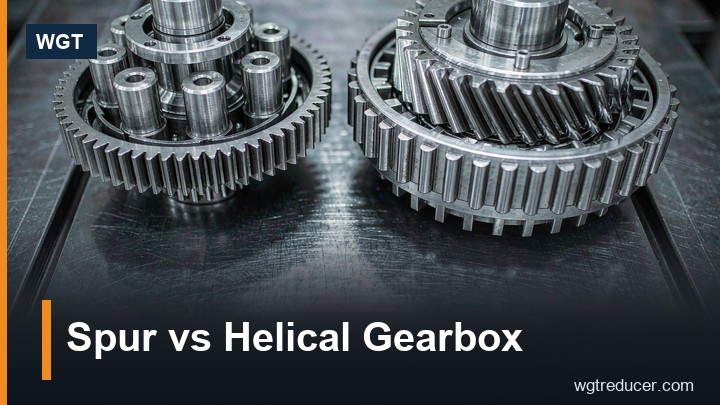
Spur vs Helical Gearbox: Noise, Capacity and When Each Wins | WGT
The difference between a spur and a helical gearbox is decided by one geometric fact: whether the teeth meet the mating tooth along a line parallel to the shaft, or on a slant. Everything else - noise, load capacity, axial thrust, price, bearing selection - follows from that. For anyone selecting a reducer, the practical question is not which type is better in general, but which one suits the duty in front of them, and where the crossover sits.
The Geometry, In One Paragraph Each
A spur gear has teeth cut straight across the face of the blank. The whole tooth engages at once, the contact line runs parallel to the shaft axis, and the load passes from tooth to tooth in a single step as the gears rotate. Nothing pushes the shafts along their axes, so the bearings carry only radial load from the mesh.
A helical gear has teeth cut at an angle to the shaft axis. Engagement starts at one corner of the tooth and sweeps diagonally across the face, so at any instant the load is shared between several teeth and changes hands gradually. That gradual transfer is what makes helical gearing quieter and, for the same face width, stronger. The price is a component of force along the shaft axis, which the bearings must absorb.
Load Capacity: Why Helical Wins on the Same Footprint
In a spur pair, one tooth carries the full tangential load at the moment of contact, then hands it to the next. In a helical pair, the slanted contact line means that at any instant the load is spread over more than one tooth, and the transition happens progressively rather than abruptly. Two consequences follow, and both matter to a gearbox designer:
- Higher torque for the same size. A helical stage can transmit more torque from the same centre distance and face width, which is why industrial gear units above a certain power density are almost always helical.
- Smoother dynamic loading. Because the load changes hands gradually, the tooth-to-tooth impact that excites noise and fatigue in a spur mesh is much reduced.
The advantage is not free. Helical teeth produce an axial force proportional to the tangential load and to the tangent of the helix angle - typically a fraction of the tangential load, but large enough that the bearings and the housing must be designed for it. At high helix angles or in multi-stage units with opposed helices, the designer has to decide whether to let those axial forces cancel between stages or carry them to a thrust bearing.
| Criterion | Spur gear | Helical gear |
|---|---|---|
| Tooth contact | Full face engages at once | Gradual, diagonal contact |
| Axial thrust on bearings | None from the mesh | Present; must be carried |
| Torque for a given size | Lower | Higher |
| Noise at speed | Louder, distinct whine | Quieter, smoother sound |
| Efficiency per mesh | Very high | Very high, marginally lower |
| Manufacturing cost | Lower | Higher |
| Typical use | Slow, simple, cost-driven drives | Industrial reducers, conveyors, process duty |
| Multi-stage builds | Rare above two stages | Standard at two, three and four stages |
Noise: The Reason Most Buyers Ask
Noise is the visible - audible - symptom of the geometry, and it is usually the first thing a plant notices after installing a cheap drive. The mechanism is simple: in a spur mesh the teeth collide rather than roll into contact, so the impact excites the housing at the tooth mesh frequency and its harmonics. A helical mesh enters and leaves contact progressively, which softens that excitation considerably.
In practice, a well-made helical unit is noticeably quieter than a spur unit of the same rating and speed - the difference is easily heard in a plant room, and it is one of the main reasons helical gearing dominates industrial reducers. The comparison is not absolute, though: a high-quality, accurately cut spur gearbox running slowly can be perfectly acceptable, while a poorly made helical unit with bad alignment can be noisy in its own right. Geometry sets the ceiling; manufacturing quality decides how close to that ceiling a given unit gets.
Where noise actually matters:
- Indoor installations near operators - packaging halls, food plants, small workshops.
- Night-time operation in residential or mixed zones, where the plant's noise licence is measured at the boundary.
- Multiple drives in one room, where several sources combine and the room's acoustics amplify the result.
Where it barely matters: a drive on a distant trestle, or a crusher station where the machine itself makes ten times the noise.
Axial Thrust: The Hidden Cost of Helical Teeth
The axial force is the trade a buyer pays for the quiet running, and it shows up in three places:
- Bearings. Thrust must be carried by a bearing arrangement designed for it, usually a tapered roller or angular contact pair at one end of the shaft. Bearings cost money, take space, and generate a little more heat.
- Housing. The case must be stiff enough to react the thrust without deflecting the shaft alignment.
- Couplings and shafts. Any axial force that reaches the driven machine has to be considered. Good designs absorb it internally, but the enquiry should establish that they do.
In a parallel-shaft unit with an even number of stages, helix directions are normally arranged so the axial forces partly cancel, which reduces the net thrust the bearings see - one reason multi-stage helical units are so common.
Where Spur Gearing Still Wins
Spur gearboxes are not obsolete, and in several duties they are the better commercial choice:
- Slow, heavy, intermittent drives where noise is irrelevant and simplicity is a virtue - gate drives, small hoists, low-speed agitators.
- Cost-sensitive applications with modest duty, where the extra capacity of helical teeth would never be used.
- Applications where axial float must be avoided - some positioning duties tolerate no end movement at all, and a spur mesh introduces none.
- Repair and spares situations where a simple, locally serviceable design matters more than quiet running.
A middle ground buyers often overlook: small helical-worm combinations, such as the S series helical-worm gearboxes, put a helical first stage ahead of a worm wheel for quiet input and a high ratio in one compact case.
How the Choice Shows Up in a Real Selection
The type decision usually falls out of the duty rather than being argued on its own. A conveyor drive running 24 hours at 15 rpm output next to a walkway will be helical, because the noise and the torque density both point that way. A slow gate drive operating a few times a shift in a yard will be spur, because nothing in the duty rewards the extra cost.
For parallel-shaft conveyor duty at industrial scale, the practical answer is a three-stage parallel shaft gearbox, which spreads the ratio over three helical meshes: each stage works at a comfortable load, the axial forces are arranged to cancel, and the case stays compact enough to sit beside the head pulley. Running the same duty point through the online selection system shows how quickly the frame follows once speed, torque and service factor are entered.
Two numbers settle most debates before any catalogue is opened:
- Output speed required - motor speed divided by this gives the ratio, which sets the number of stages.
- Peak torque, not average - with the service factor applied, this sets the frame.
Only after those two are known does the tooth type become a real question, and by then it is usually already answered by the application.
What to Put on the Enquiry
Whether the answer turns out to be spur or helical, the same short list gets a clean quotation:
- Motor power, speed and starting method.
- Required output speed and the torque at the driven shaft, with the peak stated separately from the running figure.
- Duty hours per day and the ambient conditions - temperature, dust, washdown, corrosion.
- Mounting arrangement: foot, flange, hollow bore or torque arm, and the space available around the shaft.
- Noise limits, if the installation is near people or a boundary.
- Any axial load the driven machine imposes, for example from a screw or a fan.
That list lets a supplier confirm tooth type, stage count and frame in one pass, instead of quoting a unit that runs but complains.
FAQ
Is a helical gearbox always quieter than a spur gearbox?
At the same speed, accuracy and rating, yes - the gradual tooth engagement removes the impact that excites spur mesh noise. But a badly aligned or worn helical unit can be noisier than a good spur unit, and at very low speeds both types become quiet enough that the difference stops mattering.
Why do helical gears need thrust bearings?
The slanted tooth contact produces a force along the shaft axis as well as around it. That axial component has to be reacted by the housing and carried by a bearing designed for it. In multi-stage units the helix directions are usually arranged so the forces partly cancel, but some net thrust remains.
Can I replace a spur gearbox with a helical one of the same ratio?
Mechanically the ratios can match, but the mounting and the shaft loads may not. A helical unit introduces axial thrust that the old arrangement may not have been designed for, and its case dimensions differ. Check the driven shaft's axial tolerance and the available space before exchanging types.
Does helical gearing cost more to run?
Efficiency per mesh is very close between the two, so running cost is rarely the deciding factor. The difference is in first cost, bearing arrangement and case stiffness - all capital items rather than energy items.
Which type suits a conveyor drive?
Almost always helical, and usually three stages for industrial belt speeds. The duty is continuous, the ratio is deep and the drive often sits near people, which is exactly the combination where helical gearing's quietness and torque density pay for themselves.
Summary
Spur teeth engage all at once and push only around the shaft; helical teeth engage gradually, carry more torque for the same size, run quieter, and push along the shaft as well. That single trade explains the price difference, the bearing arrangement and the noise. Choose helical for continuous industrial duty where the drive is heard, spur for slow simple drives where it is not - and settle the frame on peak torque and output speed before the tooth type is even discussed.
