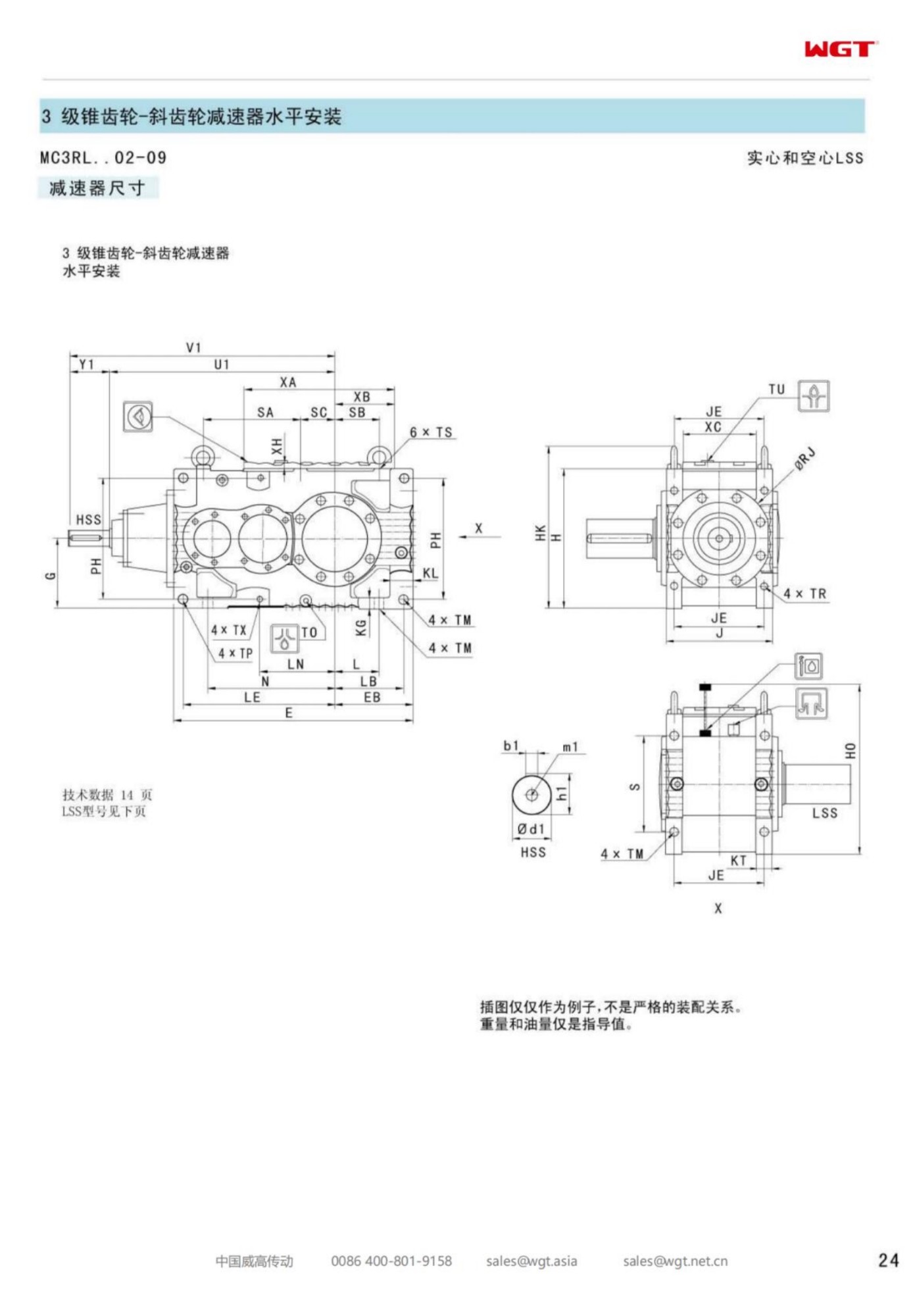
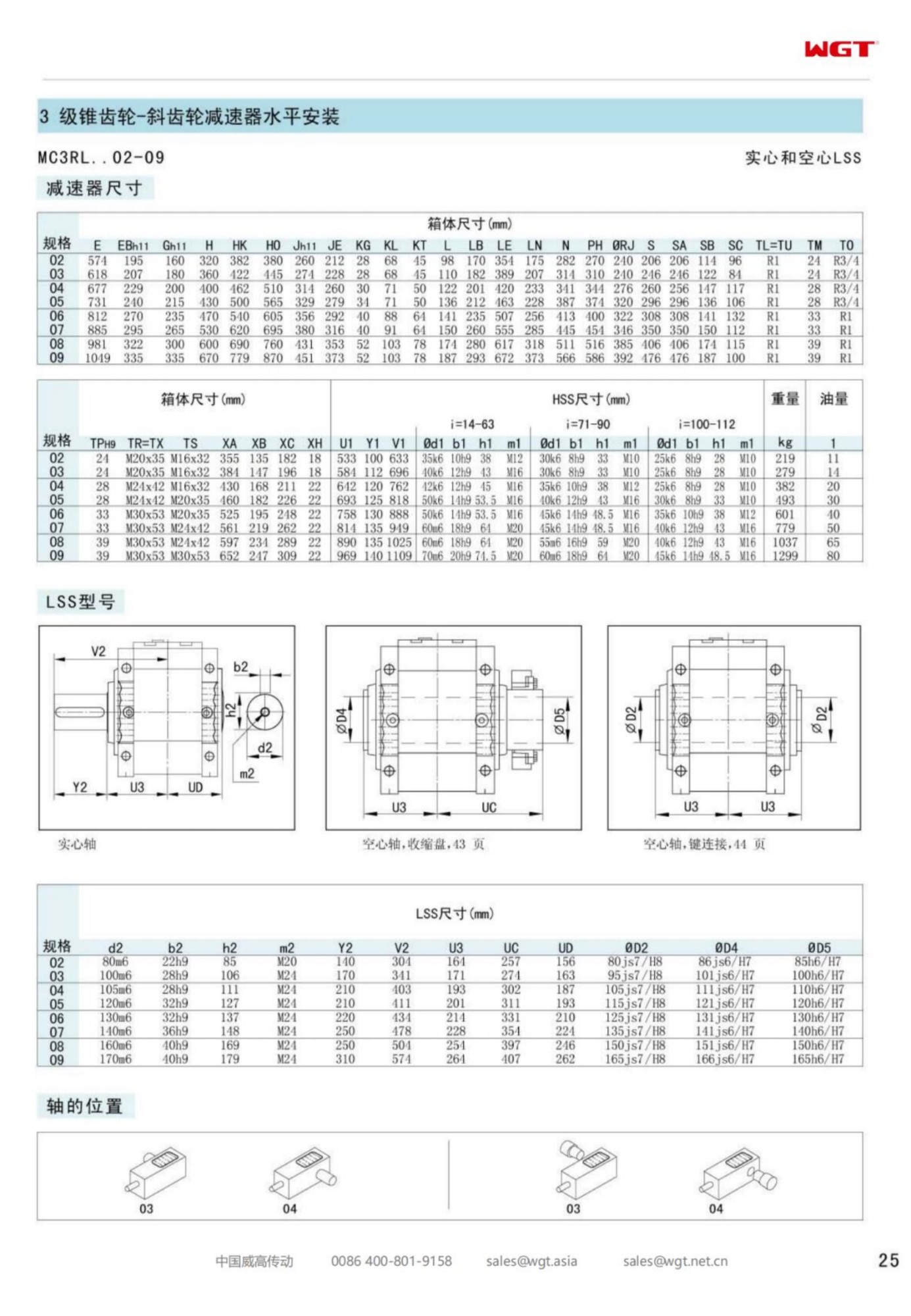
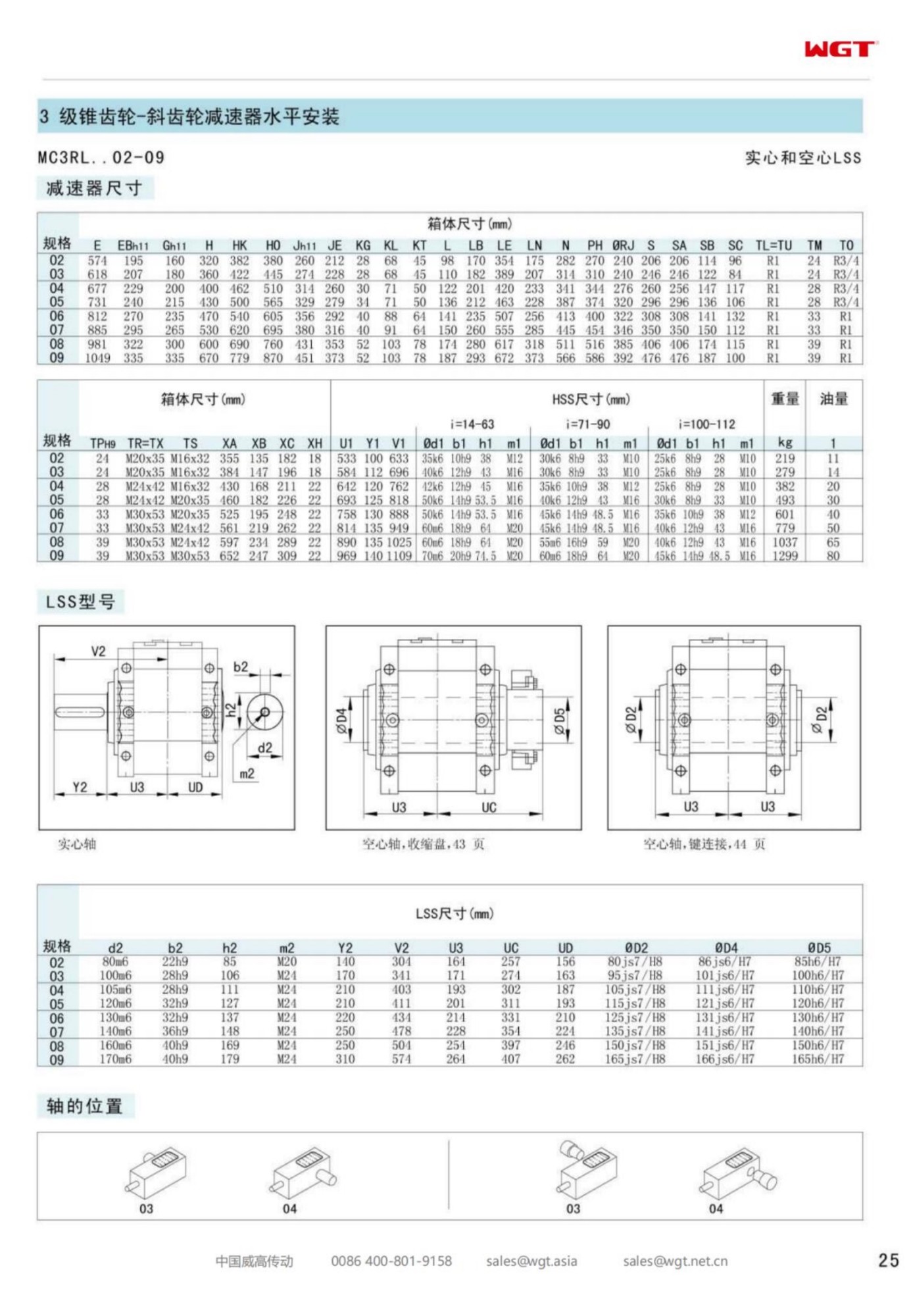
At the top of every size band sits the frame nobody buys by accident. The MC3RLSF09 bevel-helical gearbox is that unit: the ninth and largest of the commonly used right-angle frames, specified when the duty has already outgrown everything below it, or when the plant has decided once and for all that this position will never be the reason production stops. It is not an impulse purchase, and this page does not pretend otherwise.
Mechanically it completes the same arc as its siblings - bevel pair at the input, two helical stages beneath - but every element is scaled to the loads that arrive at the top of a band. Shafts are generous, bearing centres are wide, the oil volume is measured in tens of litres rather than in topping-up quantities, and the foot plane is wide enough that the foundation, not the fasteners, is the limiting stiffness.
Built for the Top of the Band
Frames are not sized by torque alone. As the numbers climb, the design questions change character: shaft deflection under overhung load, case breathing through wide thermal cycles, the ability of a slow turning bearing to keep an oil film alive. A top-of-band frame answers those questions with mass and section, which is why it looks heavier than a torque table alone would justify. The extra metal is not waste; it is the margin that lets the unit run for decades without the plant thinking about it.
There is also a system argument. Positions this heavy sit on machines that dominate the plant layout - the longest conveyor, the main mill line, the primary kiln. Choosing the ninth frame there buys a second benefit beyond torque: the right-angle input moves the motor off the machine axis, which often decides whether the whole installation fits the building it must live in.
What the Ninth Character Commits You To
The type string reads like the rest of the family, but at this size each character carries more weight, because each corresponds to a heavier casting and a longer lead time if it is wrong.
| MC | Industrial gear unit family for continuous heavy plant service |
| 3 | Three-stage train: bevel input pair and two helical reductions |
| R | Right-angle bevel-helical geometry, motor set across the driven shaft |
| L | Horizontal arrangement with both shafts level |
| S | Solid keyed output shaft, single shaft end |
| F | Foot-mounted on a rigid bedplate or grouted steel base |
| 09 | Ninth frame of the band: top-of-range torque at low output speed, highest mass in the horizontal line |
The string stays silent about three things that matter at this scale. Whether the motor sits on a bracket, a plinth or its own foundation changes the input seal access for the next twenty years. Whether the driven shaft needs a second end for a brake or barring device changes the machining before assembly. And whether the unit ships with heating for cold starts or cooling for hot enclosures changes the auxiliary connections on the foundation drawing. All three belong in the enquiry, in writing.
Load Paths Through a Very Large Case
In a unit this size the case is a structural member. Input torque enters on one axis, reaction torque leaves through the feet on another, and the belt tension or the grinding load arrives along the output. The casting ties those three systems together, and any flexibility in that triangle shows up as a moving contact pattern and a short bearing life rather than as anything a checklist would call a defect.
The practical reading is that everything below the feet is part of the gearbox. A bedplate that rocks on ungrouted shims, a foundation that cracks where the crane road passes, anchor bolts tensioned by feel - each one spends the design margin the factory put into the rib pattern. Plants that treat the foundation as the first component of the drive are the ones whose frame nines are still quiet twenty years on.
Slow Shafts, Big Bearings, Long Intervals
Output speeds at the top of the band are low, sometimes a dozen revolutions a minute. Rolling bearings do not love that regime: the film is thin, the load is heavy, and each revolution is a long event. The bearing sets in a frame nine are chosen for exactly those conditions, but their calculation depends on figures only the buyer knows - the real overhung load, the real radial and axial components, the real starts per hour.
Undeclared overhang is the classic error. A head pulley or a heavy coupling half fitted further onto the shaft than the drawing assumed multiplies the bending moment at the bearing, and no amount of scheduled maintenance recovers it. The fix costs nothing: measure the actual overhang, write it on the enquiry, and let the bearing arrangement be designed around the truth rather than around a template.
Duties Only a Frame Nine Can Hold
Bored-output vertical builds serving duties such as:
- Kiln auxiliary drives on a long wet-process kiln
- Head pulleys on the longest overland conveyors in the plant
- Ball mill circuit drives where the start must be gentle but certain
- Luffing and travel drives on a ship loader at a deep-water berth
- Drag chain conveyors hauling hot clinker to storage
- Table auxiliary drives on a vertical roller mill during maintenance turning
What these duties share is consequence. When a machine of this class stops, the plant stops with it - there is no parallel line, no bypass conveyor, no spare kiln. The ninth frame is chosen when that consequence has been priced, and the premium over a smaller unit is recognised as insurance rather than cost.
Watching a Large Unit Through Its First Year
A new frame nine teaches its plant how it behaves, and the first twelve months are when the notes should be taken. Case temperature at a fixed point, logged at the same hour each week, establishes the baseline. Vibration readings in velocity units at the three bearing housings give the trend lines that later diagnoses will lean on. Oil samples each quarter build the contamination history. None of this needs a contractor; it needs a notebook and consistency.
The first year also settles the foundation. Foot bolts relax as the grout and bedplate take up their running state, so a re-tension check at three and at twelve months is standard practice on units this size. Skipping it is how a unit enters its second decade with one loose foot, quietly changing the mesh geometry every revolution until someone books an alignment crew for a very different symptom.
The Spares List for a Frame This Size
A top-of-band unit is bought rarely and rebuilt rarely, which makes the spares decision easy to postpone and expensive to regret. The sensible minimum is held at delivery: one set of shaft seals, a breather, a sight glass, the special withdrawal tool if the drawing calls one, and a sealed drum of the correct oil grade. A spare input coupling half and a set of foot bolts join them at negligible cost while the order is open.
Beyond the shelf, the real asset is documentation. Serial number, ratio, motor orientation, commissioning readings, contact-pattern photographs and the oil analysis history, kept in a machine file that survives personnel changes. When the first major service arrives - and for a unit this size it may be a decade away - that file turns the event into a planned rebuild with the right parts on the bench, not an investigation.
Specifying a Ninth-Frame Unit Properly
Everything the factory needs fits on two pages. Motor power, speed and starting arrangement, including the starting torque the drive train must pass. Driven machine and its duty cycle, with breakaway and running torque stated separately. Output speed and tolerance. Hours per year and starts per hour, with the hardest hour described. Worst-case ambient, radiant loads included. Mounting position, motor orientation, rotation direction, second shaft end if wanted. Coupling details where already fixed. Overhung load with its lever arm, measured rather than guessed. Paint, nameplate and documentation requirements.
Submitted complete, that specification returns a quotation, a general arrangement and a delivery week that hold. Submitted as a photograph of a failed unit and a request for something similar, it returns questions, and the schedule slips while they are answered. A frame nine anchors the heaviest duty in the plant; the enquiry deserves the same seriousness as the concrete it will stand on.
How Customers Use This Unit
Automatic car-wash line
A car-wash equipment builder fits hollow-shaft reducers to its conveyor chains. The compact frame hides inside the wash tunnel, and FKM seal options handle the constant moisture.
Textile dyeing drums
A dyeing machine maker uses speed reducers on its fabric-turning drums. Low vibration (under 20 microns) prevents streaks in the fabric, and the 94-96% efficiency keeps the heat load down in a warm workshop.
What Engineers Ask Us
What ratio range does an industrial gear unit cover?
The range spans from low single-digit reductions to very high ratios by combining stage counts: two-stage builds for the lower band and up to five-stage builds for the highest reductions, with intermediate ratios available between catalogue steps on request.
Which lubrication system does the unit use?
Small and medium frames run on splash lubrication with mineral or synthetic oil. Larger frames or high ambient temperatures can be ordered with forced-feed circulation and cooling coils; the lubricant grade is stated on the nameplate and in the manual.
Model Table: Frames, Shafts and Duty
| Model | Centre distance | Output | Typical duty |
|---|
| M3PSF50 | size 50 | solid shaft, foot | conveyors, feeders |
| M3PSF60 | size 60 | solid shaft, foot | crushers, mixers |
| M3PSF70 | size 70 | solid shaft, foot | ball mills, shredders |
| M3PSF80 | size 80 | solid shaft, foot | kilns, heavy conveyors |
| M3PSF90 | size 90 | solid shaft, foot | mill and kiln drives |
| M3RSF50 | size 50 | solid shaft, foot, right-angle | inclined conveyors, elevators |
| M3RSF60 | size 60 | solid shaft, foot, right-angle | screw classifiers, feeders |
| M3RHF70 | size 70 | hollow shaft, foot, right-angle | agitators, drum drives |
| M3PHT80 | size 80 | hollow shaft, torque arm, parallel | shaft-mounted conveyors |
| M3RHT90 | size 90 | hollow shaft, torque arm, right-angle | heavy shaft-mounted drives |
Larger size numbers mean higher torque capacity and larger shafts. Because interfaces follow the common industrial dimensions, a size-for-size change is the normal upgrade route for these industrial units.
Selection Example: Head pulley of the longest overland conveyor in the plant
Take a 200 kW motor at 1480 rpm turning the head pulley at 12 rpm. The ratio follows directly: 1480 / 12 = 123.3, so a ratio near i=123 is drawn, and the thermal check is run at the dusty, sun-heated ambient of the transfer tower rather than at nameplate conditions. In this case the ninth frame carries the ratio without pushing the bevel stage to its limit, and the solid keyed shaft takes the take-up tension of a kilometre of belting without complaint. Note that the ratio comes from speeds alone, while the frame size depends on torque and service factor - never size a unit on ratio only.
![industrial helical gearbox selection chart]()
A quick visual of the selection sequence for a industrial helical unit.
![M3 series gear reducer installation examples]()
Application coverage of the the M3 series.
From Duty Point to Delivery in One Working Day
Stop guessing the ratio. Prefer to check the figures yourself? The WGT Motor & Gearbox Online Selection System gives you the model, torque margin and ratio before you ask us.
Tell us what the machine does and how hard it works; we calculate the ratio, apply the service factor and send back the drawing and quotation within one working day, including sea-freight and air-freight options. Looking for a reducer for woodworking machine? Tell us the duty point and we will confirm the model in writing.