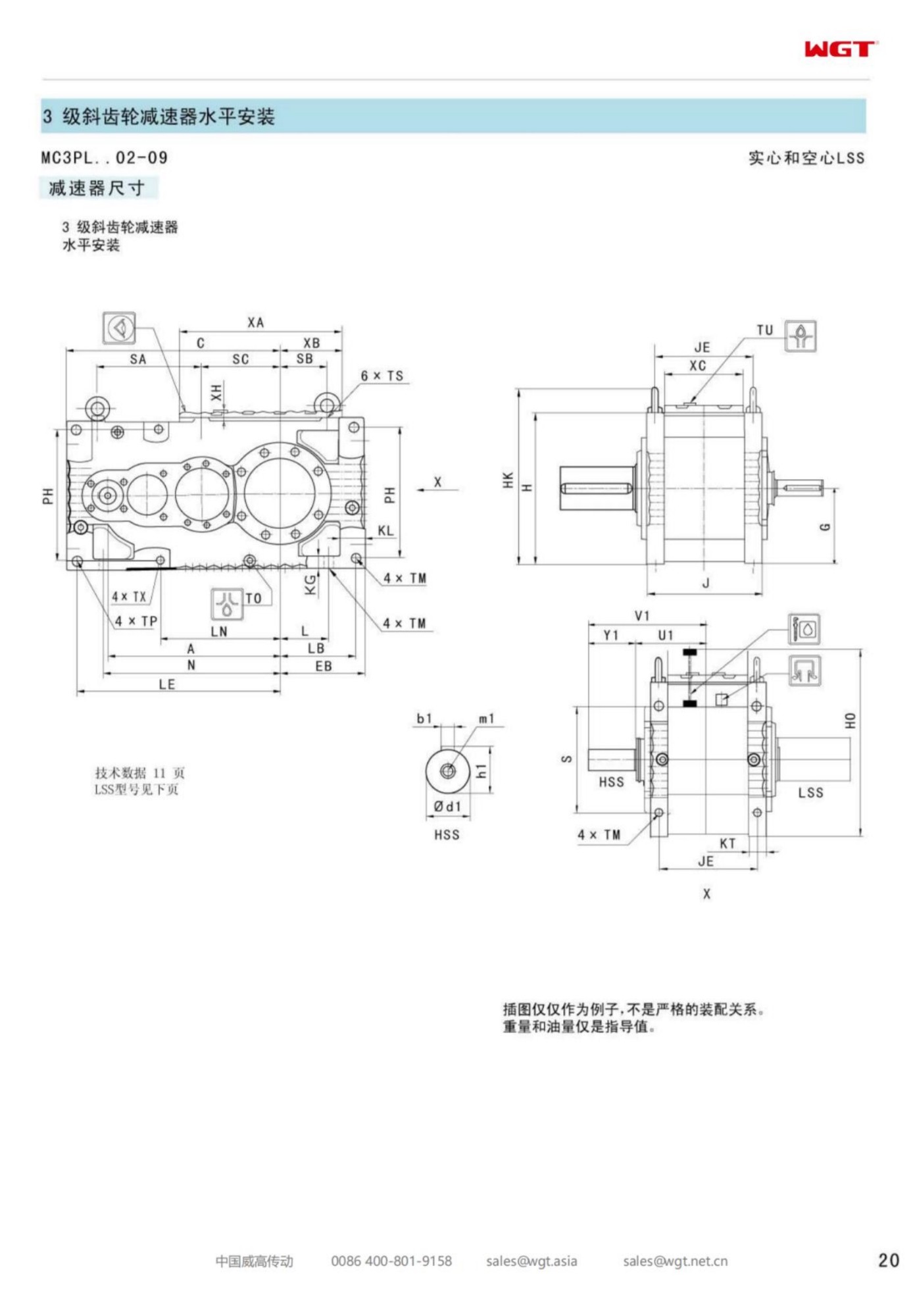
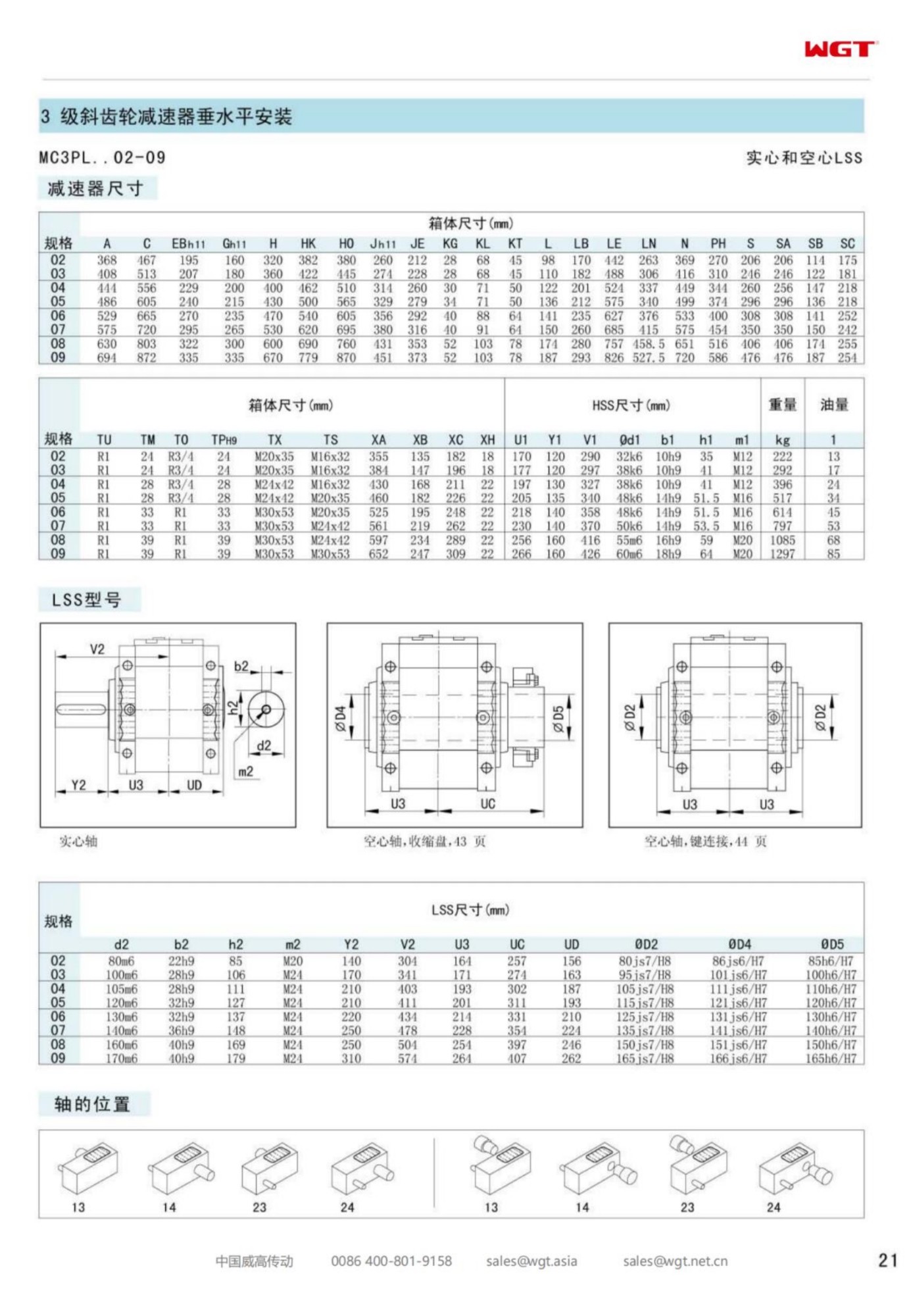
Timber arrives at a sawmill in pieces that weigh a tonne and land without ceremony. The deck conveyor that takes them runs wet, carries bark and sawdust into every crevice, and is hosed down at the end of a shift. The MC3PLST05 parallel shaft gear unit is the drive for that deck: three helical stages, a solid output keyed to the head shaft, and a torque arm that puts the reaction into the mill's own steelwork.
What follows covers the code, why an arm beats a poured block on a deck that shakes, the impact and wet-dust conditions, and the numbers a mill should quote when it asks for a price.
A Sawmill Deck Loads in Impacts, Not in Tonnes
The average tonnage on a log deck is a comfortable figure and a misleading one. The drive sees a series of arrivals: a stem dropping off a truck, a slab sliding down a chute, a piece jamming against a stop and then releasing. Each of those is a torque spike with a rise time measured in milliseconds. Sizing on the mean is how a deck drive gets a reputation for eating couplings.
Decoding MC3PLST05
Every character answers a question that would otherwise need a drawing.
| MC | Industrial gear unit family for continuous plant duty |
| 3 | Three stages of reduction in one housing |
| P | Parallel-shaft helical gearing, coaxial input and output |
| L | Level output axis into the driven shaft |
| S | Solid output shaft, keyed to the driven shaft |
| T | Torque-arm reaction, no baseplate required |
| 05 | Fifth frame of the three-stage band |
In one line: a three-stage industrial unit with parallel shafts and a level output, solid shaft, torque-arm reaction, fifth frame. A mill engineer reading that knows how the unit attaches before the datasheet arrives.
An Arm on the Deck Steel Instead of a Concrete Block
Sawmill decks are built on steel, often on a mezzanine that was never designed for a cast plinth. A torque arm bolts to a bracket on that steel and lets the shaft carry the drive's weight, so nothing has to be poured and nothing has to be drilled into a floor that may be timber or grating. The same arm makes a drive swap a two-hour job rather than a concrete event.
Solid Output Onto the Deck Head Shaft
The head shaft of a deck conveyor is supported in plummer blocks and ends in a keyed stub, which is what a solid output is made for. The coupling takes the small misalignment the structure gives, the arm takes the reaction, and the shaft stays where the mill put it. Hanging a bore over that stub is possible in the same family, but it buys nothing on a deck where the head end is accessible.
Wet Timber, Bark and Fine Sawdust
Fresh stems arrive wet, and bark carries grit that sawdust does not. The mixture that collects on a gear case is damp, acidic from the wood's own extractives, and abrasive once it dries. A finish specified for a wet mill, a breather clear of the deck's dust plume, and covers that seal properly after every inspection are worth more here than an extra rating step.
Shock Loads When a Log Lands Crooked
A stem that lands across the chain instead of along it produces a torque peak far above the steady pull, and it happens several times a shift. The service factor is where that is recorded, and the mill's own incident history is the best guide to how generous it should be. A drive chosen for smooth loading will absorb the first few of those events and then start working its way loose.
Three Stages at Deck Speed
Deck chains creep, so the ratio from a four-pole motor is deep and the three-stage band is the only sensible home for it. Three meshes give the reduction in a case that fits between the head shaft and the mill wall, and they spread the impact energy across more tooth contacts than a two-stage train would.
Keeping the Arm Bracket Out of the Log Path
On a deck, the space beside the drive is also the space where a stem can roll. The bracket has to sit clear of anything that can fall, be reachable for a bolt check, and not become a step for the operator. Saying where the arm may go at enquiry stage avoids a delivery that cannot be bolted up without cutting a handrail.
Seal Life on a Deck That Is Washed Down
A hose aimed at the drive at the end of a shift will find any lip seal that relies on a dry counterface. A protected input seal, a shaft surface that stays smooth rather than pitted, and a drain plug positioned to be opened without lifting the guard turn a monthly nuisance into an annual check. None of it is expensive at order time.
Working Back From Chain Speed
The mill knows the chain speed it wants and the head shaft diameter it has, so the head shaft revolutions are arithmetic. Motor speed divided by that gives the ratio; the pull at the chain, converted through the sprocket radius, gives the torque. Add the impact factor and the frame falls out of the table instead of being guessed.
The Details a Sawmill Should Put in the Enquiry
Send the head shaft diameter and keyway, the chain speed, the maximum piece weight and the drop height onto the deck, the motor frame and speed, the wash-down practice, and the ambient temperature in winter if the mill is unheated. A photograph of the head end and of the steel available for the bracket settles the mounting question in one exchange.
Frame Five on a Production Deck
Frame five is the middle of the band and the size that suits a deck feeding a real saw line: enough mass for impact energy to disappear into, enough shaft for a head end with a keyway in it, and a case small enough to sit on a mezzanine without a structural argument. Mills that run one shift and mills that run three tend to land on the same frame, for once.
Logs that land like hammers on a wet deck - three stages take the impacts:
- Log deck chain conveyor at a hardwood sawmill
- Slab and edging conveyor out of a bandsaw line
- Bark and offcut conveyor at a sawmill infeed
- Cant transfer chain in a softwood mill
- Timber yard cross-conveyor feeding a stacker
- Sawdust and shaving conveyor at a planing mill
Full Frame Range of the M3 Series
| Model | Centre distance | Output | Typical duty |
|---|
| M3PSF50 | size 50 | solid shaft, foot | conveyors, feeders |
| M3PSF60 | size 60 | solid shaft, foot | crushers, mixers |
| M3PSF70 | size 70 | solid shaft, foot | ball mills, shredders |
| M3PSF80 | size 80 | solid shaft, foot | kilns, heavy conveyors |
| M3PSF90 | size 90 | solid shaft, foot | mill and kiln drives |
| M3RSF50 | size 50 | solid shaft, foot, right-angle | inclined conveyors, elevators |
| M3RSF60 | size 60 | solid shaft, foot, right-angle | screw classifiers, feeders |
| M3RHF70 | size 70 | hollow shaft, foot, right-angle | agitators, drum drives |
| M3PHT80 | size 80 | hollow shaft, torque arm, parallel | shaft-mounted conveyors |
| M3RHT90 | size 90 | hollow shaft, torque arm, right-angle | heavy shaft-mounted drives |
Every frame in the table can be ordered with alternative shaft and mounting styles. If you are matching an existing installation, send the nameplate details and we confirm the equivalent frame in writing.
Installation Snapshots
Sugar mill bagasse conveyor
A sugar mill moves wet bagasse on conveyors driven by industrial gear units. High moisture, fibrous material and sticky residue are the daily conditions, and the sealed housings have kept lubricant clean between oil changes.
Slag handling crane
A steelworks drives the long-travel motion of a slag-handling crane with industrial gear units on torque arms. Heat radiation from the slag pot is handled by the increased clearance and standard high-temperature paint.
Selection Example: Log deck chain conveyor at a hardwood sawmill
Take an 18.5 kW motor at 1475 rpm driving the deck head shaft at 24 rpm. The ratio follows directly: 1475 / 24 = 61.5, so a ratio near i=61 comes from the three-stage parallel band, and the service factor is argued on a stem landing across the chain rather than on the average deck tonnage. In this case frame five hangs its reaction on a bracket welded to the deck steel, keys a solid output to the head shaft through a coupling, and specifies its finish for wet bark and wash-down water. Use the same method for any frame in the series, then confirm the service factor with us - it is the one number buyers most often get wrong.
![speed reducer selection process diagram]()
The selection path we follow when checking your enquiry.
Technical Q&A
How is each unit tested before shipment?
Every unit is run in on the bench before packing. Noise, temperature rise and backlash are recorded and the test sheet travels with the shipment, so you can file it with your incoming-inspection records.
What payment terms do you accept?
We normally work on 30% deposit and 70% against the bill-of-lading copy for sea freight, or 100% before dispatch for small orders. Other terms can be discussed for framework or repeat business.
![speed reducer use cases across sectors]()
Typical installation environments for this gearbox family.
Torque Margin Checked Before Every Quotation
No catalogue guessing. One screen in the WGT Motor & Gearbox Online Selection System is usually enough to pin down the frame size; we confirm the service factor afterwards.
Every quotation includes the calculated service factor and the resulting torque margin, so the unit you buy covers the real duty - including starts, jams and reversals - not just the average load. Looking for a gear reducer for screw conveyor? Tell us the duty point and we will confirm the model in writing.