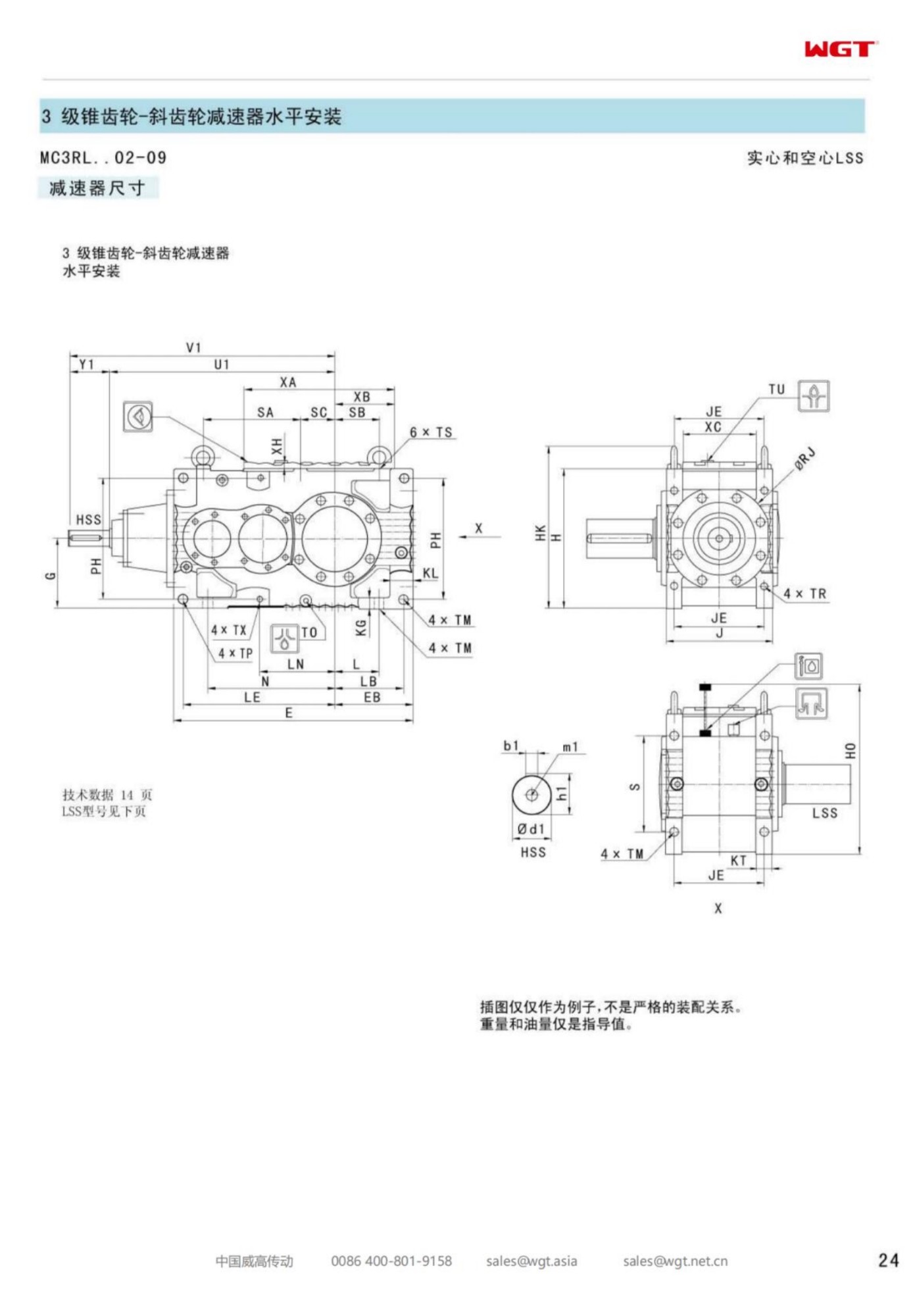
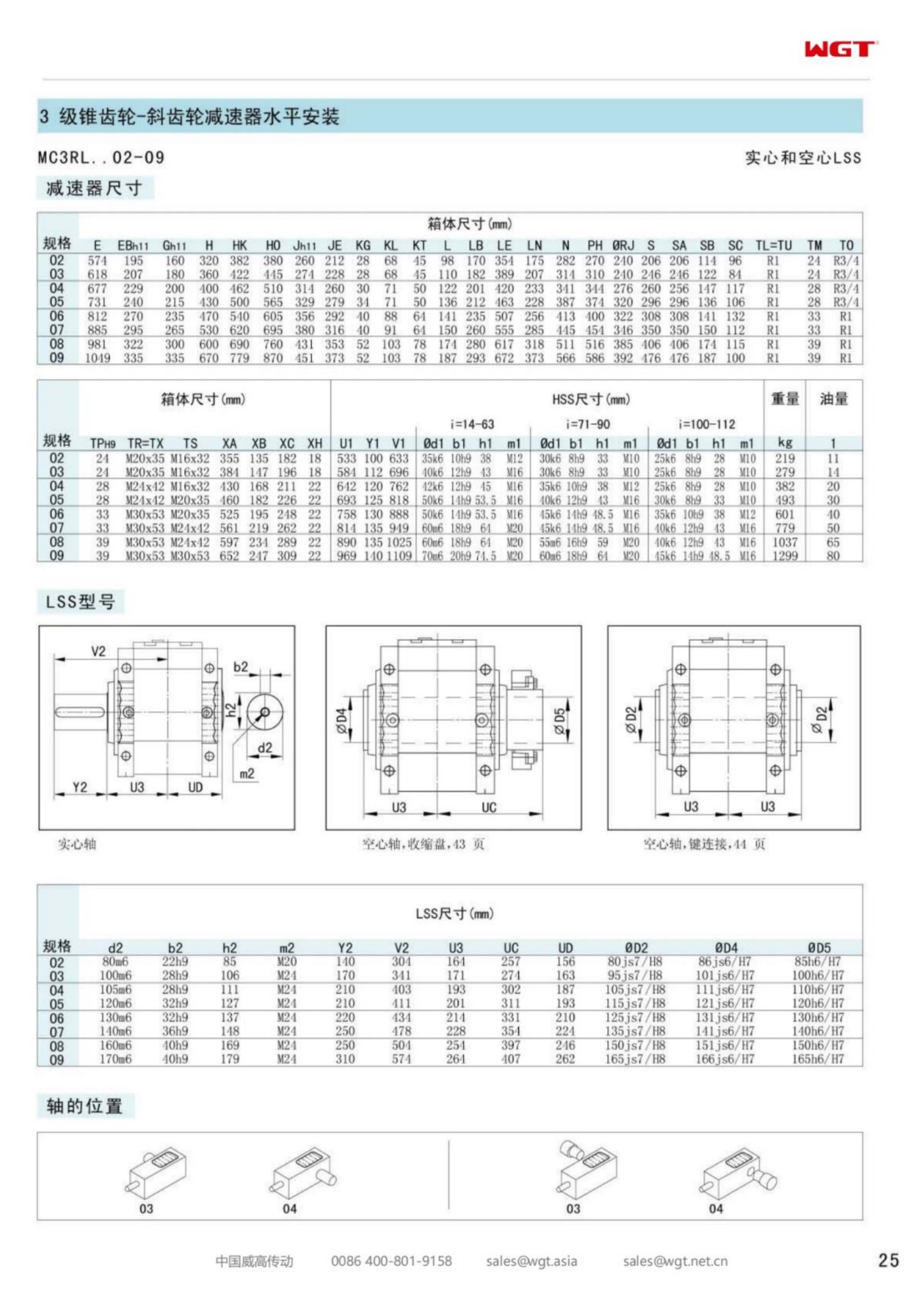
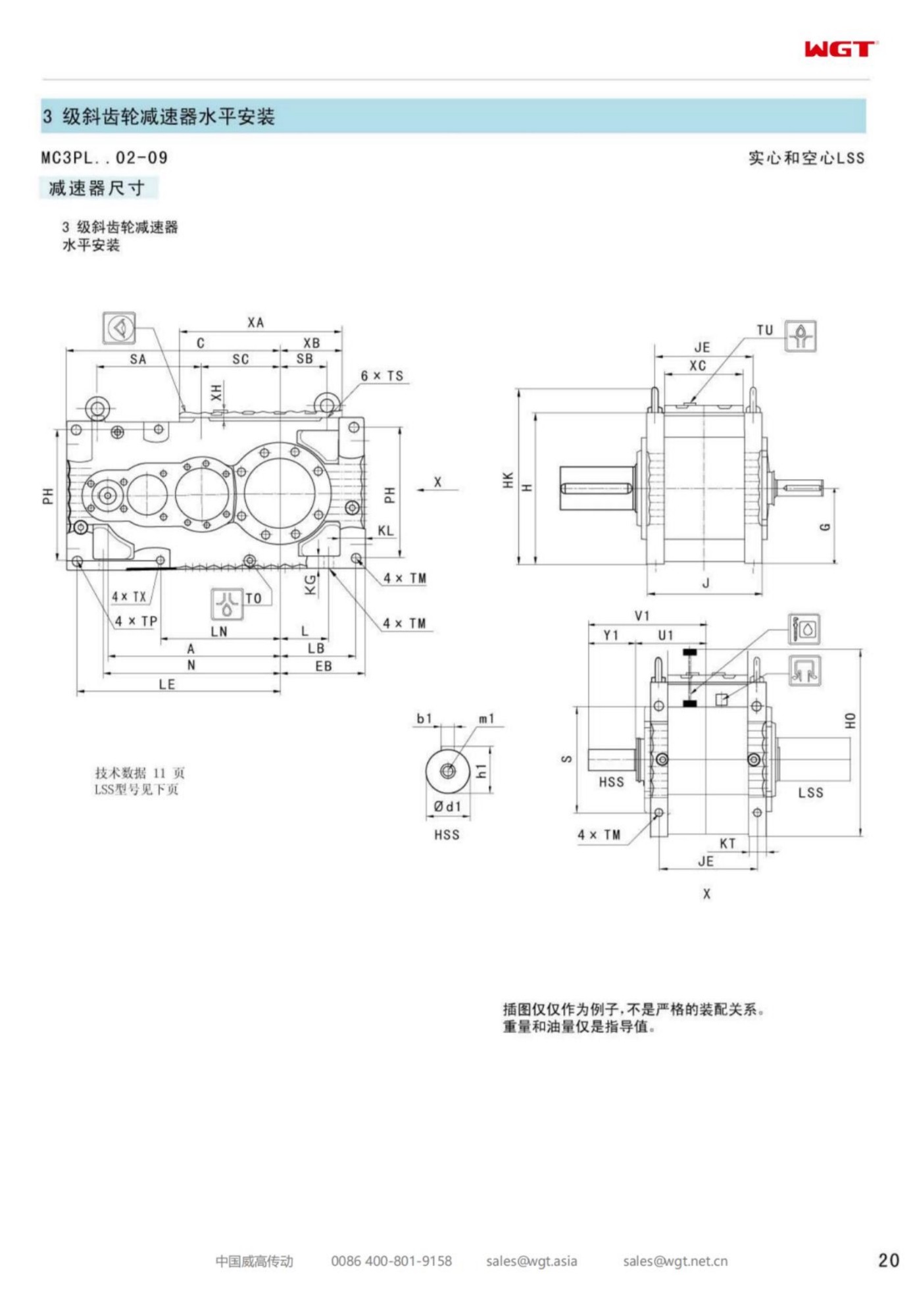
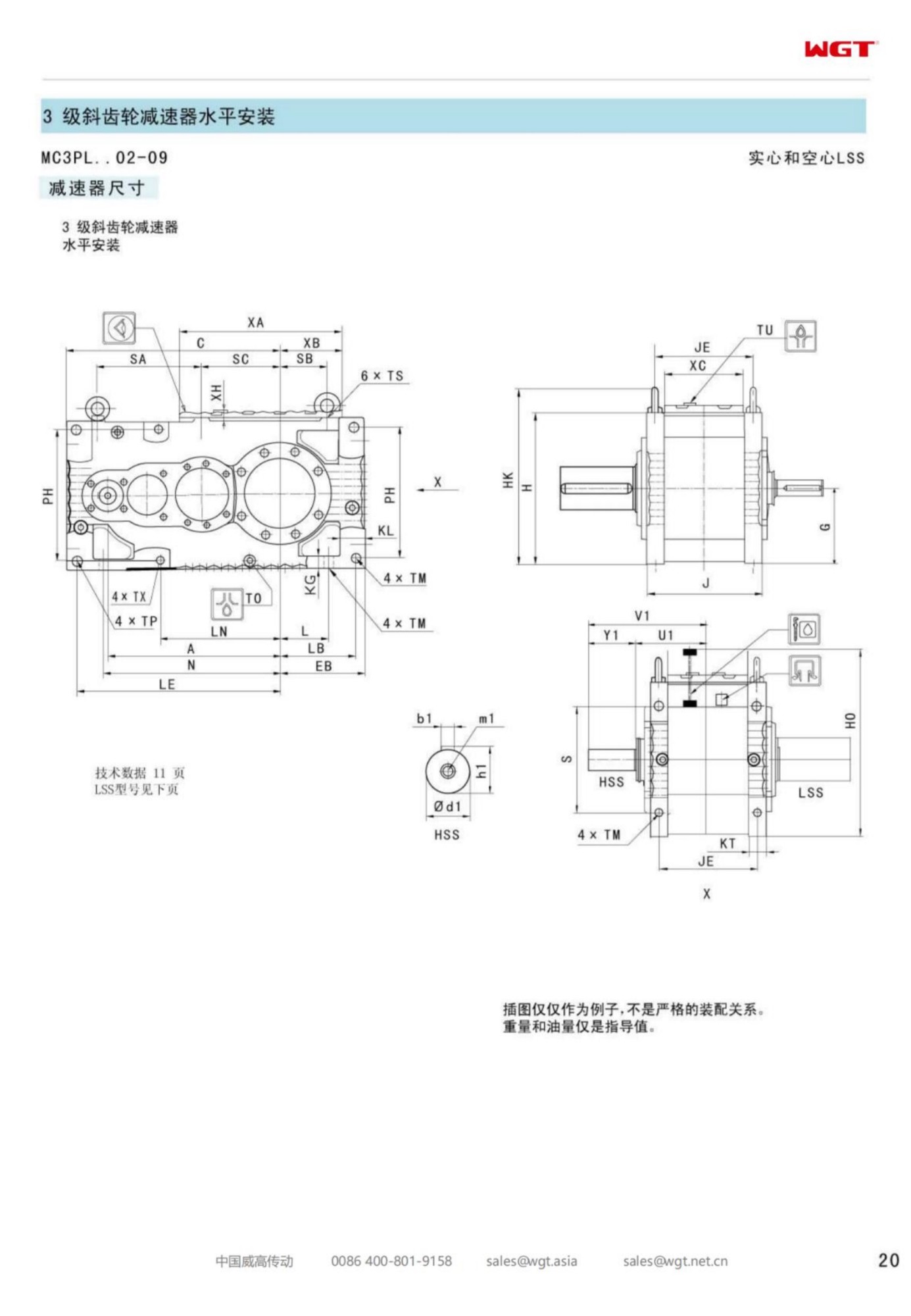
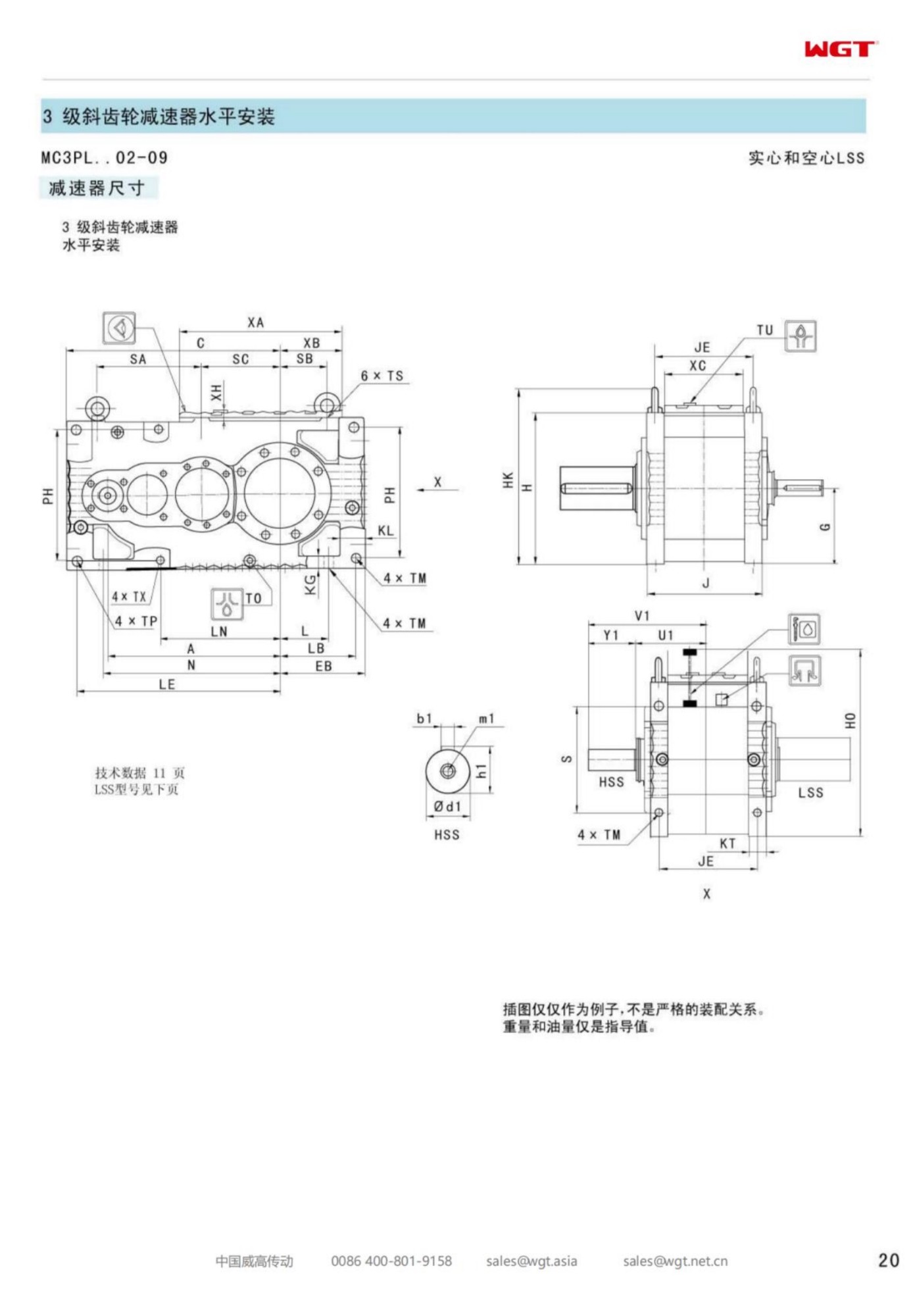
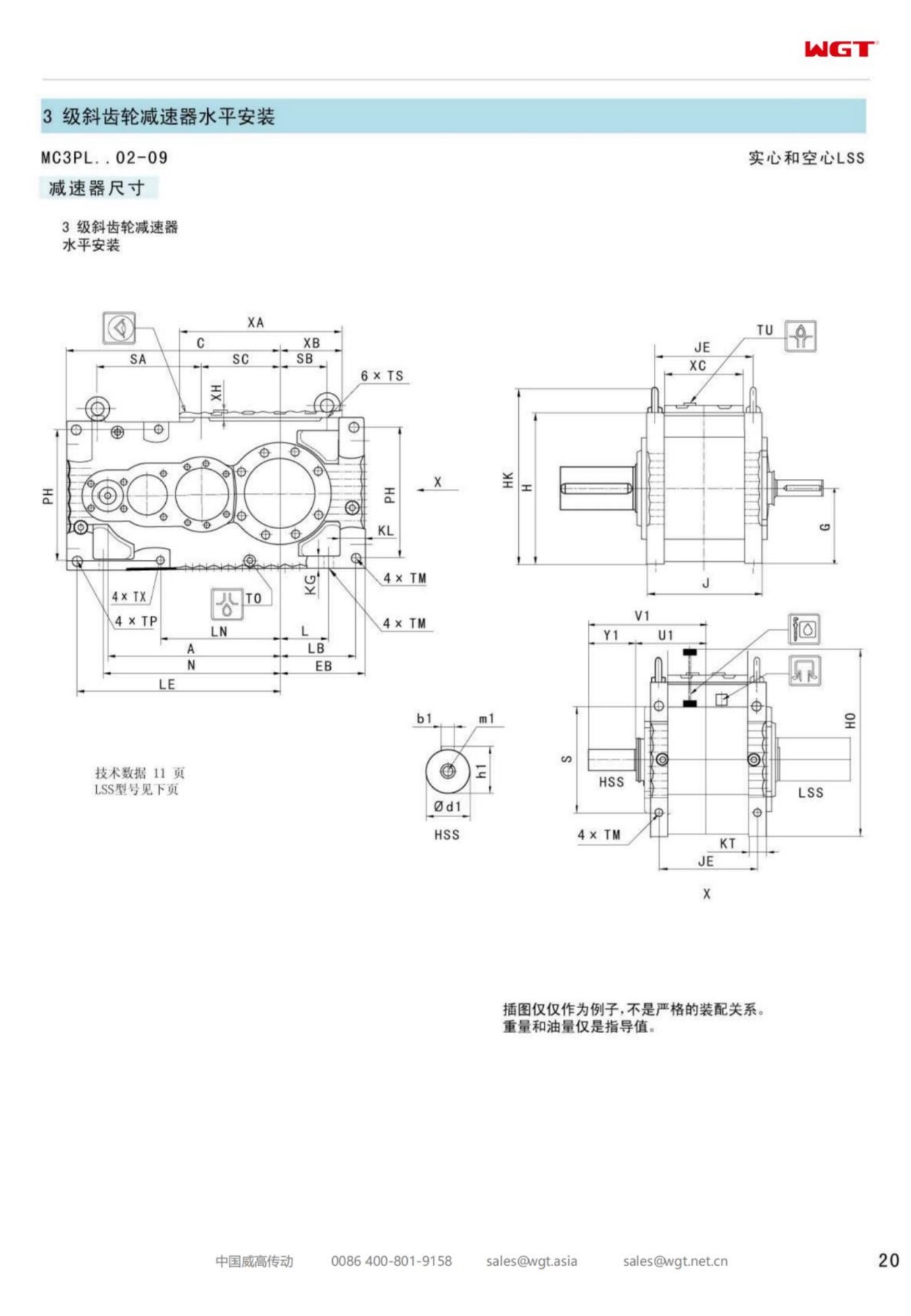
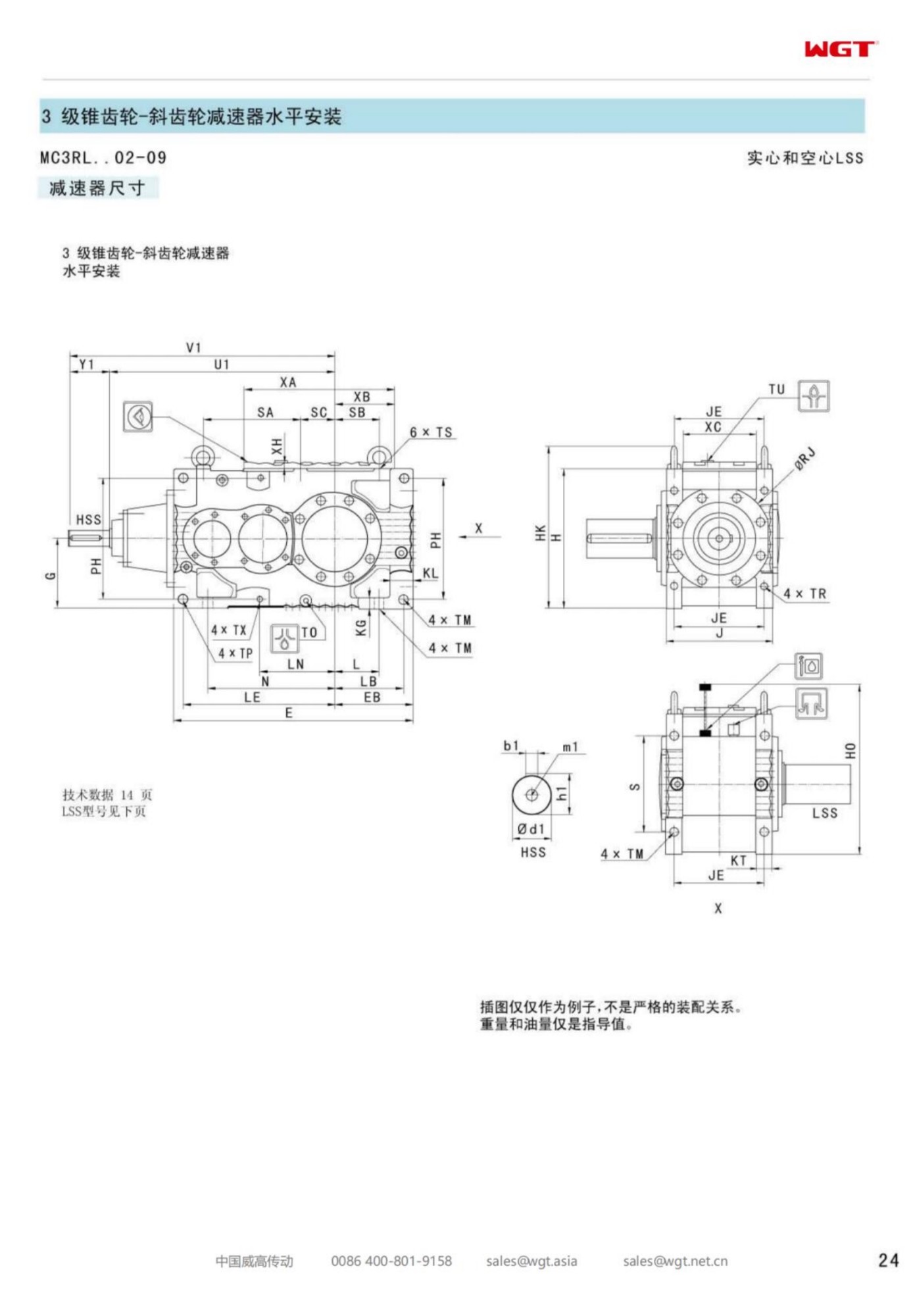
Some plants buy a gearbox and some plants buy the absence of a phone call at three in the morning. The second kind of buyer ends up looking at the MC3RLSF07 bevel-helical gearbox. It is the seventh frame of the right-angle band, one step below the top of the commonly used sizes, and it exists for duties that never really stop - where the drive is warm when the day shift arrives and still warm when the night shift leaves.
Everything about the unit is arranged around that assumption. The case has the mass to hold its shape through a full thermal cycle. The bearings are sized for the load at slow output speeds, where oil films are thin and every revolution is a long time coming. The sump holds enough oil that a small leak is a note in the log rather than a stop-work event. None of this is glamorous, and none of it appears on a data sheet headline. It is what twenty years of continuous service is actually made of.
The Frame Built for the Third Shift
Continuous operation changes the economics of every component. A drive that runs eight hours a day accumulates roughly three thousand hours a year; the same drive on three shifts accumulates more than eight thousand. Bearing fatigue, oil oxidation and seal wear all scale with those hours, and the interval between planned stops shrinks in proportion. A plant that cannot stop easily must therefore buy margin at the specification stage, because it will not be able to buy time later.
The seventh frame supplies that margin in the least fashionable places. Wider bearing spacing to keep shaft deflection small under a heavy coupling. A larger oil volume to slow the rate at which contamination becomes damage. Cast ribs positioned where the reaction torque tries to distort the case rather than where they look tidy. An inspection cover big enough to see the bevel contact pattern through - which sounds trivial until the first time someone needs to check it without pulling the unit out of the line.
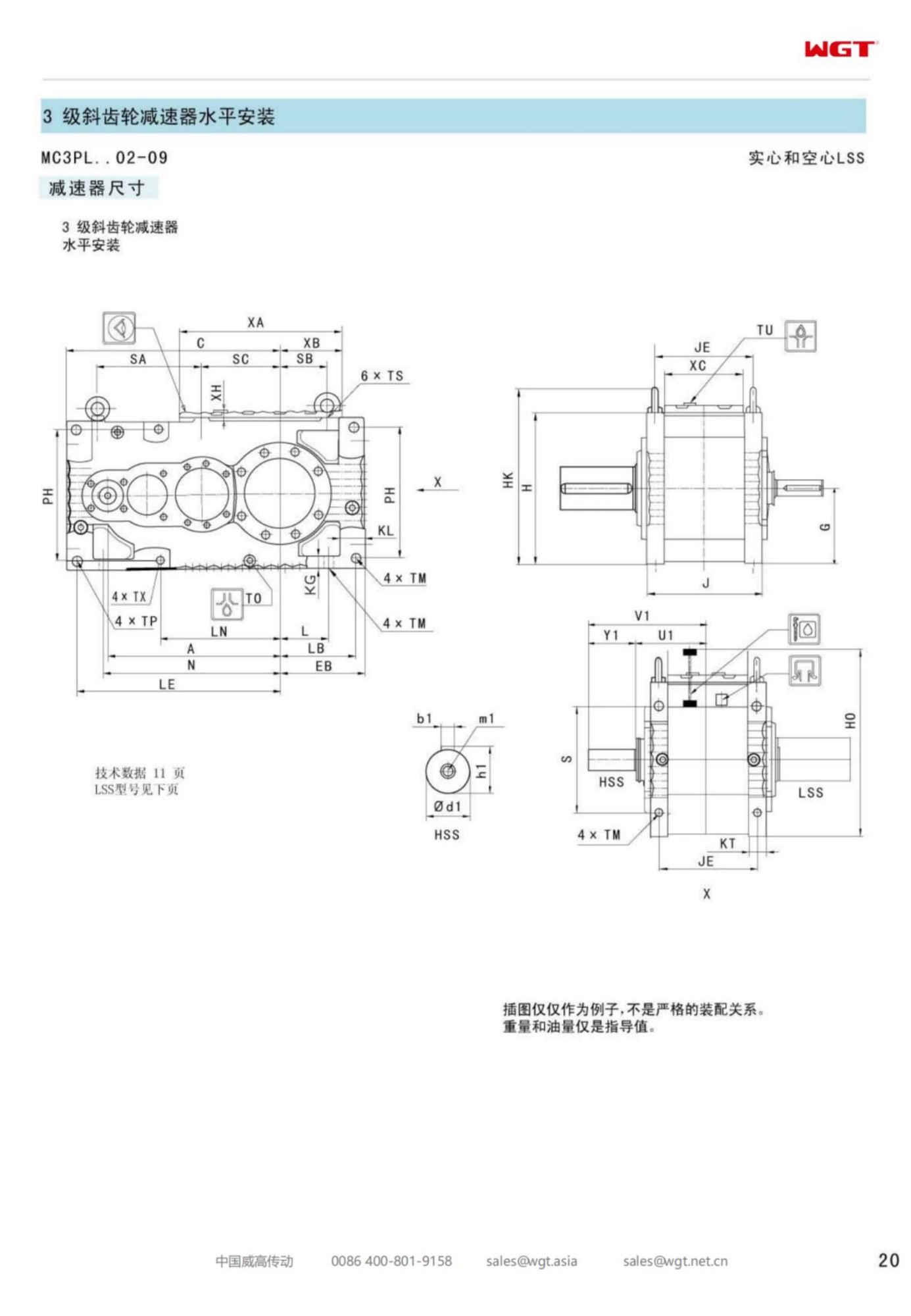
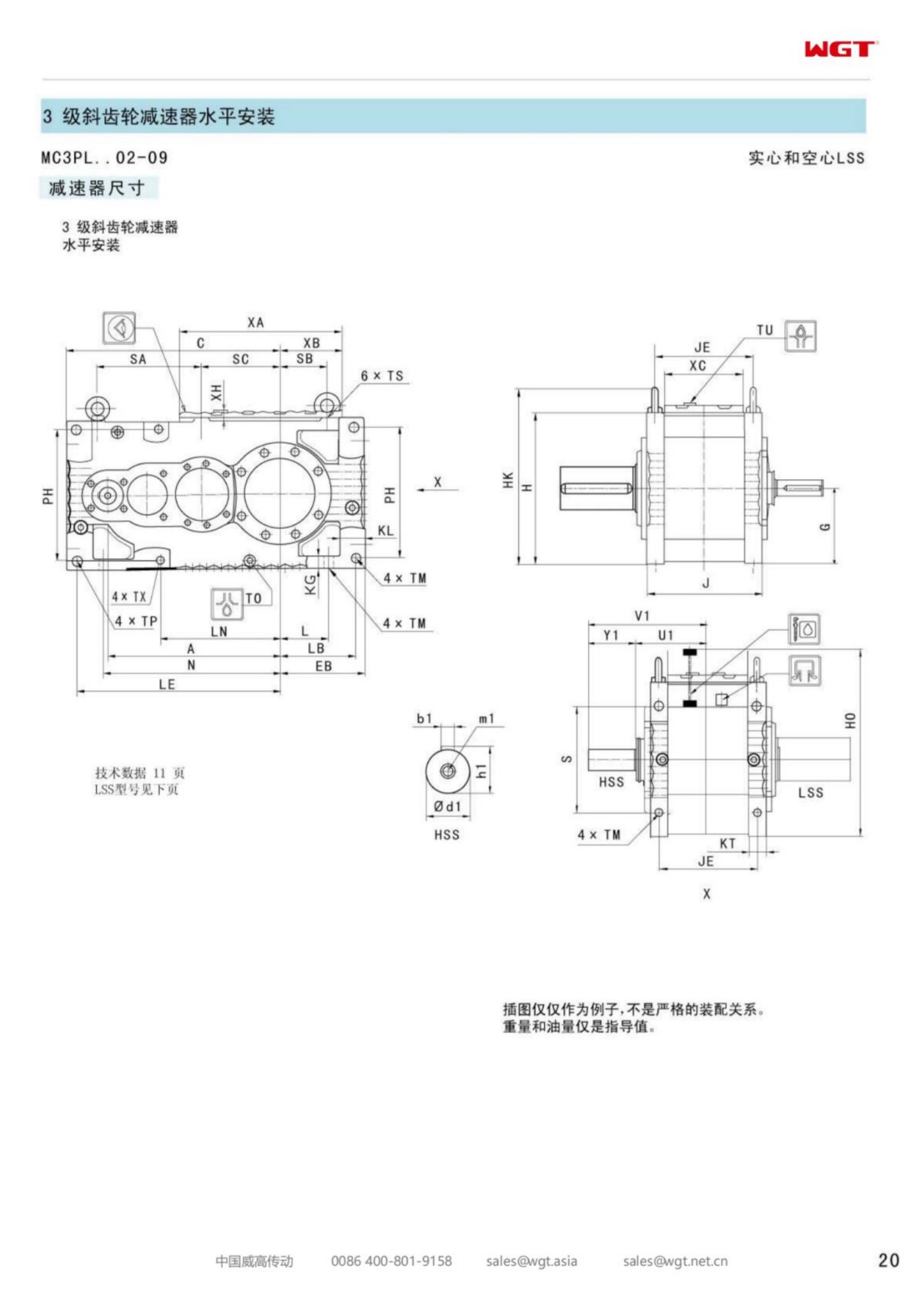
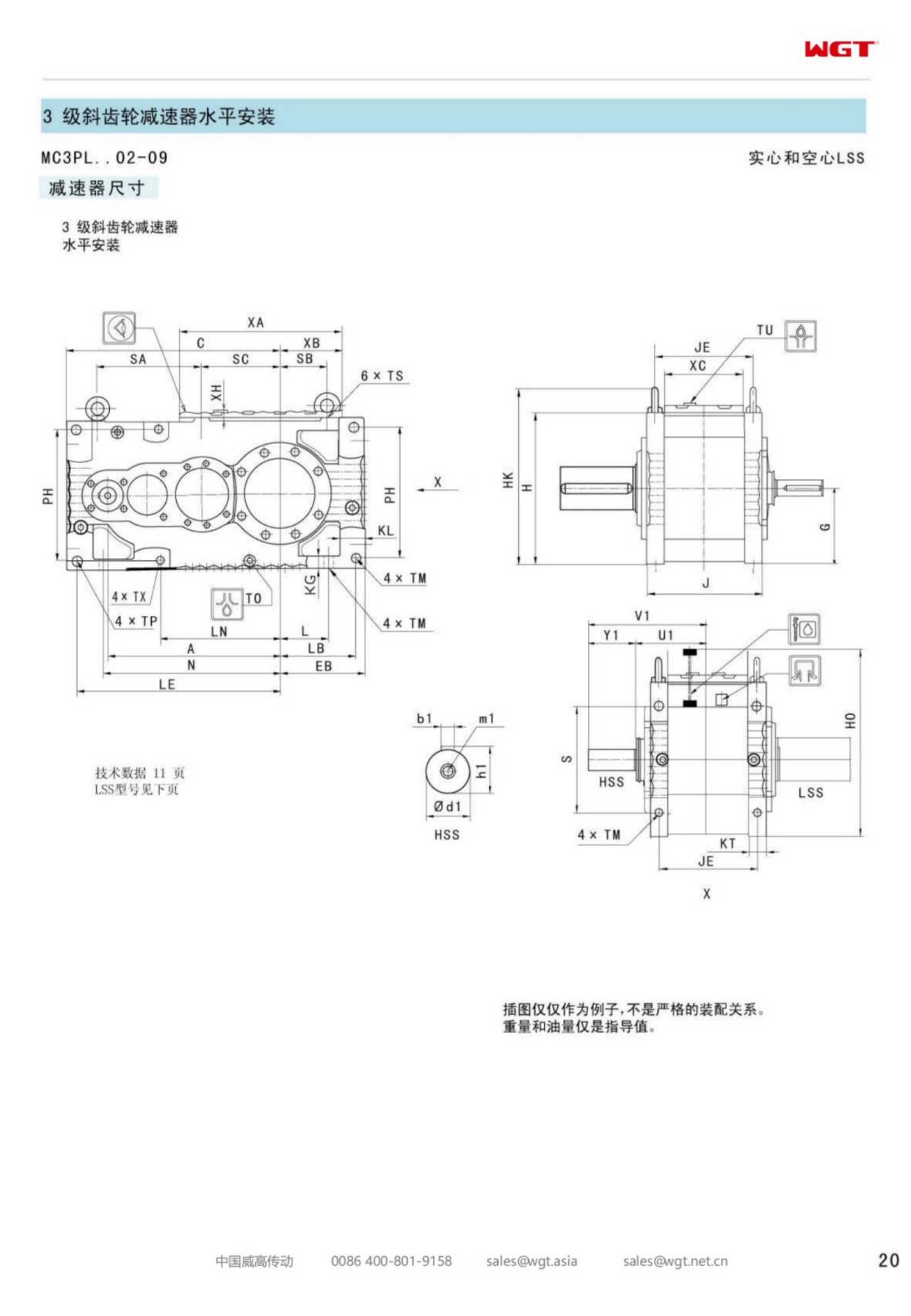
What Each Character of 07 Commits You To
The designation is short enough to memorise and specific enough to argue about, so it is worth reading slowly once. Each character locks in a physical feature that cannot be changed on site without a new casting.
| MC | Industrial gear unit family intended for continuous plant service |
| 3 | Three-stage reduction: bevel pair at the input, two helical stages at the output |
| R | Right-angle bevel-helical geometry, motor set across the driven shaft |
| L | Horizontal mounting with both shafts level |
| S | Solid keyed output shaft, one shaft end, standard machine coupling |
| F | Foot-mounted, bolted through the case feet to a rigid base |
| 07 | Seventh frame of the band: high torque at low output speed, built for round-the-clock duty |
What the string does not say is where the motor sits. On a case this size the motor can be carried on a separate frame, on a motor bracket integral with the housing, or on a raised plinth behind the unit, and each choice changes the maintenance access to the input seal. It also does not say whether the driven shaft needs a second shaft end for a brake or a manual turning device. Both belong in the enquiry, written down, before the casting is scheduled.
Bearing Life at Twelve Revolutions a Minute
Slow output speeds are quietly hostile to rolling bearings. At twelve revolutions a minute the output bearing turns fewer than a hundred thousand times in a working week, and the oil film that protects it is renewed slowly. Load, not speed, dominates the fatigue calculation, and any overhung load from a sprocket or a heavy coupling adds bending that the bearing must absorb with very little hydrodynamic help.
Two practical consequences follow. First, the overhung load figure and its lever arm must be declared in the enquiry, not estimated after delivery; a pulley mounted fifty millimetres further out than assumed can change the bearing calculation materially. Second, oil selection matters more than on a fast unit. The correct viscosity grade at the actual operating temperature is what keeps the film alive at low speed, and a grade chosen for a cold climate will leave a heavy frame under-protected in a warm plant room.
Heat Is the Real Rating at This Size
Ask what limits a large gear unit and most people answer torque. In practice, on a continuous duty at high ambient, the thermal rating often closes first. The case can only shed heat through its surface, and the surface is fixed by the frame size. Once the oil temperature stabilises above the recommended band, viscosity falls, the film thins, and every downstream assumption in the calculation starts to drift.
So the ambient figure in the enquiry should be the worst the enclosure sees, not the plant average. A drive in a still-air room next to a dryer is a different installation from the same drive on an open frame with a breeze through it, even though the nameplate reads the same. Where the margin is thin, the choices are a larger frame, a fan-cooled arrangement or improved ventilation of the room - and the third is often the cheapest by a wide margin, because it costs a louvre and a conversation rather than a new casting.
Where a Big Right-Angle Drive Earns Its Keep
Bored-output right-angle drives for large tanks, sumps and thickener centres:
- Raw mill separator drives running three shifts without a stop
- Boom luffing gear on a ship unloader at a river jetty
- Slurry pump drives at a tailings thickener underflow
- Rotary cooler discharge conveyors in a clinker line
- Heavy scraper reclaimers in a coal stockyard
- Press rolls on a board line where the felt never fully dries
These duties share a shape: high torque at modest speed, a driven machine that cannot be allowed to drift, and a plant layout where the motor simply has to sit around a corner. In each case the right-angle arrangement saves more than floor space - it keeps the motor out of the material path, which is why so many of these drives survive decades in yards where everything else rusts.
Monitoring a Heavy Unit Without a Contractor
A condition monitoring programme for one gearbox does not need a consultant. Four measurements, taken on the same day each month, cover most failure modes early. Case surface temperature at a marked spot on the output bearing housing. Oil level, read cold, at the same point on the sight glass. A listening check at the input, the bevel housing and the output, with a note of any change in pitch. A vibration reading in velocity units at the same three points, in the same direction each time.
The value is in the comparison, not the absolute number. A single reading tells you the machine is running; a series of twelve tells you whether it is running the way it did last year. Add an oil sample each quarter and the picture is complete enough to plan a bearing change during a scheduled shutdown instead of during a breakdown. Total cost: a handheld instrument, a notebook and about fifteen minutes a month.
The Spares Decision Made on Day One
Heavy frames are bought rarely, which is precisely why the spares decision should be made while the unit is new and the drawings are on someone's desk. At minimum, hold one set of shaft seals, one breather, one oil level sight glass and the correct grade of lubricant in a sealed drum. Beyond that, a spare input coupling half and a set of foot bolts cost little at the time of order and a great deal when ordered urgently against a stopped line.
Record the serial number, ratio, motor orientation and the date of commissioning somewhere the maintenance team will still find it in ten years - inside the machine file, not only on a nameplate that will be painted over. When the first rebuild eventually comes, that record is what turns a renewal exercise into a repair with the right parts on the bench before the unit is opened.
Writing an Enquiry for a Frame This Size
Everything the factory needs fits on a page and a half. Motor power, speed and starting arrangement. Output speed and tolerance. Running torque, breakaway torque and the frequency of loaded starts. Duty hours per year. True worst-case ambient with radiant sources named. Mounting position, motor orientation, and whether a second shaft end is required. Coupling type, bore and keyway if it is already chosen. Overhung load with its distance from the shoulder. Paint system, nameplate language and documentation package.
Sent complete, that page becomes a firm quotation, a general arrangement drawing and a delivery week. Sent as a photo of an old nameplate on a machine nobody has measured, it becomes a sequence of questions and a schedule that slips while they are answered. A seventh-frame unit is a twenty-year purchase; the enquiry deserves the same care as the foundation it will be bolted to.
Selection Example: Separator drive on a raw mill running three shifts
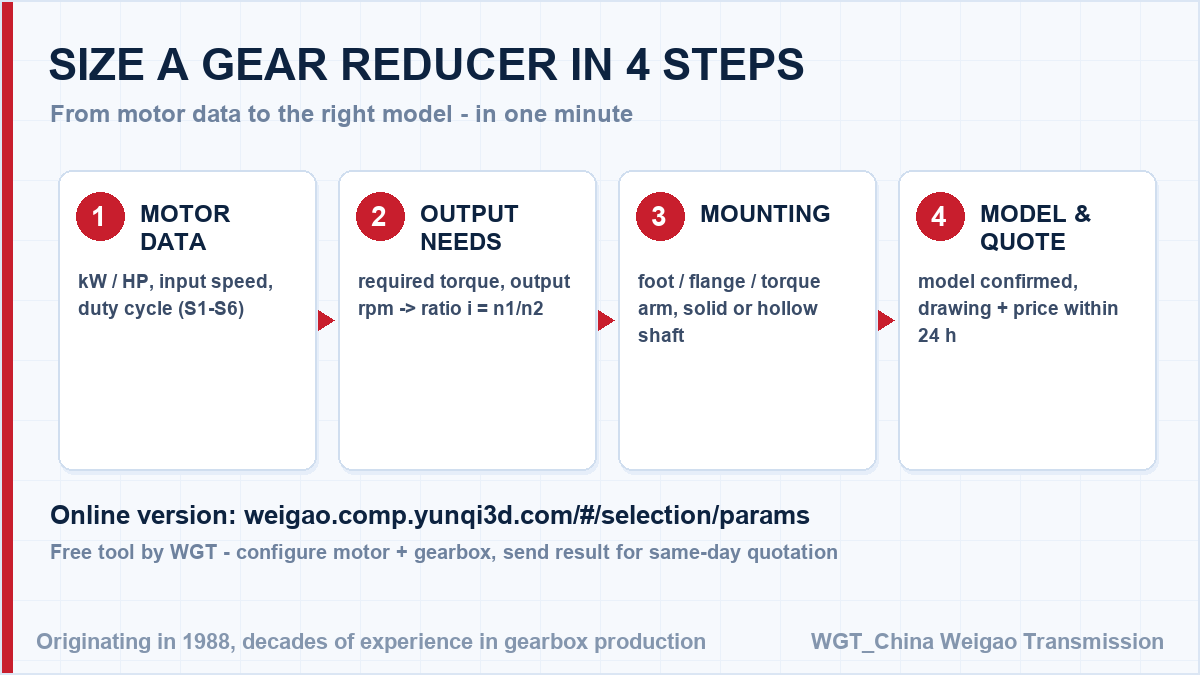
Take a 110 kW motor at 1490 rpm turning the separator rotor at 24 rpm. The ratio follows directly: 1490 / 24 = 62.1, so a ratio near i=62 is drawn, and the thermal rating at the measured enclosure ambient - not the annual average - decides whether auxiliary cooling is needed. In this case the seventh frame carries that heat load in still air without a fan, and its bearing set is sized for a rotor that keeps turning at low speed through every shutdown of the kiln behind it. Work through the same three steps - speed, output speed, torque - and the model number falls out; we verify it against the duty class before quoting.
![gear reducer ratio calculation steps]()
From duty point to model number - the same four steps every time.
Applications in Industry
Lime kiln auxiliary drive
A lime producer fits a smaller industrial gear unit as the auxiliary drive of its rotary kiln. Turning the kiln slowly during shutdowns and start-ups is exactly the low-speed, high-torque duty the frame was chosen for.
Tunnel boring backup drive
A tunnelling contractor uses industrial gear units on the backup gantry conveyors of its TBM. The units arrived dimensionally matched to the gantry interfaces, so installation took hours rather than days.
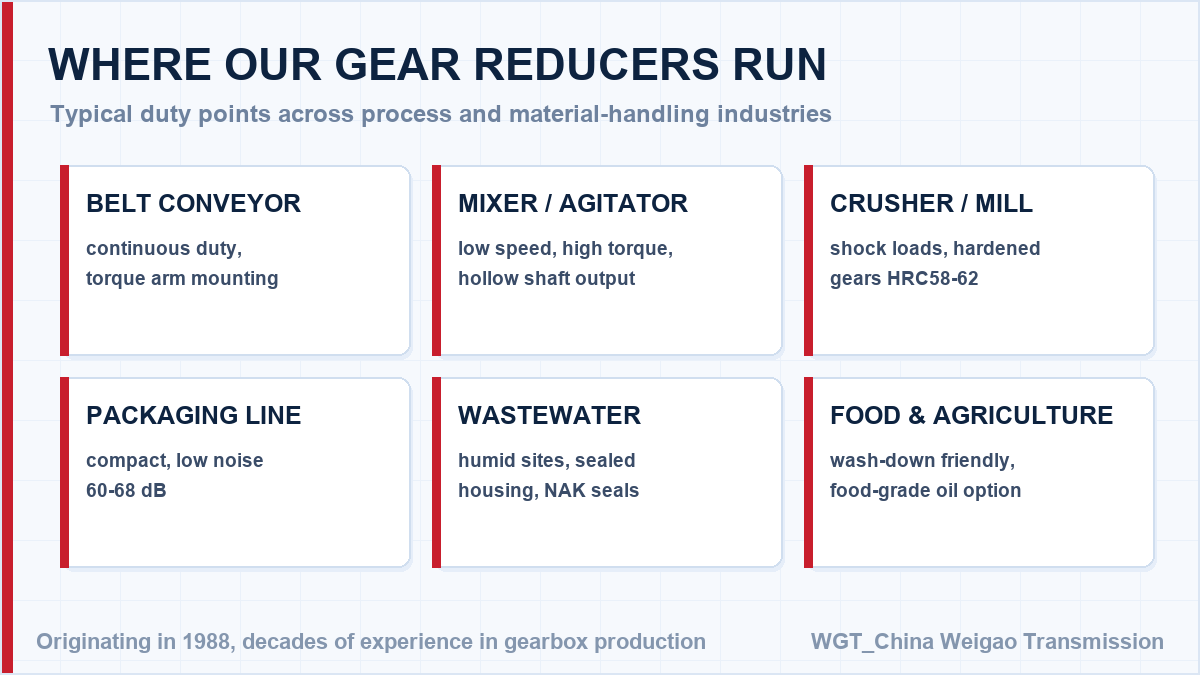
![gear reducer industries served - WGT]()
Industry map: the sectors where the M3 series is most common.
Buyer Questions and Answers
Do you support commissioning and after-sales service?
Every shipment includes an installation manual and a test record. Our engineers answer commissioning questions by e-mail or video call, and spare seals, bearings and shafts remain traceable to your original order for years afterwards.
What is a service factor and which value should I use?
The service factor multiplies your required torque to cover shock and duty class: around 1.0 for uniform conveyors, 1.25 for moderate shocks and 1.5 or higher for crushers, shredders and reversing drives. Tell us the driven machine and we apply the correct value before quoting.
M3 Series Model Overview
| Model | Centre distance | Output | Typical duty |
|---|
| M3PSF50 | size 50 | solid shaft, foot | conveyors, feeders |
| M3PSF60 | size 60 | solid shaft, foot | crushers, mixers |
| M3PSF70 | size 70 | solid shaft, foot | ball mills, shredders |
| M3PSF80 | size 80 | solid shaft, foot | kilns, heavy conveyors |
| M3PSF90 | size 90 | solid shaft, foot | mill and kiln drives |
| M3RSF50 | size 50 | solid shaft, foot, right-angle | inclined conveyors, elevators |
| M3RSF60 | size 60 | solid shaft, foot, right-angle | screw classifiers, feeders |
| M3RHF70 | size 70 | hollow shaft, foot, right-angle | agitators, drum drives |
| M3PHT80 | size 80 | hollow shaft, torque arm, parallel | shaft-mounted conveyors |
| M3RHT90 | size 90 | hollow shaft, torque arm, right-angle | heavy shaft-mounted drives |
The series is sized for continuous heavy duty rather than by motor power alone: the required torque with the service factor decides the frame, and the stage count (2 to 5) decides the ratio band.
Get Your Drawing and Quotation within 24 Hours
Ready to size your drive? Run your duty point through the WGT Motor & Gearbox Online Selection System first: it saves a round of emails and gets you to a firm price faster.
Or simply send your motor data (kW, speed, duty) and driven-machine details through the inquiry button - we reply with a completed datasheet, dimension drawing and factory price the same working day. Looking for a gear reducer for food processing machine? Tell us the duty point and we will confirm the model in writing.