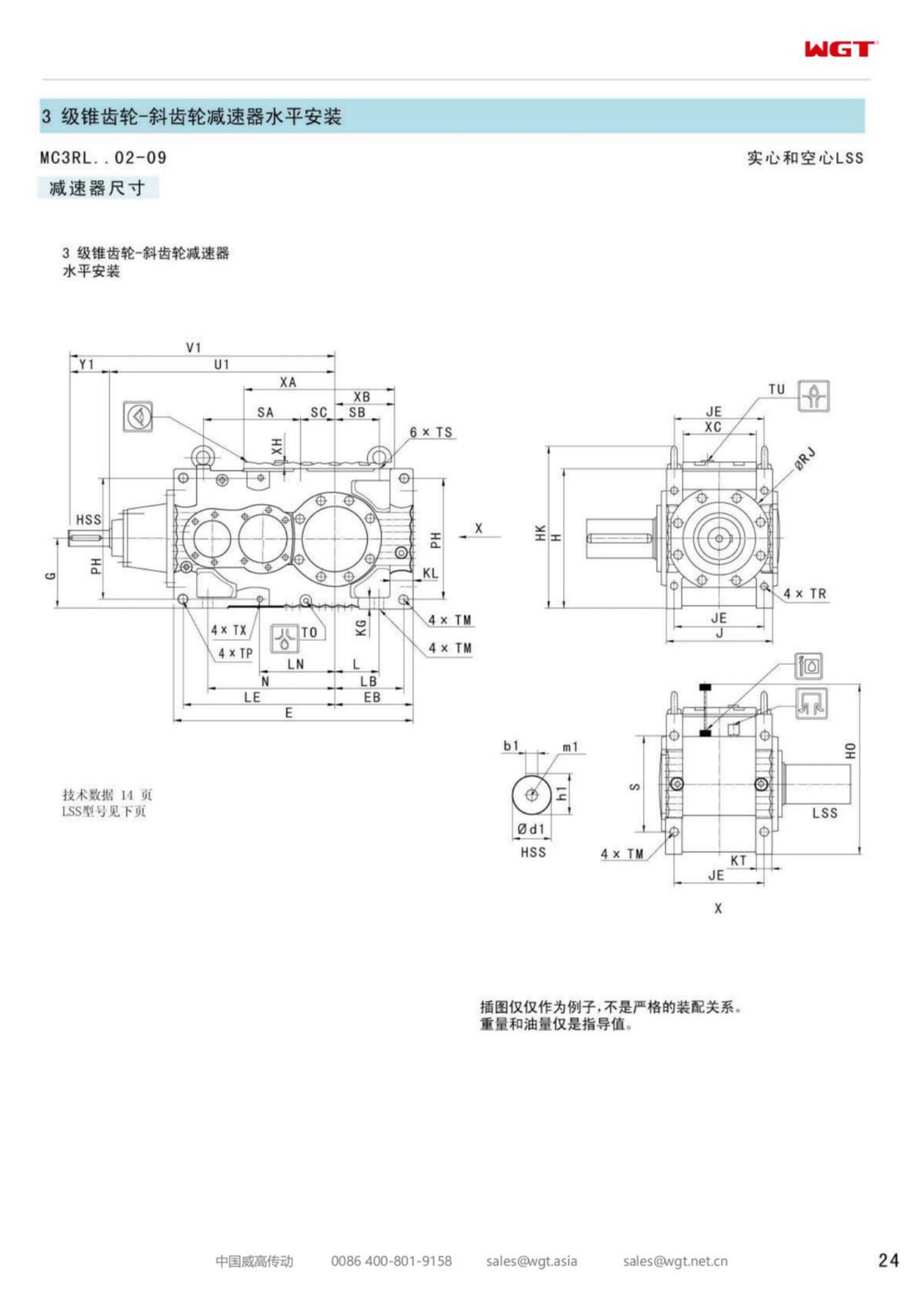
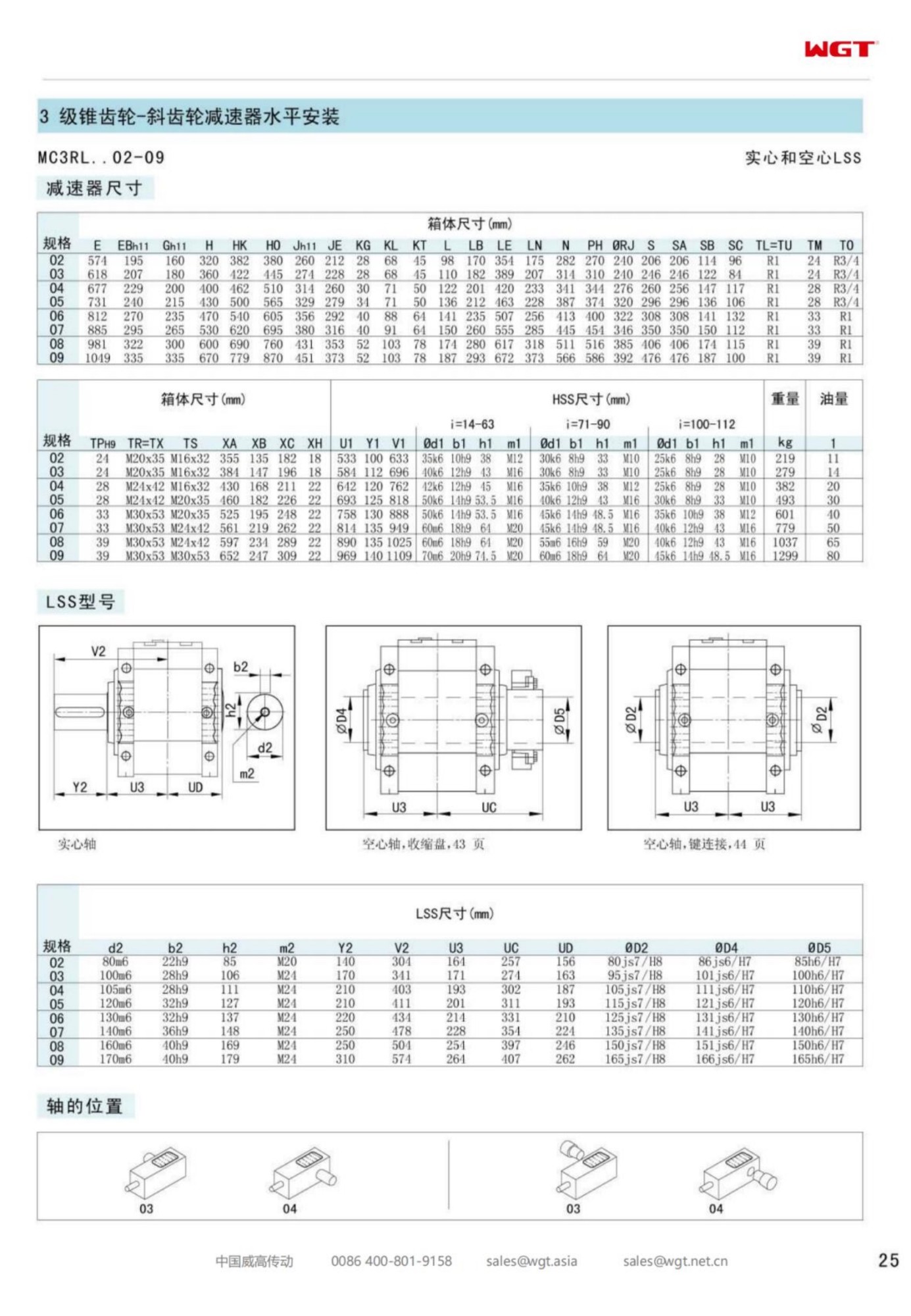
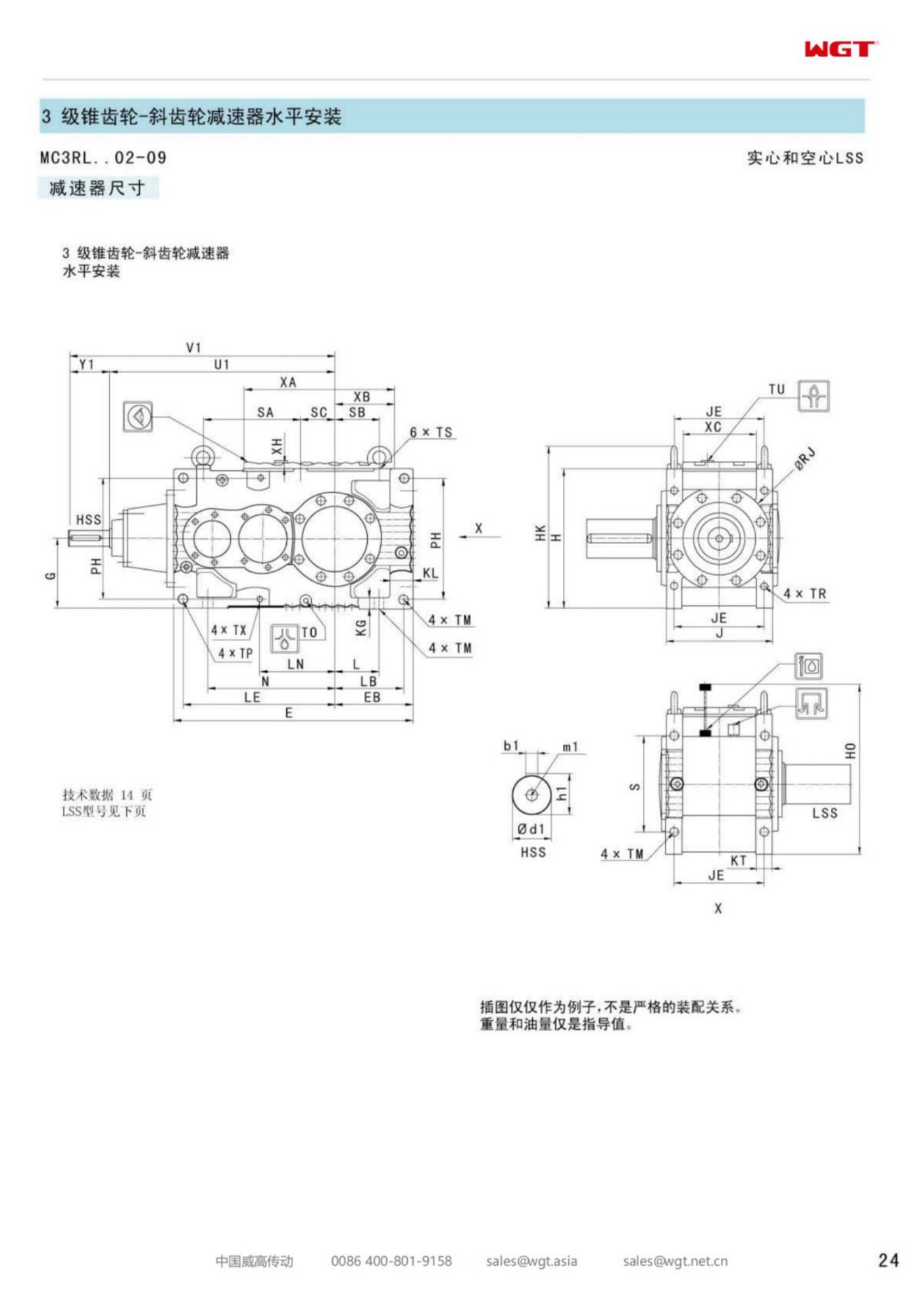
Plants are full of corners, and corners are expensive. A conveyor run along a wall, an agitator beside a tank, a feeder tucked under a hopper - each is a place where a straight-through drive box would push the motor into a walkway, a column or another machine. The MC3RLSF02 three-stage bevel-helical gear unit is the entry frame of the right-angle branch of the MC industrial family: a bevel stage turns the drive path ninety degrees at the input, and two helical stages below it do the speed cutting. The result is a deep overall ratio delivered across a corner instead of along a line.
As the smallest frame of the band it carries the lightest continuous duties of the family, and it earns its place in plants where the geometry of the room decides the layout long before the drive is chosen. A unit like this is specified once and then quietly turns for fifteen or twenty years - which is exactly what the following pages are for.
A Right Angle, Put To Work
Turning the input across the output axis does three useful things at once. It shortens the drive footprint along the machine shaft, so the gearbox no longer needs the length a parallel unit demands. It lets the motor stand to the side - against a wall, beside a tank, clear of an access gangway. And it puts the first, fastest mesh into a bevel pair, which absorbs the motor speed gracefully and hands a calmer input to the helical stages that follow.
The trade is honest: a bevel mesh costs a little more to cut and a little efficiency to run, and it wants its pattern checked properly at assembly. In return the machine designer gains a degree of layout freedom that no parallel-shaft case can offer. Where that freedom saves a foundation change or a relocated walkway, the corner has paid for itself before the unit is even energised.
The Order Code, Read Once at the Bench
Every character of the type string commits the factory to a physical feature. Decode it once, with the general-arrangement drawing open, and it becomes shorthand the whole project team can rely on.
| MC | Industrial gear unit family built for continuous plant duty |
| 3 | Three reductions in series - a bevel input stage followed by two helical stages |
| R | Bevel-helical design: motor input turned ninety degrees to the output shaft |
| L | Horizontal mounting position - shafts level, case resting on its foot plane |
| S | Solid output shaft with a parallel key, made for keyed machine couplings |
| F | Foot mounting onto a prepared horizontal foundation |
| 02 | Entry frame of the bevel-helical band, which runs from 02 up to 09 |
Two properties the string cannot carry - the exact ratio and the orientation of the motor relative to the case - belong in the enquiry as plain words. A right-angle unit has more orientation choices than a parallel one, and each choice moves the breather, the dipstick and the drain. Say them out loud early.
Why a Bevel Stage Earns Its Keep
The bevel pair is the hardest-working geometry in the case: it takes full motor speed and turns it through a right angle in a single mesh. Cut and lapped well, it runs cool and quiet for decades; set up carelessly, it announces itself with a whine that no later alignment can cure. This is why the contact pattern of the bevel teeth deserves a photograph in the commissioning file - a five-minute check that documents the health of the most sensitive mesh in the unit.
Downstream of that corner, the two helical stages behave like any well-made parallel pair: progressive speed cutting, generous face widths, and a share of the load spread across teeth designed for exactly this duty. The deep ratios of the three-stage layout arrive without a towering case, which keeps the centre height low and the installation honest.
Duties That Suit the Smallest Frame
Right-angle vertical duties where the motor must stay at deck level:
- Screw conveyors under lime and cement silos in cramped basements
- Small rotary feeders and airlock valves on dust-collection hoppers
- Agitators in pickling tanks where the motor must sit beside the bath
- Cooling-drum drives on mineral fines that run around the clock
- Paddle mixers in brick and clay preparation sheds
- Inclined belt conveyors along plant walls with no headroom to spare
The common thread is steady rotation at modest torque in places where layout, not brute force, is the deciding argument. Where a duty grows past the frame - a feeder that packs, a screw that bridges - the correct answer is the next size up, not a service factor stretched on paper.
Placing the Motor Where the Wall Is
A right-angle unit gives the layout designer options, but each option is a commitment. The motor can sit left or right of the case, above or below centre, and the position decides which face carries the breather and whether the drain plug remains reachable over the plinth. Before the order is placed, stand at the installation spot with the outline drawing and physically walk the choices: where the motor hangs, where the cable box points, whether the dipstick can be read without a mirror and a torch.
Ten minutes of standing in the room beats a site modification after delivery. Right-angle drives are the family where this exercise pays best, because the corner multiplies the number of plausible - and implausible - arrangements.
First Run, First Oil, First Records
The first hundred hours decide the tone of the next twenty years. Fill the correct oil grade to the level mark with the case cold; confirm rotation direction before any loaded start, because a bevel stage turning backwards is a short and expensive conversation; run unloaded and listen at each bearing position. The bevel mesh should settle into a smooth tone within the first hour - a persistent whine at one shaft speed is a pattern check waiting to be requested, not a noise to get used to.
Log sump temperature and the general sound signature at a fixed weekday, and re-torque the holding-down bolts after the first warm run. A small frame forgives a great deal, but the habit of writing numbers down costs nothing and is the single best predictor of a long service life.
An Enquiry That Lands Right the First Time
One page, plainly written, gets a firm quotation back in a single pass: motor kilowatts, speed and starting method; output speed with the tolerance the process accepts; absorbed torque with any recurring shock described in words; running hours per day and starts per hour; the honest worst-case ambient; mounting position with the motor orientation named; shaft dimensions if an existing coupling or screw must be kept; paint, nameplate and documentation wishes.
The plants that run this family without drama are the ones whose enquiries read like checklists. The 02 is a small frame with a large habit of staying out of the news - and it keeps that habit best when the first email says everything the second one otherwise would.
Selection Example: Screw conveyor under a lime storage silo
Take an 11 kW motor at 1460 rpm turning the conveyor screw at 39 rpm. The ratio follows directly: 1460 / 39 = 37.4, so a ratio near i=37 is drawn from the three-stage bevel-helical band, and the frame is checked against the standing load of a screw that can pack under a bridged silo. In this case the right-angle input lets the motor sit beside the trough instead of along it, which is exactly what a crowded silo basement asks of a drive. The same three numbers - motor speed, target output speed, required torque - are all you need; our engineers (or the online selector below) cross-check the service factor for your duty cycle.
![gear reducer selection flow chart - ratio and frame size]()
Figure: from motor data to a confirmed gearbox model in four steps.
Common Models in the M3 Series
| Model | Centre distance | Output | Typical duty |
|---|
| M3PSF50 | size 50 | solid shaft, foot | conveyors, feeders |
| M3PSF60 | size 60 | solid shaft, foot | crushers, mixers |
| M3PSF70 | size 70 | solid shaft, foot | ball mills, shredders |
| M3PSF80 | size 80 | solid shaft, foot | kilns, heavy conveyors |
| M3PSF90 | size 90 | solid shaft, foot | mill and kiln drives |
| M3RSF50 | size 50 | solid shaft, foot, right-angle | inclined conveyors, elevators |
| M3RSF60 | size 60 | solid shaft, foot, right-angle | screw classifiers, feeders |
| M3RHF70 | size 70 | hollow shaft, foot, right-angle | agitators, drum drives |
| M3PHT80 | size 80 | hollow shaft, torque arm, parallel | shaft-mounted conveyors |
| M3RHT90 | size 90 | hollow shaft, torque arm, right-angle | heavy shaft-mounted drives |
The table below shows the M3 industrial range: P builds are all-helical on parallel axes, R builds add a bevel input stage for a right-angle drive; S / H describe the low-speed shaft and F / T the mounting.
Application Cases
Steel mill transfer car
A rolling mill drives its slab transfer cars with industrial gear units mounted on torque arms. Reversing duty every few minutes is handled without complaint, and the hollow-shaft connection keeps the wheel axles free of couplings.
Rotary dryer drive
A minerals processor powers a rotary dryer with a large foot-mounted gear unit. Slow rotation with high torque is the natural duty band, and the housing stays within its temperature limits without auxiliary cooling.
![industrial gearbox applications - conveyor mixer crusher wastewater]()
Figure: typical industries that use the WGT S-series gear reducers.
Frequently Asked Questions
What is the recommended oil change interval?
The housing is lubricated for life under normal duty and normal ambient. In hot, humid or continuous service, change the oil after the first 400 running hours and then every 4000 hours, or once a year, whichever comes first.
What paint finish and corrosion protection is applied?
Housings are shot-blasted and finished with a two-component industrial paint in RAL colours, giving good protection for indoor and sheltered outdoor duty. For aggressive or coastal sites, ask for the heavy-duty coating option.
Do you supply spare parts such as seals and bearings?
Seal kits, bearings, output shafts and covers are available from stock or on short lead time. We keep the drawings for every unit we ship, so a replacement part ten years from now is still traceable to your original order.
Site Survey Data? We Size It for You
Have the machine data but not the model? Not sure which model fits? Try our online WGT Motor & Gearbox Online Selection System to match motor power, ratio and mounting in one minute.
Send the conveyor length, belt speed, drive pulley diameter or the machine duty description. We run the full selection - ratio, frame, service factor - and return the datasheet with the quote. Looking for a gearbox for belt conveyor? Tell us the duty point and we will confirm the model in writing.