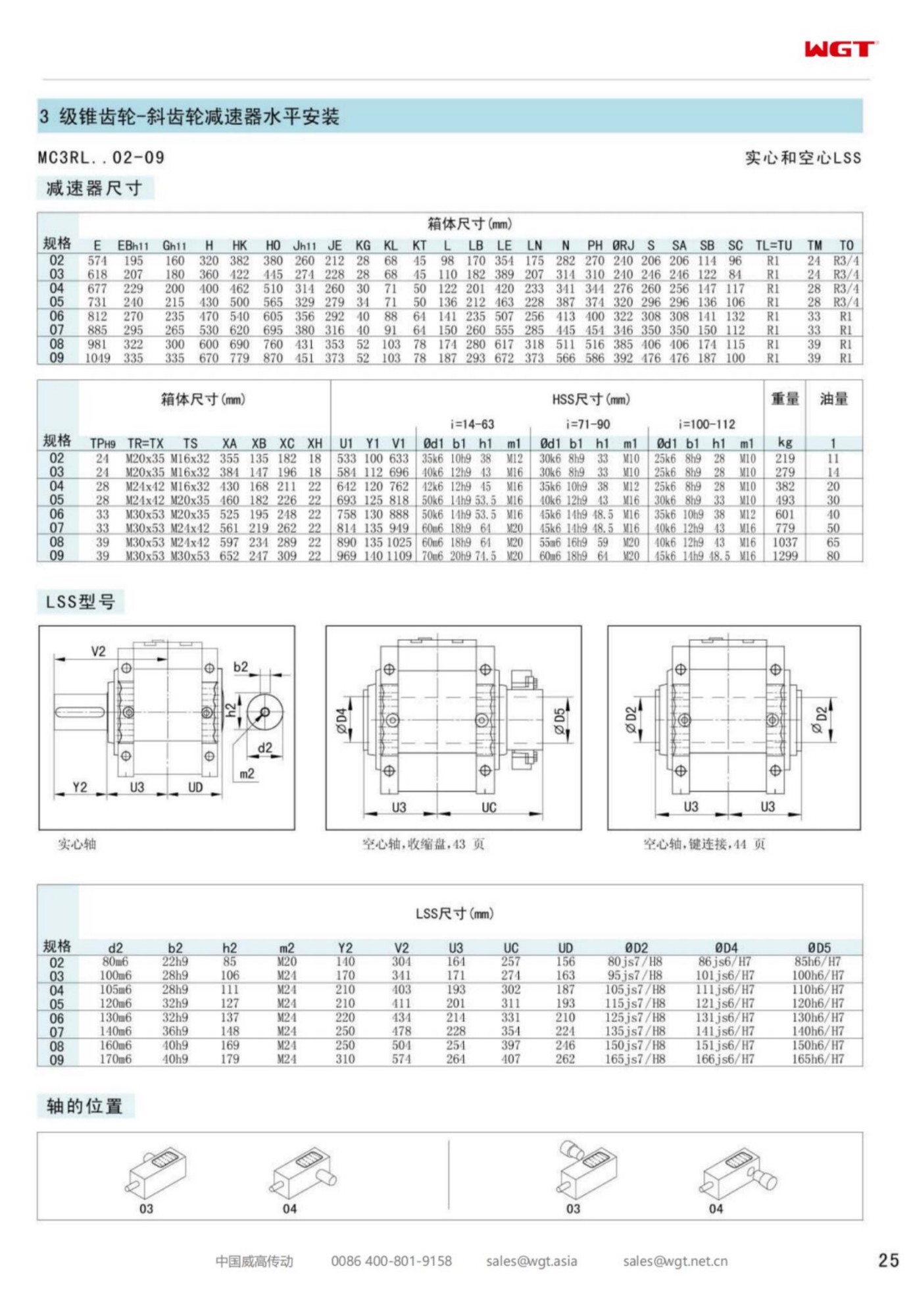
At the top of the hollow-bore, foot-mounted band, the machinery on the output side stops being auxiliary. The MC3RLHF07 bevel-helical gearbox is specified where a stalled drive stops a section of plant: run-of-mine conveyors out of a pit bottom, thickener drives at the tail of a concentrator, crane long travel in a heavy machine bay, log decks that run from first light to last. This page is written for the engineers who size those drives and the crews who install them.
The train remains the family's three-stage arrangement - bevel input, two helical reductions - with the output a hollow bore that mounts over the driven shaft from a footed case. What the seventh frame changes is the scale of every margin: bearing sections wide enough for real overhang, an oil volume with genuine thermal reserve, and a case whose mass does part of the damping a smaller unit would borrow from its foundations. On duties with shock and dust, that mass is a feature, not a cost.
Top of the Mid Band, Feet Still on the Floor
Above the seventh frame the band shifts character: the driven machinery becomes heavier still, and torque arms, fabricated bases and written lifting plans begin to dominate the installation. The frame seven sits just below that line - the largest unit a plant can still treat as a standard catalogue item, fitted by its own crew on its own schedule. That position explains its popularity: the torque of heavy process machinery with the installation discipline of a mid-band drive.
Ratios overlap across the band, so a frame seven frequently shares its ratio with a frame six. The choice between them is made by the worst hour: the loaded restart after an emergency stop, the surge when a chute slumps, the summer shift when the gallery air is warm and the dust is thick. Sizing to that hour, rather than to the average, is what separates a drive that coasts from one that visits the workshop.
Machines That Grow Into a Frame Seven
Drives whose worst hour, not their average, chose this frame:
- Run-of-mine belt conveyors hauling coal from the pit bottom
- Thickener drives at the tail end of a concentrator
- Overhead crane long-travel drives on a heavy machine bay
- Slurry mixer lines at a mineral processing plant
- Log deck chains at a sawmill running from first light to last
- Reclaimer travel drives creeping along a stockpile duty
What links that list is mass in motion. A conveyor loaded from the pit bottom carries a belt of coal that cannot be argued with at restart; a thickener turns a rake through settled solids all week; a log deck takes timber as it arrives, not as the schedule would like. Each is a slow, heavy, unforgiving duty - and each sits beyond what the lower half of the hollow-bore band was sized for.
Reading the Order Code Before It Is Cast
The designation compresses a dozen decisions into seven characters, and reading it against the duty before the order is placed prevents most post-order correspondence. The table runs the same letters once more, this time with the seventh frame in view.
| MC | Industrial gear-unit family for continuous plant service |
| 3 | Three-stage train: bevel pair at the input, two helical reductions after it |
| R | Right-angle geometry: the motor parks across the driven shaft, where the aisle and access want it |
| L | Horizontal build on feet: both shafts level in one case |
| H | Hollow output bore: the case mounts over the driven shaft, no coupling in the line |
| F | Foot mounting onto a bedplate or fabricated base |
| 07 | Seventh frame: heavy process torque just below the band's fabricated-base territory |
Beyond the string sit the choices that never make the code but always make the difference: which face carries the motor, where the breather must present itself to survive dust or hose spray, whether a second shaft end is wanted for a brake or an encoder, and which rotation direction the first jog of the motor must produce. Each is a line on the order confirmation; none of them can be added by the fitter on the day.
Sized Against the Worst Shift of the Year
The frame seven punishes one selection habit above all: duty cycles written for the gentle hour. A conveyor described as continuous with soft starts, and the same conveyor in truth restarting loaded twice a shift after trips, occupy the same row of an optimistic table and part company in year two. Breakaway torque, starts per hour and the worst material surge belong on the enquiry in writing, because they are the inputs the service factor is honestly calculated from.
Overhang keeps its importance even with the bore doing the locating. Anything hung beyond the driven shaft - a sprocket for an auxiliary drive, a sheave, a bracket for a scraper blade - loads the output bearings through a lever the rating never saw, and at this frame the lever arms are long. Stating the overhang costs a line on the enquiry and removes the assumption most often proved wrong at commissioning.
Mass, Pads and the Level Sequence
A frame seven has real weight, and weight changes the installation arithmetic. The pads are levelled in the diagonal sequence before final tightening, because a case of this mass will find any error a shim left behind and hold it for a decade. The unit is lifted only from the points shown on the outline drawing, supported so its weight never rides on the bore edges, and eased onto the shaft square - driven on fast, a bore this size cannot complain until it is too late.
The failure modes worth naming are the ones the mass encourages. A holding-down bolt torqued against an unleveled pad turns the pad into a hinge. A torque arm used as a second foundation imposes a load path the bearings were never credited for. Both announce themselves later as fretting at the bore and a seal that weeps on one side - symptoms that read as factory faults and almost never are.
Thermal Reserve Where the Air Is Hot
Oil volume grows with the frame, and so does the unit's patience with heat - but patience is not immunity. Beside a kiln, under a summer roof, or in a warm underground gallery, the thermal check is run at the true corner ambient, not the nameplate assumption. Oil life roughly halves for every ten degrees the sump runs past its design point, and at this frame the sump is large enough that a thermal failure arrives slowly and expensively.
The remedies are ordinary and cheap. Move the breather out of the dust stream. Direct a fan of air across the case. Raise the oil grade for the season. Record the case temperature after four loaded hours at commissioning, and every reading taken afterwards has a baseline to be judged against - which turns a vague report of running warm into a maintenance decision with numbers behind it.
One Spares Shelf Across the Band
Plants that run the hollow-bore band learn to hold it as a family: one breather standard, one oil grade, one seal-kit logic, one strip-down sequence the crew knows without the manual. A frame seven that needs attention borrows the shelf, the procedure and the confidence built for the smaller frames around it. That is the quiet argument for staying within one family across a band of duties - the second and third units cost less than the first, not in purchase price, but in everything after it.
The question worth asking at specification time is not whether the frame seven is the minimum for the duty. It is whether the plant's standard covers the duty with margin, and if it does, whether the paper saving of a smaller frame is worth leaving the family for. In three-shift service, it rarely is.
Starting Methods and the Electrical Half
The mechanical frame is only half the selection; the electrical half is written in the starting method. A direct-on-line start delivers full torque instantly and asks the bevel pair to take it - acceptable on a lightly loaded mixer, harsh on a conveyor loaded from a hopper. A soft starter eases the current and the torque up together and is often the cheapest margin a heavy duty can buy. A variable drive goes further and lets the line ramp at whatever pace the material allows, at the cost of a panel and someone who understands it.
Whatever the method, the number that belongs on the enquiry is starts per hour, because thermal duty and mechanical duty both follow it. Six gentle starts a shift and sixty hard ones a shift can share a running load and live in different frames. Stating the number costs nothing and ends the guessing; omitting it hands the assumption to whoever draws the shortest line on the order.
The Inspection Round That Finds Trouble Early
The monthly round on a frame seven takes twenty minutes and finds most of what goes wrong in this band. Oil level, cold, on the level. Breather clean and dry. Case temperature by hand or probe at the same point each visit, against the commissioning baseline. Seal lips for a weep that has not yet reached the floor. Feet bolts snug, torque arm bushings alive, and the paint film around the feet unbroken - a crack in the paint at a pad corner is a shim story told in advance.
Once a year the round goes deeper: an oil sample to the lab, a look at the bevel pattern if the opportunity offers, and a vibration reading compared with the baseline taken when the unit was new. Twenty minutes a month and an hour a year is the entire maintenance argument for a footed, hollow-bore build - and it is the difference between renewing a seal at the next planned outage and explaining an unplanned one.
What to Send for a Quotation in Days
The enquiry that moves quickly answers the questions a selection engineer would otherwise ask back. Motor power, speed and starting method. The driven machine and its load pattern, with starts per hour and breakaway in writing. Output speed and the tolerance the process accepts. Hours per day, honestly counted across a real week. The ambient at the actual position, dust, heat and washdown included. Driven shaft diameter, keyway and usable length to the bore. Mounting position, motor orientation, rotation direction, overhang. Paint, nameplate and documentation requirements.
Sent complete, that list returns a firm quotation and an outline drawing that bolts into the layout without a query round. Sent thin, it returns questions, and at this frame every round of questions is a week the production plan had already committed. A frame seven is not the largest unit in the band; the delay from an incomplete enquiry can still be the most expensive line on the project.
Model Range and Centre Distances
| Model | Centre distance | Output | Typical duty |
|---|
| M3PSF50 | size 50 | solid shaft, foot | conveyors, feeders |
| M3PSF60 | size 60 | solid shaft, foot | crushers, mixers |
| M3PSF70 | size 70 | solid shaft, foot | ball mills, shredders |
| M3PSF80 | size 80 | solid shaft, foot | kilns, heavy conveyors |
| M3PSF90 | size 90 | solid shaft, foot | mill and kiln drives |
| M3RSF50 | size 50 | solid shaft, foot, right-angle | inclined conveyors, elevators |
| M3RSF60 | size 60 | solid shaft, foot, right-angle | screw classifiers, feeders |
| M3RHF70 | size 70 | hollow shaft, foot, right-angle | agitators, drum drives |
| M3PHT80 | size 80 | hollow shaft, torque arm, parallel | shaft-mounted conveyors |
| M3RHT90 | size 90 | hollow shaft, torque arm, right-angle | heavy shaft-mounted drives |
Frame sizes in this series follow a widely used industrial dimension ladder: foundations, couplings and guards of the existing installation are reused as they are.
Proven Installations
Pet-food extruder feeder
A pet-food plant chose reducers for the feeder screws ahead of its extruders. Steady torque at variable output speed keeps the kibble size consistent, and washdown sealing protects the unit during sanitation shifts.
Ceramic tile press feeder
A ceramic tile producer fitted reducers to press feeders. The dusty environment is handled by sealed housings, and the stable low-speed output stops the tile blanks shifting before pressing.
![gearbox applications in quarry food and water plants]()
Conveyor, mixer, crusher and wastewater duties share the same gear family.
Selection Example: Run-of-mine belt conveyor at a coal mine pit bottom
Take a 45 kW motor at 1480 rpm driving the head pulley at 21 rpm. The ratio follows directly: 1480 / 21 = 70.5, so a ratio near i=70 is drawn, and the frame is checked against a restart with the belt fully loaded after an emergency stop underground. In this case the seventh frame carries that restart with the thermal reserve a warm, dusty gallery demands, and the footed case holds the drive pulley line true through years of loaded starts. Motor speed over target speed gives the ratio; the driven machine decides the service factor, and the two together decide the model.
![industrial gear unit sizing procedure diagram]()
The four inputs the online selector asks for.
Request the Datasheet and Dimension Drawing
Need documentation for approval? Work out the ratio, torque and frame size yourself with the WGT Motor & Gearbox Online Selection System, then send the result - we confirm it in writing.
We issue complete technical files on request: dimension drawing, rating table, test record format and material certificates, in English and ready for your engineering or purchasing approval package. Looking for a speed reducer for cement plant? Tell us the duty point and we will confirm the model in writing.
FAQ: Selection, Mounting and Maintenance
Can the reducer be supplied with a brake motor or an IEC motor flange?
Yes. We supply the reducer as a bare unit with an IEC standard input flange, and you can bolt on any IEC or NEMA motor - including a brake motor. The flange dimensions follow the common IEC pattern, so existing motors drop straight on.
What is the service factor and how is it applied?
The service factor is a multiplier applied to your required torque to cover shocks and duty class - typically 1.0 for uniform duty, 1.25 for moderate shocks, 1.5 or more for heavy shock loads. Send us the driven machine and duty and we will apply the correct factor.