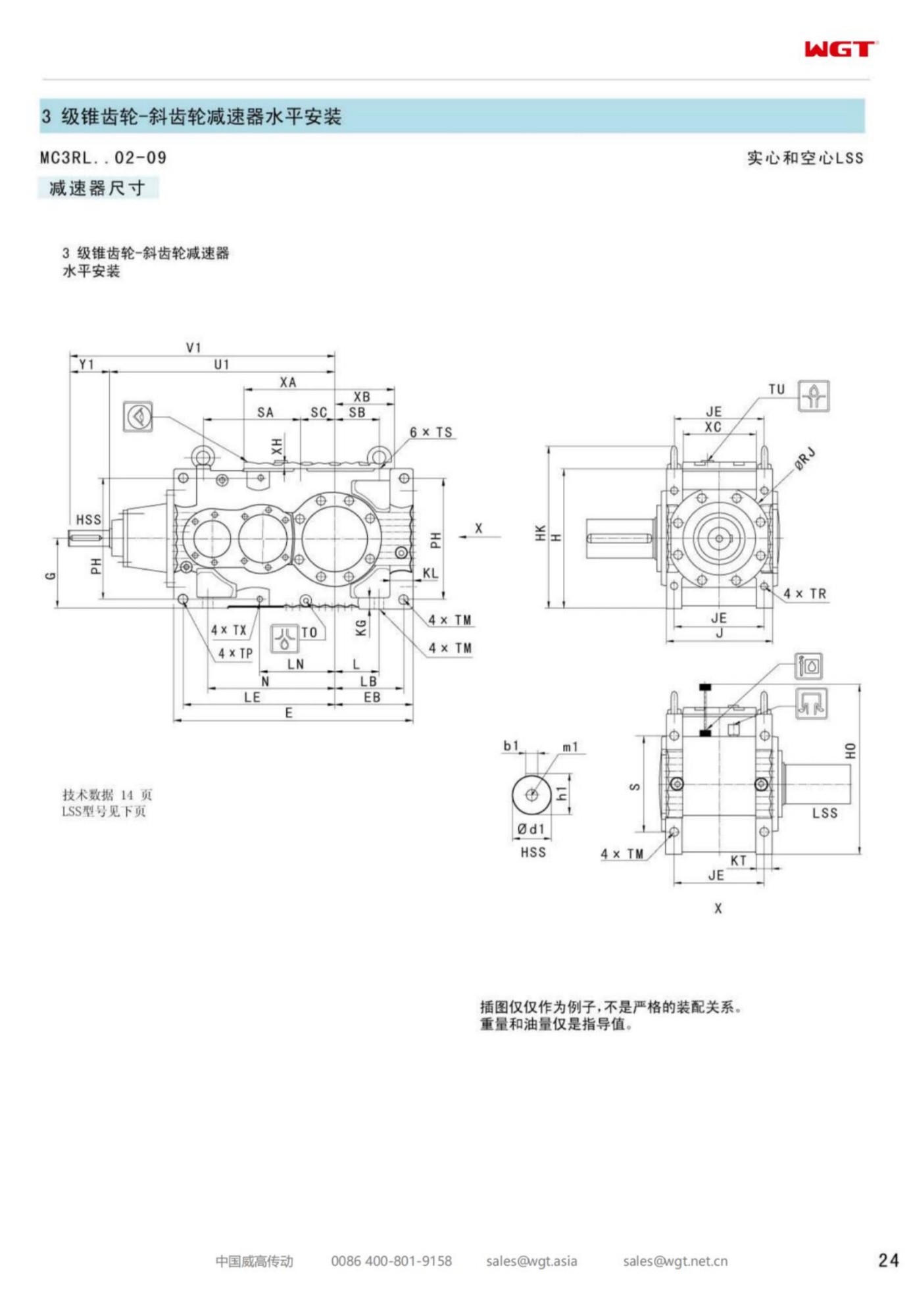
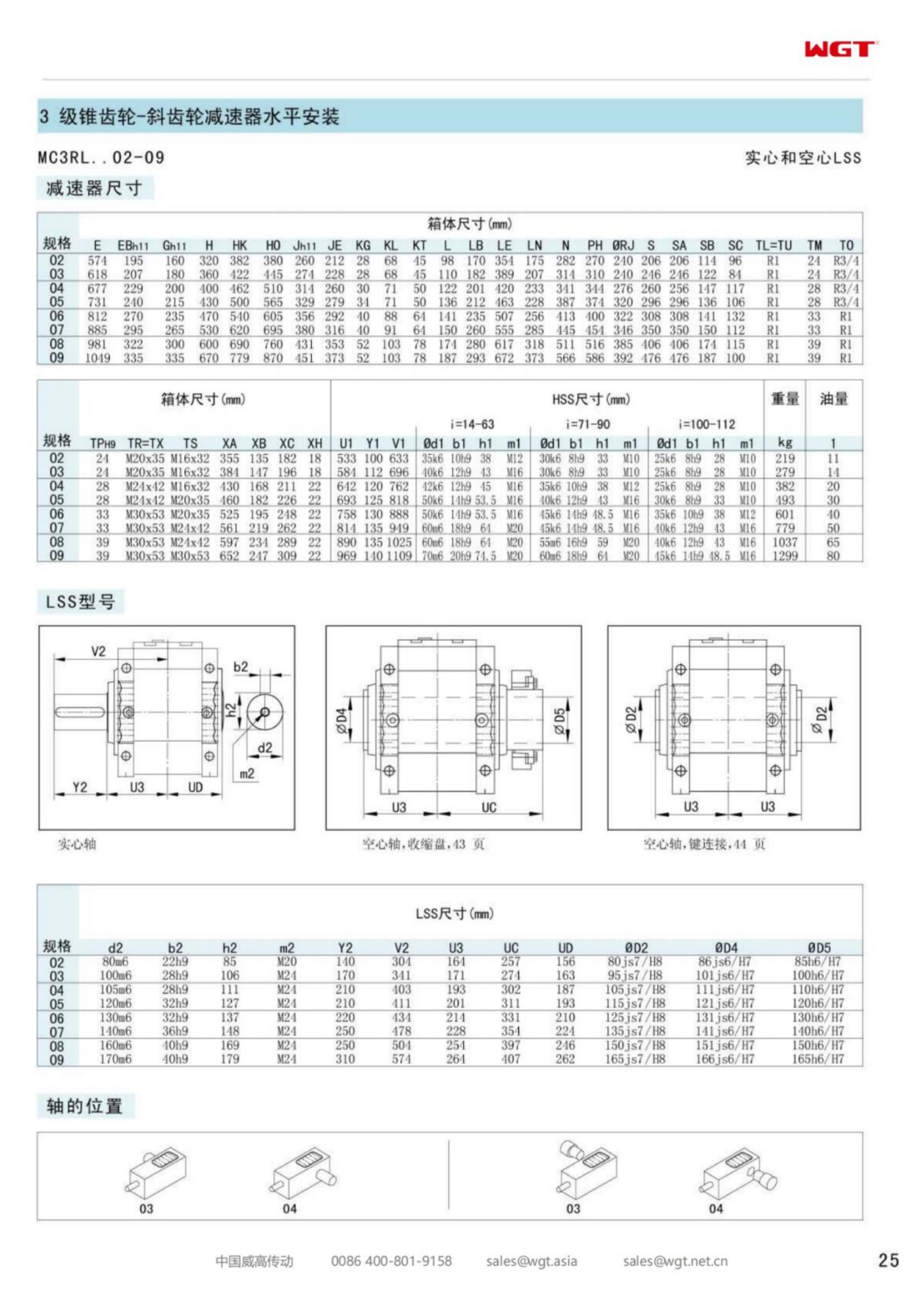
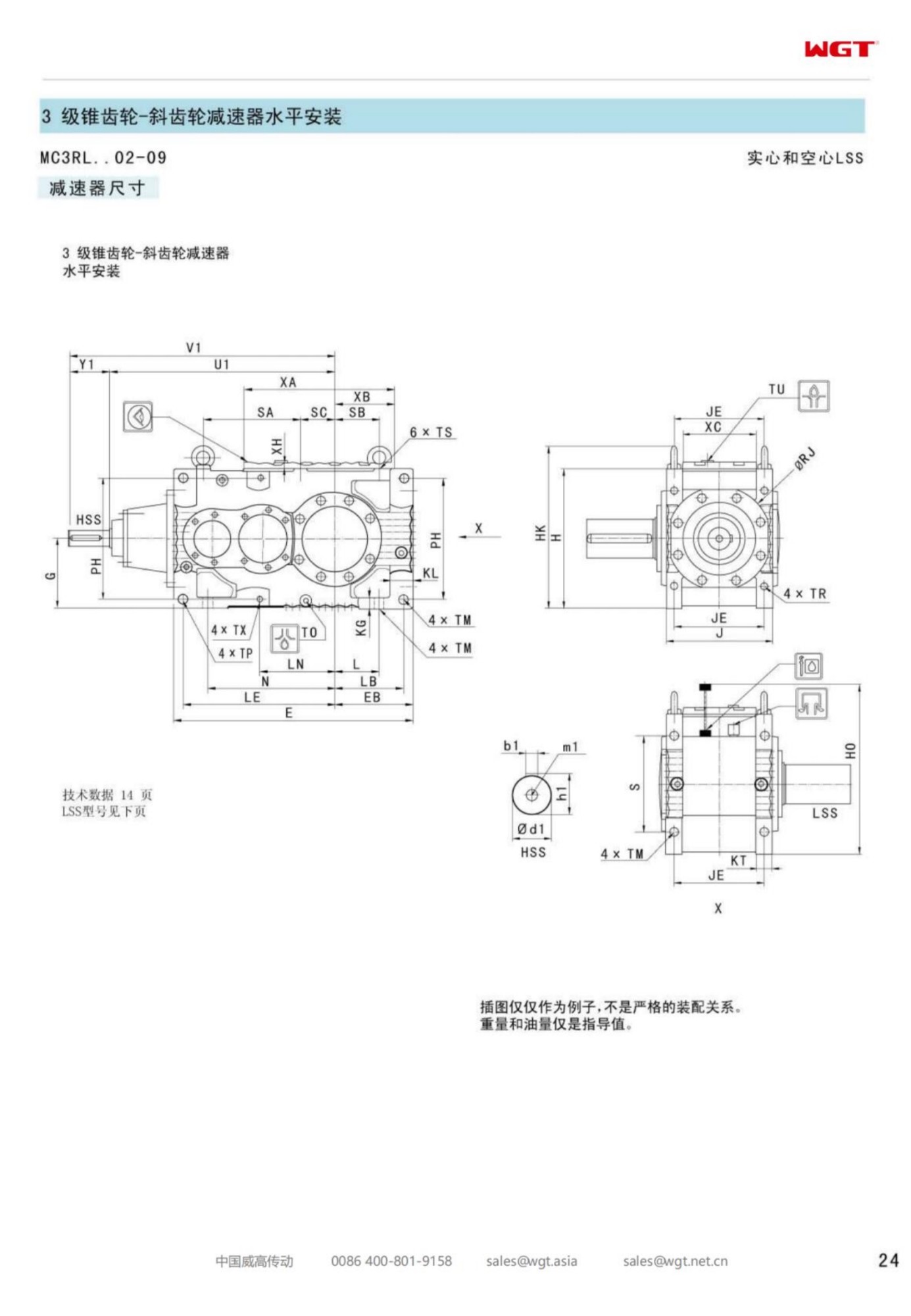
Two frames above the smallest hollow-bore builds, the duties stop being incidental. A plant that fits a MC3RLHF04 bevel-helical gear unit is usually driving something the process would notice within the hour if it stopped - a rake that sets the water balance, a feeder the crusher waits on, a chain the kiln depends on. This page describes the frame four as it is actually applied, and what separates a unit that lasts from one that merely starts.
The train is unchanged across the family: a bevel pair turns the motor input through a right angle and two helical stages take the speed down. The output stays a hollow bore that climbs over the driven shaft, and the case still sits on feet. What grows with the frame number is everything around that arrangement - the bore diameter, the oil volume, the bearing sections and the consequences of getting the installation wrong.
Two Frames Further Up the Load Ladder
The jump from frame three to frame four is wider than the numbers suggest. Ratios overlap between adjacent sizes, so the same output speed is available from either. What changes is the thermal reserve, the overhang capacity and the way the case behaves when a conveyor stalls under a full load. A frame three selected on running torque alone will pass the calculation; a frame four chosen with the worst hour in mind will still be quiet years later.
Plants that standardise on the mid band for this reason tend to buy fewer, larger units rather than many marginal ones. The holding cost of one spare, one oil grade and one fitting procedure across a dozen positions beats the paper saving of sizing each drive to its exact minimum.
The Frame That Carries Real Process Load
Ask where frame fours end up and the list is consistent across industries: thickeners and clarifiers, lime and flour screw conveyors, crusher-feed belt aprons, cooler chains, flocculant mixers, scraped surface exchangers. None of these are headline machines, yet all of them gate the process behind them. The common selection problem is not steady power but episodes - the stalled rake after a power dip, the surge when a chute slumps, the restart against a settled cake. Those episodes are what the service factor exists to absorb, and they are why the duty description on an enquiry matters more than the running kilowatts.
Reading the Letters in a Frame Four Order
The type string carries the whole arrangement, and each character maps to a decision that was made before the case was cast.
| MC | Industrial gear unit family for continuous plant service |
| 3 | Three reductions: bevel input pair plus two helical stages |
| R | Right-angle bevel-helical layout, motor set across the output |
| L | Horizontal build, both shafts level in one case |
| H | Hollow output bore that mounts directly over the driven shaft |
| F | Foot mounting onto a bedplate or fabricated base |
| 04 | Fourth frame of the band: mid duties where episodes, not averages, size the unit |
Three order-time choices sit outside the string and all of them shape daily ownership. Where the motor sits decides which face the breather and filler present to the aisle. Rotation direction fixes which bevel flank carries the load. And the clock position of the bore relative to the feet decides whether the drain lands over a drum or over a live cable route. Each is free on paper and expensive to change after delivery.
Duties a Frame Four Is Handed Daily
Continuous small-duty points this gearbox is a known fit for:
- Thickener rake drives at mine water treatment ponds running every daylight hour
- Screw conveyors moving hydrated lime from silo to slaking bench
- Belt feeders under crusher discharge chutes at mid-size quarries
- Cooler drag chains on a brick works through the firing season
- Mixer drives on flocculant make-up batches dosed twice a shift
- Scraped surface heat exchangers on a fat processing line
What binds that list together is episodic load. The running figure is modest; the events are not. A unit specified against the events - with the restart torque counted and the starts per hour stated - coasts through them. One specified against the average spends its life one bad surge away from a bevel pattern that has lost its markings.
Bore, Key and the Discipline of the Fit
With a hollow-bore build the fit is the coupling. The bore, the key and the shaft must agree on diameter, key width and length of engagement, and the retaining hardware has to hold the case against axial creep without preloading it. Before the unit goes up, three checks are worth a quiet half-hour: shaft runout at the seat, keyway parallelism, and the actual bore diameter against the drawing. All three are cheap to measure and expensive to discover by fretting.
Mounting follows the same logic as the small frames but with more mass to control. Support the unit so its weight never rides on the bore edges, slide it home, fit the key and the retainer, then level the feet before final tightening. A case twisted onto its shaft by an unleveled pad shows up later as a seal that weeps on one side and a bore that has gone orange - symptoms that read as manufacturing faults and almost never are.
Lubrication Habits for a Mid-Band Workhorse
At this size the oil does more than lubricate; it is the plant's only window into the unit's health. The first change comes early, at a few hundred hours, to clear the running-in debris. After that, a sample once a year is enough for most duties, and it tells a story no visual check can: water ingress from a tired breather, wear metal from a bevel mesh losing its pattern, the silicon that betrays a breathing dust path. Plants that sample on schedule renew units at overhaul; plants that guess renew them at inconvenient moments.
Breathers deserve the same attention as the oil itself. A mid-band unit usually lives near dust or washdown, and a plain breather in either atmosphere becomes a slow pump moving the problem into the sump. The right breather, positioned clear of hose spray and dust streams, costs little and removes the most common root cause on the failure report.
Heat, Dust and the Mid-Band Environment
Frame fours frequently sit in the hottest belt of the plant - beside kilns, under roofs in summer, in corridors that get hosed down. The thermal rating must be checked at the corner temperature, not the workshop average, because oil life roughly halves for every ten degrees the sump runs hot. Where the check fails, the remedies are ordinary: move the breather, direct a fan of air across the case, or step up one frame for the oil volume rather than the torque.
Dust behaves differently from heat but ends in the same place. Fine mineral dust on a hot case bakes into a blanket that holds the heat in, so a wipe-down during the monthly round is genuine maintenance, not housekeeping. The combination of clean fins, correct oil level and an honest ambient keeps a mid-band unit inside its thermal budget for decades.
Specifying a Frame Four Without a Query Round
A complete enquiry for this frame fits on one page. Motor power, speed and starting method. The driven machine, its load pattern, and the episodes - starts per hour, breakaway, the worst surge described in a sentence. Output speed and the tolerance the process accepts. Hours per day, honestly counted. Ambient at the actual position, including washdown. Driven shaft diameter, keyway and length available to the bore. Mounting position, motor orientation, rotation direction. Paint and documentation needs.
Sent whole, that list returns a firm quotation and an outline drawing that bolts into the layout without a query round. Sent as a power figure and a shaft diameter, it returns questions, and in procurement each round of questions costs a week the schedule rarely has. The frame is mid-sized; the time saved by writing the duty down properly is not.
Selection Example: Thickener rake drive at a mine water treatment pond
Take an 11 kW motor at 1460 rpm turning the rake at 33 rpm. The ratio follows directly: 1460 / 33 = 44.2, so a ratio near i=44 is drawn from the three-stage band, and the frame is checked against the stall that follows a power dip with the rake buried in settled solids. In this case a fourth frame clears that restart with margin, and the hollow bore drops straight over the rake shaft, so no coupling has to be aligned above a pond that cannot be drained for the job. The same three numbers - motor speed, target output speed, required torque - are all you need; our engineers (or the online selector below) cross-check the service factor for your duty cycle.
![gear reducer selection flow chart - ratio and frame size]()
Figure: from motor data to a confirmed gearbox model in four steps.
Common Models in the M3 Series
| Model | Centre distance | Output | Typical duty |
|---|
| M3PSF50 | size 50 | solid shaft, foot | conveyors, feeders |
| M3PSF60 | size 60 | solid shaft, foot | crushers, mixers |
| M3PSF70 | size 70 | solid shaft, foot | ball mills, shredders |
| M3PSF80 | size 80 | solid shaft, foot | kilns, heavy conveyors |
| M3PSF90 | size 90 | solid shaft, foot | mill and kiln drives |
| M3RSF50 | size 50 | solid shaft, foot, right-angle | inclined conveyors, elevators |
| M3RSF60 | size 60 | solid shaft, foot, right-angle | screw classifiers, feeders |
| M3RHF70 | size 70 | hollow shaft, foot, right-angle | agitators, drum drives |
| M3PHT80 | size 80 | hollow shaft, torque arm, parallel | shaft-mounted conveyors |
| M3RHT90 | size 90 | hollow shaft, torque arm, right-angle | heavy shaft-mounted drives |
The table below shows the M3 industrial range: P builds are all-helical on parallel axes, R builds add a bevel input stage for a right-angle drive; S / H describe the low-speed shaft and F / T the mounting.
Application Cases
Cement plant clinker belt
A cement plant drives its clinker transport belt with reducers in dusty, high-ambient conditions. Sealed housings and a 40 deg C maximum temperature rise let the units sit close to the kiln without extra cooling.
Paper mill pulp agitator
A paper mill uses reducers on pulp chest agitators. Continuous 24-hour duty is handled by lifetime lubrication, and the low backlash keeps the agitator steady when the stock consistency changes.
![industrial gearbox applications - conveyor mixer crusher wastewater]()
Figure: typical industries that use the WGT S-series gear reducers.
Frequently Asked Questions
What documentation comes with an industrial gear unit?
Every shipment carries an installation manual, a dimension drawing, the nameplate data and a bench test record covering noise, temperature rise and backlash. Material certificates for shafts and gearing are available on request.
How is the unit transported and lifted on site?
Units ship in export wooden crates with lifting points on the housing clearly marked. On site, lift only from these points with the specified slings - lifting from shafts or covers is expressly forbidden in the manual.
What tooth quality and grinding finish do you apply?
Gearing is case-hardened and profile-ground to international accuracy grades, with crowning and end relief applied to avoid edge loading. This is what keeps noise and vibration stable over years of continuous duty.
Fast Quotation for OEM and Repeat Orders
Buying one unit or one hundred? Not sure which model fits? Try our online WGT Motor & Gearbox Online Selection System to match motor power, ratio and mounting in one minute.
Single units ship on the same production route as batch orders, with no minimum-order surcharge. For OEM programmes we hold framework pricing and reserve capacity for your scheduled call-offs. Looking for a gearbox for steel mill? Tell us the duty point and we will confirm the model in writing.