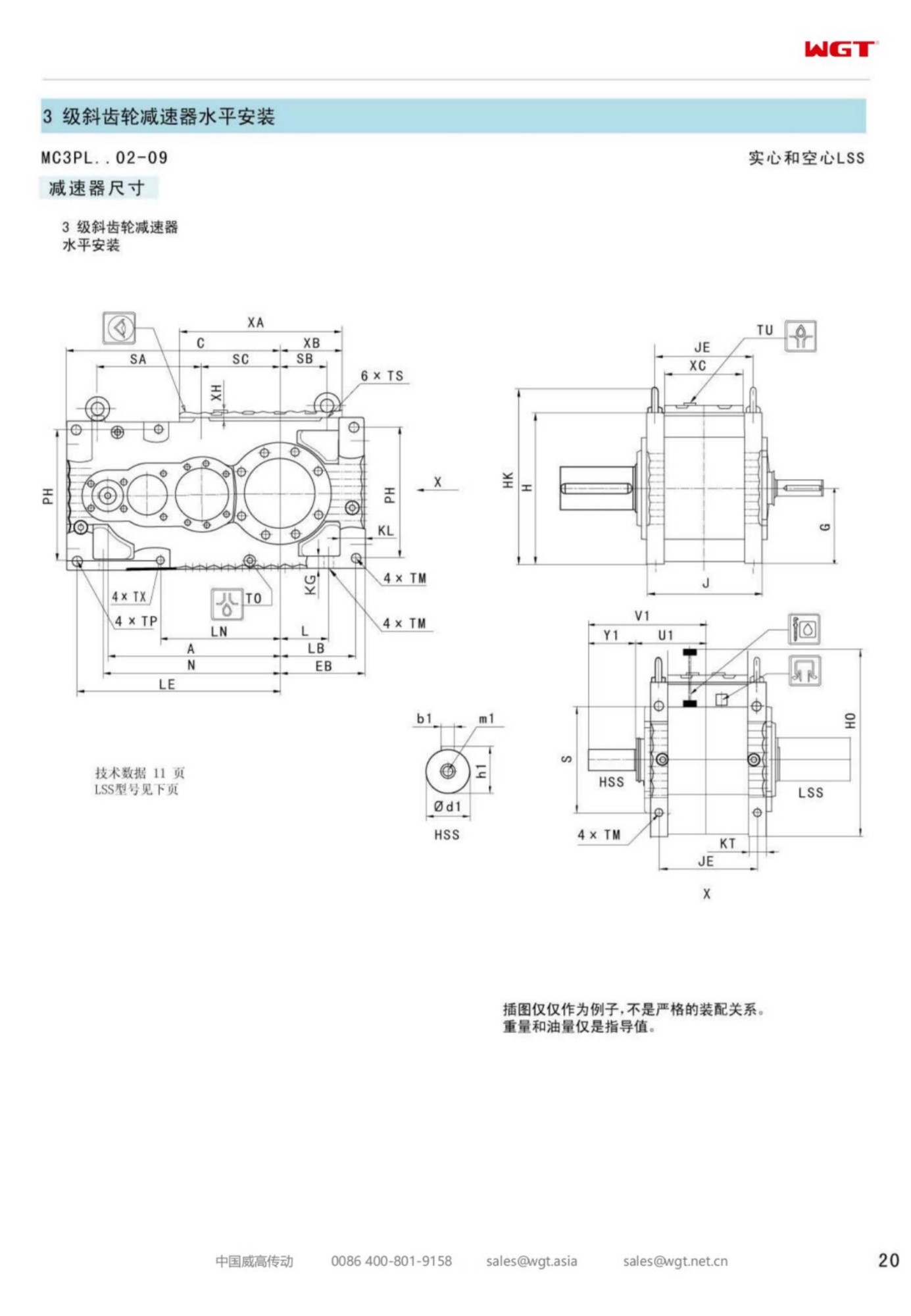
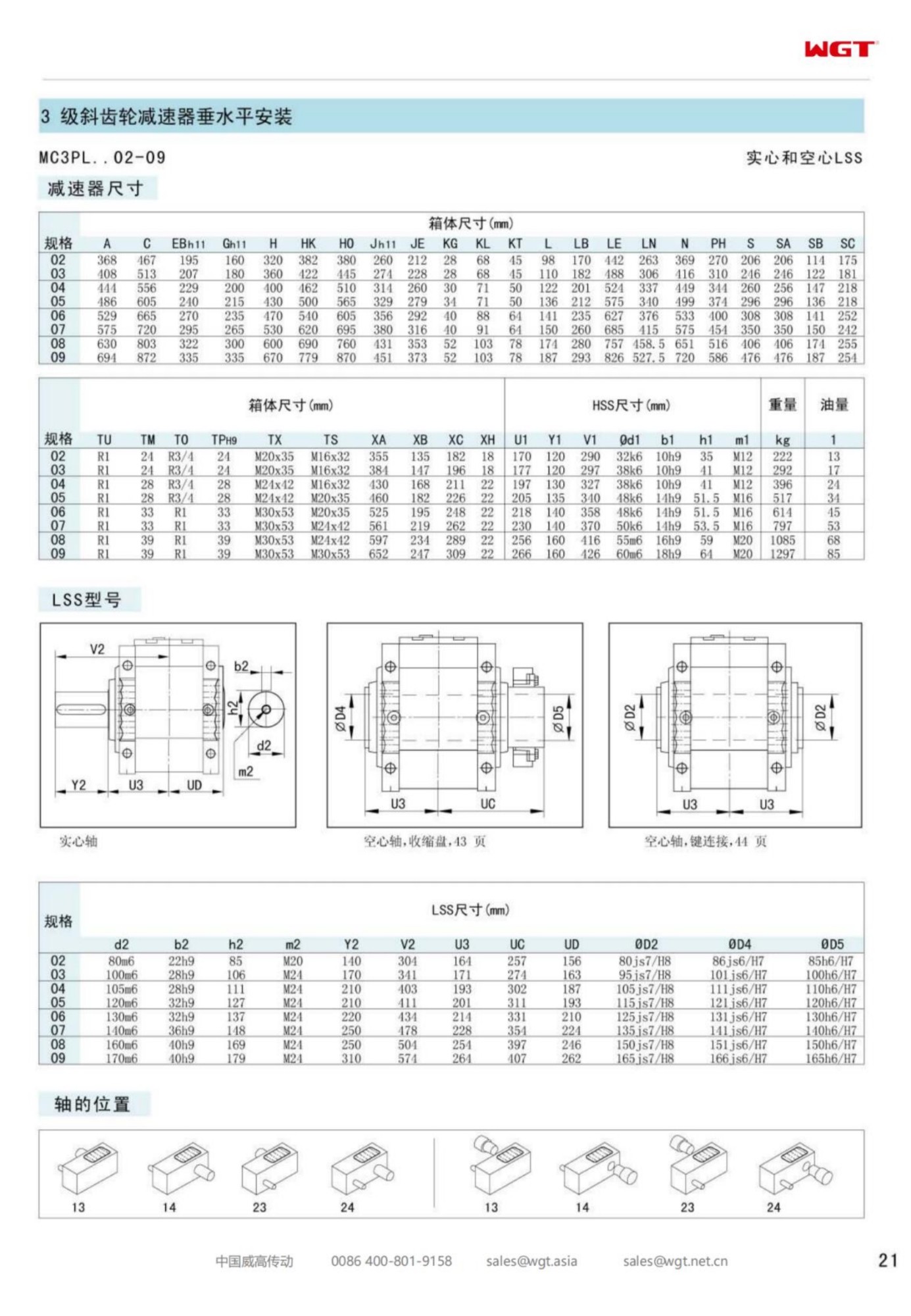
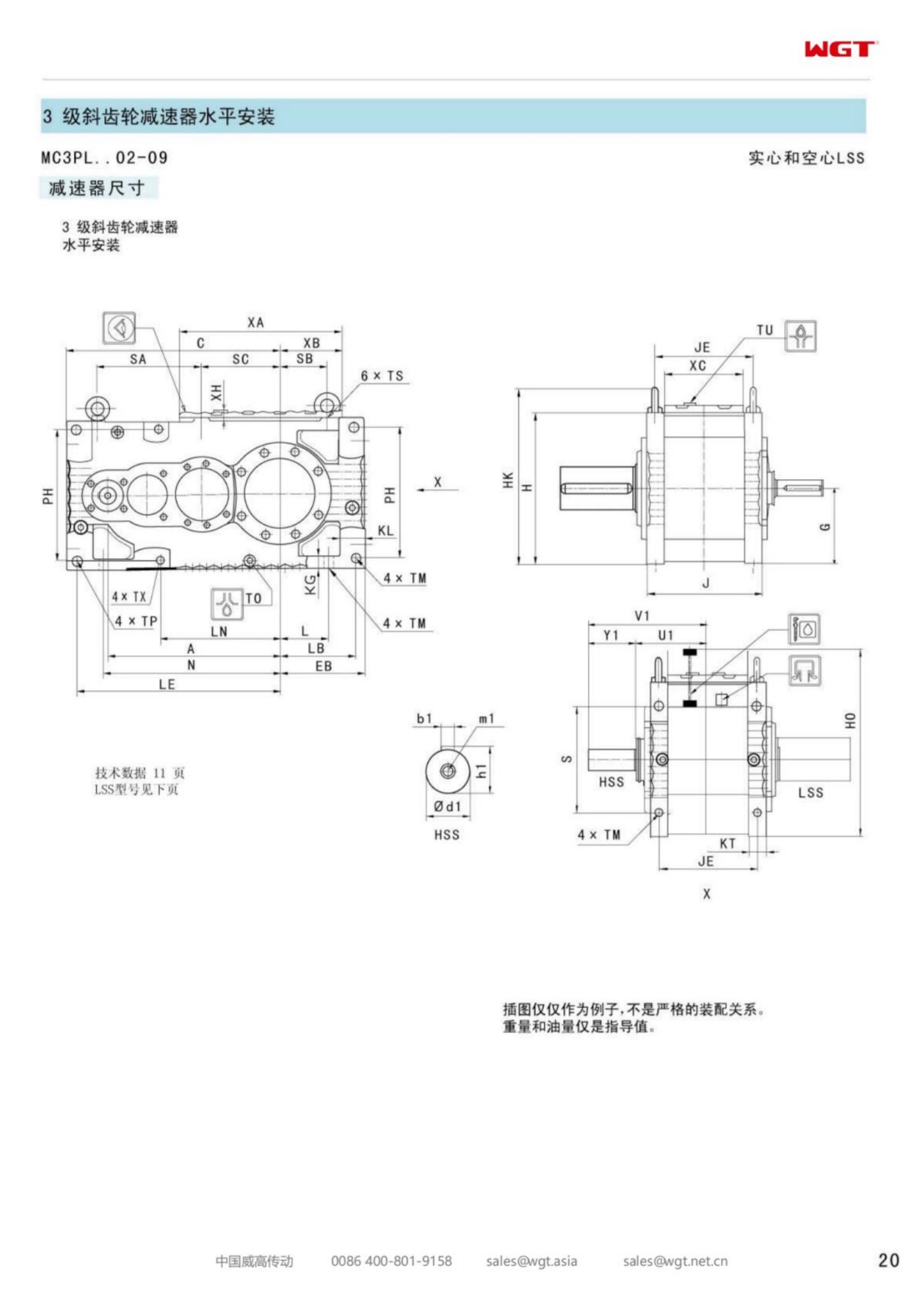
Every gearbox range has a frame it sends to the jobs the others decline, and in the three-stage parallel line that is the MC3PLSF07 heavy-duty parallel shaft gearbox. It is the frame chosen when a feeder has to start buried, when a discharge belt must restart with the crusher still full, when a kiln turning gear has to creep a red-hot shell. The extra metal in the case, the shafts and the bearings is not prestige - it is the physical reserve those minutes demand.
The layout is the family's: three helical reductions in one plane, a footed cast case, a solid keyed output shaft, the motor alongside. What distinguishes the 07 is the section. Gear faces, shaft diameters and bearing spans are all a step above the 06, so the same ratio is delivered with a lower stress level and a fatter margin against the moment the plant remembers why it bought this frame.
The Top Frame of the Line and What It Actually Buys
Buying the top frame is often cheaper than it looks on the day. A drive sized one frame down lives close to its limits, runs hotter, and turns every jam and restart into an event; the bigger frame absorbs the same events without comment. Over a decade the difference shows up in overhauls deferred, spares not consumed and stops that never happened.
The honest counter-argument also holds: a duty comfortably inside a smaller frame gains nothing mechanical from the 07 except price. The frame earns its place where the duty has a violent moment - a breakaway, a stall, a restart under full load - and where the plant stops when this drive stops. Size against the worst minute, not the average one, and the choice usually makes itself.
Reading the Code Without Guesswork
The designation compresses the mechanical decisions into seven characters; decode it before the order, not after delivery.
| MC | Compact industrial gear unit, multi-stage helical construction |
| 3 | Three reduction stages, specified for deep ratios beyond a practical two-stage band |
| P | Parallel shafts with input and output in one horizontal plane |
| L | Long-section case with cast feet and a large inspection opening |
| S | Solid keyed output shaft, sized for slow high-torque machines |
| F | Foot mounting onto a horizontal bedplate |
| 07 | Top frame of the three-stage range - the heaviest shaft and bearing set in the line |
The ratio and mounting position sit outside the code and both alter the drawing. Where the unit sits in place of old hardware, send the measured shaft dimensions and the old drawing number with the enquiry; a caliper reading taken on site settles an argument a scanned manual page cannot.
Breakaway Torque: the Number That Decides the Order
Most drives are sized on running load, and most drive failures begin at start-up. A feeder buried in material, a belt loaded end to end after a trip, a mixer turned over after a long settle - each can demand two or three times its running torque for the first seconds. If that figure is never stated, the frame gets chosen against the running load and lives permanently one size too small.
Get the breakaway number from the machine maker where possible, or state the worst case honestly and let the service factor carry it. The 07 frame is designed to be chosen this way: its reserve is real metal, not a marketing factor, and using it deliberately is what separates a drive that shrugs off the jam from one that hands in its gears.
Duties That End Up on the 07
Bored-output vertical builds serving duties such as:
- Apron feeders taking crushed rock straight off the grizzly
- Crusher discharge conveyors that restart fully loaded
- Auxiliary turning gear on rotary kilns and dryers
- Shredder infeed conveyors at scrap and wood-recycling yards
- Mine hoist and skip-loading auxiliary drives
- Ball and rod mill feed belt conveyors at concentrators
The common thread is a machine whose worst moment is famous at the plant - the restart everyone waits through, the feeder that must break free before the process continues. The 07 exists so those moments are routine instead of memorable.
Mounting, Alignment and the First Run
A heavy frame forgives a lot, but not a careless bed. Check the foundation for level and cleanliness before the unit lands, shim to true rather than to force, and torque the foundation bolts to the drawing values - a foot pulled out of flat by an overtightened bolt becomes a bent case, and a bent case becomes a noise nobody can trace. Dial or laser align the coupling cold, then re-check warm, and file both readings.
Treat the first run as a test: run unloaded, listen at the case, re-check the oil level with the unit warm, then load progressively rather than all at once. On a drive chosen for breakaway duty, the first loaded start is the moment the whole selection is either proved or revisited - give it the attention it deserves.
Monitoring That Catches Trouble Before It Stops the Plant
Big frames rarely fail without warning; the warning just has to be recorded. Log sump and bearing temperatures against load at a fixed point each week, note vibration at the same bearing positions after any foundation work or machine swap, and read the drain-plug magnet at every oil change - a grey paste is normal running-in, bright glittering particles are a decision that cannot wait.
The log earns its keep at the overhaul. With three years of readings, the scope is decided from evidence: bearings changed because the trend said so, seals renewed because the temperature shift pointed at oil loss, and the second drive on the same duty specified with the first one's whole history in hand. Without the record, every overhaul is a guess and every guess is expensive.
A Complete Enquiry in One Message
Tick these before sending: motor rating, speed and starting method; output speed and the tolerance the process accepts; absorbed torque at the running load and at breakaway, stated separately; duty cycle, hours per day and starts per hour; the stall or jam scenario the plant considers normal; mounting position, bedplate drawing and available height; shaft and bore dimensions where hardware is kept; overhung load and its distance if a pulley or sprocket is fitted; ambient temperature, dust and moisture; paint, nameplate and documentation requirements.
A complete list comes back as a fixed, orderable quotation in one exchange. A partial list comes back padded with assumptions - and the day those assumptions meet a buried feeder is the day the project pays for them.
How Customers Use This Unit
Cold-store conveyor
A cold-store operator uses reducers on freezer-room conveyors. Low-temperature synthetic oil and moisture-resistant seals keep the units running below -20 deg C ambient.
Bakery spiral cooler
A bakery equipment builder fits units to spiral cooler drives. The compact right-angle layout fits under the spiral cage, and food-grade lubrication was specified for the hygienic area.
What Engineers Ask Us
What is the service factor and how is it applied?
The service factor is a multiplier applied to your required torque to cover shocks and duty class - typically 1.0 for uniform duty, 1.25 for moderate shocks, 1.5 or more for heavy shock loads. Send us the driven machine and duty and we will apply the correct factor.
What ambient temperature range can the unit work in?
Standard units suit -10 to +40 deg C ambient with the supplied mineral oil. For lower temperatures we fill with synthetic oil; for higher ambient or frequent starting we advise the next larger frame or an oil cooler.
Model Table: Frames, Shafts and Duty
| Model | Centre distance | Output | Typical duty |
|---|
| M3PSF50 | size 50 | solid shaft, foot | conveyors, feeders |
| M3PSF60 | size 60 | solid shaft, foot | crushers, mixers |
| M3PSF70 | size 70 | solid shaft, foot | ball mills, shredders |
| M3PSF80 | size 80 | solid shaft, foot | kilns, heavy conveyors |
| M3PSF90 | size 90 | solid shaft, foot | mill and kiln drives |
| M3RSF50 | size 50 | solid shaft, foot, right-angle | inclined conveyors, elevators |
| M3RSF60 | size 60 | solid shaft, foot, right-angle | screw classifiers, feeders |
| M3RHF70 | size 70 | hollow shaft, foot, right-angle | agitators, drum drives |
| M3PHT80 | size 80 | hollow shaft, torque arm, parallel | shaft-mounted conveyors |
| M3RHT90 | size 90 | hollow shaft, torque arm, right-angle | heavy shaft-mounted drives |
Larger size numbers mean higher torque capacity and larger shafts. Because interfaces follow the common industrial dimensions, a size-for-size change is the normal upgrade route for these industrial units.
Selection Example: Apron feeder restart at a primary crushing station
Take a 45 kW motor at 1485 rpm breaking a feeder free that is buried in material, at a head shaft speed of 10 rpm. The ratio follows directly: 1485 / 10 = 148.5, which sits at the deep end of the three-stage band, and the service factor is raised to cover a breakaway torque two or three times the running load. In this case the heavy shaft and bearing set of the 07 exists for exactly that moment, so the drive is chosen against the worst minute of the shift instead of the average one. Note that the ratio comes from speeds alone, while the frame size depends on torque and service factor - never size a unit on ratio only.
![industrial helical gearbox selection chart]()
A quick visual of the selection sequence for a industrial helical unit.
![M3 series gear reducer installation examples]()
Application coverage of the the M3 series.
Custom Shafts and Ratios for OEM Builds
Non-standard interface? Prefer to check the figures yourself? The WGT Motor & Gearbox Online Selection System gives you the model, torque margin and ratio before you ask us.
Splined, extended or flanged output shafts and special ratios are quotable for OEM volumes. Tooling cost is amortised across the order, and the drawing approval cycle starts the day you ask. Looking for a gear reducer for textile machinery? Tell us the duty point and we will confirm the model in writing.