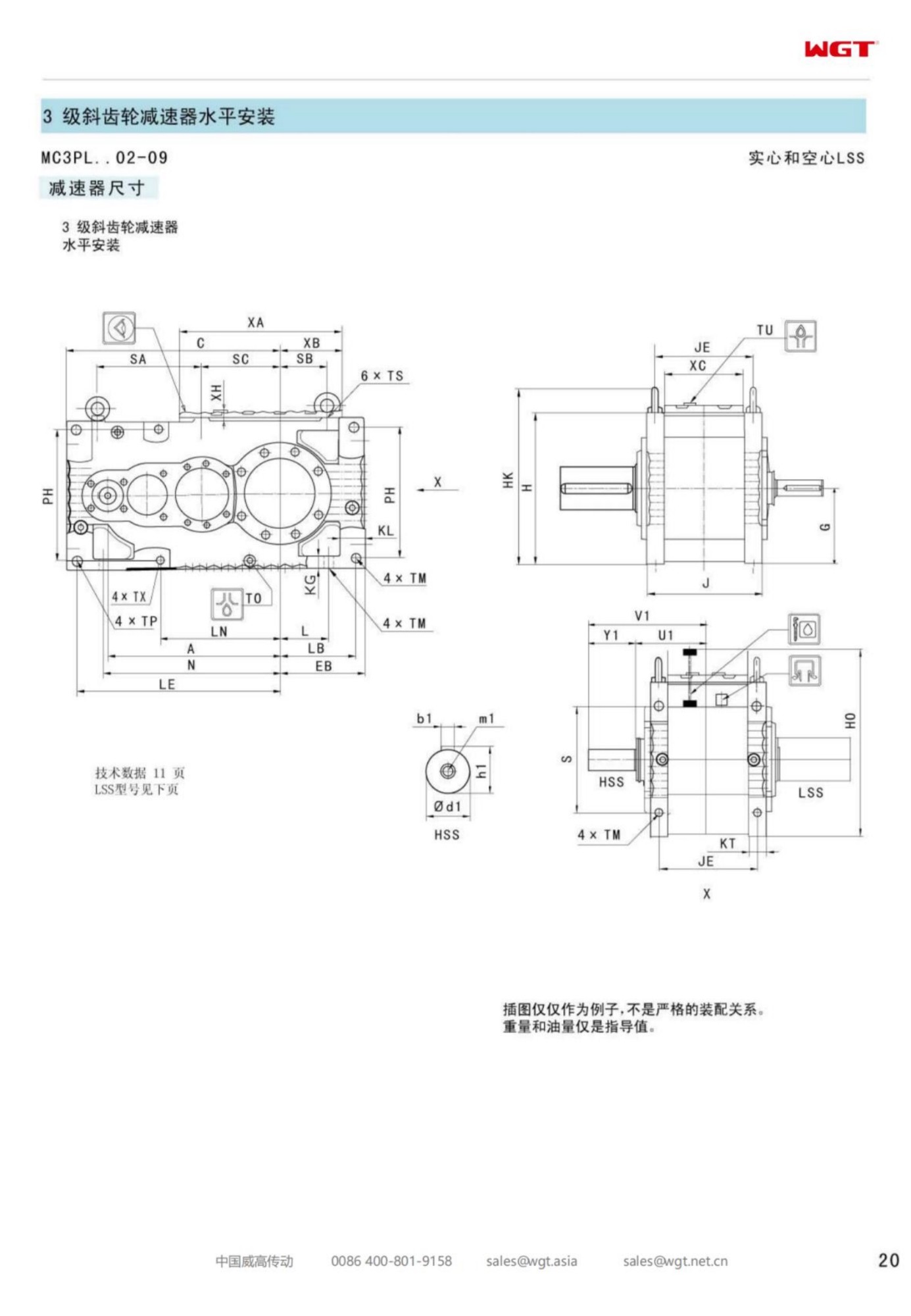
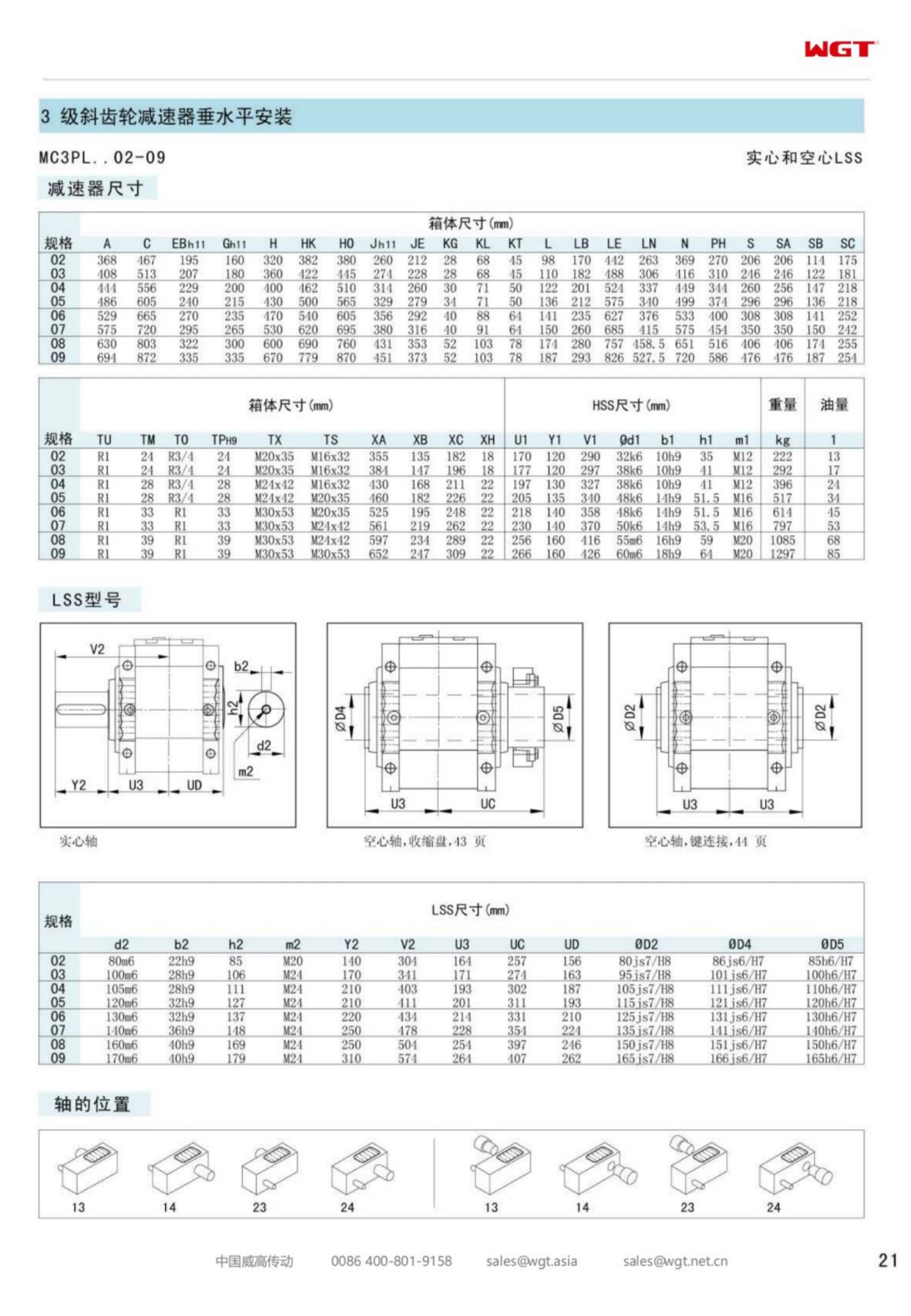
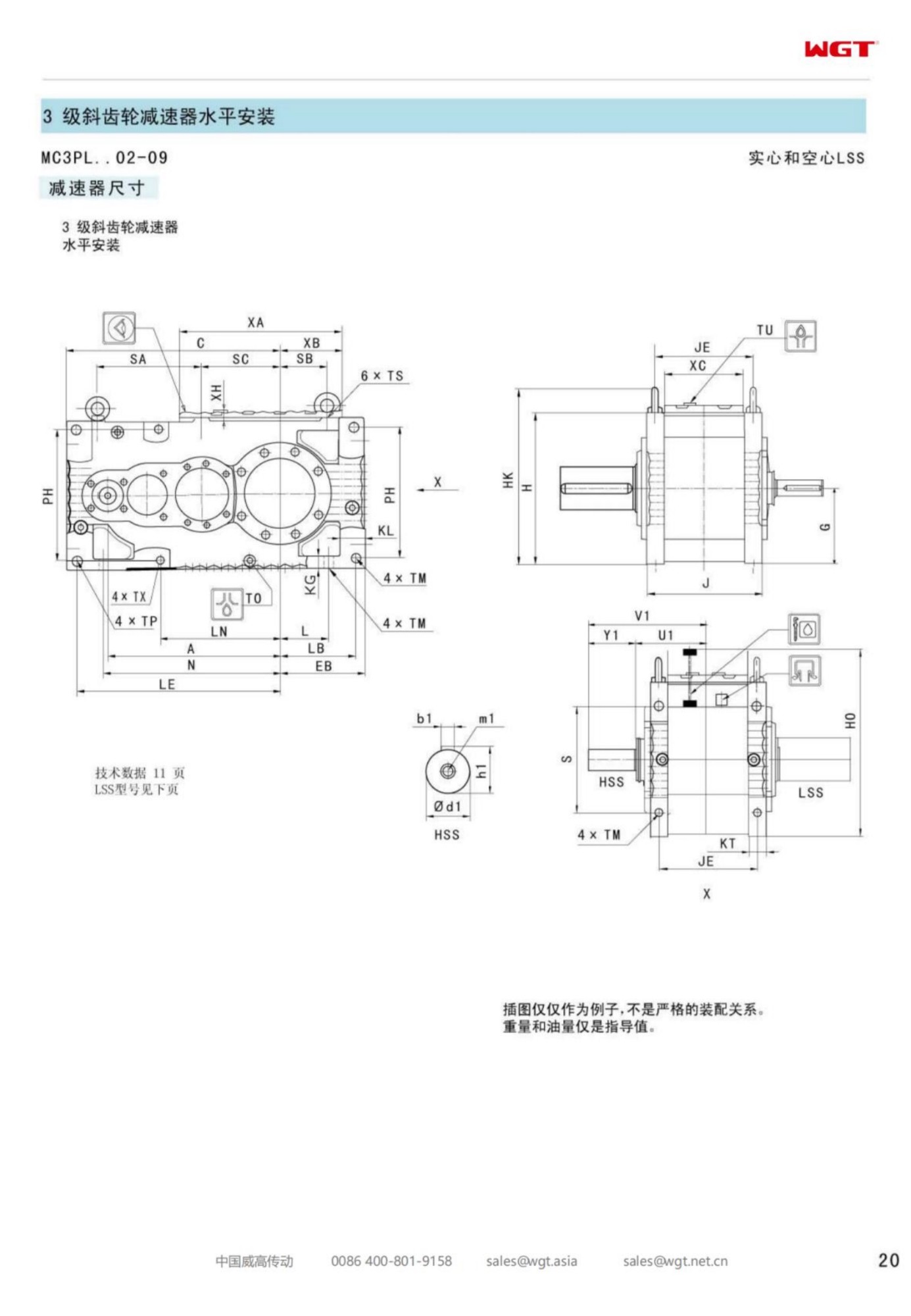
The MC3PLSF06 three-stage industrial gearbox belongs to that part of a plant nobody photographs: the closed gallery, the conveyor run under the clinker shed, the dryer building where the ambient never drops below forty degrees. Drives in these places are not chosen for their catalogue peak. They are chosen because they hold their temperature, their oil and their bearings through shift after shift of continuous running - and the 06 frame was drawn for exactly that kind of life.
The mechanical layout matches the rest of the three-stage line: three helical meshes in one plane, a long footed case, a solid keyed output shaft with the motor mounted alongside. What the frame adds is area - wider gear faces, a deeper sump and more case surface to shed heat - and in continuous duty, surface area is a specification, not a detail.
Sizing for Continuous Duty in Hot Galleries
A gearbox that runs eight hours a day in open air cools between shifts. A gearbox inside a closed gallery at a cement works never gets that break, and the air around it is already warm from the process. Under these conditions the thermal rating matters as much as the torque rating, and the two are checked separately: the torque table says whether the teeth survive, the thermal balance says whether the oil does.
The 06 frame buys its place in these installations by moving both limits at once. The wider faces spread the same transmitted load across more tooth contact, and the larger case radiates the resulting heat without fins, fans or forced lubrication. Plants that have tried to stretch a smaller frame in such corners usually arrive at this frame after one summer of trip-outs; the ones that size honestly from the start never hear about the problem.
Decoding the Designation Before the Drawing Is Released
Every letter in the type code is a commitment the factory builds to. Read the string in order and the ordering mistakes mostly disappear.
| MC | Compact industrial gear unit of the multi-stage helical family |
| 3 | Three helical reductions - the route to deep ratios at a workable size |
| P | Parallel shaft arrangement - low, long and easy to guard |
| L | Long case profile with cast feet and a full-width inspection cover |
| S | Solid output shaft with parallel key for a slow, torque-heavy machine |
| F | Foot mounting onto a horizontal bedplate |
| 06 | Fourth frame of the three-stage range - wider faces and a deeper sump than the 05 |
Two things the code never carries are the ratio and the mounting position, and both redraw the case. Quote the output speed with the tolerance the process accepts, and state where the unit will actually stand - which side the motor hangs, how close the wall is, whether the breather clears the guarding. Those sentences cost nothing in the enquiry and save a revised drawing later.
Margins for Machines That Run Past Their Rating for a Minute
Continuous-duty machines rarely run at a steady load. A filter cake conveyor surges when the press discharges; a rotary screen takes a shock every time a lump bridges and breaks; a foundry transfer belt meets a hot casting set down harder than the crane driver admits. The running torque is one number, but the plant is lived in for the peaks, and the service factor exists to buy the peaks.
The honest way to size the 06 is to take the absorbed torque at the worst recurring moment, apply the factor the duty class demands, and read the frame from there - then confirm the thermal side at the real ambient, not at twenty degrees. Do both and the frame runs with margin every hour it works. Skip the thermal check and the unit can pass on paper yet spend every August near its trip temperature, which is how drives earn reputations they do not deserve.
Where the 06 Frame Earns Its Keep
Large vertical frames of this band are routinely specified into:
- Clinker transfer belts inside closed grinding halls that never stop
- Sludge dryer and thermal screw drives at district treatment works
- Drag chains moving wet filter cake at dewatering stations
- Press-line feed conveyors in wood-panel and particleboard plants
- Rotary screening drums at composting and soil-conditioning yards
- Transfer conveyors under furnace and ladle bays at foundries
What these duties share is continuous running, moderate power, deep reduction and an ambient that gives nothing back. The 06 carries them with the quiet confidence of a frame that has been sized for the conditions rather than for the brochure.
Bearing Life and the Loads Nobody Logs
Gear ratings get calculated; bearings get forgotten. A coupling on a well-aligned drive imposes almost nothing, but a belt pulling sideways or a chain sprocket hung outboard of the bearing presses on the output bearing with a force the catalogue never mentions. Bearing life falls with roughly the cube of that extra load, so a modest uncounted pull can turn a ten-year bearing into an eighteen-month one.
Measure or calculate the overhung load at its true distance from the bearing and compare it with the permitted figure at that distance. If the number is uncomfortable, say so in the enquiry - a strengthened bearing set, a shorter lever or a coupling instead of a belt drive usually costs far less than the stoppage it prevents. And keep the coupling aligned: a flexible coupling forgives residual misalignment within its rating, a rigid one passes all of it straight into the bearings.
Oil, Breathers and the Small Habits That Add Years
In continuous duty the oil is a component, not an afterthought. Check the level at the sight glass on a fixed schedule, read the sump temperature at the same point each week, and change the oil on evidence as well as on the calendar: milky oil means water - condensation in a damp gallery or a careless washdown hose - while fast darkening and a burnt smell mean the unit has been running hot somewhere the log did not record.
Keep the breather clean. A blocked breather turns every thermal cycle into a pressure cycle that pumps oil past the seals, and the resulting slow leak reads as a seal problem when it was really a maintenance problem. On dusty sites, fit the extended breather or the remote line so the breath point sits outside the dust envelope. None of these habits costs more than minutes, and together they decide whether the case outlives the machines it drives.
What to Send So the Quotation Comes Back Fixed
A one-pass specification for this frame contains: motor rating, speed and starting method; the required output speed with its tolerance; absorbed torque at the driven machine, with the worst recurring peak described plainly; duty cycle, hours per day and starts per hour; the true ambient the unit will stand in, because the thermal check depends on it; mounting position, bedplate details and available height; shaft and bore dimensions where existing hardware is kept; overhung load and its distance if a pulley or sprocket is fitted; and the paint, nameplate and documentation requirements.
Send that in one message and the frame, ratio and options come back fixed in a single exchange. Hold any of it back and the quotation arrives padded with assumptions - and every assumption is discovered during installation, when it costs the most.
Available Frames and Their Typical Duty
| Model | Centre distance | Output | Typical duty |
|---|
| M3PSF50 | size 50 | solid shaft, foot | conveyors, feeders |
| M3PSF60 | size 60 | solid shaft, foot | crushers, mixers |
| M3PSF70 | size 70 | solid shaft, foot | ball mills, shredders |
| M3PSF80 | size 80 | solid shaft, foot | kilns, heavy conveyors |
| M3PSF90 | size 90 | solid shaft, foot | mill and kiln drives |
| M3RSF50 | size 50 | solid shaft, foot, right-angle | inclined conveyors, elevators |
| M3RSF60 | size 60 | solid shaft, foot, right-angle | screw classifiers, feeders |
| M3RHF70 | size 70 | hollow shaft, foot, right-angle | agitators, drum drives |
| M3PHT80 | size 80 | hollow shaft, torque arm, parallel | shaft-mounted conveyors |
| M3RHT90 | size 90 | hollow shaft, torque arm, right-angle | heavy shaft-mounted drives |
Note that PSF and RSF frames of the same size share the mounting footprint; the R build simply inserts a bevel stage, so switching layout rarely forces a foundation change.
Questions and Answers
What warranty and documentation come with the gearbox?
A one-year warranty covers material and workmanship. Each unit ships with a test record (noise, temperature rise, backlash), a dimension drawing and an installation manual.
How do I calculate the ratio I need?
Divide motor speed by the target output speed (i = n1/n2), then check the required torque against the rating table with your service factor. The online selector below does this automatically.
Can the reducer be supplied with a brake motor or an IEC motor flange?
Yes. We supply the reducer as a bare unit with an IEC standard input flange, and you can bolt on any IEC or NEMA motor - including a brake motor. The flange dimensions follow the common IEC pattern, so existing motors drop straight on.
Installation Examples
Asphalt plant aggregate feeder
An asphalt plant powers its aggregate feeders with reducers in outdoor, dusty conditions. The cast-iron housing and standard paint finish have come through several winters without refurbishment.
Fertiliser granulator drum
A fertiliser producer drives granulator drums with gear units. The slow, high-torque rotation needed to tumble the granules is a natural fit, and the torque-arm option avoids a heavy base frame.
![gear box application map for industry]()
From quarries to food plants - one right-angle drive concept.
Selection Example: Clinker transfer belt inside a closed grinding hall
Take a 30 kW motor at 1475 rpm turning the belt head pulley at 16 rpm. The ratio follows directly: 1475 / 16 = 92.2, so a ratio near i=92 is drawn from the three-stage band, and the frame is checked at the true hall ambient so the thermal reserve is confirmed rather than assumed. In this case the wider gear faces and deeper sump of the 06 hold sump temperature through three shifts, which is what a gallery that never stops asks of its drive. The ratio is the easy part. The service factor for the shock level is what makes the selection safe, and we check that for you at no charge.
![how to choose a speed reducer model]()
Ratio first, then torque, then frame size: the standard selection route.
From RFQ to Dispatch - One Account Manager
Tired of chasing suppliers? The WGT Motor & Gearbox Online Selection System covers motor power, ratio and mounting on one screen - enter your numbers and see the model immediately.
One account manager follows your enquiry from selection to dispatch, with lead times and test dates confirmed in writing. Urgent unit needs and project volumes are handled on the same route. Looking for a gearbox for steel mill? Tell us the duty point and we will confirm the model in writing.