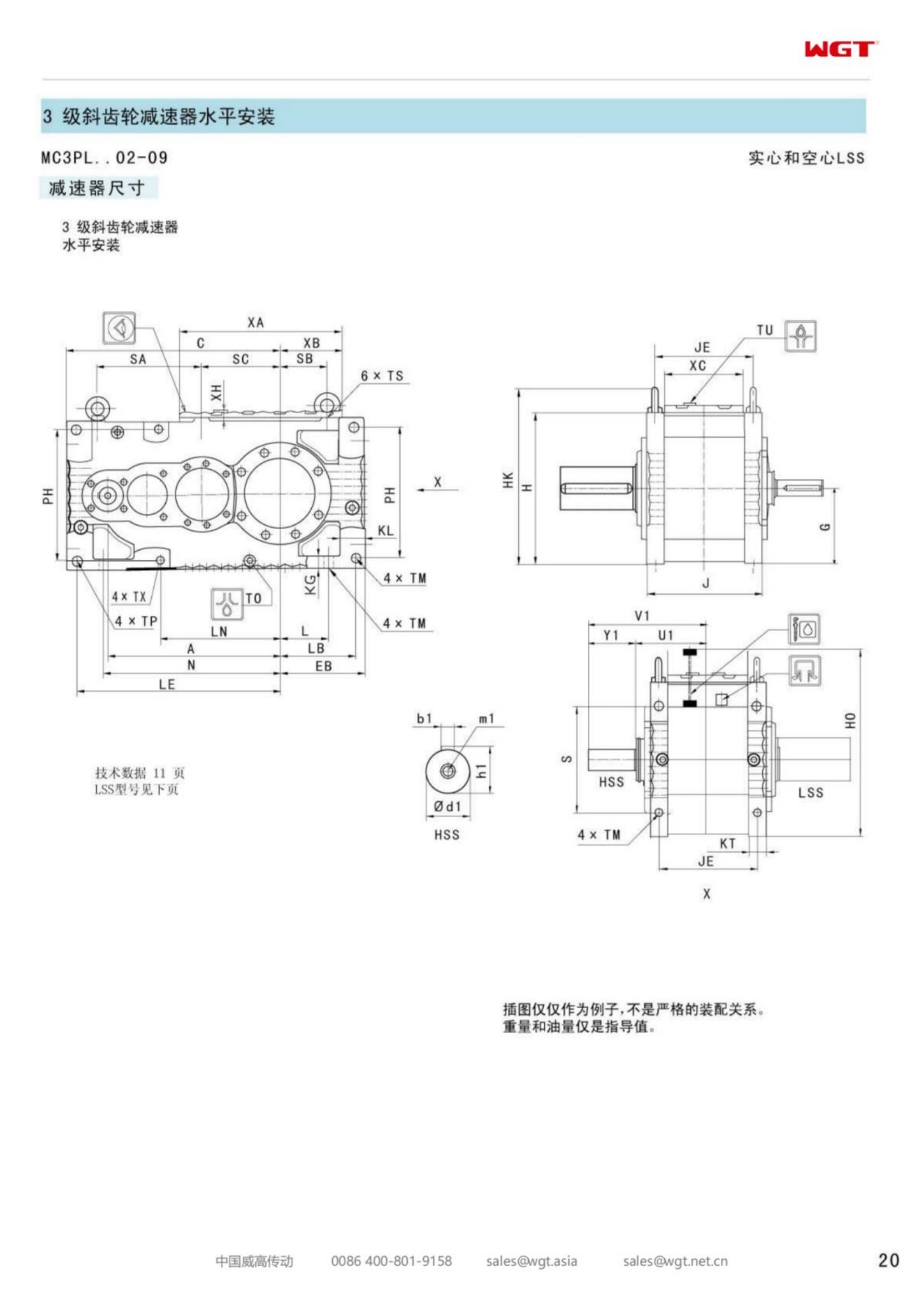
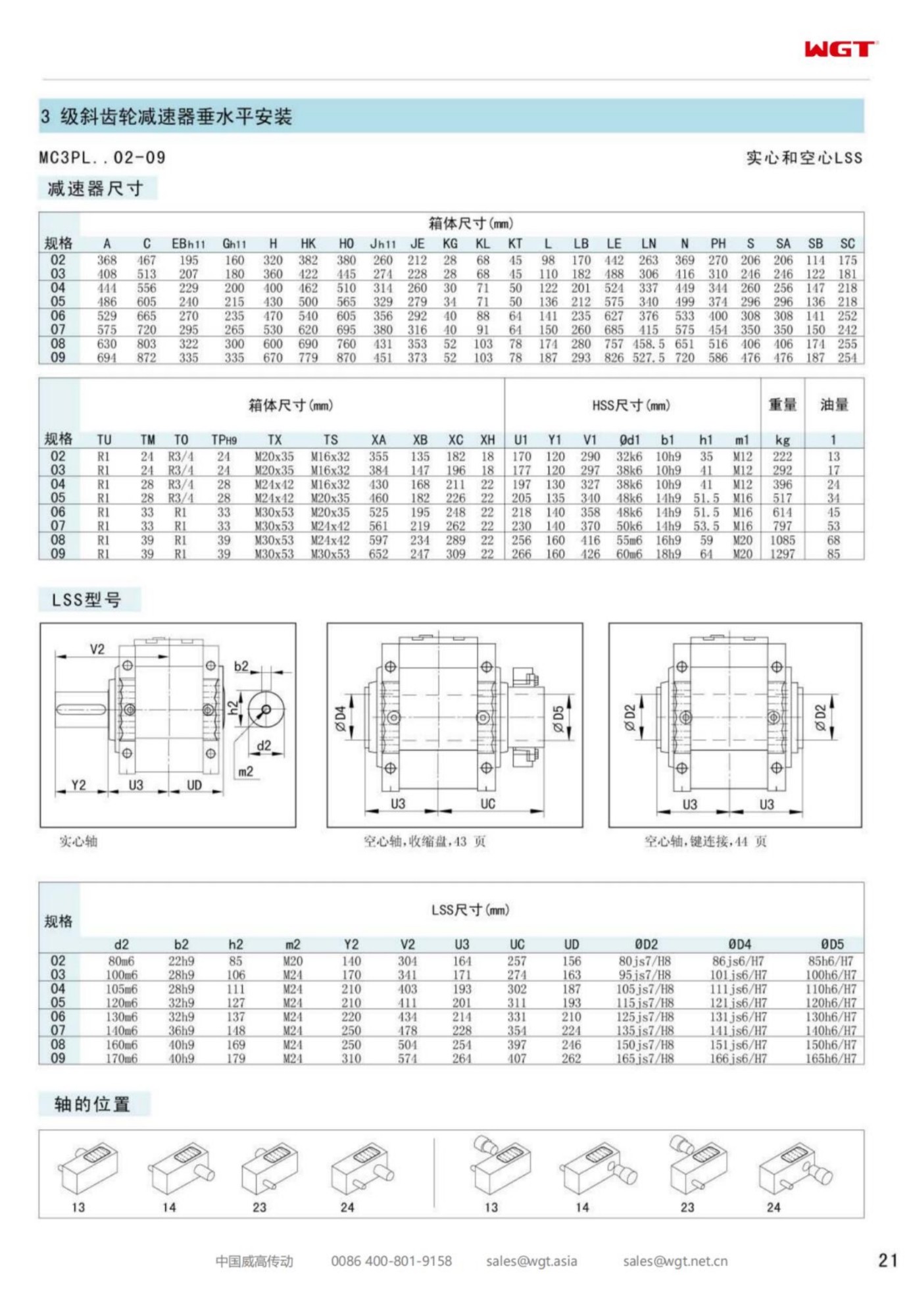
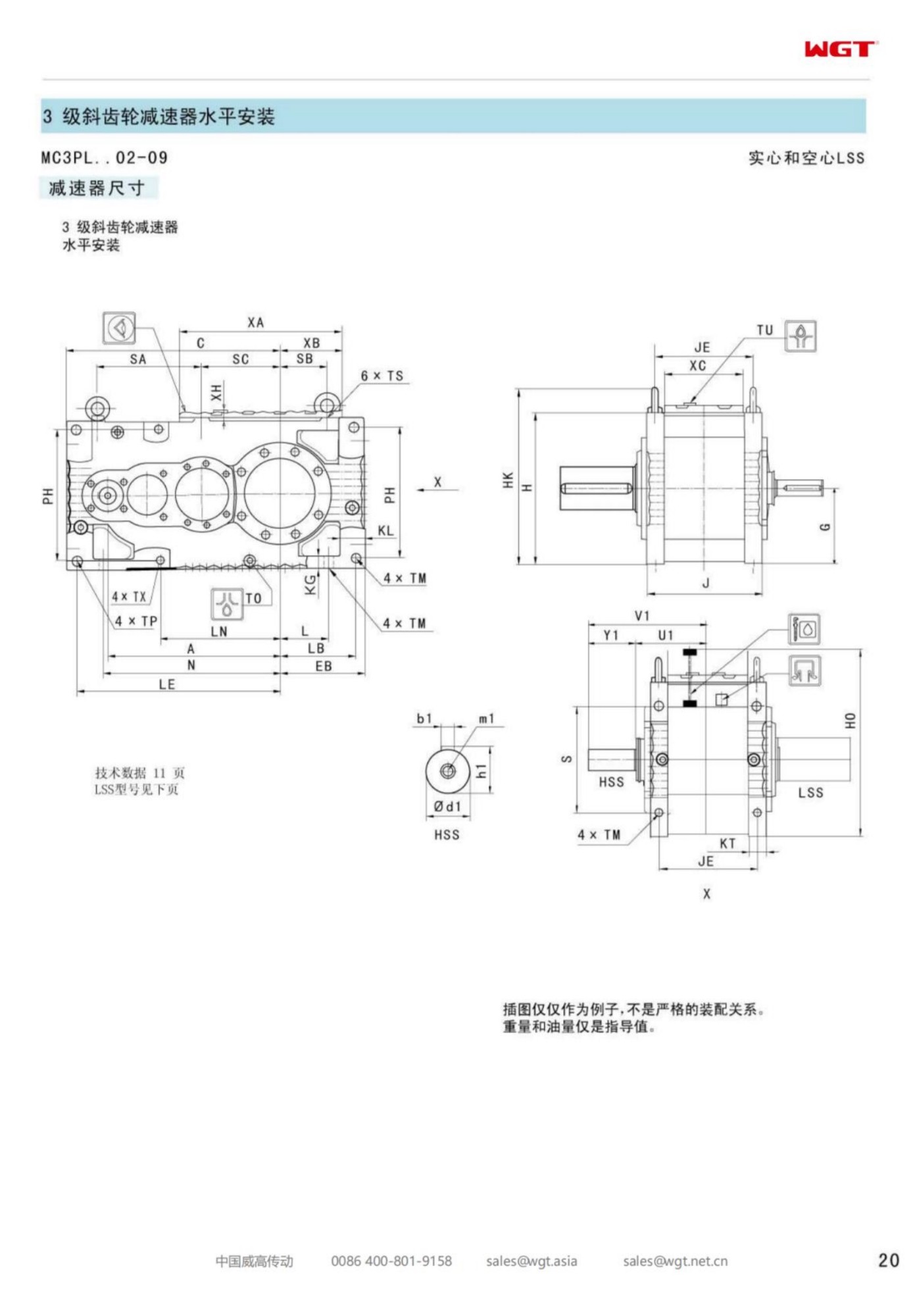
The MC3PLSF04 parallel shaft gearbox is the frame an enquiry lands on when the duty has grown past the two smaller castings in the three-stage line. The architecture does not change on the way up - three helical meshes in one plane, a footed case, a solid keyed output shaft - but the material does: wider gear faces, a heavier output shaft and a bearing set sized for torque that the smaller frames would pass on. That is the frame's whole reason for being: to hold margin without forcing the plant into the next housing size and its bigger price.
This page works through the frame the way an engineer does at the desk: where it sits against its neighbours, how the type code translates into a drawing, how the rating table is used honestly, and the installation details that keep the unit quiet through its first decade rather than its first month.
Stepping Up from the 03 Without Oversizing
The jump from the 03 to the 04 looks small on a catalogue page and behaves differently on a plant. The wider faces raise the thermal ceiling, so a drive that sat near its temperature limit in a warm gallery on the smaller frame runs with room to spare on this one. The heavier shaft carries the starting moment of a machine that comes up loaded - a flooded conveyor, a drum full of sticky material, a feeder buried under a collapsed pile - and that headroom is what buyers are really purchasing when they move one frame up.
The discipline runs both ways. A duty comfortably inside the 03 rating does not become better on the 04; it becomes more expensive per newton-metre and the unit runs lightly loaded, which wastes nothing mechanically but wastes budget every order. The honest comparison is rating at the required service factor against price, thermal margin and spare commonality - and when those line up, the 04 earns its place.
What Each Letter of the Code Commits You To
Read the designation in order and most ordering mistakes surface before the drawing is released.
| MC | Compact industrial gear unit of the multi-stage helical family |
| 3 | Three helical reductions, specified when the ratio lies beyond a practical two-stage band |
| P | Parallel shaft arrangement - the drive stays low and long, not tall |
| L | Long case profile with cast feet and a side inspection cover |
| S | Solid output shaft with parallel key, sized for slow high-torque machines |
| F | Foot mounting on a horizontal bedplate |
| 04 | Third frame of the three-stage range, above the 03 in face width and shaft size |
The ratio and the mounting position never appear in the string, and both change the drawing. Quote them explicitly: an output speed with a tolerance band, and the position the unit will actually stand in, including which side the motor hangs and how close the nearest wall is for the breather and the dipstick.
Reading the Rating Table the Way the Factory Does
A rating table lists nominal output torque per ratio, and the number printed there is a starting point, not an answer. The factory takes the absorbed torque of the driven machine, multiplies by the service factor the duty class demands, and compares the product with the rating - then checks the thermal side separately, because a gearbox can pass the torque line and still cook in a hot corner of the plant. Both checks use the same three inputs: motor speed, output speed and absorbed power or torque.
Two inputs most enquiries forget are the start and the stop. A machine that begins its cycle under load imposes a moment far above running torque for a second or two, and a machine that can stall - a jammed conveyor, a bridged hopper - needs a factor that covers the clearance event, not just the duty. Stating these plainly lets the frame be chosen for the plant as it actually behaves, including its bad days.
Machines That Land on the 04 Frame
Mid-band vertical frames like the size 70 are specified into:
- Chain conveyors under sawdust and shavings silos at furniture plants
- Drum scrubber and washing screen drives at small aggregate plants
- Rake drives on clarifiers at district water treatment works
- Loading belt conveyors at fertiliser and seed bagging sheds
- Rotary vane feeder drives on lime and carbon dosing skids
- Drag chain conveyors moving spillage and grain residues at port sheds
The pattern across these duties is a long-running machine with modest power, deep reduction, and material that surges. The 04 carries the surges with margin instead of living at its limit, and margin is what keeps a stoppage from turning into a stripped gear set.
Alignment Records That Pay Off at the Next Overhaul
Alignment done at commissioning is worth little unless someone writes it down. Record the readings - laser or dial, both shaft axes, with the machine cold and again warm - and file them with the drive's paperwork. Three years later, when a bearing sounds rough or a coupling insert wears early, the old readings tell you whether the foundation has moved, the bedplate has settled or the driven machine has shifted. Without the record, every diagnosis starts from scratch and every overhaul carries a gamble.
Re-check after any event that shakes the plant: a foundation repair, a machine swap on the same bedplate, or a jam violent enough to trip the drive. The half hour spent re-measuring and updating the file is the cheapest insurance in the whole drive train.
Warm-Up, Oil Condition and the Change You Can See
Cold oil on a winter morning behaves differently from warm oil mid-shift, and a gearbox started hard from cold churns unmixed thick oil through bearings that are momentarily starved. On sites with cold seasons, run the drive lightly for a few minutes before loading it, or fit a sump heater if the duty cannot wait. The habit costs minutes and buys years on the output bearing set.
Condition shows at the sight glass and the drain plug. Oil that turns milky has water in it - condensation in a damp gallery or a washdown habit. Oil that darkens fast and carries a burnt smell has been hot. The magnet on the drain plug tells the truth about wear: a grey paste is normal running-in, bright glittering particles are not. Change the oil on evidence and calendar together, and the sump stays honest.
Turning Site Notes into an Orderable Specification
A specification that quotes first time contains: motor rating, speed and starting method; the required output speed with the tolerance the process accepts; absorbed torque or power at the driven machine, with the starting condition stated; the duty cycle, including starts per hour and the jam or stall scenario the plant considers normal; mounting position, available height and bedplate details; shaft and bore dimensions where existing hardware is kept; ambient conditions - temperature, dust, moisture, washdown; and the paint, nameplate and documentation requirements.
Send that in one message and the frame, ratio and options come back fixed in a single exchange. Hold any of it back and the quotation arrives padded with assumptions, and assumptions are what get discovered during installation, when they cost the most.
Questions We Hear Most Often
How is the unit transported and lifted on site?
Units ship in export wooden crates with lifting points on the housing clearly marked. On site, lift only from these points with the specified slings - lifting from shafts or covers is expressly forbidden in the manual.
What tooth quality and grinding finish do you apply?
Gearing is case-hardened and profile-ground to international accuracy grades, with crowning and end relief applied to avoid edge loading. This is what keeps noise and vibration stable over years of continuous duty.
Can existing motors, couplings and guards be reused?
In most upgrade projects yes: because input and output interfaces follow the common industry dimensions, the existing motor, coupling and guard usually bolt straight on. Send the old nameplate and we confirm before you order.
Choosing the Right Frame Size
| Model | Centre distance | Output | Typical duty |
|---|
| M3PSF50 | size 50 | solid shaft, foot | conveyors, feeders |
| M3PSF60 | size 60 | solid shaft, foot | crushers, mixers |
| M3PSF70 | size 70 | solid shaft, foot | ball mills, shredders |
| M3PSF80 | size 80 | solid shaft, foot | kilns, heavy conveyors |
| M3PSF90 | size 90 | solid shaft, foot | mill and kiln drives |
| M3RSF50 | size 50 | solid shaft, foot, right-angle | inclined conveyors, elevators |
| M3RSF60 | size 60 | solid shaft, foot, right-angle | screw classifiers, feeders |
| M3RHF70 | size 70 | hollow shaft, foot, right-angle | agitators, drum drives |
| M3PHT80 | size 80 | hollow shaft, torque arm, parallel | shaft-mounted conveyors |
| M3RHT90 | size 90 | hollow shaft, torque arm, right-angle | heavy shaft-mounted drives |
One family, two layouts. Choose P for a coaxial-in / parallel-out drive train, R when the motor must turn 90 degrees; then pick the shaft type and mounting style that the machine interface needs.
Selection Example: Drum scrubber feed at an aggregate washing plant
Take an 18.5 kW motor at 1470 rpm turning the scrubber drum at 14 rpm. The ratio follows directly: 1470 / 14 = 105, which sits in the three-stage band, and the frame is checked against the surge of a drum that comes up full after a feed pile collapses into the wash box. In this case one frame above the 03 buys the thermal headroom a warm wash plant needs, so the drive keeps its margin through the summer shift rather than living at its cooling limit. It always comes down to those three figures. Send them over and we confirm the frame, ratio and service factor in writing.
![online gearbox selection system workflow]()
Selection workflow used by our engineers for every quotation.
Real-World Duty Points
Pet-food extruder feeder
A pet-food plant chose reducers for the feeder screws ahead of its extruders. Steady torque at variable output speed keeps the kibble size consistent, and washdown sealing protects the unit during sanitation shifts.
Ceramic tile press feeder
A ceramic tile producer fitted reducers to press feeders. The dusty environment is handled by sealed housings, and the stable low-speed output stops the tile blanks shifting before pressing.
![right angle gearbox duty points overview]()
An overview of the duty points this series is built for.
OEM Framework Pricing and Reserved Capacity
Building machines in series? Use the WGT Motor & Gearbox Online Selection System to turn your motor data into a model number, and we will quote that exact unit within the day.
For OEM programmes we hold framework prices and reserve production slots for scheduled call-offs, so your line never waits on a gearbox. Ask for the framework terms with your first enquiry. Looking for a gearbox for packaging machine? Tell us the duty point and we will confirm the model in writing.