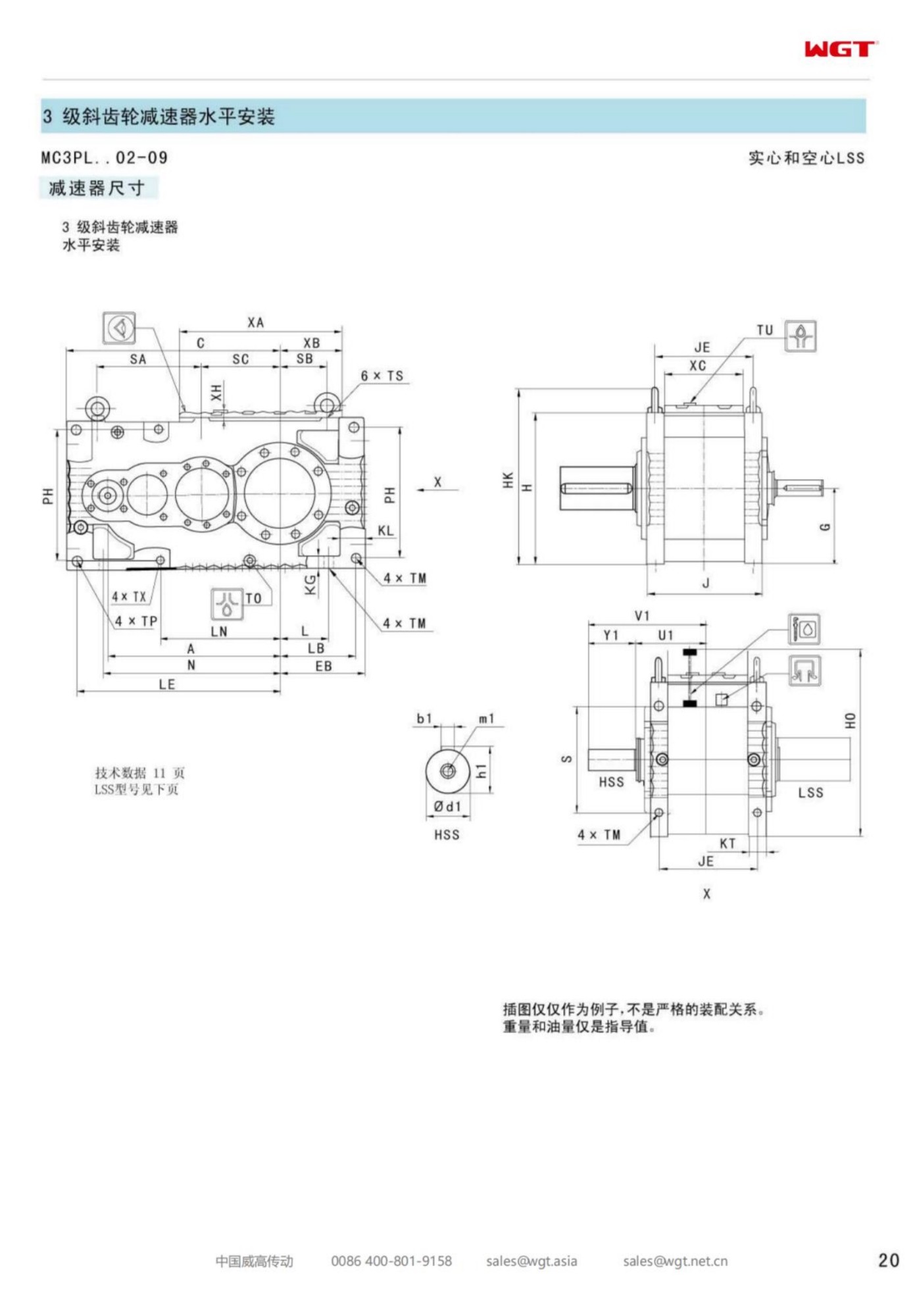
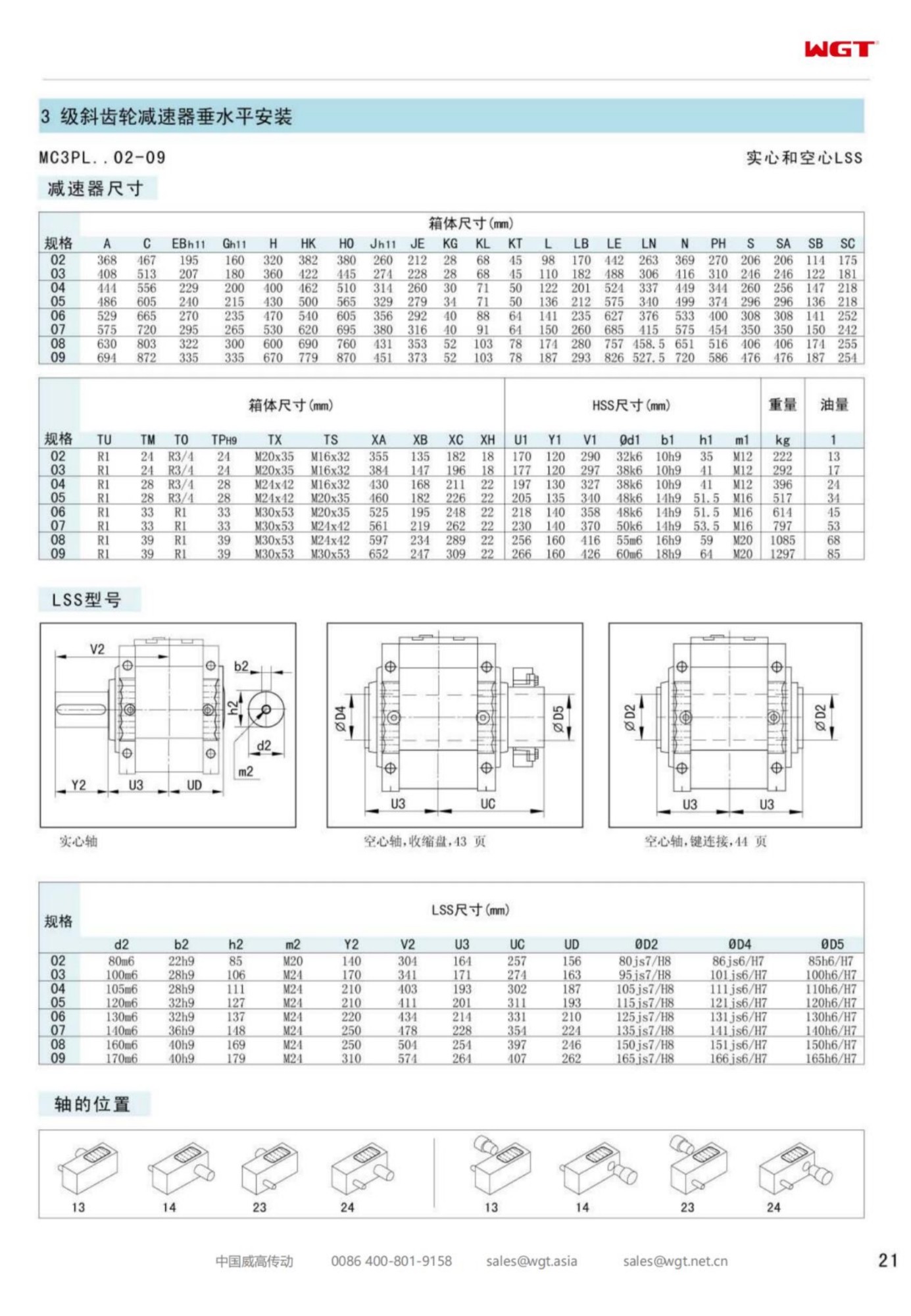
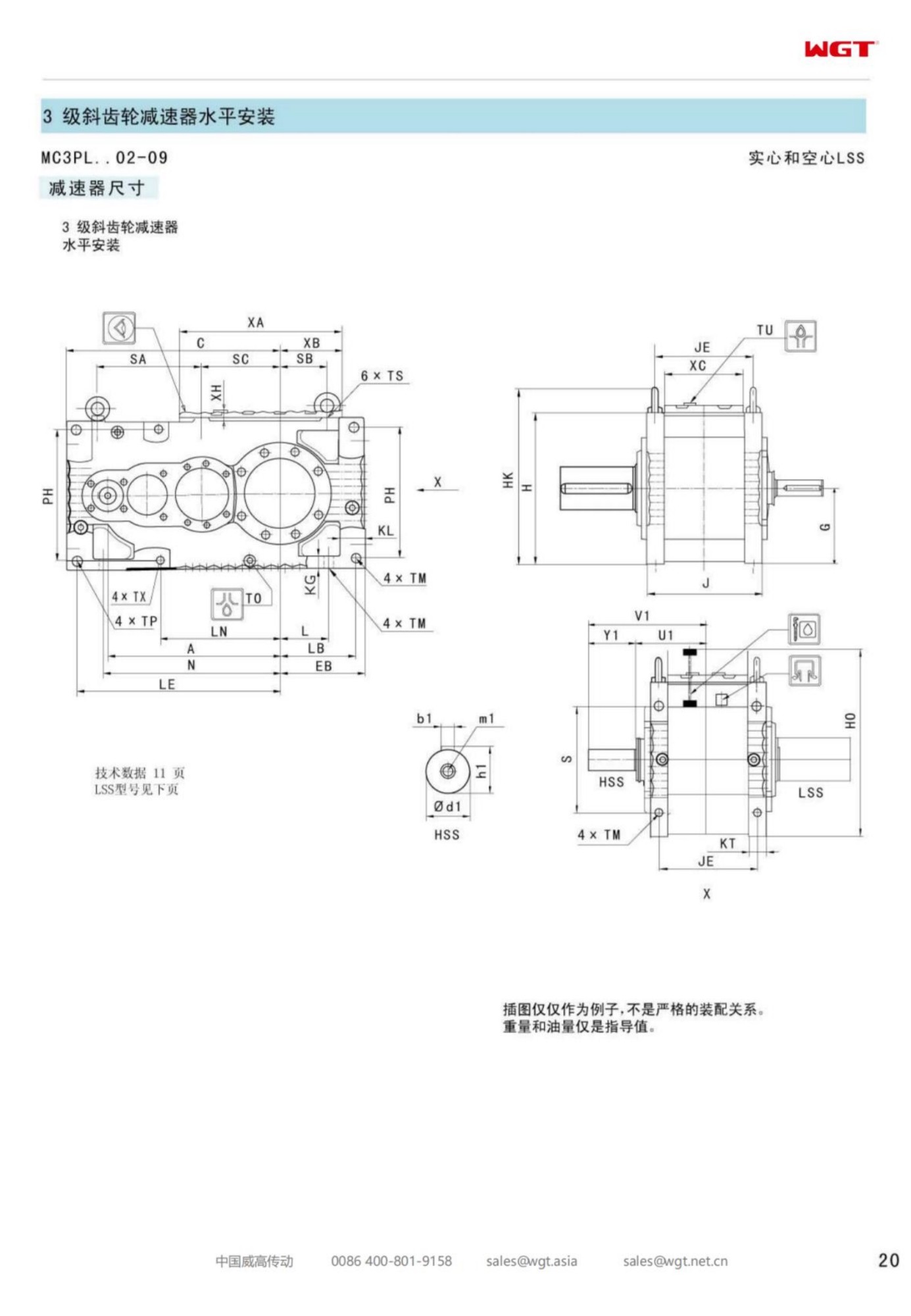
The MC3PLSF02 parallel shaft gearbox is the entry frame of the three-stage line, and it is chosen for a reason that has nothing to do with size: the driven shaft has to turn far slower than a two-stage unit can manage at a sensible centre distance. Three helical reductions in one plane give a deep ratio inside a case that still fits a low frame, which is why this unit turns up on screw conveyors, small airlocks and batch mixers where floor space is tight and the speed requirement is not.
What follows is not a catalogue extract. It is the sequence an engineer works through when the duty is known and the frame still has to be justified - ratio first, then torque with a service factor, then the mechanical details that decide whether the unit sits quietly for a decade or complains from the first week.
Why a Third Stage Appears in the Drawing
Two helical stages cover a wide band, and for most conveyor and mixer duties they are enough. The limit arrives when the output speed drops below roughly fifteen revolutions per minute while the motor stays at four-pole speed. Push a two-stage unit to that ratio and the gear diameters grow until the case is wider than the space available and the cost curve turns upward sharply. A third reduction splits the total ratio into three moderate steps, each with a pinion that remains practical to cut and a wheel that remains practical to mount.
The trade is efficiency. Every helical mesh costs a fraction of a percent, so a three-stage unit runs a little warmer and draws slightly more current than a two-stage unit of the same rating. On a duty that needs the ratio there is no alternative worth arguing about; on a duty that does not, the two-stage frame is the better purchase. Making that distinction honestly at the enquiry stage is worth more than any option on the order.
Decoding the Nameplate Before You Order
The type code is a compressed record of the decisions already taken. Read it left to right and a mis-ordered unit is usually caught before the drawing is released.
| MC | Industrial gear unit of the compact multi-stage family |
| 3 | Three reduction stages in helical gearing |
| P | Parallel shafts, input and output on one horizontal plane |
| L | Long case profile with cast feet and a side inspection cover |
| S | Solid output shaft with parallel key |
| F | Foot mounting for horizontal installation |
| 02 | Smallest frame of the three-stage range |
Two fields never appear in that string and both of them change the drawing: the exact ratio and the mounting position. A unit ordered without them is built to a default, and a default on a retrofit is how a second purchase gets made.
The Ratio Bands a Three-Stage Unit Opens Up
With three meshes the available band stretches from roughly one hundred to well past four hundred, depending on the combination chosen. That range is not continuous in practice; the factory works with discrete gear pairs and the achievable ratios cluster around preferred combinations. The useful way to specify is to state the output speed the process needs, plus the tolerance either side that the process can live with, and let the gear pairs be selected inside that window.
Where a variable-frequency drive is part of the package, the ratio question eases considerably. Choosing a ratio near the middle of the motor's usable band, and covering the extremes electrically, usually produces a smaller frame running cooler than one sized for the slowest point alone. The motor then carries the adjustment, and the gearbox is left doing what it does best: steady reduction at a comfortable mesh speed.
Duties That Suit the Smallest Frame in This Line
Vertical duties where the size 60 frame is the working choice:
- Screw conveyors and drag chain conveyors in grain intake pits
- Small rotary airlock and rotary valve drives on dust collectors
- Belt transfer points in light aggregate and sand plants
- Paddle and ribbon mixers on batch mortar lines
- Sludge scraper and thickener rake drives at small treatment works
- Pallet and roller conveyor drives in cold-store distribution halls
Those duties share a pattern. The absorbed power is modest, the speed is low, the machine runs for long stretches, and the space around the drive is cramped. A compact three-stage unit answers all four conditions at once, which is why this frame exists in the range at all.
Bedplate Preparation for a Long Narrow Case
A three-stage case is longer than a two-stage unit of similar capacity, and length is what makes a soft bedplate obvious. Two pads that are flat individually can still be out of plane with each other, and a casting pulled down onto such a pair will carry a bending load through the housing for its entire life. Check the pads with a straight edge and feeler gauges along the length, and check the diagonals for twist before anything is lifted into place.
Shim in solid stacks under each foot rather than stacking loose washers, bring the unit down with the lifting gear still attached, and read a precision level along both shaft axes. Torque the hold-down bolts in a cross pattern in two passes, then re-read the level. If the reading moves, the bedplate is springing and the fix belongs in the steelwork, not in the shim pack.
Oil, Breathers and the First 500 Hours
The running-in period is where a gearbox either settles or reveals a problem, and the evidence is cheap to collect. Check the sight glass at the start of each shift against a painted mark; a level that creeps downward with no visible weep is a seal or a breather issue, not a mystery. Wipe the breather when the plant is dusty - a blocked breather pushes oil past the seals and looks exactly like a failed seal from the outside.
Bring the first oil change forward to clear the metallic paste that fresh gears produce, and look at the drain oil and the drain plug magnet while it is out. A light grey film is normal. Bright flakes, or a magnet carrying a furry layer, means something is wearing faster than it should and the sample is worth sending for analysis before the second change is due.
What the Enquiry Must State
For a frame this size the enquiry is short, but it does need to be complete. Give the motor rating, speed and starting method; the output speed or ratio required and the band around it that the process accepts; the absorbed torque or power at the driven machine, with the starting condition stated separately where the machine can begin its cycle loaded; the mounting position, available height and any bedplate drawing; shaft and bore dimensions where existing hardware must be reused; and the ambient conditions, including dust, washdown and whether the drive sits in still air inside a cabinet. Paint specification and nameplate language finish the list.
Send those in one message and the frame, ratio and options are confirmed in a single exchange. Send half of them and the quotation comes back with assumptions written into it, which is the point where a project discovers three weeks later that an assumption was wrong.
Field Applications
Mining slurry pump drive
At a mineral processing site, hollow-shaft reducers drive slurry pump agitators. The hollow bore takes the pump shaft with no coupling, so a pump change-out no longer means re-aligning a separate drive.
Palm oil mill fruit elevator
A palm oil mill powers its fruit elevator with reducers. The humid, oily atmosphere is handled by FKM seals, and the compact frame fits between the steriliser and the threshing drum.
![where gear reducers are used in industry]()
Where these units are installed across industry.
Selection Example: Small rotary airlock on a dust collection hopper
Take an 11 kW motor at 1480 rpm turning the airlock rotor at 12 rpm. The ratio follows directly: 1480 / 12 = 123, which a two-stage layout cannot reach at a sensible centre distance, so three stages are used and the frame is checked against the starting torque of a rotor that may be sitting in packed dust. In this case the long three-stage case keeps the drive low enough to sit under the hopper discharge, where a taller two-stage unit of equivalent ratio would foul the structure. Once the ratio is fixed, check the required output torque against the rating table with the service factor applied - that is what decides the frame, not the ratio alone.
![gearbox selection guide: speed, torque, service factor]()
How a ratio and a frame size are determined, step by step.
Frame Sizes and Typical Duties
| Model | Centre distance | Output | Typical duty |
|---|
| M3PSF50 | size 50 | solid shaft, foot | conveyors, feeders |
| M3PSF60 | size 60 | solid shaft, foot | crushers, mixers |
| M3PSF70 | size 70 | solid shaft, foot | ball mills, shredders |
| M3PSF80 | size 80 | solid shaft, foot | kilns, heavy conveyors |
| M3PSF90 | size 90 | solid shaft, foot | mill and kiln drives |
| M3RSF50 | size 50 | solid shaft, foot, right-angle | inclined conveyors, elevators |
| M3RSF60 | size 60 | solid shaft, foot, right-angle | screw classifiers, feeders |
| M3RHF70 | size 70 | hollow shaft, foot, right-angle | agitators, drum drives |
| M3PHT80 | size 80 | hollow shaft, torque arm, parallel | shaft-mounted conveyors |
| M3RHT90 | size 90 | hollow shaft, torque arm, right-angle | heavy shaft-mounted drives |
The size number is the key dimension that steps up torque capacity through the range: 50 to 90 in horizontal builds, 10 to 90 in vertical builds. Gearing philosophy is shared across the family.
Shutdown Planned? Order Ahead of the Window
Beat the shutdown window. Engineers can size the unit themselves in the WGT Motor & Gearbox Online Selection System - input speed, torque and duty, get the model instantly.
For planned maintenance windows we reserve production capacity and ship the unit ahead of the shutdown date, so the swap takes hours instead of days. Tell us the window and we work back from it. Looking for a gearbox for crusher? Tell us the duty point and we will confirm the model in writing.
Common Questions from Buyers
What ambient and altitude limits apply?
The standard build suits -10 to +40 degrees C at altitudes below 1,000 m with the supplied oil grade. Colder sites get synthetic oil and heaters; high altitudes or hot climates may call for the next frame size or forced cooling.
Do you supply the unit with an electric motor fitted?
We deliver the bare gear unit with an input suitable for your motor, or as a complete motor-gearbox assembly aligned and tested at the works. For upgrade projects many customers keep the existing motor and order the unit alone.
How is the gear unit protected against dust and moisture?
Housings are gasket-sealed with labyrinth or lip seals at both shafts as standard. Dusty plants, washdown areas and outdoor installations are covered by coating and sealing options specified together with the order.