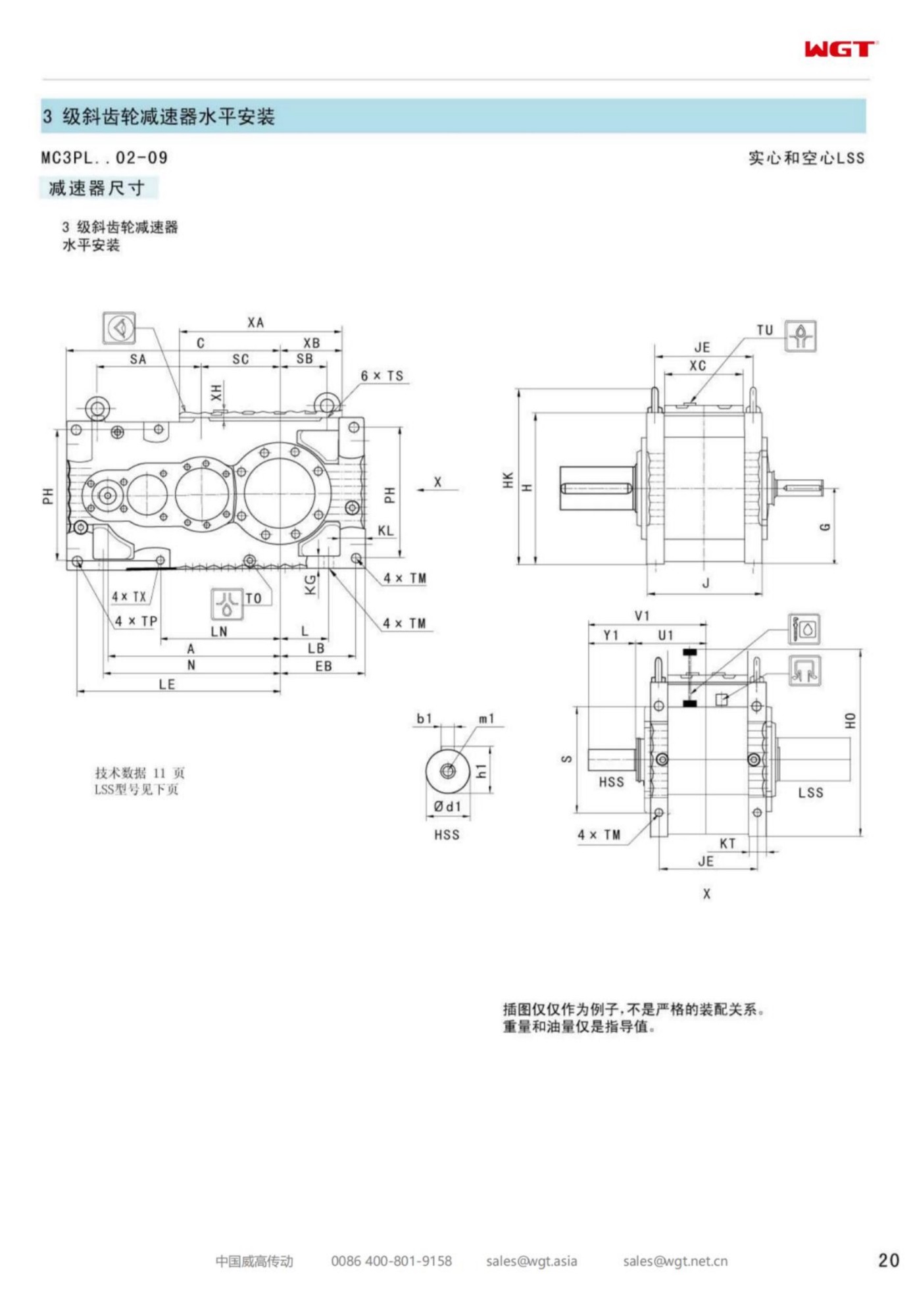
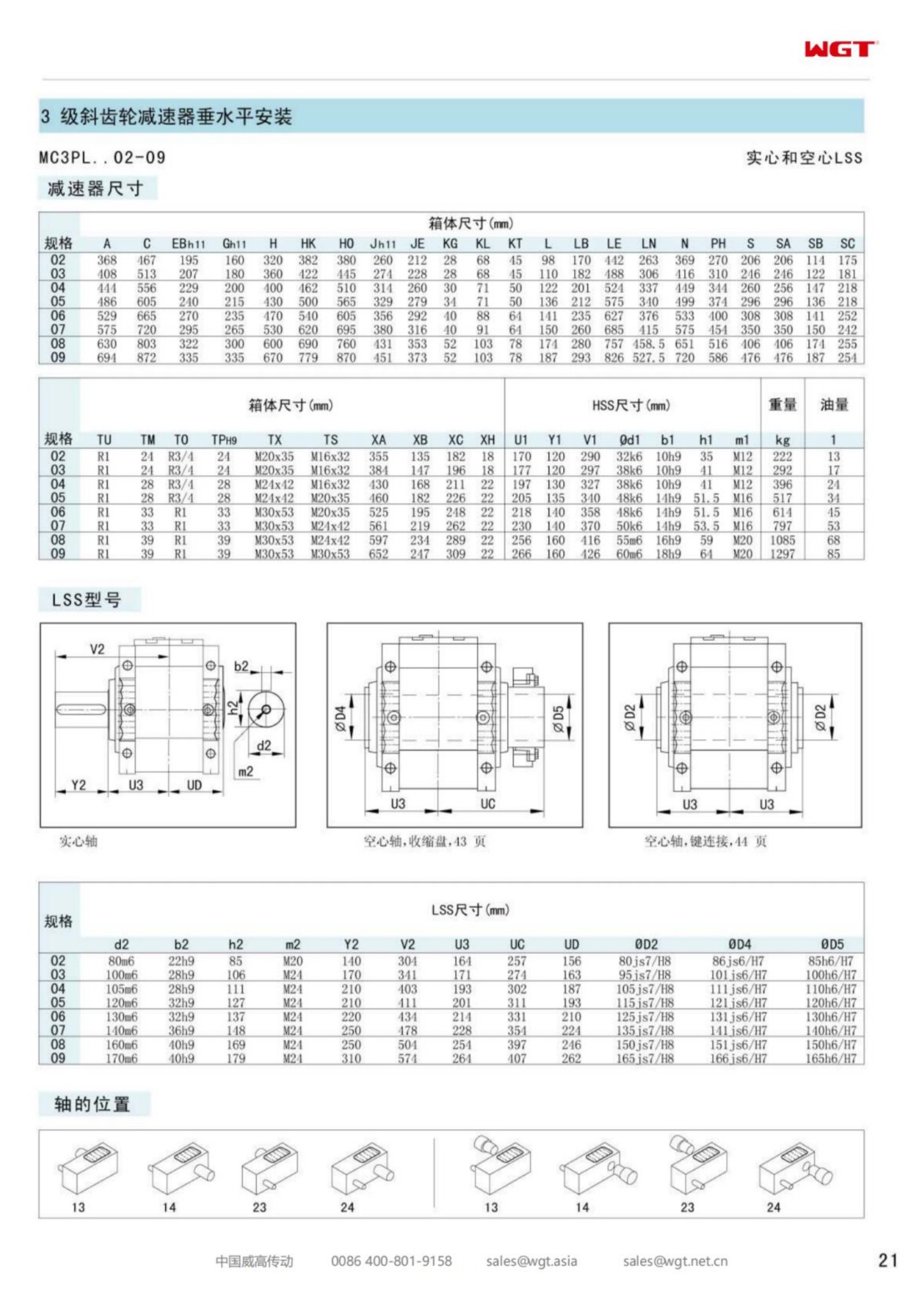
Coal arrives at a power station by ship, rail or truck, but it reaches the bunkers on belts that climb through elevated galleries - long, enclosed, inclined and running to the station's load rhythm, not the weather's. A gallery drive is a curious mixture: torque demand is steady once flowing, yet the restart after a frozen or consolidated load is the moment that selects the frame. The MC3PLHT03 parallel shaft gearbox answers that selection with three reductions, a hollow bore that drops onto the head shaft, and a motor line that runs along the gallery where the clearance actually is.
The sections below walk through the choices a station engineer weighs: what the code letters commit to, how the incline changes the arithmetic, and where the hidden costs of a wrong frame hide.
An Incline Changes More Than the Torque
On level ground, belt power is friction plus acceleration. Add an incline and the whole load hangs on the drive continuously - there is no downhill side returning energy, only a column of coal lifted every hour the unit runs. The gearbox sees a steady, unforgiving torque with none of the duty-cycle relief a horizontal belt enjoys.
Gallery angles also concentrate spillage: fines roll back down the belt into the drive area. The case and its seals inherit that geography whether the designer planned for it or not.
Decoding MC3PLHT03 Letter by Letter
Each character in the designation is a commitment the drawing then has to honour.
| MC | Heavy-duty industrial gear unit series |
| 3 | Three reductions between input and output |
| P | Parallel helical stages, shafts in one vertical plane |
| L | Horizontal output into the head shaft |
| H | Hollow bore, shaft-mounted without a low-speed coupling |
| T | Torque-arm reaction into the gallery structure |
| 03 | Second frame from the small end of the range |
The '3' matters most in a gallery: incline duty with a cold, consolidated start asks for ratio depth that two stages can only deliver by oversizing the first wheel, and oversizing costs headroom a narrow walkway does not have.
Keeping the Motor in the Line of Travel
Galleries are built to a standard corridor width. Every right-angle drive spends that width on the motor's sideways overhang; a parallel-shaft unit spends it on nothing - the motor trails behind the pulley along the belt's own axis.
That geometry also simplifies the emergency swap. When a motor fails at three in the morning, a unit whose motor sits in open line access is changed in hours; one wedged against a handrail becomes a shift-long conversation with rigging.
The Restart That Decides the Frame
Coal consolidates. Overnight vibration, moisture and settling turn a standing load into a mass that grips the idlers and resists the first metre of travel. The breakaway demand on a stalled, loaded gallery belt can double or triple the running figure for a few seconds - and those seconds pass through every gear mesh the unit owns.
Selection practice at well-run stations is blunt: take the worst restart, not the average hour, apply the service factor there, and let the running case fall where it falls. A frame chosen on averages survives the average and fails on the exception.
Coal Dust and the Breather
Pulverised coal dust is not just abrasive - under the right conditions it is reactive. A gearbox breathing dusty air all day eventually packs its breather, and a blocked breather turns temperature swings into seal-pumping pressure cycles.
The practical specification is a breather sited and filtered for the atmosphere, inspected on the rounds, plus seals chosen with dust exclusion in mind ahead of oil retention. Oil loss is visible and cheap; dust ingress is silent and not.
Winter Oil, Summer Oil
A gallery is an outdoor structure. The same unit that runs warm in August faces a start in February with oil thick as syrup. Two answers exist: a grade that covers the local span, or sump heating where winters are serious. Choosing neither means every cold start runs briefly on a dry film - which is exactly how gear flanks earn their first pits.
The enquiry line 'minimum ambient at start' looks small on paper and decides real money in the sump.
Torque Arm Against the Gallery Frame
Gallery steelwork is designed around the belt it carries, and the torque arm should be treated as part of that load path from day one. The bracket lands on a member that can take the reaction without local flexing; the arm's adjustment provides belt tension; and the arrangement leaves room to swing a hammer for installation without inventing new vocabulary.
Where the existing steel was sized before the drive existed, a brief check by the structural engineer at order time beats a cracked weld discovery at commissioning.
Belt Speed and Where the Ratio Comes From
Gallery belts are speed-limited by the coal itself: too fast and fines lift off the incline, too slow and the transfer houses upstream cannot clear their queues. The output speed the process wants therefore arrives as a settled number, and the gearbox's job is to reach it from a standard motor speed without inventing non-standard parts.
Three stages reach most gallery ratios with round, catalogued wheel sets. That matters years later, when a spare pinion is wanted in a hurry and a strange intermediate ratio is the thing standing between the order and the shelf.
Weighfeeders and Speed Stability
Many gallery belts feed gravimetrically - the belt weighs what it carries. Output speed stability matters twice over: the weighing accuracy depends on it, and combustion control depends on the weighing. Three stages at a steady ratio give the drive train a stable platform; the rest is the belt's discipline.
Backlash in the final mesh, wear on the hollow-bore keyway, and torque-arm slop all appear first as weighfeeder noise, long before they appear as metal damage. The instruments police the gears for free.
What Goes Into the Enquiry
The gallery drive enquiry that gets a straight answer states: motor power and speed, output speed, restart method and worst-case breakaway assumption, head shaft dimensions, incline angle, minimum ambient, and whether the atmosphere demands dust-ignition-safe accessories. Each line removes a round-trip.
A sketch of the drive end with the shaft dimensioned is worth more than any paragraph describing it.
Service Windows the Station Actually Has
Outage windows are short and crowded. Everything about the unit that can be pre-staged outside the window should be: oil volumes, spare seals, the torque-arm bolts, the breather. A hollow-bore unit rewards this planning doubly, because swapping it onto an existing head shaft skips the coupling alignment that once consumed a full outage day.
Frame Three Across the Years
Stations that selected this frame with the restart in the arithmetic, the breather in the atmosphere and the winter in the oil report the long-run result the catalogue cannot print: a drive that answers every load-despatch morning without ceremony. In a coal gallery, freedom from ceremony is the entire specification.
An incline that never sleeps and a restart that doubles the torque - three stages carry it:
- Inclined coal gallery conveyor at a thermal power station
- Bunker feed belt from the transfer house
- Rail unloading station reclaim conveyor
- Stockpile reclaim belt at the fuel yard
- Slope conveyor between crusher house and silo top
- Emergency standby coal belt on the same corridor
The M3 Series at a Glance
| Model | Centre distance | Output | Typical duty |
|---|
| M3PSF50 | size 50 | solid shaft, foot | conveyors, feeders |
| M3PSF60 | size 60 | solid shaft, foot | crushers, mixers |
| M3PSF70 | size 70 | solid shaft, foot | ball mills, shredders |
| M3PSF80 | size 80 | solid shaft, foot | kilns, heavy conveyors |
| M3PSF90 | size 90 | solid shaft, foot | mill and kiln drives |
| M3RSF50 | size 50 | solid shaft, foot, right-angle | inclined conveyors, elevators |
| M3RSF60 | size 60 | solid shaft, foot, right-angle | screw classifiers, feeders |
| M3RHF70 | size 70 | hollow shaft, foot, right-angle | agitators, drum drives |
| M3PHT80 | size 80 | hollow shaft, torque arm, parallel | shaft-mounted conveyors |
| M3RHT90 | size 90 | hollow shaft, torque arm, right-angle | heavy shaft-mounted drives |
All frames in the table belong to one industrial family. P = helical parallel-shaft, R = bevel-helical right-angle; the low-speed shaft is solid (S) or hollow (H), mounted on feet (F) or a torque arm (T).
Selection Example: Typical duty point
Consider a typical duty for this frame: the driven shaft has to run at a fraction of motor speed. Motor speed divided by the target output speed gives the ratio, rounded to the nearest available step, and the required torque with the service factor then fixes the frame size. That single division gives the catalogue ratio; the service factor for your duty class is then applied to the torque, and the frame size follows.
![how to size a industrial helical gearbox in four steps]()
Sizing flow: motor speed, target output speed, torque, service factor.
Where This Series Works in Practice
Lime kiln auxiliary drive
A lime producer fits a smaller industrial gear unit as the auxiliary drive of its rotary kiln. Turning the kiln slowly during shutdowns and start-ups is exactly the low-speed, high-torque duty the frame was chosen for.
Tunnel boring backup drive
A tunnelling contractor uses industrial gear units on the backup gantry conveyors of its TBM. The units arrived dimensionally matched to the gantry interfaces, so installation took hours rather than days.
Technical Questions, Answered
What is the difference between a keyed hollow shaft and a shrink-disc connection?
A keyed hollow shaft is the economical choice for normal torque and easy maintenance. A shrink-disc connection transmits higher torque with zero backlash and no keyway wear, and is preferred for reversing or high-torque duties.
Can I get a CAD drawing or 3D model for my design review?
Yes. Send us the model and ratio and we provide a 2D dimension drawing and a 3D STEP model for your review, usually the same working day. Drawings follow the layout of the original series so they drop into your existing assembly.
![industrial helical gear reducer application fields]()
Common application areas for right-angle industrial helical drives.
Size It, Quote It, Ship It
One minute, one model. Skip the back-and-forth: configure your drive in the WGT Motor & Gearbox Online Selection System and send us the result for a same-day quotation.
Give us the driven machine, the required output speed and the daily running hours, and we return a confirmed model number with torque margin and a firm price - no obligation, no charge for the selection work. Looking for a gear reducer for textile machinery? Tell us the duty point and we will confirm the model in writing.