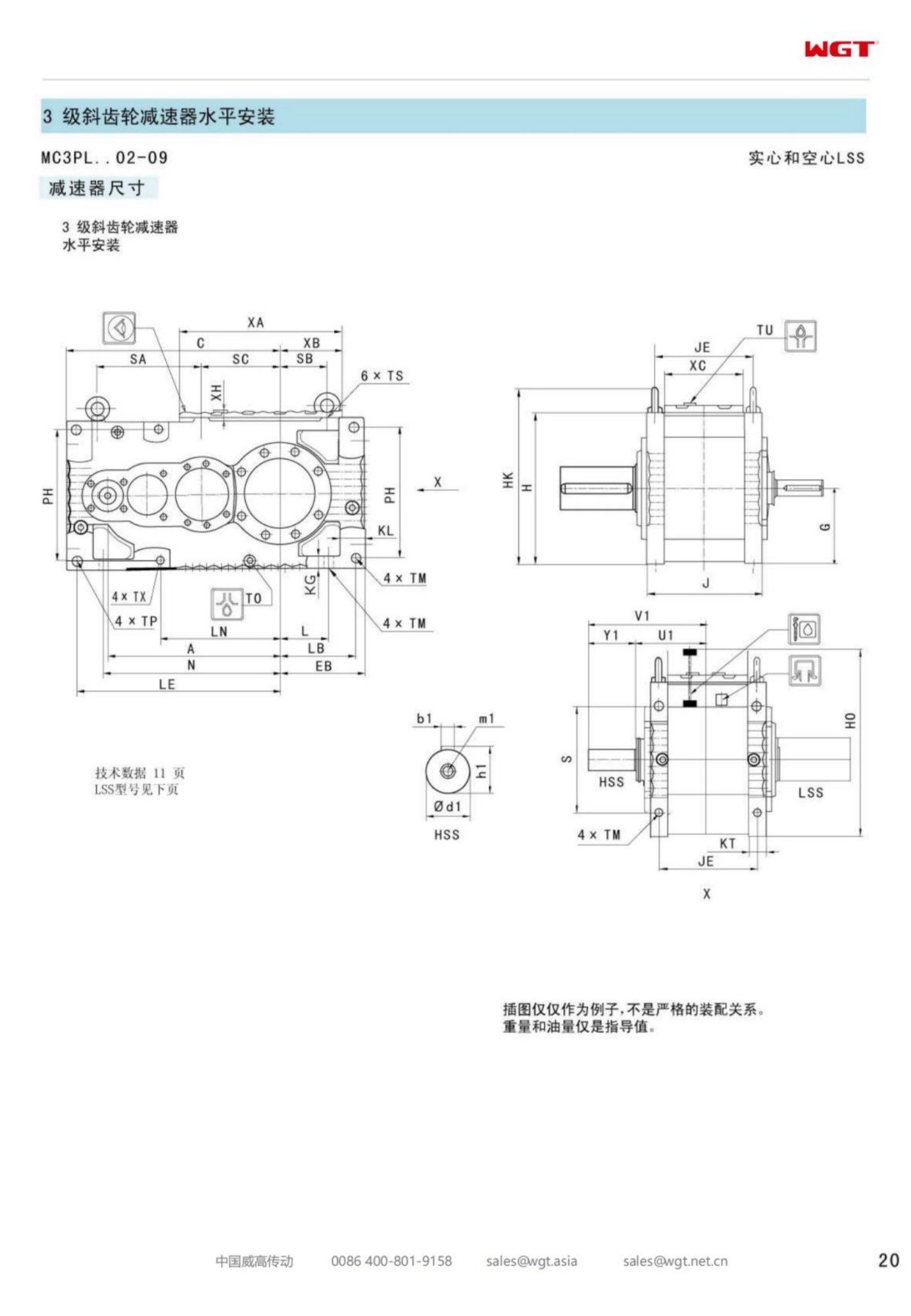
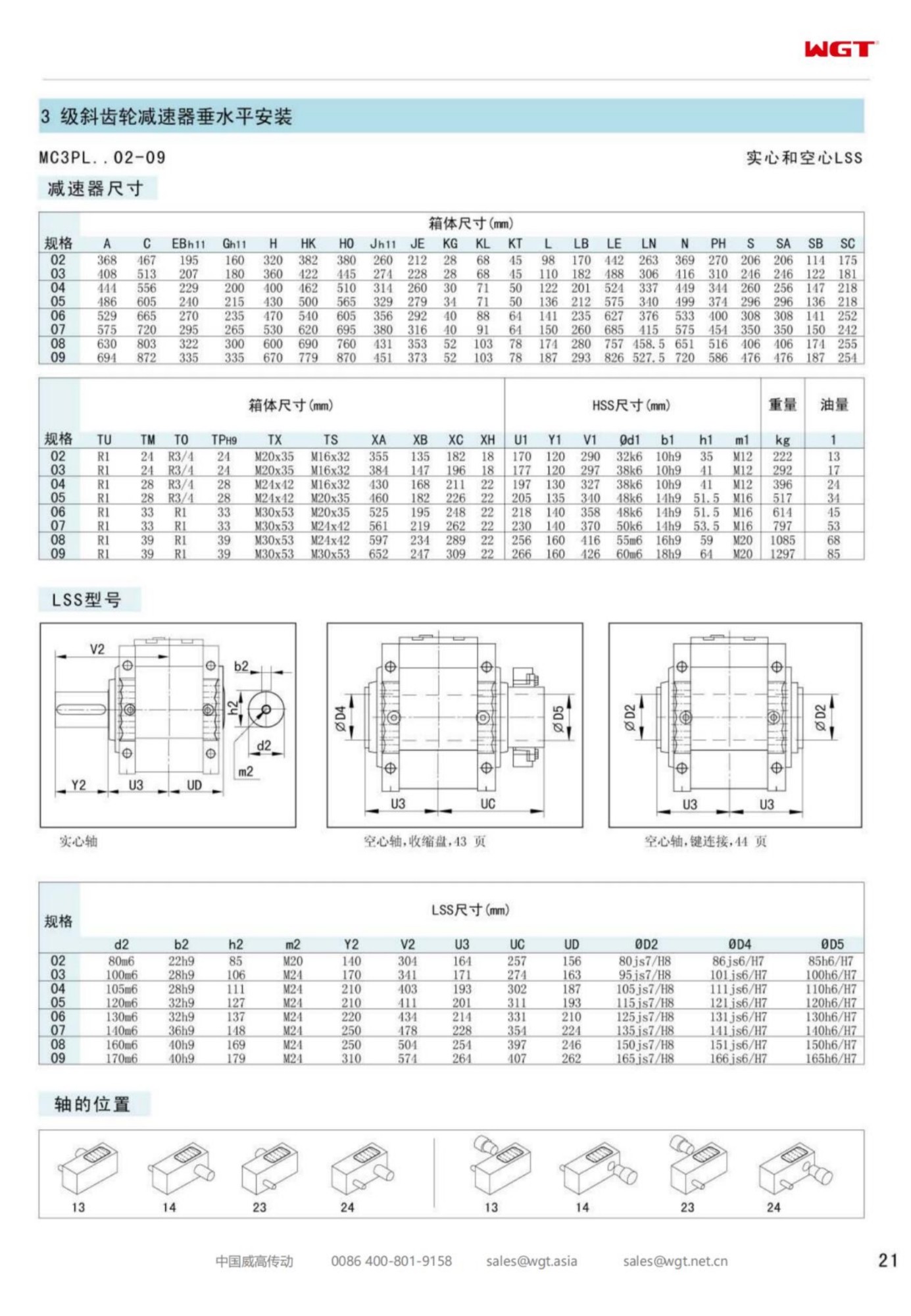
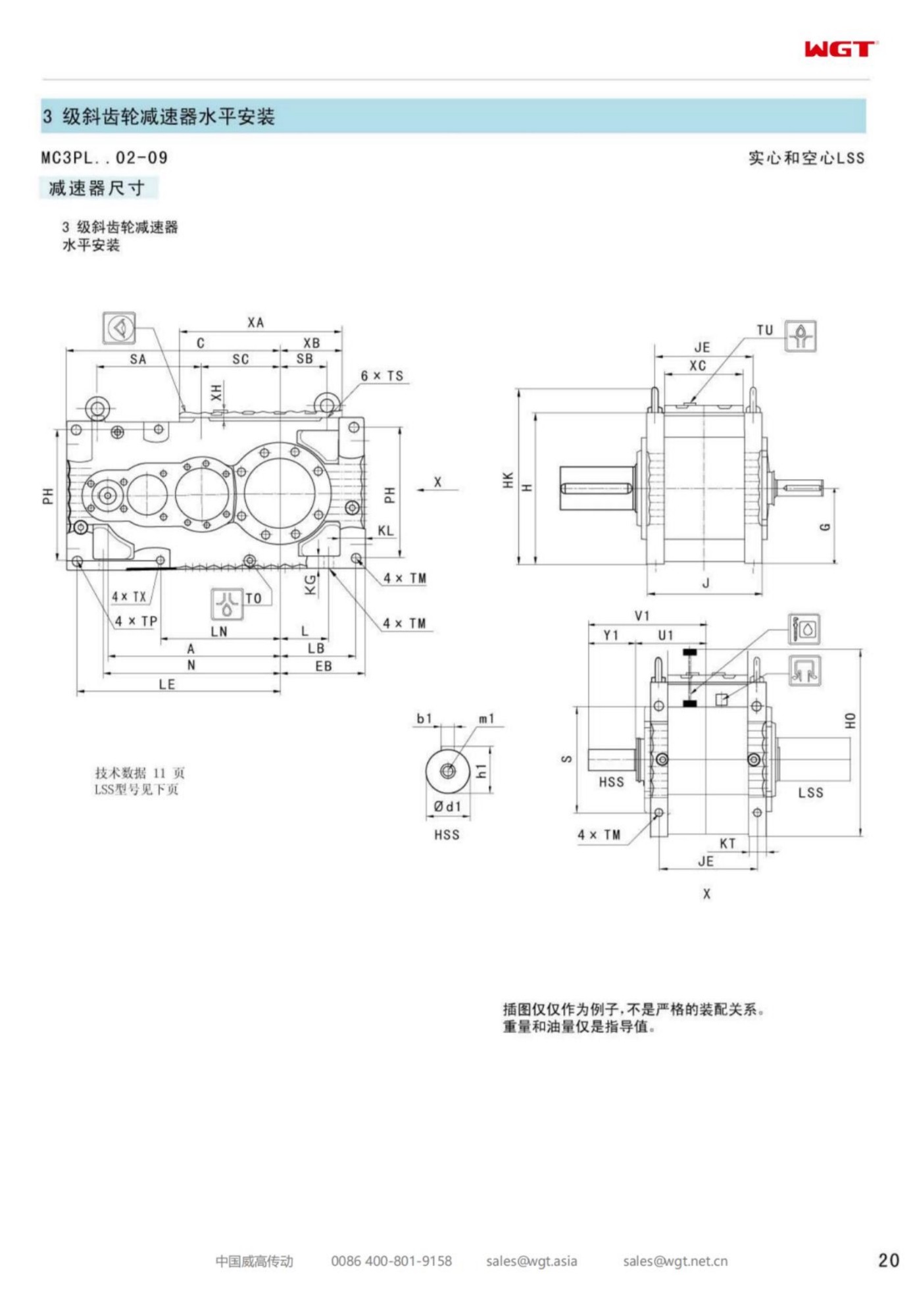
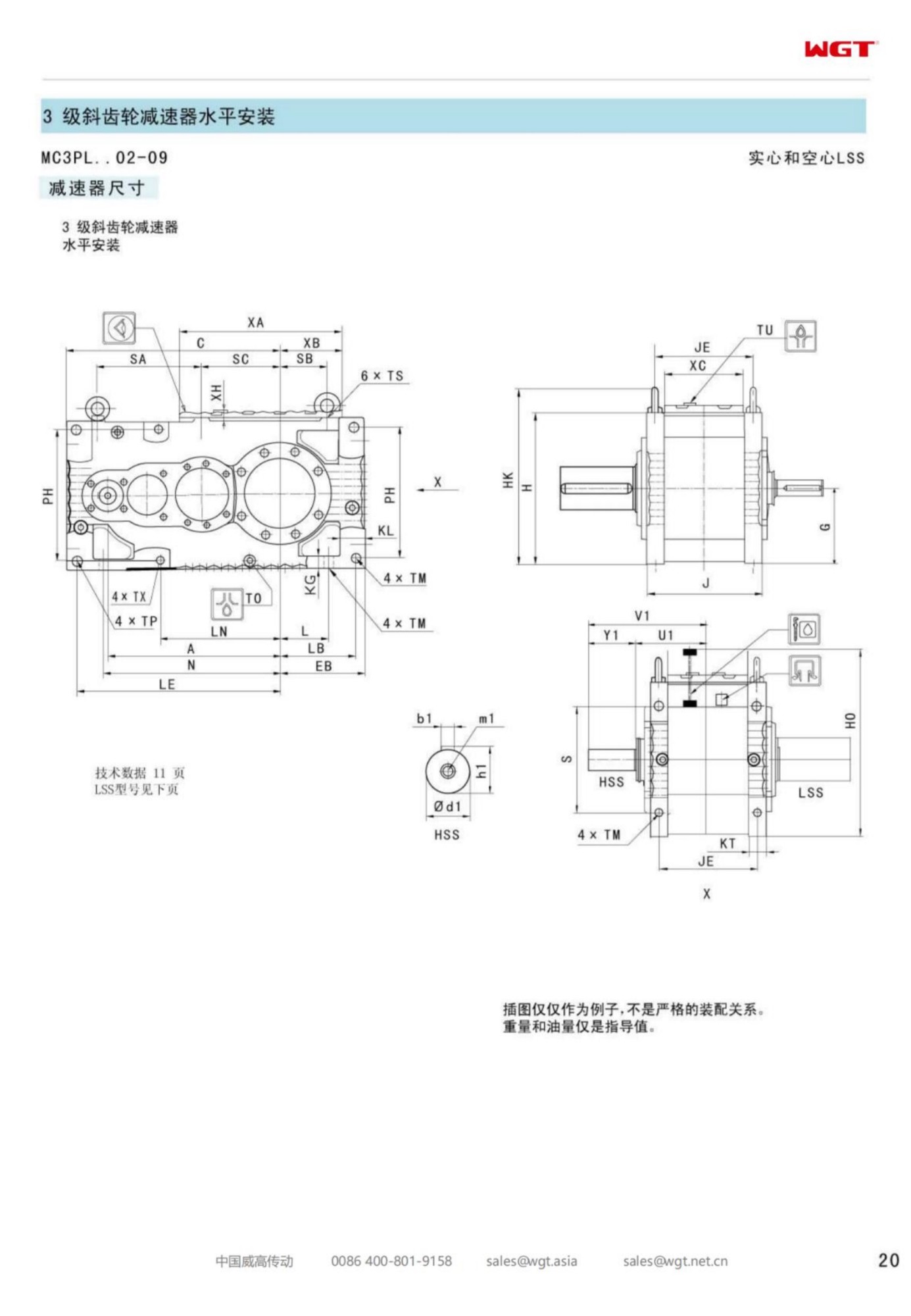
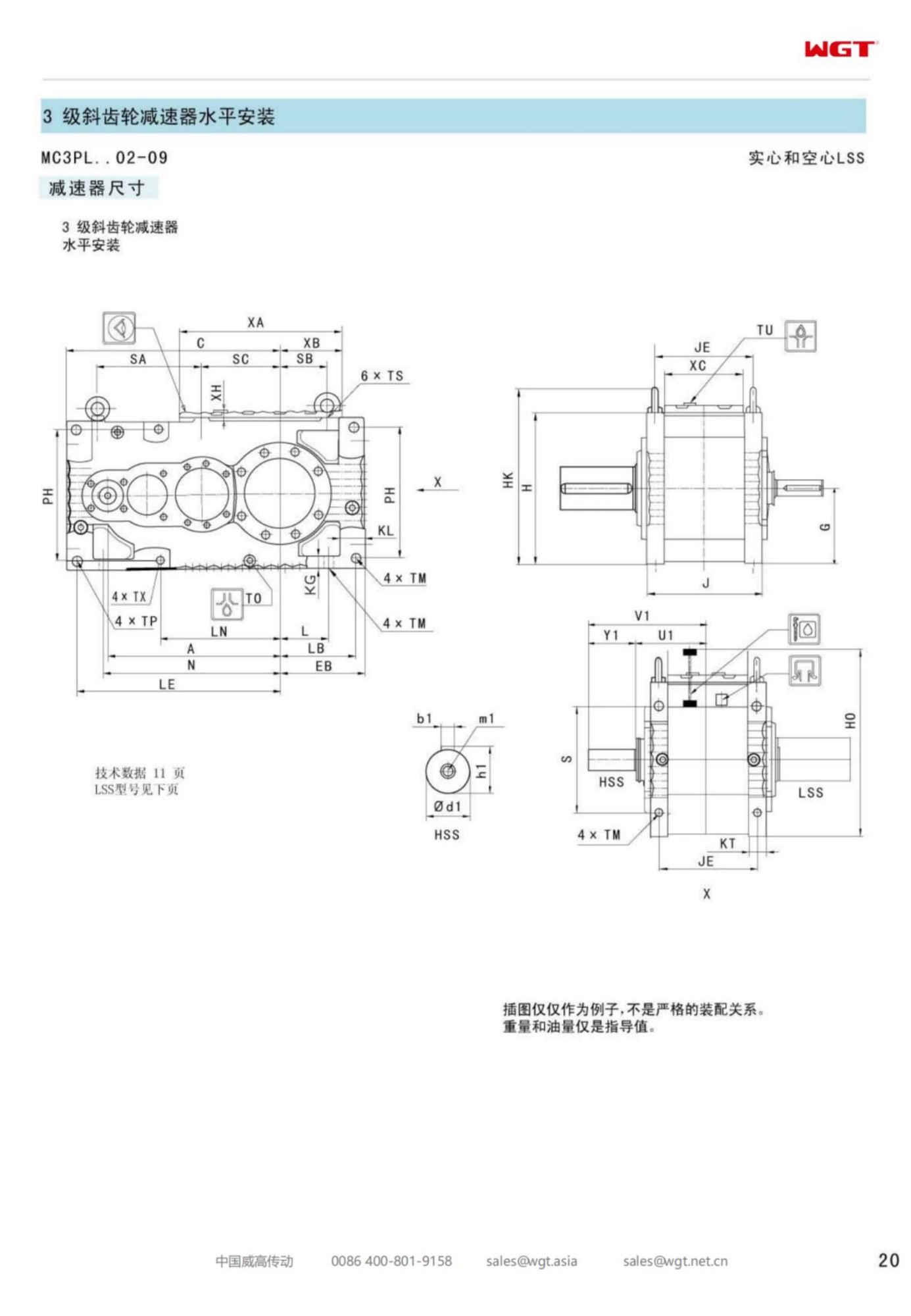
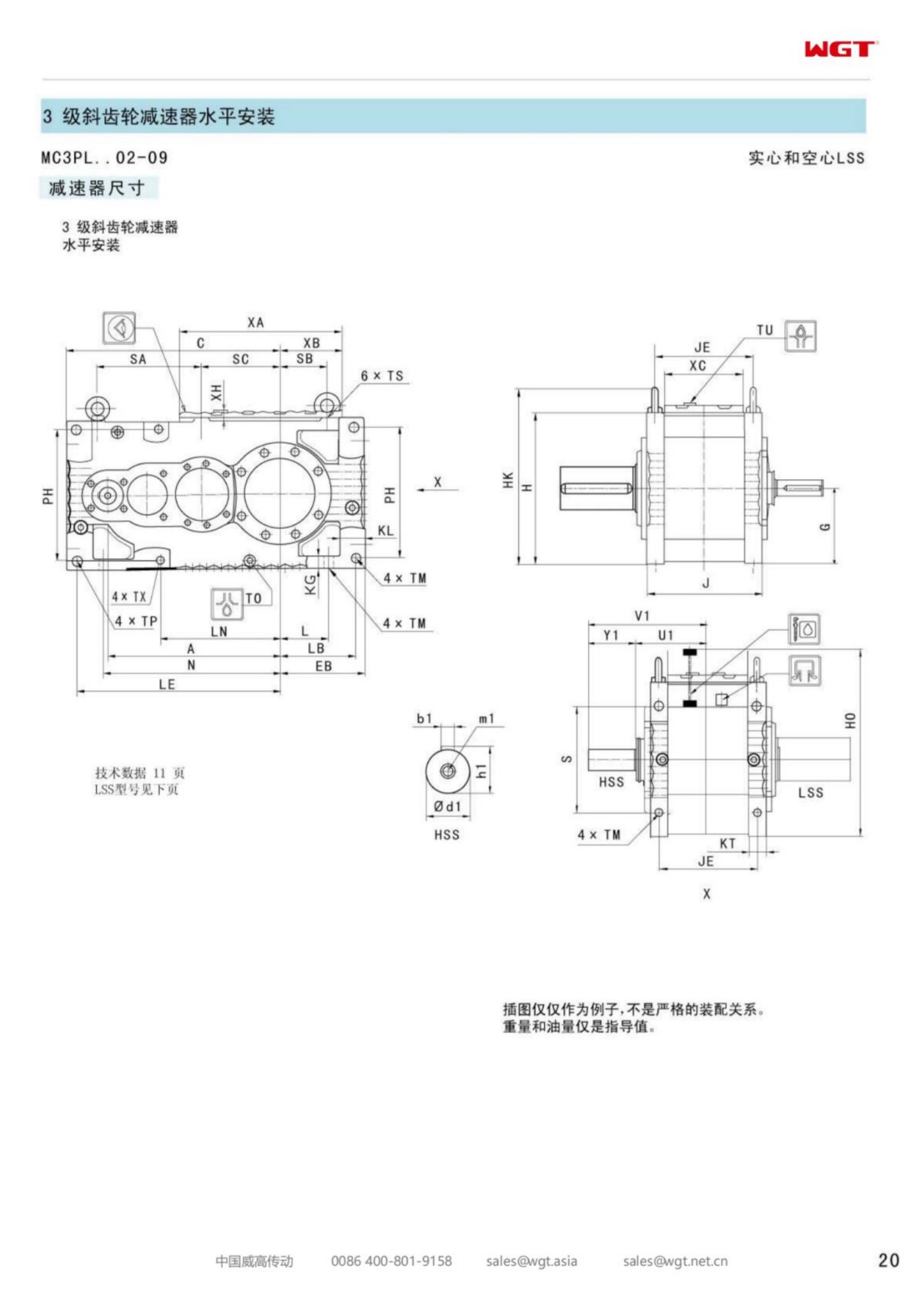
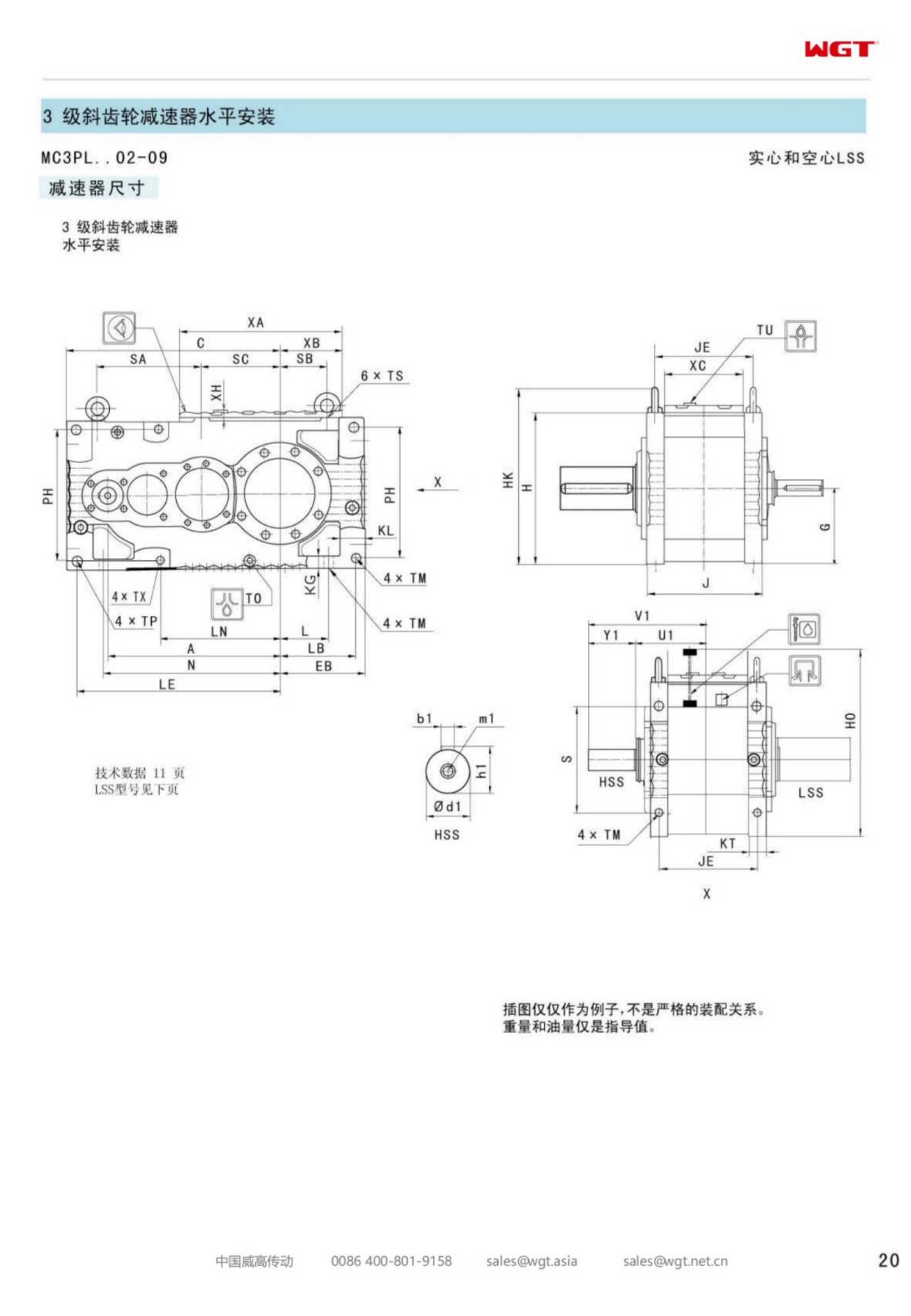
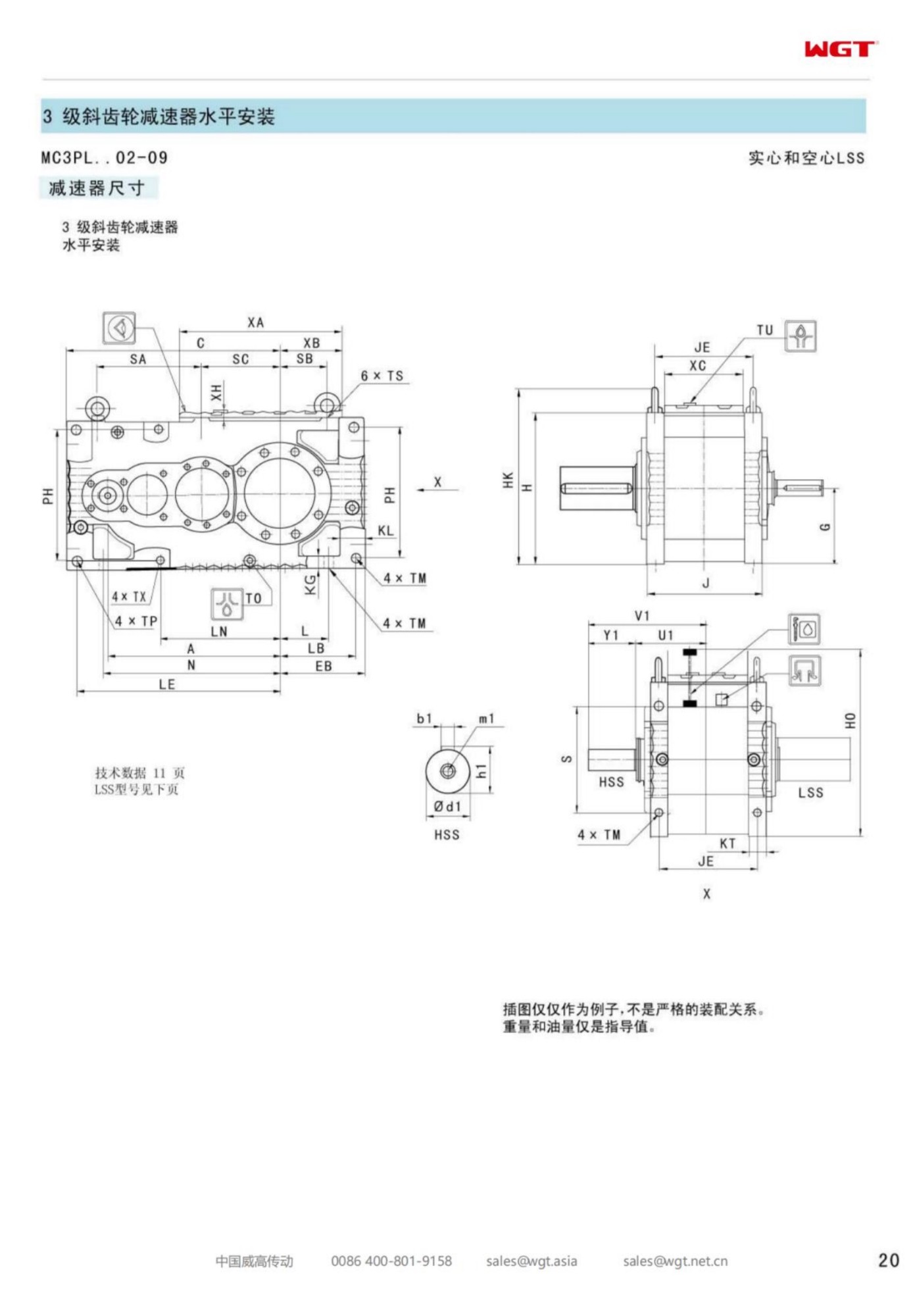
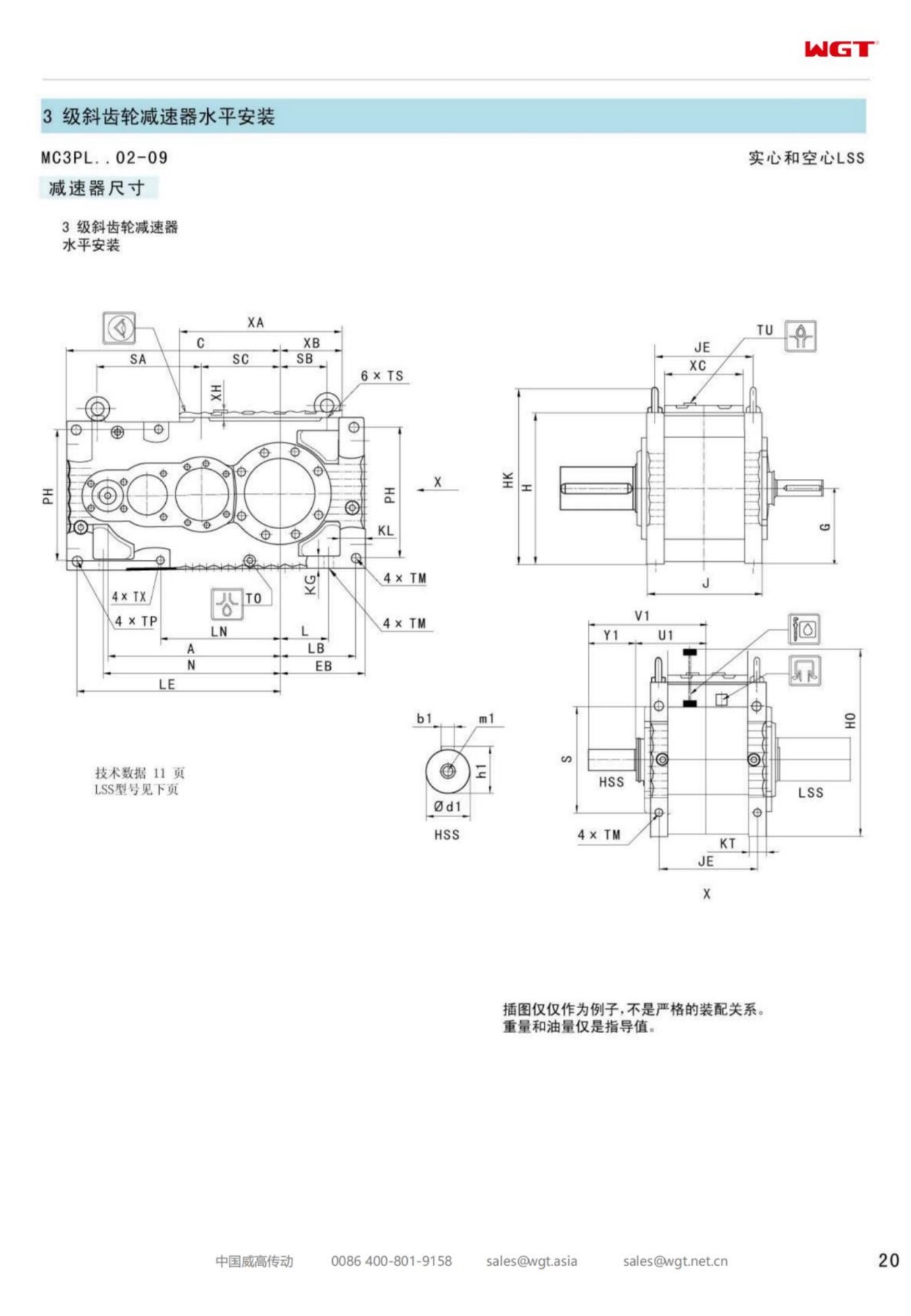
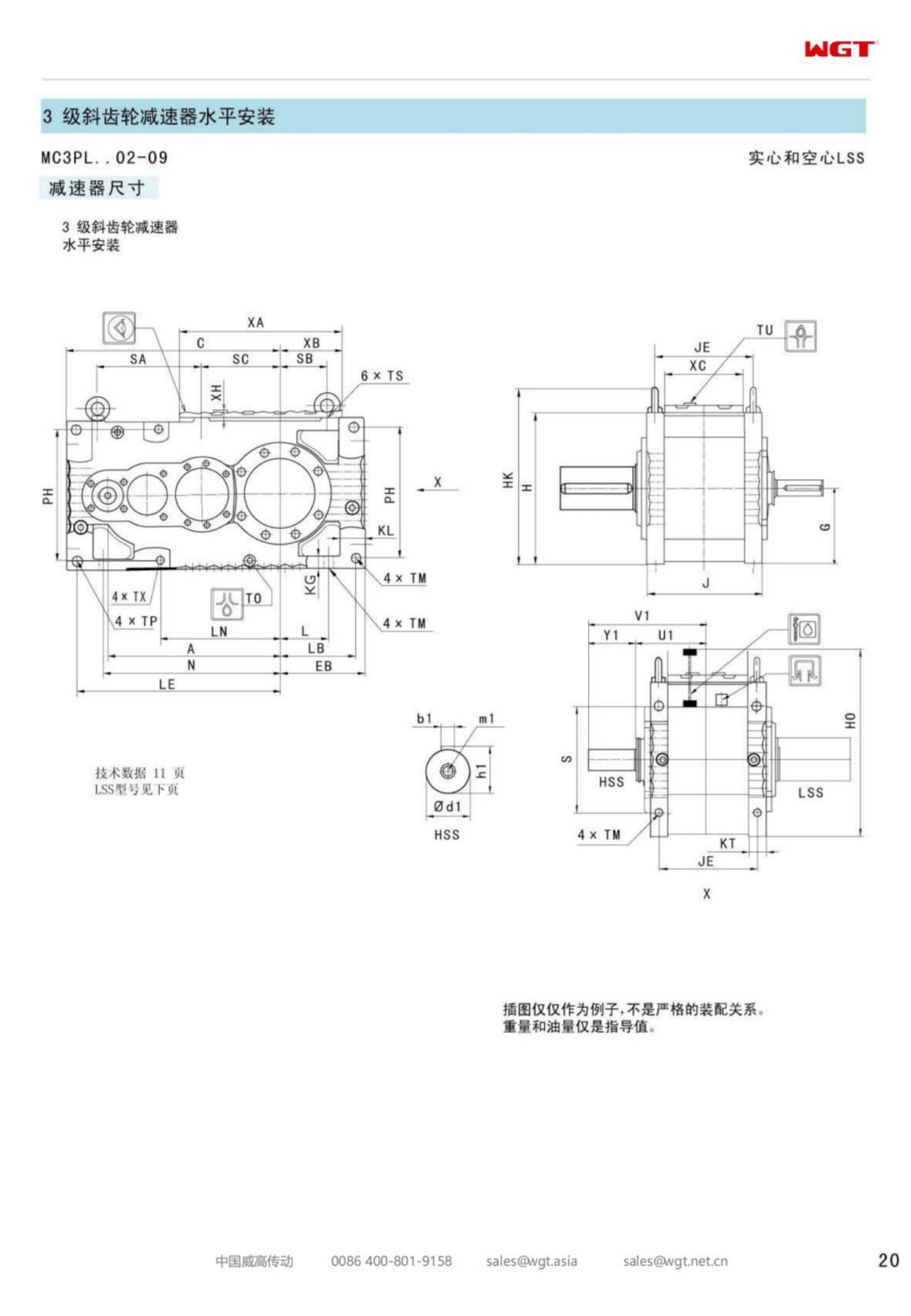
Clinker leaves the cooler at a temperature that punishes anything careless above it, falls into a shed the size of a small hangar, and then has to leave again on a schedule the kiln does not control. The belt that reclaims it runs under the pile, in dust that finds every lip and labyrinth, and it starts and stops around the dispatch plan rather than around the mill's convenience. That is a slow-shaft, high-torque duty with a motor that wants to sit along the conveyor line - which is exactly the geometry the MC3PLHT02 three-stage parallel shaft gearbox was drawn for: a hollow bore straight onto the head shaft, a torque arm braced into the shed steelwork, and three reductions in a case that fits beside the belt instead of over it.
These notes are written for the plant engineer who has to buy that drive once and live with it for a decade: what the size code settles, why the parallel layout earns its place in a reclaim gallery, and what a well-written enquiry avoids having to guess.
Heat, Dust and the Reclaim Gallery
A clinker shed is not a neutral environment. Ambient air near a fresh pile sits well above room temperature for hours after discharge, radiant heat comes off the pile face, and the dust is abrasive, alkaline and relentless. Paint systems fail from the outside in; lip seals fail from the inside out.
What that means for the drive is specific: a case with enough metal to sink the heat, a breather positioned where dust cannot migrate into it, and an output arrangement that keeps the shaft seal away from the worst of the spillage. None of it is exotic. All of it is decided at selection, not at the counter.
Reading the MC3PLHT02 String
The size code answers the layout questions before anyone opens the general arrangement.
| MC | Industrial gear unit family for continuous plant duty |
| 3 | Three stages of reduction inside one case |
| P | Parallel-shaft helical build, input and output axes level and in line |
| L | Level output axis, horizontal into the driven machine |
| H | Hollow output bore, keyed onto the conveyor head shaft |
| T | Torque-arm bracket, the reaction taken by structure, not foundations |
| 02 | Entry frame of the three-stage band |
Two of those letters do most of the work in a reclaim gallery. The hollow bore means the gearbox hangs on the belt's own head shaft, so alignment is built in rather than chased with laser equipment on a dusty mezzanine. The torque arm means the reaction goes into steelwork the shed already has.
Why Parallel Beats Right-Angle in a Long Gallery
A reclaim belt's drive end usually sits at the end of a straight run, with room along the line and almost none across it. A right-angle unit turns the motor out sideways into that scarce space; a parallel unit keeps the motor in line with the belt, tucked behind the pulley where the gallery already has clearance.
There is a second benefit that shows up in the maintenance schedule: every coupling you delete is a coupling you never align again. Shaft mounting removes the low-speed coupling entirely, which is the one that eats most of the alignment effort in a dusty plant.
Three Stages and the Slow Belt
Reclaim belts run slowly because clinker does not need speed, it needs mass moved predictably. Slow output with a 1500 rpm motor behind it means a deep ratio, and a deep ratio in two stages forces compromises - either a big first wheel or a skinny final pinion. Three stages spread the work: each pair runs closer to its sweet spot, the case stays compact, and the thermal margin survives the summer ambient without a forced-cooling retrofit.
The entry frame of the band suits the smaller reclaim lines, the sort that feed a cement mill at a measured, continuous rate rather than dumping in surges.
Torque Arm Into the Shed Steelwork
A torque arm is only as good as the steel it pushes against. On a reclaim installation the bracket wants to land on a member that sees the reaction in compression or shear along its grain, not on a cantilever added as an afterthought. The arm should be adjustable - slotted or screw-adjusted - so belt tension can be set without shimming the gearbox itself.
One practical habit from the field: fit the arm loose at trial start, run the belt under load, then lock it where the unit settles. A torque arm pinned before the first loaded run usually gets re-pinned by the fitters within a month anyway.
What Heat Does to the Lubricant
Clinker-shed ambients push oil temperatures up before the gearbox adds its own losses. The consequence is not dramatic failure but slow thinning: viscosity drops, the film between gear flanks gets braver every month, and pitting arrives a year earlier than the catalogue promised.
The answer is to size the thermal rating at the shed's worst afternoon, not its annual average, and to set an oil-change interval that respects the duty cycle of a dispatch-driven belt - many short runs with long idles age oil differently from one continuous campaign.
Starting Under a Full Pile
The hardest moment in a reclaim drive's life is the first second after a stop with the belt loaded and the pile bridged over the take-up. Breakaway torque can sit far above running torque, and three stages have to carry that spike through every mesh at once.
Specifying the service factor for the start, not the run, is what separates an installation that starts from one that is discussed. Soft-start or VSD control helps the electrical side; the mechanical side still needs a frame chosen with the spike in the number.
Spillage, Seals and the Output Seal Position
Fine clinker dust works into any gap that faces downward or outward. Keeping the output seal out of the direct drip line of spillage, adding a simple labyrinth collar where the shaft exits, and inspecting the seal lip at every belt-side service are the three habits that decide whether a hollow-bore unit reaches fifteen years or seven.
None of these are catalogue options - they are installation disciplines, and they belong in the enquiry so the supplier's drawing reflects them.
Sizing the Frame to the Dispatch Profile
Two sheds with identical tonnage can need different frames. One dispatches in long steady campaigns that let the case reach thermal equilibrium; the other starts and stops around ship and truck arrivals, and every restart re-spends the starting budget. The first can drop a frame size; the second cannot.
Give the duty cycle, not just the tonnage, and the selection lands on the frame the plant actually needed.
What the Enquiry Should Contain
A reclaim-gallery drive enquiry that avoids a second round of questions carries: motor power and speed, required output speed or ratio, the belt's starting method, the head shaft diameter and key dimensions, the direction of rotation viewed from the motor, and an honest note on ambient temperature and dust load.
Photographs of the existing arrangement, if there is one, shorten the exchange further - the mounting geometry is visible in one picture and buried in ten emails.
Maintenance Access in a Working Shed
The day the oil plug faces a wall is the day the oil change gets deferred. Positioning the unit so filler, drain and level gauge all face the walkway costs nothing at installation and pays back at every service. The same logic applies to the breather: reachable, inspectable, and swapped on schedule rather than remembered.
A Frame Two Through a Long Campaign
Plants that sized the entry frame honestly - start spike included, thermal afternoon included, torque arm anchored to real steel - report the quiet outcome: the drive simply never makes the meeting agenda. In a clinker shed, disappearing from the maintenance calendar is the highest praise a gearbox can earn, and it is bought at selection time, not in the crisis.
Hot clinker, alkaline dust and a restart on a bridged pile - three stages hold the line:
- Clinker reclaim belt under a storage shed
- Cement plant dispatch loader conveyor at the shed out-feed
- Clinker transfer belt between silo and cement mill feed
- Cooler discharge collection belt at a mid-size kiln line
- Limestone reclaim belt ahead of the raw mill
- Additive stockpile reclaim conveyor at the cement works
Selection Example: Typical duty point
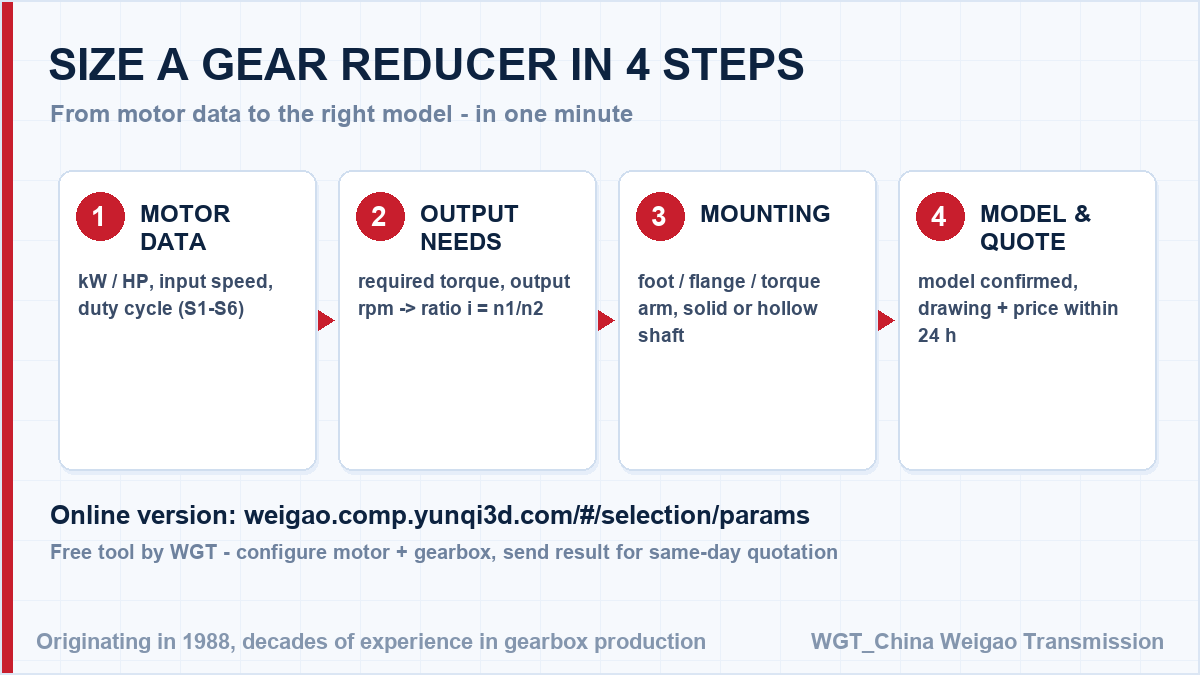
Take an MC3PLHT02 unit on a driven machine that must turn far slower than the motor. Motor speed divided by the target output speed gives the ratio, rounded to the nearest available step, and the required torque with the service factor then fixes the frame size. The same three numbers - motor speed, target output speed, required torque - are all you need; our engineers (or the online selector below) cross-check the service factor for your duty cycle.
![gear reducer selection flow chart - ratio and frame size]()
Figure: from motor data to a confirmed gearbox model in four steps.
Common Models in the M3 Series
| Model | Centre distance | Output | Typical duty |
|---|
| M3PSF50 | size 50 | solid shaft, foot | conveyors, feeders |
| M3PSF60 | size 60 | solid shaft, foot | crushers, mixers |
| M3PSF70 | size 70 | solid shaft, foot | ball mills, shredders |
| M3PSF80 | size 80 | solid shaft, foot | kilns, heavy conveyors |
| M3PSF90 | size 90 | solid shaft, foot | mill and kiln drives |
| M3RSF50 | size 50 | solid shaft, foot, right-angle | inclined conveyors, elevators |
| M3RSF60 | size 60 | solid shaft, foot, right-angle | screw classifiers, feeders |
| M3RHF70 | size 70 | hollow shaft, foot, right-angle | agitators, drum drives |
| M3PHT80 | size 80 | hollow shaft, torque arm, parallel | shaft-mounted conveyors |
| M3RHT90 | size 90 | hollow shaft, torque arm, right-angle | heavy shaft-mounted drives |
The table below shows the M3 industrial range: P builds are all-helical on parallel axes, R builds add a bevel input stage for a right-angle drive; S / H describe the low-speed shaft and F / T the mounting.
Application Cases
Sugar mill bagasse conveyor
A sugar mill moves wet bagasse on conveyors driven by industrial gear units. High moisture, fibrous material and sticky residue are the daily conditions, and the sealed housings have kept lubricant clean between oil changes.
Slag handling crane
A steelworks drives the long-travel motion of a slag-handling crane with industrial gear units on torque arms. Heat radiation from the slag pot is handled by the increased clearance and standard high-temperature paint.
![industrial gearbox applications - conveyor mixer crusher wastewater]()
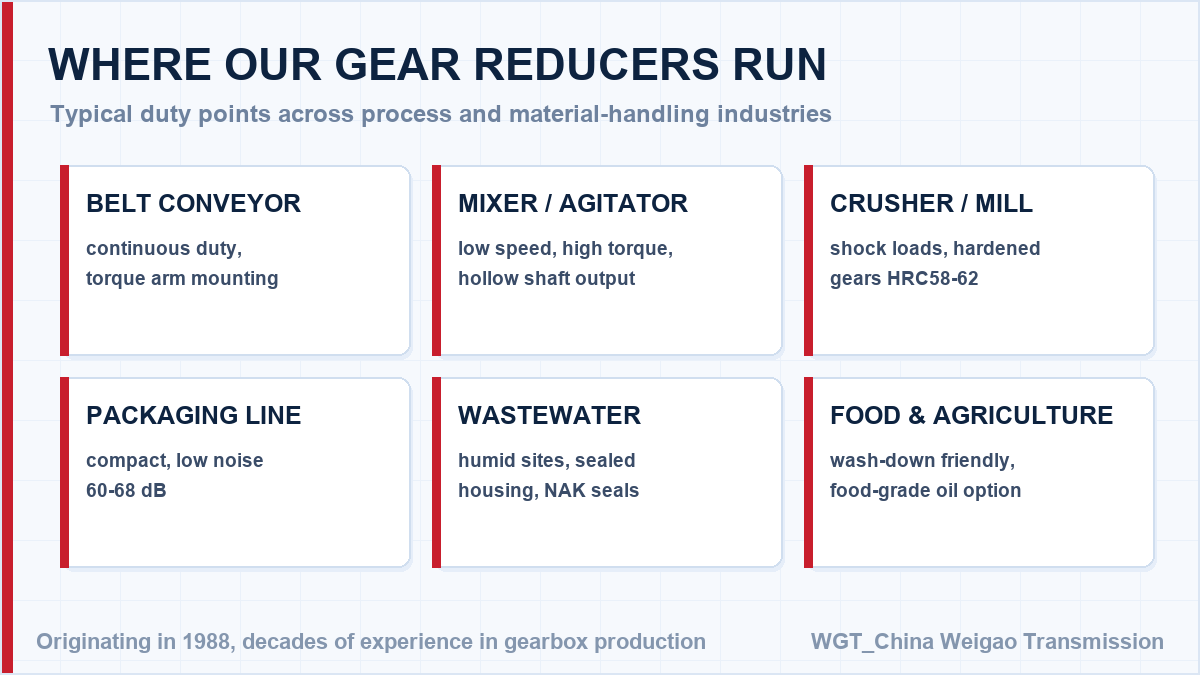
Figure: typical industries that use the WGT S-series gear reducers.
Frequently Asked Questions
Why does low backlash matter, and what is the limit?
Backlash is the small free rotation between input and output. We hold it within 20 arcmin - tight enough for indexing tables, positioning drives and reversing applications, without the cost of a precision servo gearbox.
Do you offer food-grade or washdown versions?
We can supply food-grade lubricant, FKM (Viton) oil seals and stainless fasteners for washdown areas. These units are common in bakeries, dairies and packaging halls where hygiene and moisture are daily concerns.
How do I install the unit on an inclined conveyor?
Mount the unit with the output shaft horizontal or as recommended for your mounting position, and choose the anti-run-back option so the loaded belt cannot drive the gearbox backwards when power is cut. Tell us the incline angle when you order.
Get Your Drawing and Quotation within 24 Hours
Ready to size your drive? Not sure which model fits? Try our online WGT Motor & Gearbox Online Selection System to match motor power, ratio and mounting in one minute.
Or simply send your motor data (kW, speed, duty) and driven-machine details through the inquiry button - we reply with a completed datasheet, dimension drawing and factory price the same working day. Looking for a gearbox for steel mill? Tell us the duty point and we will confirm the model in writing.