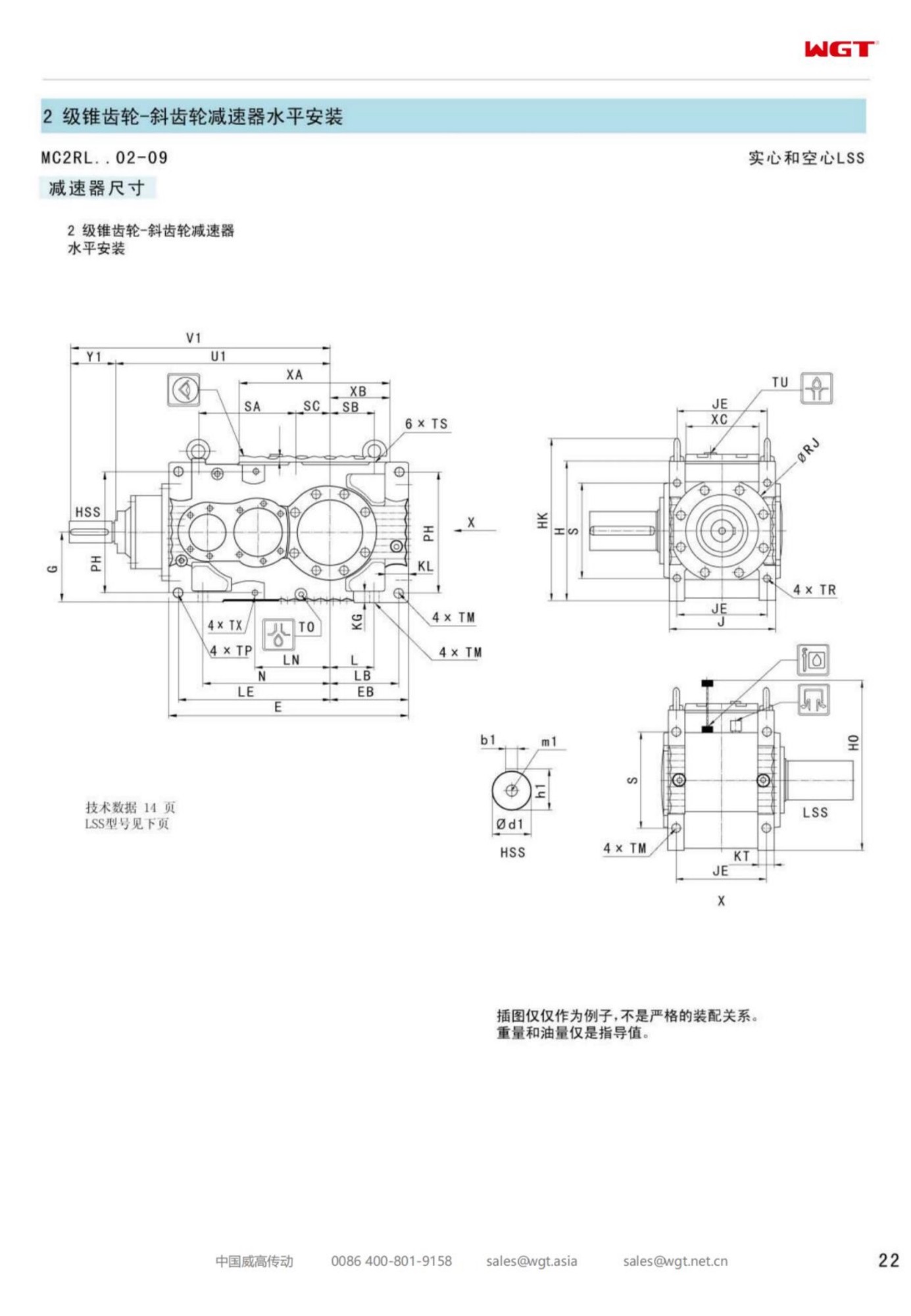
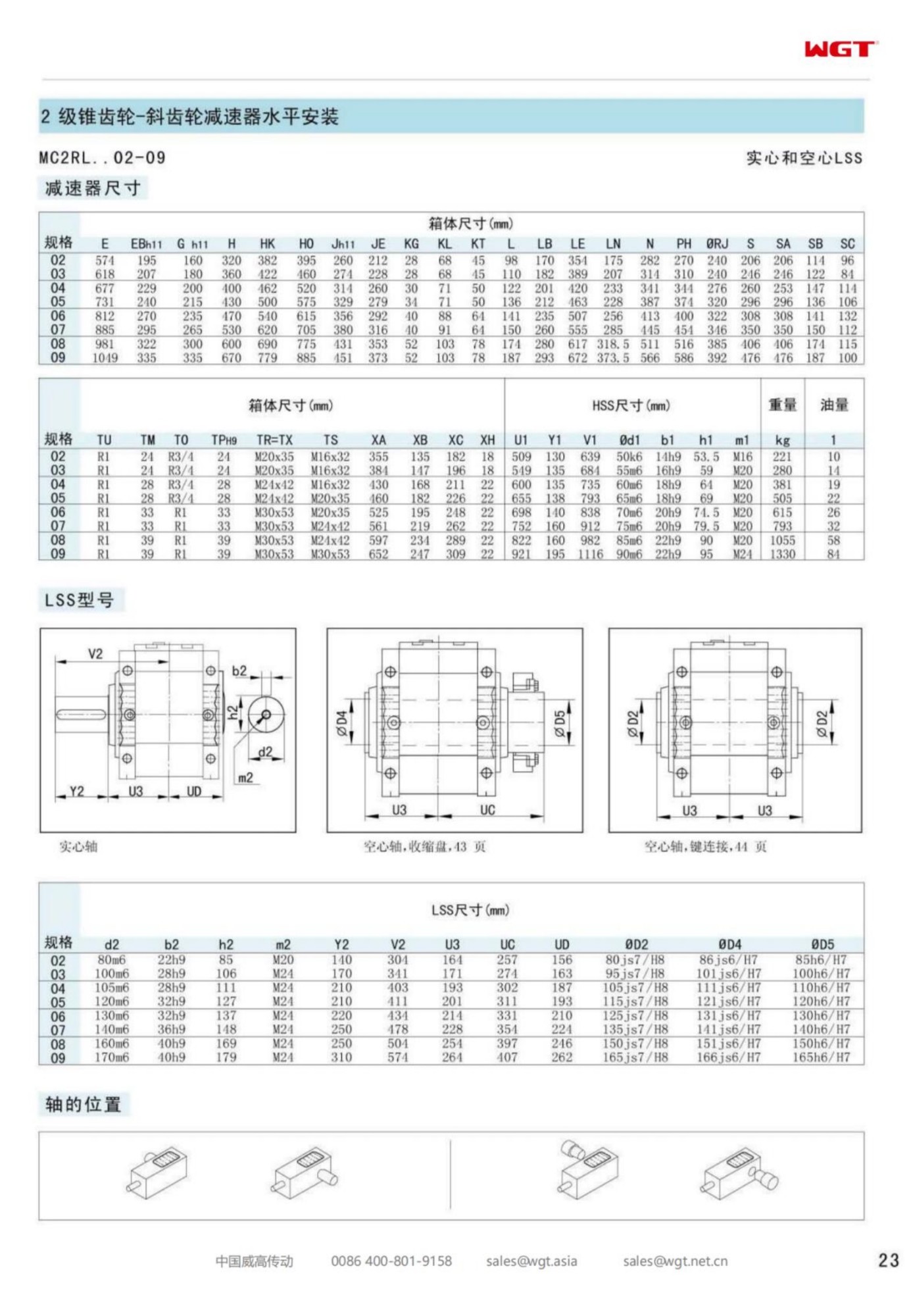
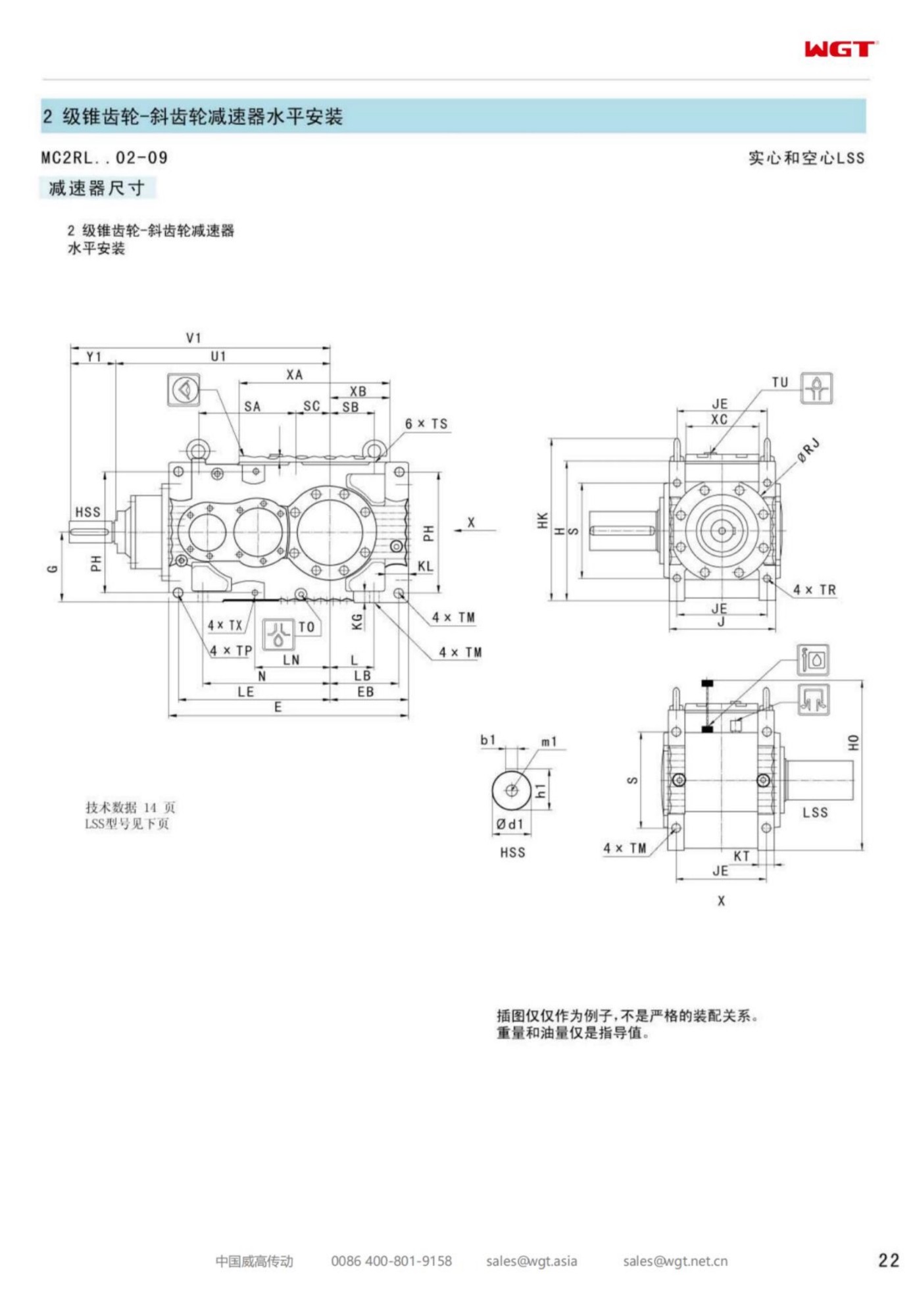
Fertiliser is a product that fights its own handling. Granules arrive warm and slightly sticky, pick up moisture from any cool surface, and shed a dust that is not just abrasive but chemically active. The MC2RLHT07 right-angle hollow shaft gear unit is the frame quoted for the conveyors between the granulator, the cooler and the bagging line, where the drive hangs on the head shaft and the motor sits out of the product path.
The notes below cover what the salt load does to a case, why the damp week matters more than the average humidity, how a recycle loop changes the load pattern, and what to put on the enquiry so the frame arrives with the right seals, paint and arm bracket.
Salt in the Air, Dust on the Case
Ammonium and potassium salts do not need to be wet to attack steel. A fine dust settles on the case, absorbs the night's moisture, and turns into a thin film of electrolyte that works on paint edges, fastener threads and shaft shoulders.
The specification that survives it is unglamorous: a paint system with proper dry film thickness, fasteners in a grade that will still turn after two seasons, and a case profile that sheds rather than collects. A smooth top cover and no upward-facing ledges are worth more here than any coating claim on a brochure.
Reading the MC2RLHT07 String
Read the code from left to right and the frame tells you what it does before the drawing arrives.
| MC | Industrial gear unit family for continuous plant duty |
| 2 | Two stages in the case - a helical set working into a bevel set |
| R | Right-angle build, the motor set clear of the product path |
| L | Level output axis along the conveyor frame |
| H | Hollow output bore keyed onto the head shaft |
| T | Torque-arm bracket reacting into the gallery steel |
| 07 | Seventh frame, above the middle of the bore ladder |
Geometry is settled by the letters. Duty is settled by the enquiry: product chemistry, granule temperature, dust loading, washing practice between recipes, and the starts a shift actually delivers.
Frame Seven on the Granulation Line
Frame seven appears where a fertiliser plant moves tonnage without moving rock: the cooler discharge belt, the recycle return, the elevator feed into screening, the take-away that fills the bagging hopper. Loads are steady but the product is not.
It carries that work with a stiff case that keeps the bevel pattern true under a pulsing belt pull, bearings sized for a long campaign rather than a demonstration, and a bore that fits the shaft the pulley really has - which is often a shaft that has been dressed once already.
Caking, Humidity and the Damp Week
One damp week does more damage than a month of dry running. Damp granules cake in the hopper, the belt starts against a solid mass instead of a stream, and the drive sees a breakaway torque that no average figure predicted.
Two defences are cheap: a service factor chosen on the caked start rather than the running load, and a control sequence that brings the belt up before the gate opens. Both are decided at the enquiry stage. Neither can be retrofitted by the maintenance team once the frame is on the shaft.
Coating Drum and the Recycle Loop
The recycle loop is where the duty pattern gets interesting. Fines that failed the screen come back, often warm and often damp, and the conveyor that carries them runs at a different rhythm from the main line: short bursts, frequent starts, and periods of idling while the screen catches up.
Idling is not free. A drive that sits still in a humid gallery cools to ambient, condenses on the case interior, and starts again with water in the oil space. A breather that filters and a short warm-up before load are the practical answers, along with oil changes timed to the campaign rather than the calendar.
Bagging Belt Starts
Bagging is a stop-start business by nature. The belt advances, the weigher fills, the bag is sealed and dropped, and the belt starts again - hundreds of times a shift on a busy line.
Starts are what wear a drive, not running hours. Each start loads the mesh, the bore and the arm pin, and a frame sized only on running torque will be the one that develops a bore fit problem in the second year. Declare the starts per hour and the restart practice at the controls; the frame and the service factor follow from those two numbers.
Torque Arm on a Retrofitted Gallery
Fertiliser plants grow by addition. A gallery built for one conveyor carries two a decade later, and the steelwork that holds the second drive was sized for a handrail.
A torque arm is the friend of that situation, because it lets the reaction go where there is structure instead of demanding a foundation that does not exist. The stay still has to land on a member designed for load: pick a column or a main beam, keep the stay short and square to the reaction, and treat the pin and bush as service items with a grease interval in the plan.
Screw and Bucket Elevator Duty
Between the granulator and the cooler there is usually a screw, and between the cooler and the screen a bucket elevator. Both start loaded, and a screw that has stood overnight with damp product in the trough starts against a plug.
For these positions the hollow-bore mount is a practical advantage: the drive sits on the shaft end, the reaction goes into the casing or the elevator leg, and there is no coupling to align in a space nobody can reach. Specify the trough or leg dimensions, the shaft end, and the cleanout practice, and the mounting follows.
Corrosion Chemistry and Fastener Choice
Not all fertiliser dust behaves the same way. Nitrate-based products are more aggressive on mild steel than urea, and a plant that changes recipe changes the corrosion case without changing a single drawing.
Ask what the plant runs today and what it might run in three years. A fastener grade and a paint system chosen for the harder product cost almost nothing at order stage and avoid the situation where a cover bolt shears off during a routine inspection because the thread has been quietly consumed.
Cleaning Between Product Changes
Recipe changes bring wash-down, and wash-down brings water to places the layout wanted dry. The drive that survives is the one whose seals were chosen for wet cleaning and whose paint was chosen for the detergent, not the one with the highest ingress claim on paper.
Where the cleaning is aggressive, consider a lip seal with a dust guard on the output side and a breather re-routed to a dry point. Both are order-time options. Both are expensive to add once the unit is hanging in a gallery above a bagging line.
Writing the Enquiry for a Fertiliser Drive
The enquiry that gets this right names the product, not just the tonnage: chemistry, granule temperature, dust character, moisture in the damp season, cleaning agents, starts per hour, shaft details, and the member available for the stay.
The reply should answer as a system: bore and key against the drawing, ratio and belt or screw speed, service factor defended on the caked start, seals named for wet cleaning, paint and fasteners for the salt load, arm geometry confirmed against the gallery. Then the drive arrives as part of the process instead of a component that has to be argued into it.
A Frame Seven Through the Campaign
Fertiliser campaigns are judged at the end, not the start. The plant that finishes on schedule usually has drives whose trend lines stayed flat, whose breathers were cleaned on the walk, and whose arm pins still had grease in them at the last inspection.
Frame seven carries its half of that bargain: gearing that holds speed, a case that shrugs off the dust, and margin reserved for the caked morning. The operator's half is the walk, the sample bottle and an enquiry that told the truth about the product. Both halves are cheap. Skipping either is not.
Salt dust, damp weeks and a caked morning start - frame seven keeps the granulation line moving:
- Cooler discharge belt at a compound fertiliser granulation plant
- Recycle fines return conveyor ahead of the screening stage
- Bucket elevator feed into the coating drum
- Bagging hopper infill conveyor on a blending line
- Bulk load-out belt under finished product silos
- Screw conveyor carrying damp product to the drier
Full Frame Range of the M3 Series
| Model | Centre distance | Output | Typical duty |
|---|
| M3PSF50 | size 50 | solid shaft, foot | conveyors, feeders |
| M3PSF60 | size 60 | solid shaft, foot | crushers, mixers |
| M3PSF70 | size 70 | solid shaft, foot | ball mills, shredders |
| M3PSF80 | size 80 | solid shaft, foot | kilns, heavy conveyors |
| M3PSF90 | size 90 | solid shaft, foot | mill and kiln drives |
| M3RSF50 | size 50 | solid shaft, foot, right-angle | inclined conveyors, elevators |
| M3RSF60 | size 60 | solid shaft, foot, right-angle | screw classifiers, feeders |
| M3RHF70 | size 70 | hollow shaft, foot, right-angle | agitators, drum drives |
| M3PHT80 | size 80 | hollow shaft, torque arm, parallel | shaft-mounted conveyors |
| M3RHT90 | size 90 | hollow shaft, torque arm, right-angle | heavy shaft-mounted drives |
Every frame in the table can be ordered with alternative shaft and mounting styles. If you are matching an existing installation, send the nameplate details and we confirm the equivalent frame in writing.
Installation Snapshots
Stacker-reclaimer travel drive
A bulk terminal drives the travel gear of a stacker-reclaimer with units. Long-travel duty with frequent direction changes is smoothed by the ground gearing, and backlash stays within 20 arcmin over the full rail length.
Automatic parking system
A parking equipment manufacturer uses reducers on its puzzle-type car stackers. The hollow shaft takes the drive axle directly, and the quiet 60-68 dB operation suits installations inside residential buildings.
Selection Example: Cooler discharge belt at a granulation plant
Take a 37 kW motor at 1480 rpm turning the belt at 48 rpm. The ratio follows directly: 1480 / 48 = 30.8, so a ratio near i=31 comes out of the two-stage right-angle band, and the service factor is argued on the caked start after a damp week rather than on the running tonnage, with the wash-down chemistry named in the same line. In this case frame seven carries fertiliser duty with salt-tolerant paint and fasteners, a dust lip ahead of the output seal, and an arm stay taken into the gallery beam. Use the same method for any frame in the series, then confirm the service factor with us - it is the one number buyers most often get wrong.
![speed reducer selection process diagram]()
The selection path we follow when checking your enquiry.
Technical Q&A
Can I reuse my existing couplings and foundations?
Yes. Centre distances, shaft dimensions and flange bolt patterns follow the common industry standards, so couplings, guards and foundations do not have to be redesigned. Send the nameplate details and we confirm the equivalent frame in writing.
Can the reducer be used outdoors or in a washdown area?
Standard paint and NAK seals suit sheltered outdoor duty. For washdown or coastal sites specify the heavy-duty coating, FKM seals and stainless fasteners; for humid rooms we recommend the breather and oil-check routine in the manual.
![speed reducer use cases across sectors]()
Typical installation environments for this gearbox family.
OEM Framework Pricing and Reserved Capacity
Building machines in series? One screen in the WGT Motor & Gearbox Online Selection System is usually enough to pin down the frame size; we confirm the service factor afterwards.
For OEM programmes we hold framework prices and reserve production slots for scheduled call-offs, so your line never waits on a gearbox. Ask for the framework terms with your first enquiry. Looking for a speed reducer for cement plant? Tell us the duty point and we will confirm the model in writing.