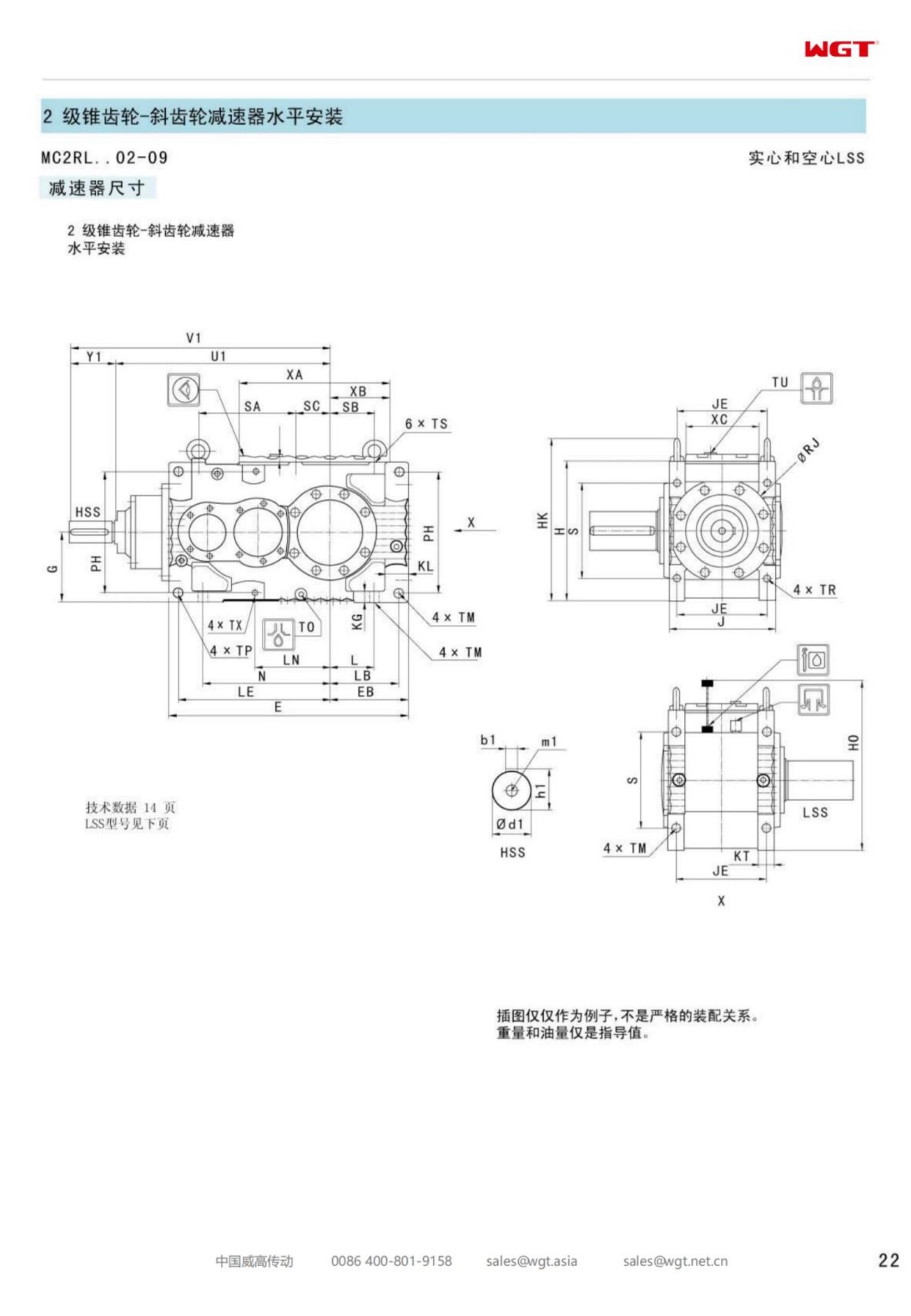
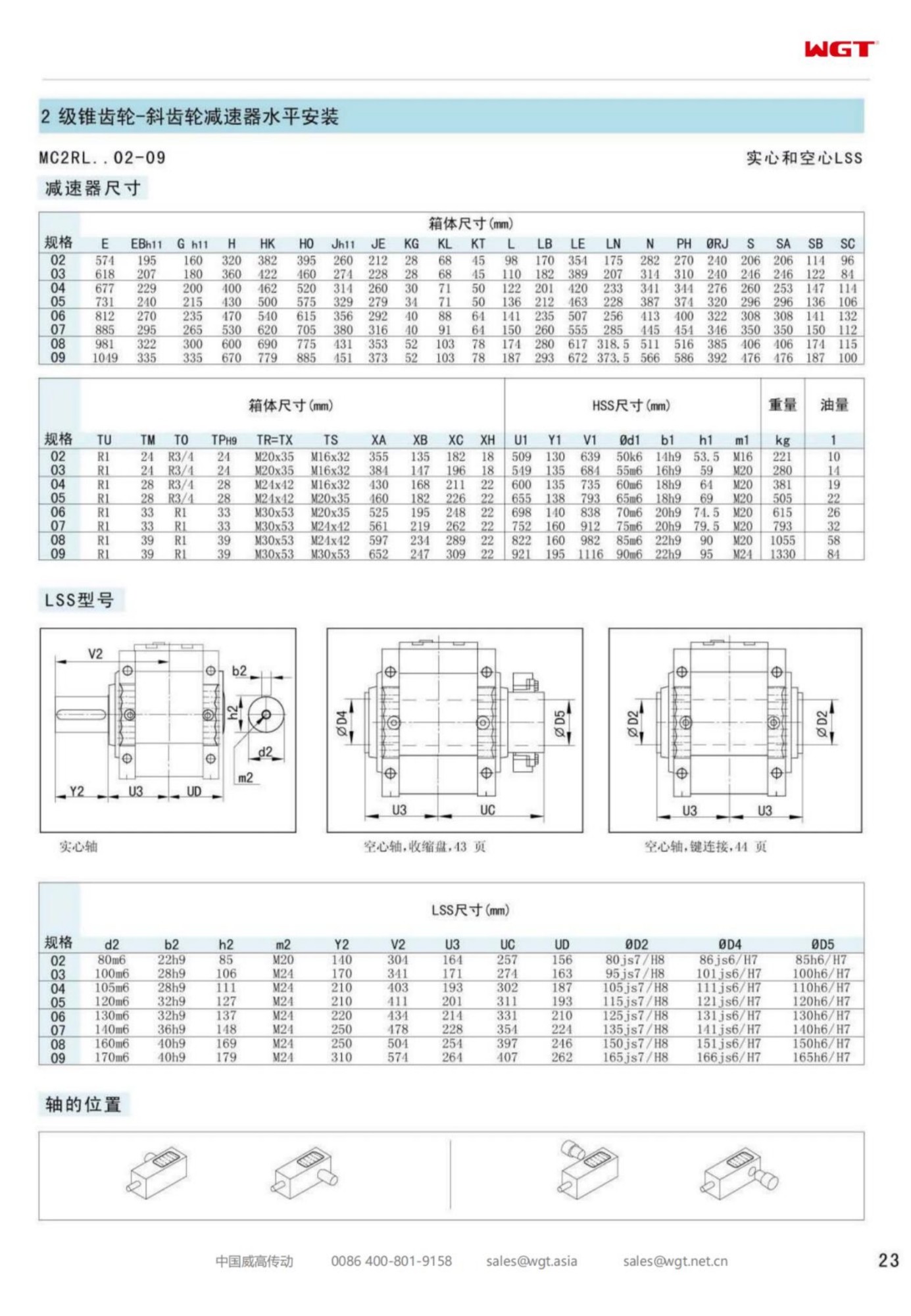
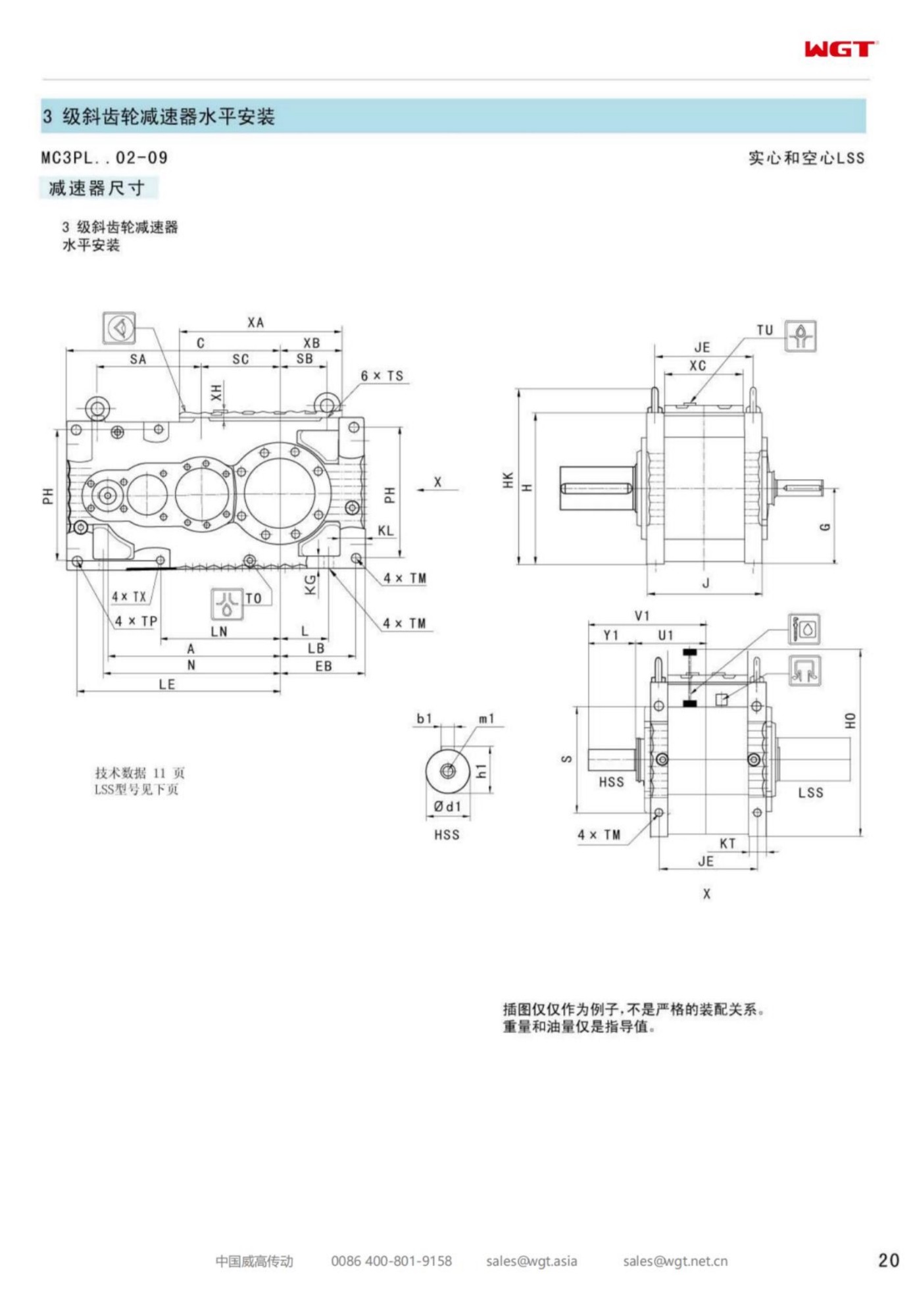
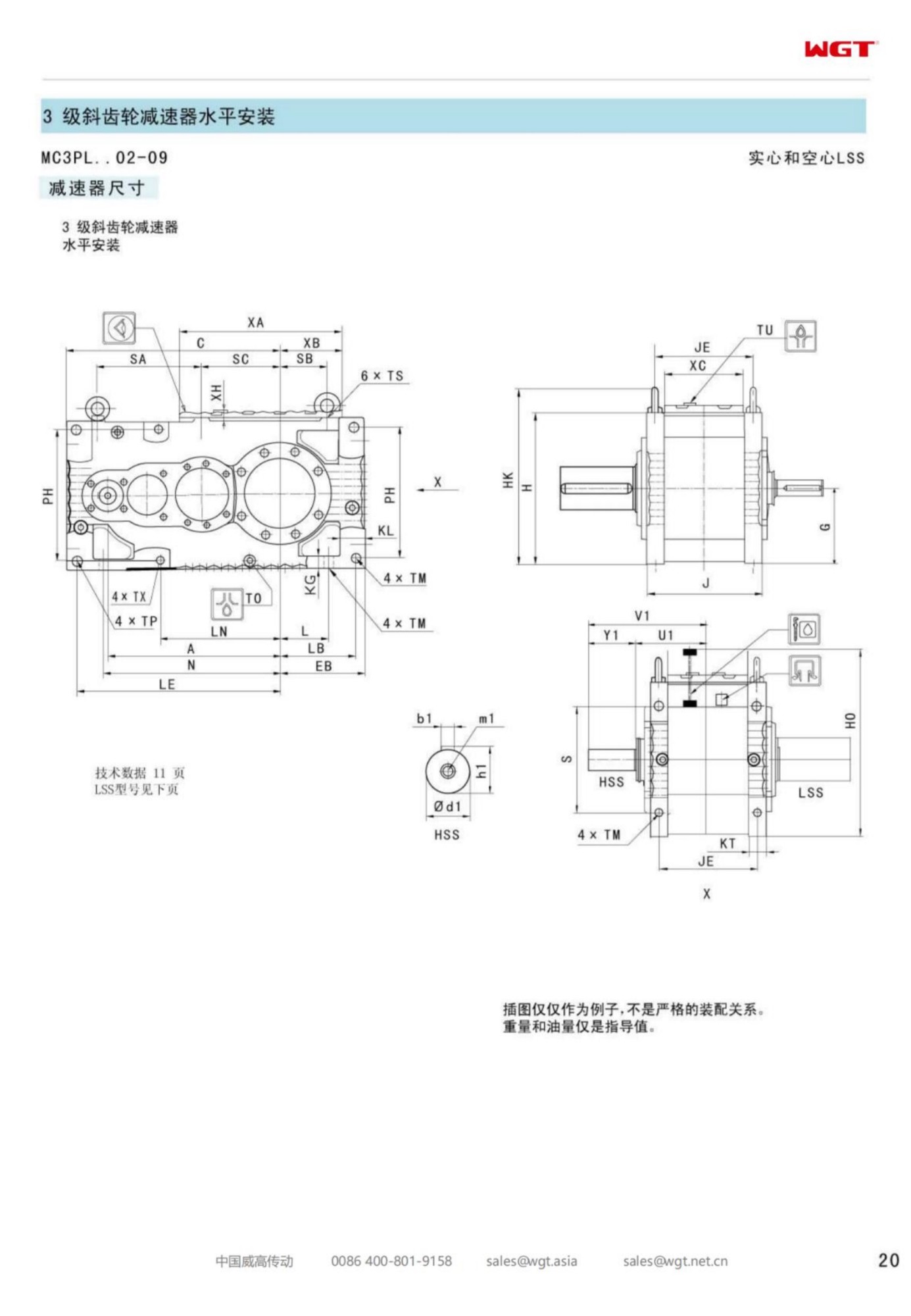
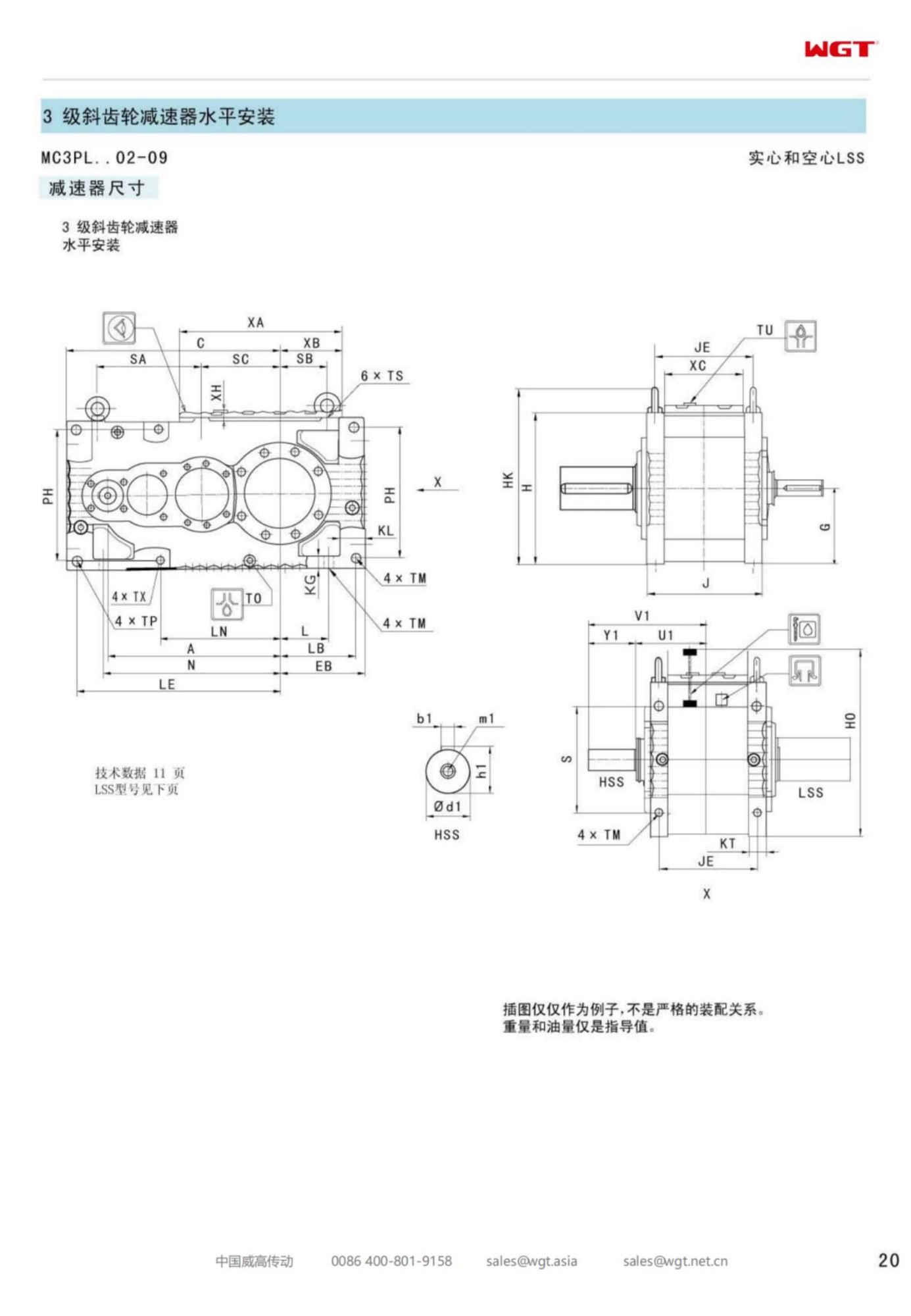
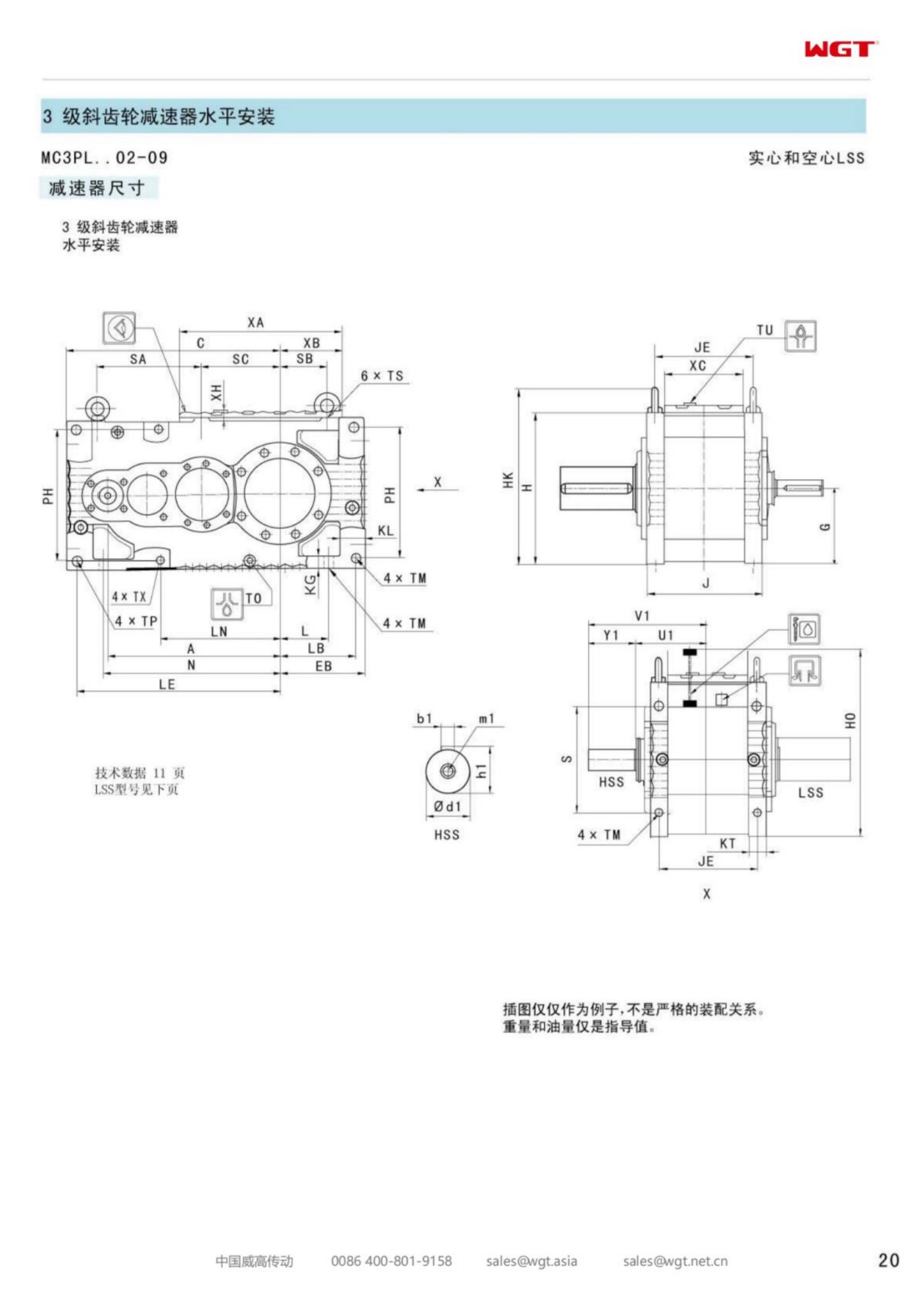
Sugar is a material that behaves like no other bulk solid a gearbox meets. It flows when dry and warm, sets like concrete when damp, and its dust finds every warm surface in the building. Around the diffuser and the milling train, drives also wash in hot water, breathe syrup-laden air, and run flat out for the whole crushing season. The MC2RLHF06 right-angle hollow shaft gearbox is the frame this family quotes for that floor - carrier conveyors through the mill, diffuser screws, and the bagasse runs that carry fibre out to the boiler yard.
This page is written for mill engineers and their fitters: why crystalline sugar loads a drive unlike grain or stone, what hot-water wash-down does to a shaft-mounted case, how juice and condensate attack paint and seals, and what a crushing campaign asks of a frame that cannot stop until the season does. It closes with the enquiry sheet that keeps the right frame arriving before the next campaign starts.
Frame Six in the Sugar House
Frame six sits where sugar handling stops being a few small conveyors and becomes the spine of the plant. Carrier and intermediate belts between the shredder and the diffuser, the main extraction screw itself, and the bagasse runners out to the boilers all fall into this band. Torque is high, speed is slow, and the building around the drive is warm, wet and sweet all at once.
What the frame contributes is slow-turning strength. At diffuser speeds the gears work at high torque for every revolution, so tooth contact, bearing capacity and seal quality matter more than any catalogued power figure. A frame chosen for this floor is chosen for its ability to push steadily for a hundred days without a rest.
Reading the MC2RLHF06 String
The type code reads the same as its siblings, and on the mill floor each letter earns its place.
| MC | Industrial gear unit family built for continuous plant duty |
| 2 | Two gear stages, one helical pair and one bevel pair in a right-angle case |
| R | Right-angle layout, motor at ninety degrees to the conveyor or screw axis |
| L | Horizontal build, output axis parallel to the ground |
| H | Hollow output bore, the screw or carrier shaft passes straight through |
| F | Footed housing with reaction pads against the mill steel |
| 06 | Sixth frame, the heavy end of the extraction-line band |
The string fixes geometry; the order must carry the sweet side of the story. Cane or beet, the extraction route, wash-down temperature and frequency, the ambient the floor actually reaches in high summer, and the campaign length between overhauls. Sugar plants that declare these openly receive frames whose seals, paint and oil grades were picked for their building, not for a catalogue photograph.
Sticky Product and the Crystallisation Problem
Dry sugar is a nuisance; damp sugar is an adhesive. Spillage that lands on a case top or around a seal housing absorbs moisture overnight and becomes a caramel that glues dust, fibre and insects into a hard crust. Left alone, that crust holds water against paint and steel and slowly becomes a corrosion cell the paint never intended to fight.
The defence is routine rather than coating: spillage cleared on the shift it falls, case tops wiped at the same walk that checks the oil, and seal lands kept clean enough that a lip is never asked to run over set sugar. Plants that treat crystallisation as a housekeeping fact keep their drives painted and sealed for a decade; plants that scrape crusts off once a year buy paint and seals instead.
Bagasse Fibre and Wrapped Drives
Bagasse is the stringy villain of the mill floor. Fibre wraps rotating shafts, packs into guard gaps, and ropes itself around anything warm and turning, including the coupling and the input end of a shaft-mounted unit. A wrapped drive runs hot at its seals, hides leaks under fibre, and turns a two-minute repair into a shift-long unwrapping exercise.
Specification and layout both help: smooth guards with clearances that shed fibre, breathers positioned and shrouded so rope cannot reach them, and an inspection route that looks under the fibre for the oil weep it hides. A gearbox on bagasse duty is never really hidden - it is only as clean as the last walk past it.
Hot Wash-Down Around the Mill Floor
Sugar houses wash with hot water, and a shaft-mounted case on a wash-down floor collects that water exactly where gravity wants it: along the head shaft, into the case joint, under the output seal lip. Hot water is gentler than a cold hose on bearings but crueler on paint, softening some systems and lifting others at every chip and scratch.
The practical answer is a wash plan written for the drive, not just the floor: breathers bagged or capped during washing, drains and joints checked after every wet campaign, a paint system specified for hot-water splashing rather than mere humidity, and touch-up done the week the first blemish shows, not the month after. Washing keeps the plant hygienic; the drive survives it by plan, not luck.
Juice, Condensate and Sweet Corrosion
Juice mist and condensate carry sugar into places hands never reach - inside guards, under brackets, along cable trays above the case. There the film dries and rewets on every shift, and bare steel under a scratched paint line loses the argument quietly. Corrosion on a mill drive rarely starts with a dramatic spill; it starts with a drip nobody claimed.
Order-time answers are cheap: a coating system chosen for sugary wet atmospheres, stainless or plated fasteners at the points splashing reaches first, seal lip materials matched to the wash chemistry, and a breather that filters what the building breathes. Mill floors that walk their drives monthly with a torch find rust as a freckle; floors that wait for the campaign end find it as a repair.
Torque Swings from the Diffuser Floor
Extraction is a choppy business at the slow end. Fibre mat density changes with the cane, wash water arrives in slugs, and an imbibition upset can load the diffuser screw unevenly for an hour at a time. The drive sees this as a torque trace with peaks, not a flat line - and slow, high-torque peaks are exactly the load case that ages gear teeth and press-fits fastest.
Frames specified against the trace rather than the average behave differently over a campaign: keys stay tight, shrink fits stay true, and the tooth pattern found at overhaul still looks like the one in the textbook. The enquiry should ask for the worst trace the control system recorded; the reply should size the frame against it and say so in writing.
The Campaign Season and Its Intensity
A sugar mill runs its year in one long breath. When crushing starts, the plant runs until the crop is done - weeks or months without a scheduled pause - and every drive on the extraction line is part of that promise. Maintenance happens in the window the season allows: quick checks on the run, real work deferred to the stop.
Frame six is built for that rhythm. Oil capacity sized for continuous slow-turning duty, bearings chosen for their L10 life at campaign length, and a design that treats the mid-season stop as abnormal. The mills that sail through a campaign are the ones that finished the last one with a list and spent the off-season clearing it - the drive's campaign is won in the off-season, every time.
Bore, Keyway and the Diffuser Screw Shaft
On a hollow-bore mounting the fit is the alignment, and a diffuser screw shaft is a long, working member that deserves measuring rather than assuming. Diameter and keyway at the seat, seat length against the case spigot, and the screw's own hanger or end bearings checked before the unit goes on - a sagged screw cannot be rescued by any bore, and an out-of-square seat writes its complaint into the seal within weeks.
Fit-up records belong in the mill file: what was measured, where the clearance sat, which shims were used. Three seasons later, when the unit comes off for a campaign overhaul, that record is the difference between a planned two-day job and an archaeological dig.
Oil, Heat and the Sweet-House Sump
A warm building, slow gears and continuous duty add up to a sump that runs hotter than the ambient suggests, and sugar dust does nothing to help the case shed it. Oil age accelerates quietly, and a weep under the head shaft becomes sticky within a shift, advertising itself to every particle in the air.
The discipline is small and pays for itself: level and temperature logged at the same mark on the same walk, samples drawn mid-campaign and at season end, changes made with the same grade from a sealed drum, and the magnet read at every change. A sump treated as an instrument tells the mill what the drive endured - and the records argue the next frame's specification far better than a brochure.
Writing the Enquiry for a Mill Drive
The enquiry that works for this floor declares the sweet facts plainly: shaft diameter, keyway and seat length measured at the screw or carrier; output speed; the worst torque trace the season recorded; wash-down temperature and frequency; juice or condensate exposure by zone; campaign length between overhauls; and the reaction steel available for the bracket.
The reply should answer item by item: bore and keyway against the drawing, ratio and speed at the screw, service factor defended against the recorded trace, seals and paint named for the wash and the atmosphere, oil graded for the sump temperature the floor actually reaches. One page there, one page back - and the frame that arrives before the next campaign is specified for sugar as it really is, wet and sticky and unstoppable.
A Frame Six Through a Crushing Campaign
The verdict on a mill drive is written at season end, when the case is wiped and the oil is sampled and the tooth pattern finally gets its look. Frames that come through clean were hung on measured shafts, washed by a plan rather than a habit, kept free of set sugar by a walk that never skipped, and sized against the torque the floor actually produced.
Frame six carries its half of that bargain with slow-turning strength, seals and paint picked for the sweet house, and margins argued from the trace rather than the table. The mill's half is the walk, the wash plan and the honest enquiry. Mills that pay both halves start every campaign with the same drives they ended the last one with - and that continuity is worth more than any single purchase price.
Crystalline sugar, bagasse fibre and a floor washed with hot water - frame six runs the mill line:
- Diffuser screw drive on a raw sugar juice extraction line
- Intermediate carrier conveyor through a cane milling train
- Bagasse conveyor from the final mill to the boiler fuel yard
- Sugar dryer discharge conveyor at a refinery packing plant
- Molasses-area transfer conveyor under a crystallisation floor
- Pelletised sugar transfer line at an export terminal
Selection Example: Diffuser screw drive on a raw sugar juice extraction line
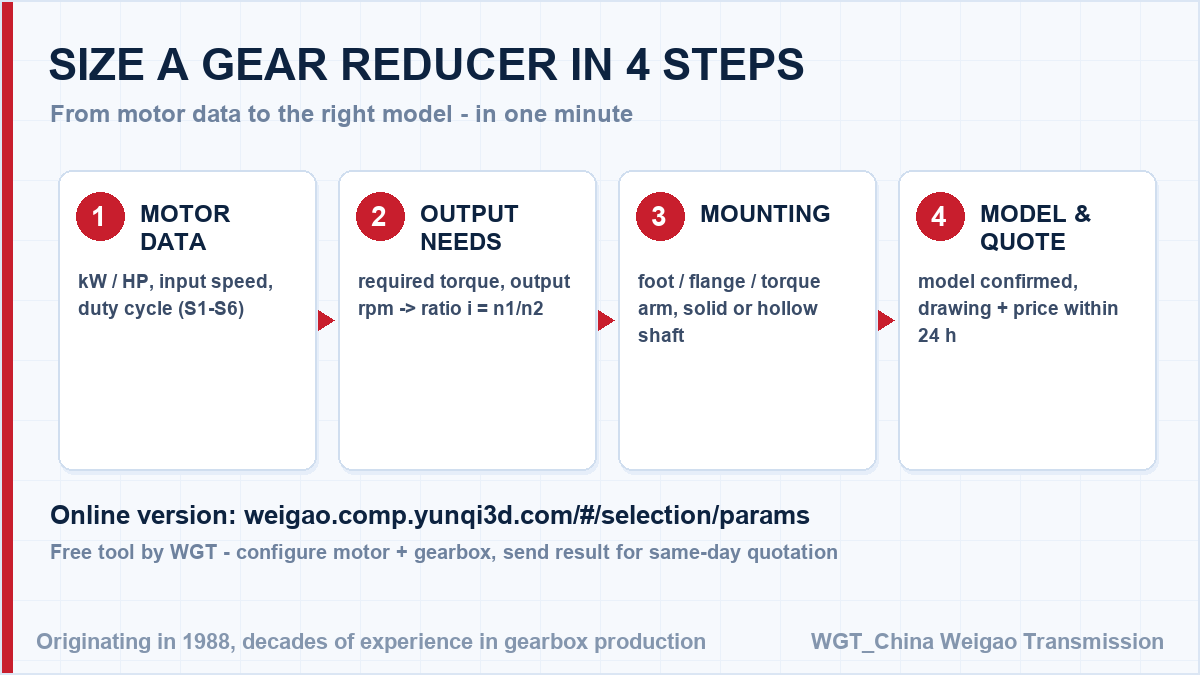
Take a 45 kW motor at 1480 rpm turning the diffuser screw at 24 rpm. The ratio follows directly: 1480 / 24 = 61.7, so a ratio near i=62 comes out of the two-stage right-angle band, and the frame is confirmed against the worst torque trace the crushing season recorded rather than the running load, with the wash-down and juice-exposure zones declared beside the ratio. In this case frame six carries the mill duty on slow-turning strength - seals and paint picked for hot wash-down and a sweet wet atmosphere, and oil graded for the sump temperature the floor actually reaches. The same three numbers - motor speed, target output speed, required torque - are all you need; our engineers (or the online selector below) cross-check the service factor for your duty cycle.
![gear reducer selection flow chart - ratio and frame size]()
Figure: from motor data to a confirmed gearbox model in four steps.
Common Models in the M3 Series
| Model | Centre distance | Output | Typical duty |
|---|
| M3PSF50 | size 50 | solid shaft, foot | conveyors, feeders |
| M3PSF60 | size 60 | solid shaft, foot | crushers, mixers |
| M3PSF70 | size 70 | solid shaft, foot | ball mills, shredders |
| M3PSF80 | size 80 | solid shaft, foot | kilns, heavy conveyors |
| M3PSF90 | size 90 | solid shaft, foot | mill and kiln drives |
| M3RSF50 | size 50 | solid shaft, foot, right-angle | inclined conveyors, elevators |
| M3RSF60 | size 60 | solid shaft, foot, right-angle | screw classifiers, feeders |
| M3RHF70 | size 70 | hollow shaft, foot, right-angle | agitators, drum drives |
| M3PHT80 | size 80 | hollow shaft, torque arm, parallel | shaft-mounted conveyors |
| M3RHT90 | size 90 | hollow shaft, torque arm, right-angle | heavy shaft-mounted drives |
The table below shows the M3 industrial range: P builds are all-helical on parallel axes, R builds add a bevel input stage for a right-angle drive; S / H describe the low-speed shaft and F / T the mounting.
Application Cases
Wood chipper line
A board mill drives its drum chipper with a heavy-duty gear unit. Knife engagement shocks arrive several times a second, and the case-hardened gearing with generous bearing spans has shown no measurable wear.
Fertiliser plant drag chain
A fertiliser complex runs drag-chain conveyors on industrial gear units in a corrosive atmosphere. The heavy-duty epoxy coating and FKM seals have kept the units presentable and leak-free through several campaign cycles.
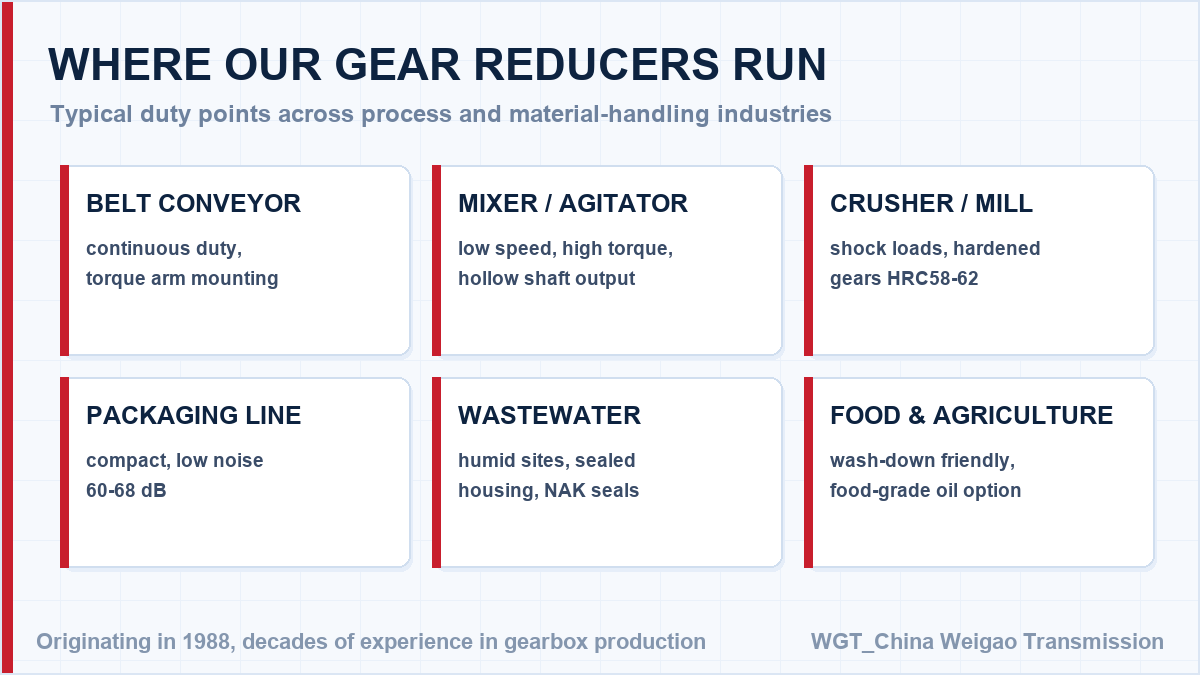
![industrial gearbox applications - conveyor mixer crusher wastewater]()
Figure: typical industries that use the WGT S-series gear reducers.
Frequently Asked Questions
Can existing motors, couplings and guards be reused?
In most upgrade projects yes: because input and output interfaces follow the common industry dimensions, the existing motor, coupling and guard usually bolt straight on. Send the old nameplate and we confirm before you order.
What happens if my duty changes after installation?
Send us the new duty point. A revised torque and service-factor calculation is free of charge, and the answer is usually one of three: the unit is fine, add an oil change interval, or plan a frame change at the next shutdown.
Can this unit mount on my existing installation without redesign?
Yes - the series is manufactured to the same centre distances, shafts and flange dimensions of the common industry frames, so couplings, guards and foundations stay untouched.
Fast Quotation for OEM and Repeat Orders
Buying one unit or one hundred? Not sure which model fits? Try our online WGT Motor & Gearbox Online Selection System to match motor power, ratio and mounting in one minute.
Single units ship on the same production route as batch orders, with no minimum-order surcharge. For OEM programmes we hold framework pricing and reserve capacity for your scheduled call-offs. Looking for a gearbox for wastewater treatment? Tell us the duty point and we will confirm the model in writing.