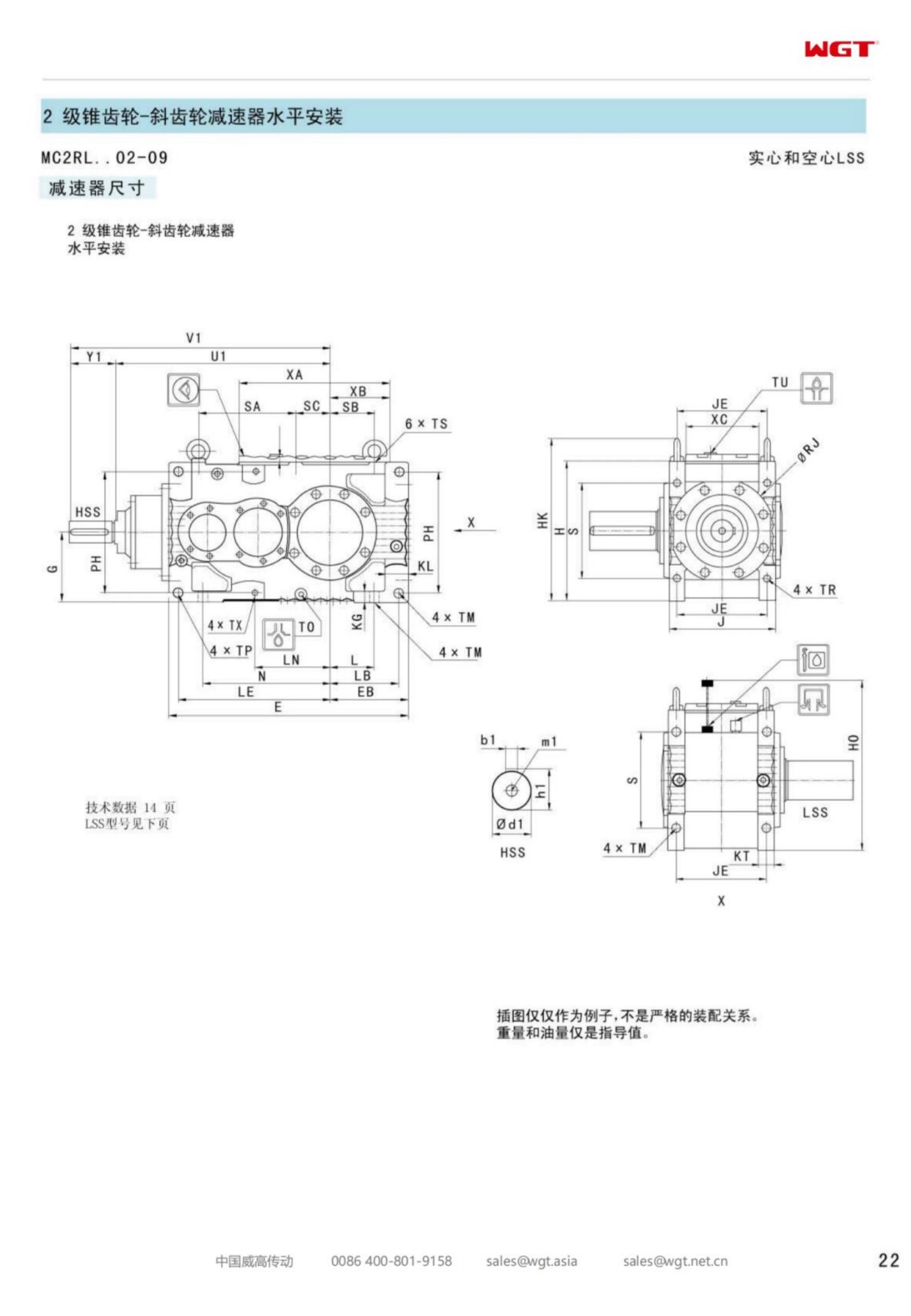
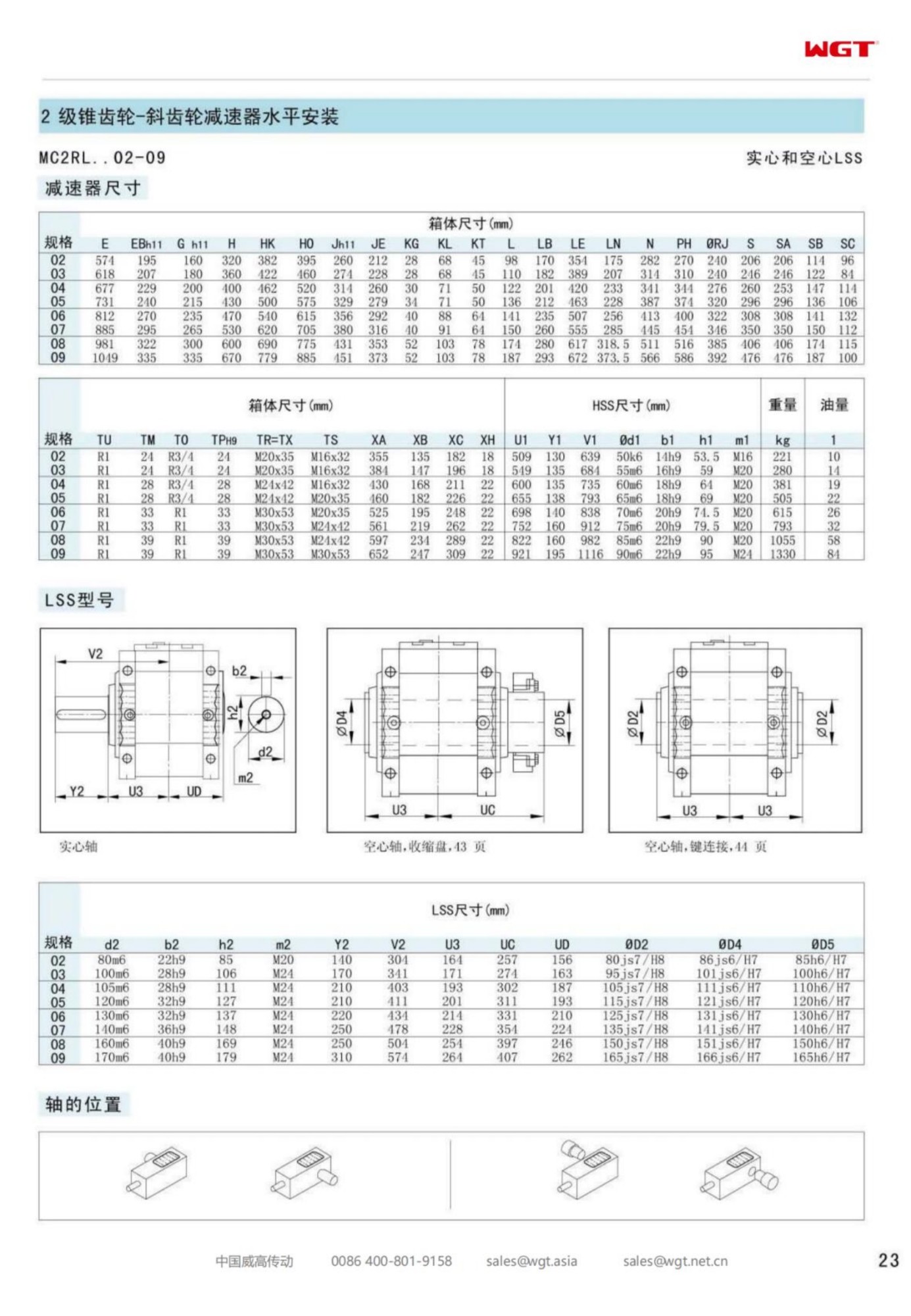
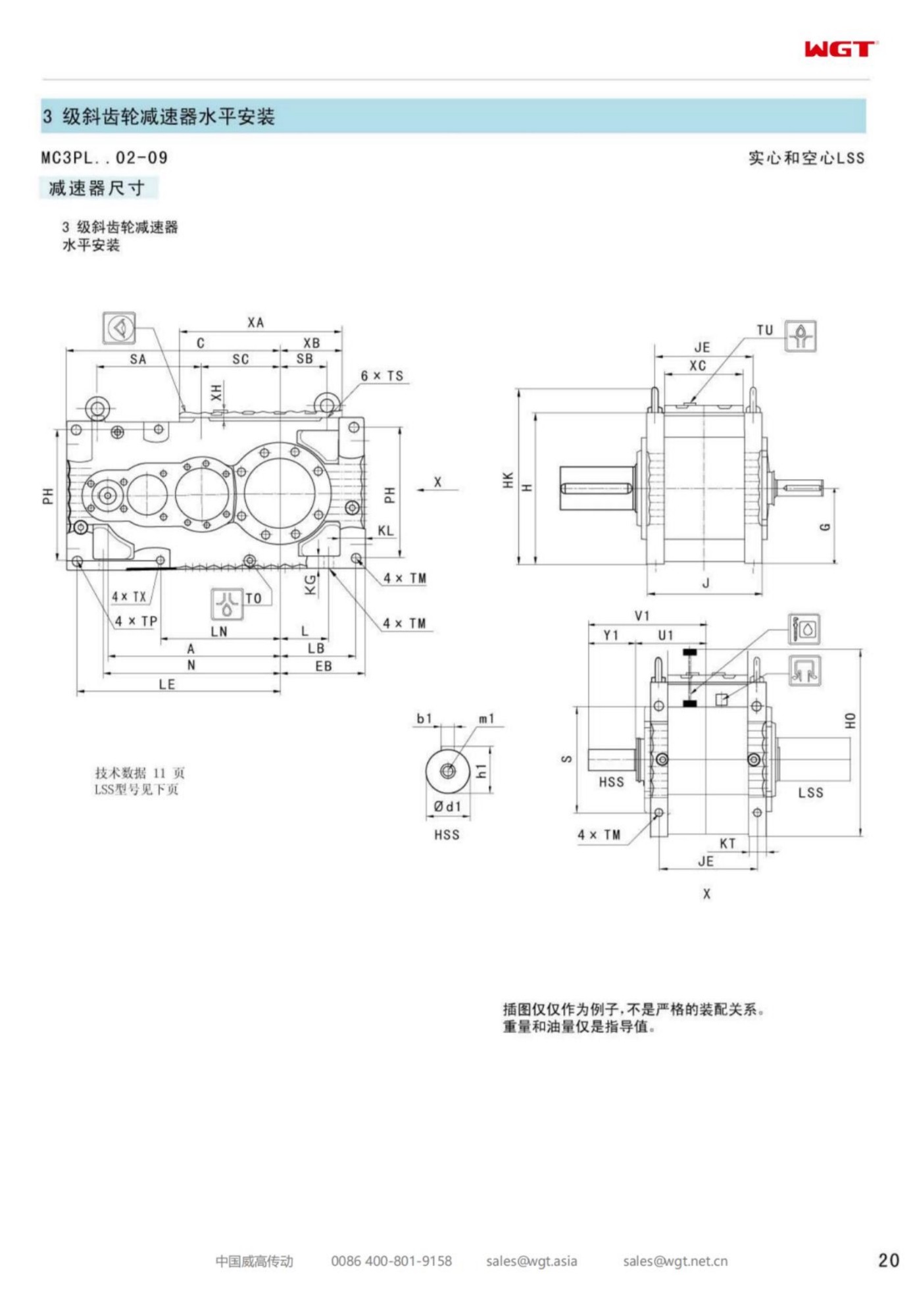
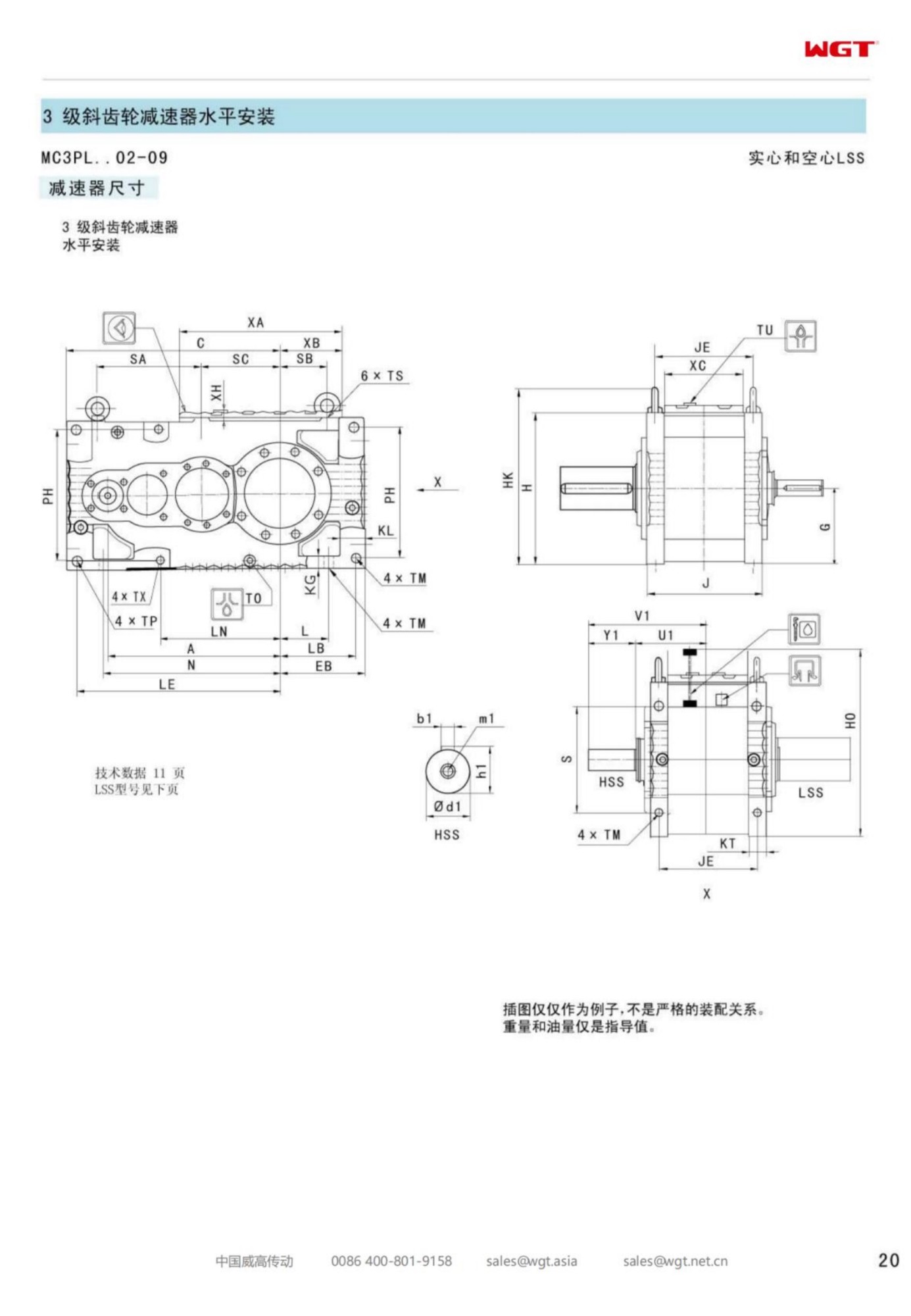
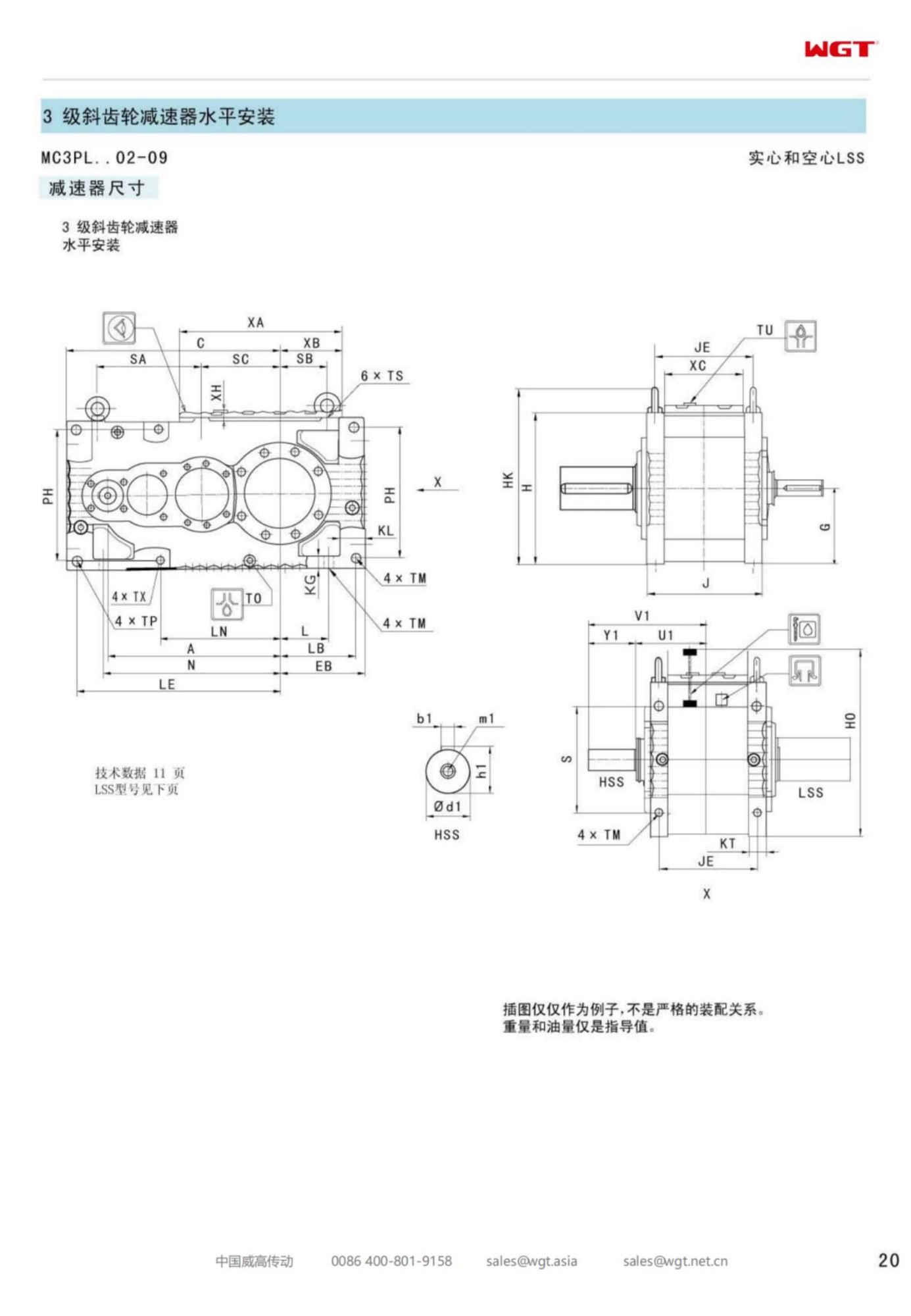
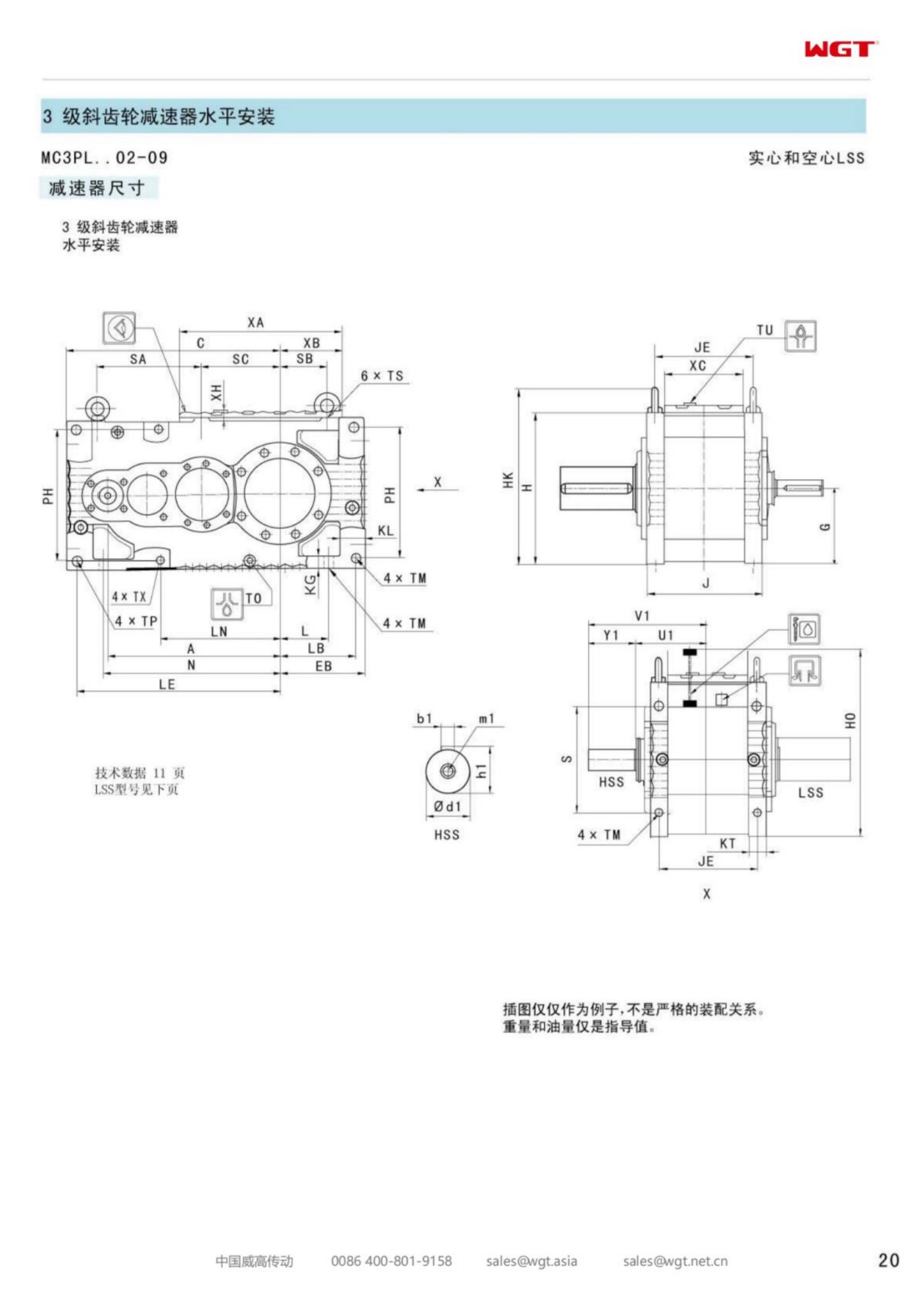
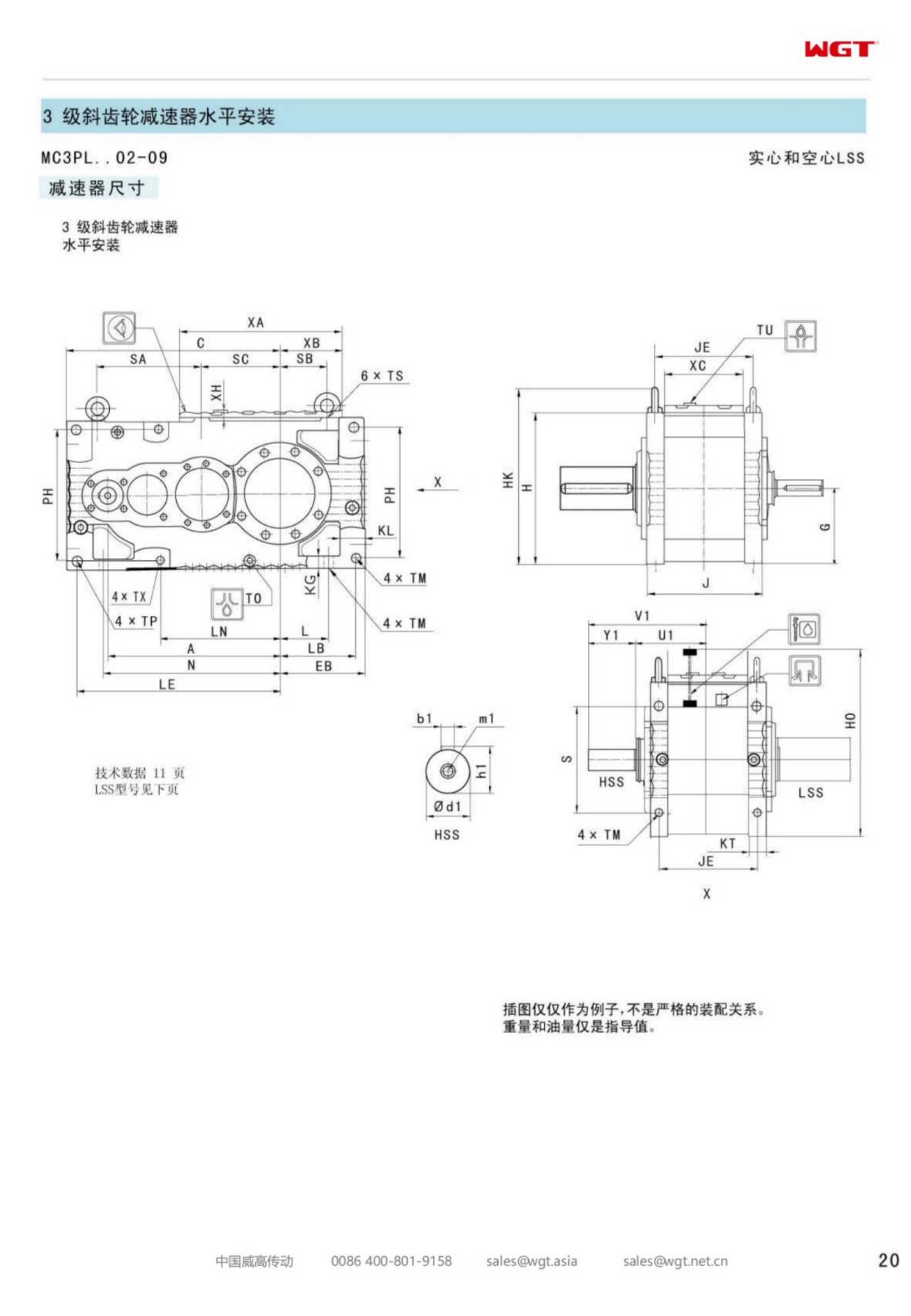
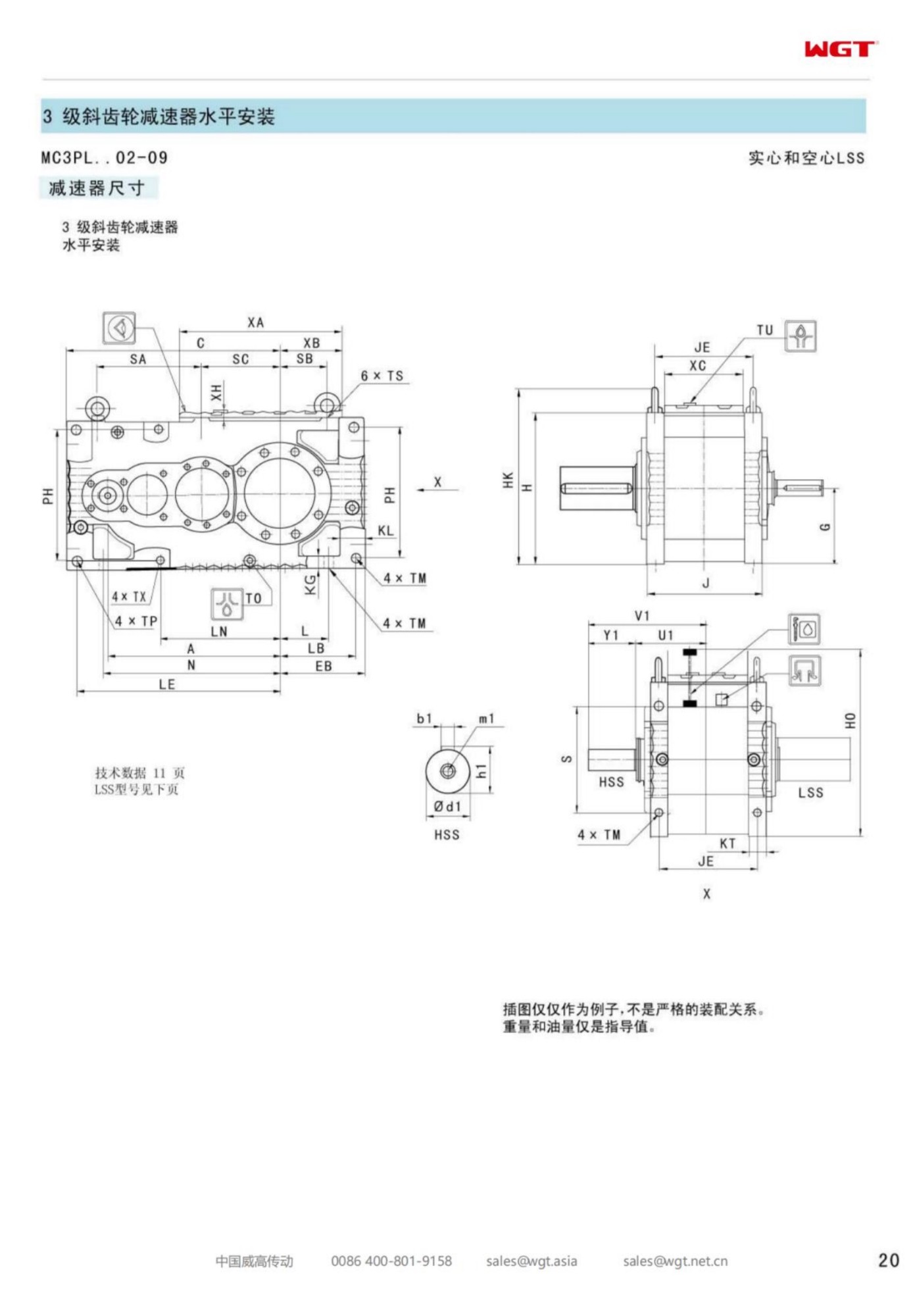
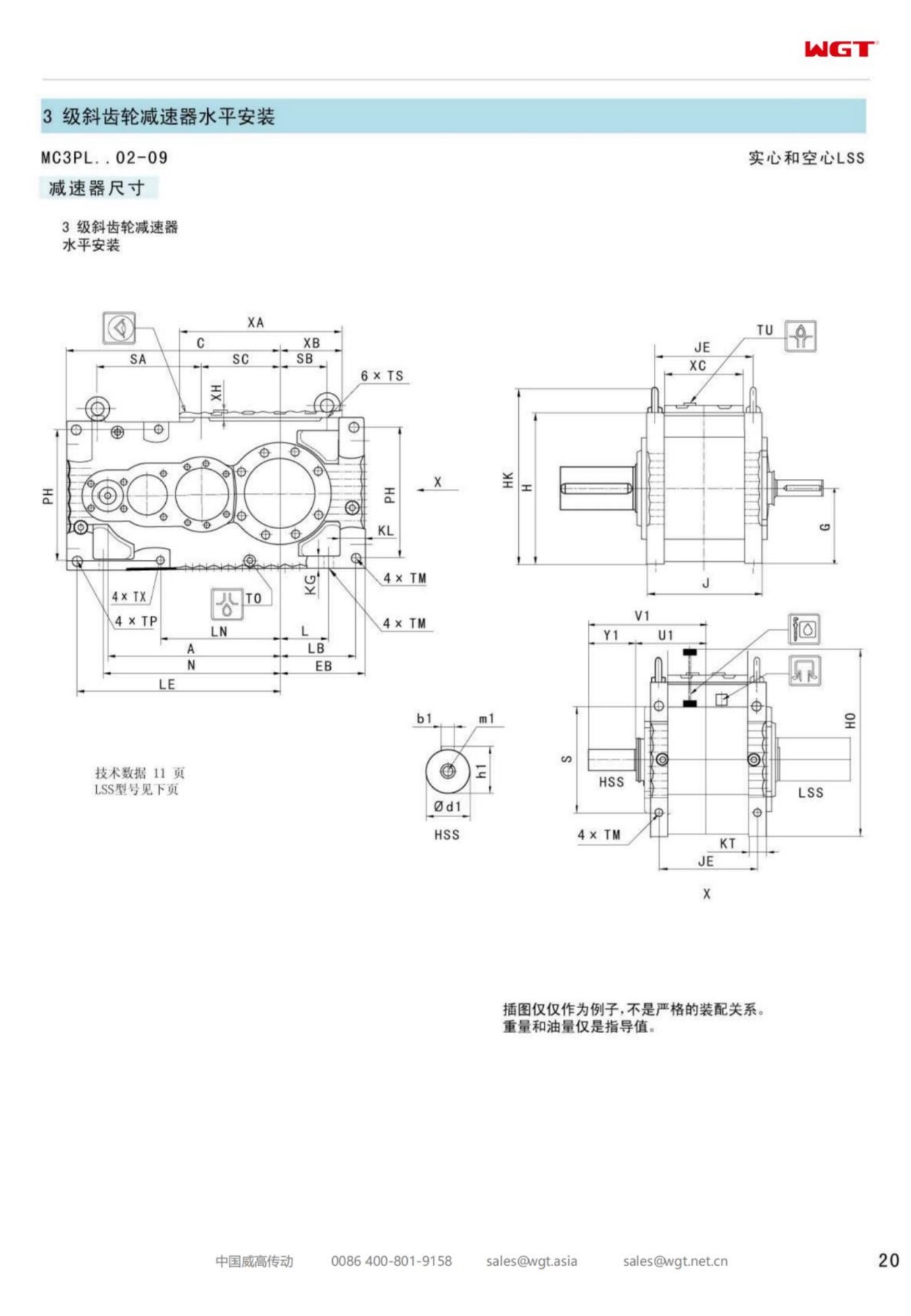
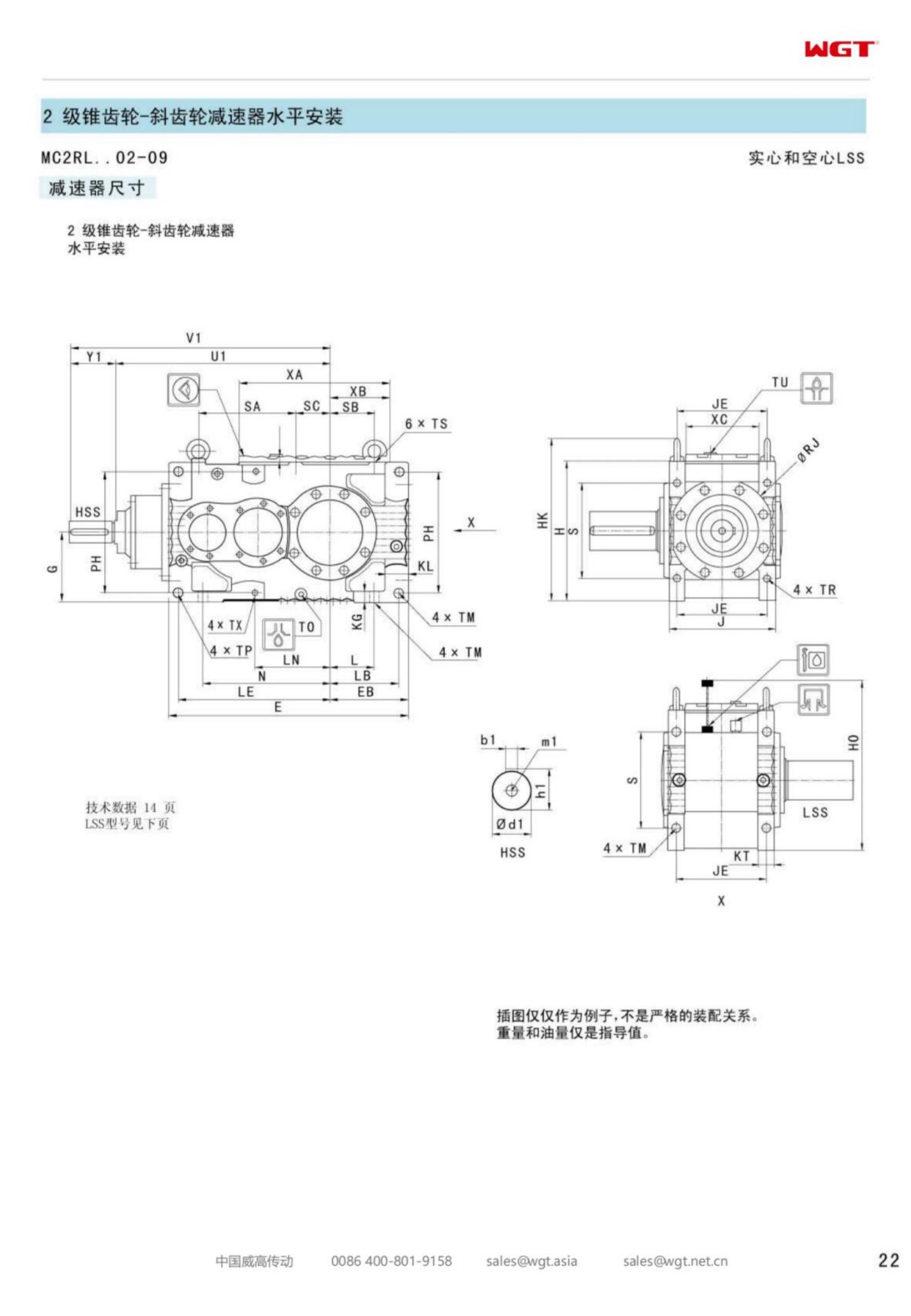
Biomass fuel is the material a gearbox hopes never to meet. It is stringy enough to wrap, wet enough to bridge, light enough to fool a rating table, and it lives beside a boiler house that radiates heat all year. The MC2RLHF05 right-angle hollow shaft gear unit is the frame this family quotes for that world - screw feeders under day silos, drag chains into boiler hoppers, and the reclaim belts that keep a boiler fed around the clock.
This page covers what a fuel-handling line actually asks of a drive: why a duty that swings is harder than a duty that runs heavy, what wet-dry cycling does to seals and corrosion, how heat and combustible dust change the specification, and what an enquiry must declare so the frame that arrives is the frame the yard needed. Frame five carries a full step of capacity above frame four and keeps the same shaft-mounted logic.
Frame Five in the Fuel Yard
Frame five is the rung where fuel handling becomes a plant-scale system: day silos feeding a combined heat and power boiler, hog fuel conveyors at a sawmill, refuse-derived fuel metering into a waste-to-energy line. The common thread is not torque but variability - no two hours of fuel are alike, and the drive feels every difference.
What the frame contributes is headroom with manners: enough rating to carry the heaviest wet batch without sweating, and enough reserve that the lightest batch never runs the gears near a resonance. On a duty defined by its swings, the frame that wins is the one whose worst day is a Thursday, not an event.
Reading the MC2RLHF05 String
As always, the type code is the geometry in shorthand, and each position matters in the yard.
| MC | Industrial gear unit family built for continuous plant duty |
| 2 | Two gear stages, one helical pair and one bevel pair in a right-angle case |
| R | Right-angle layout, motor set at ninety degrees to the conveyor axis |
| L | Horizontal build, output axis parallel to the ground |
| H | Hollow output bore, keyed straight onto the screw or drag chain shaft |
| F | Footed housing with reaction pads for the torque bracket |
| 05 | Fifth frame, one step above the quarry-transfer band |
The string fixes shape and mounting; the order must carry the fuel. Its moisture range, its bulk density wet and dry, its worst bridging behaviour, the boiler house temperature the case will live in, and the clean-down regime the site actually practises. Fuel that was declared as chips and arrives as soggy mulch is a specification failure, not a maintenance surprise.
Stringy Material and the Loads It Makes
Fibrous fuel does not flow; it wraps, ropes and packs. A screw that fed cleanly at dawn can be dragging a woven ball of bark by noon, and the torque signature of that ball is a slow climb followed by a snap when it tears free. Every part of the drive train - coupling, keys, gearing, bracket - sees both halves of that cycle.
Specification can reduce the wraps but never eliminate them: bigger clearance at the feed, shaft configurations chosen for the fuel's habit, and a drive train sized for the snap rather than the climb. The honest line is that stringy fuel asks the gearbox to be strong in events, and frame five's margin is what makes that ask reasonable.
Wet Batches, Dry Batches and Everything Between
Fuel arrives wet after a stormy delivery week and bone dry in a hot one, and the two states load the machine differently. Wet fuel is heavier, denser and more likely to adhere; dry fuel flows too well, floods the feeder, and turns the metering problem into a containment one. The drive that is sized on one state is mis-sized for the other.
The practical answer is to declare the envelope at order time: minimum and maximum moisture, corresponding densities, and the feed strategy for each. A frame selected against the envelope runs mildly all year; a frame selected against the average spends its life apologising at both extremes, in overload alarms and in wasted rating.
Bridging, Starve-Feeding and Torque Swings
A bridged silo starves its feeder, and a starved feeder hands the drive a stop-start life that no duty table captures. Then the bridge collapses, a metre of packed fuel arrives at once, and the same drive meets a starting torque several times its running load. Swings like these are the reason fuel-yard gearboxes age differently from process-line ones.
The countermeasures are half mechanical and half electrical: silo dischargers and agitators that keep fuel moving, feeder controls that ramp rather than snatch, and a service factor chosen for the collapse event, not the nameplate. A plant that logs its bridges and feeds that history into the next drive order buys margin where it actually gets used.
Heat, Corrosion and the Boiler House Fence
Stand ten metres from a boiler house and the air is warmer, drier and busier with gases than the catalogue assumed. Case paint ages differently, breathers pull warm damp air on temperature swings, and condensation forms inside the case on cool nights following hot days - a small weather system that runs on the gearbox skin.
The answers are ordered, not improvised: a paint system matched to the atmosphere, a breather that filters and dries, drain plugs positioned and checked so condensate leaves, and an oil grade chosen for the sump temperature the site measures rather than the one the brochure assumes. Corrosion on a fuel-yard drive is slow, quiet, and entirely negotiable at order time.
Seals and Breathers in a Combustible Dust Zone
Wood and biomass dusts burn, and a hot, oily, dusty gearbox in that atmosphere is a housekeeping topic before it is a safety one. Dust layered on a warm case, oil weeping onto an absorbent floor, and a breather crusted with fibres - each is minor alone and significant in company.
The specification that keeps the unit respectable is short: dust-tight seal packages with lips suited to fibrous contamination, a filtered breather wiped on the walk, case surfaces kept clean enough to feel warm with a bare hand, and any weep treated as a same-shift job. Fuel yards that enforce two minutes of care around each drive never meet the alternative conversation.
The Hollow Bore on a Screw or Drag Chain
Whether the bore lands on a screw shaft or a drag chain head shaft, the fit is the alignment, and fuel-yard shafts earn their living in dirty conditions. Measured at the seat rather than assumed, keyway clean and full-length, and the shaft's own supports - hanger bearings, trough ends - checked before the unit goes on, because a sagged shaft cannot be corrected by any bore.
Mounting and demounting also deserve a plan: clearance for the puller, a method for the day the shaft must come out with the unit, and a note in the maintenance file of what was actually measured at installation. Fuel lines run for years, and the drive that came off easily at year five was planned off at day one.
Housekeeping, Hygiene and the Clean-Down Rule
Fuel yards wash down, and water plus a shaft-mounted case is a study in where gravity sends trouble. Wash water finds the case joint, runs the shaft, and pools under the output seal; fibres in the water wrap every protrusion including breathers and dipsticks.
A clean-down rule written for the drive, not just the building, keeps the unit healthy: breathers bagged or capped during wash-down, the case top treated as part of the clean route, drain checks after every wet campaign, and a repaint touch-up the week the first stone chip appears. None of it is engineering; all of it is why some drives look new at year ten and others look retired.
Monitoring a Duty That Swings
On a steady duty, condition monitoring compares today with last month. On a fuel duty that swings, the comparison is meaningless unless load state is noted alongside the measurement - vibration and temperature taken during a wet batch say nothing about a dry one. What works is context: readings tagged with the feed state, trends reviewed against the fuel log.
Even without instruments, the crew's ear and hand remain effective: a tone change during bridging events, a bearing housing that runs warmer at the same feed state, an oil sample grey with fibre dust. The monitoring programme that survives in a fuel yard is the one the yard crew owns, because they are the only people who know what the machine was doing when the number was taken.
Writing the Enquiry for a Fuel-Handling Line
The enquiry that gets a correct frame declares the fuel as honestly as the duty: shaft diameter, keyway and seat length; output speed; the moisture and density envelope; the worst recorded bridge, flood or stall; starts per shift; boiler-house ambient across the year; the dust's combustibility and the site's clean-down regime; and the reaction steel available for the bracket.
The reply should answer each: bore and keyway against the drawing, ratio and speed, the service factor defended against the collapse event, seal and breather package named for the dust, paint and oil for the atmosphere, and a mounting-demounting sketch. One page there, one page here - and the drive that arrives is specified for the yard as it is, fuel wet and all.
A Frame Five Across a Heating Season
The heating season is the frame five exam: months of continuous feeding, fuel state swinging with the weather, no window for a stop that cools a boiler. The units that pass were chosen against the envelope rather than the average, hung on shafts that were measured, breathered and sealed for the dust they actually breathe, and watched by a crew that knew what normal sounded like.
Frame five provides the headroom and the manners; the yard provides the honesty of the declaration and the discipline of the walk. Between them, a boiler that never starves and a gearbox nobody remembers are the same story - and that story is the one worth writing at order time.
Stringy fuel, wet batches and a boiler house that never cools - frame five carries the biomass line:
- Screw feeder under a biomass day silo at a combined heat and power plant
- Drag chain conveyor feeding a fluidised bed boiler hopper
- Bark and hog fuel transfer conveyor at a sawmill energy plant
- Refuse-derived fuel metering conveyor at a waste-to-energy line
- Bottom ash drag conveyor under a biomass boiler
- Wood chip reclaim conveyor serving a district heating boiler house
Full Frame Range of the M3 Series
| Model | Centre distance | Output | Typical duty |
|---|
| M3PSF50 | size 50 | solid shaft, foot | conveyors, feeders |
| M3PSF60 | size 60 | solid shaft, foot | crushers, mixers |
| M3PSF70 | size 70 | solid shaft, foot | ball mills, shredders |
| M3PSF80 | size 80 | solid shaft, foot | kilns, heavy conveyors |
| M3PSF90 | size 90 | solid shaft, foot | mill and kiln drives |
| M3RSF50 | size 50 | solid shaft, foot, right-angle | inclined conveyors, elevators |
| M3RSF60 | size 60 | solid shaft, foot, right-angle | screw classifiers, feeders |
| M3RHF70 | size 70 | hollow shaft, foot, right-angle | agitators, drum drives |
| M3PHT80 | size 80 | hollow shaft, torque arm, parallel | shaft-mounted conveyors |
| M3RHT90 | size 90 | hollow shaft, torque arm, right-angle | heavy shaft-mounted drives |
Every frame in the table can be ordered with alternative shaft and mounting styles. If you are matching an existing installation, send the nameplate details and we confirm the equivalent frame in writing.
Installation Snapshots
Coal handling conveyor
A power station coal-handling plant standardized on one industrial gear family for thirty drives. A single spare-part pool now covers the whole conveyor network, from transfer points to the bunker feed.
Dredger pump drive
A dredging contractor powers its slurry pump skid with an industrial gear unit built for shock loads. The dense abrasive mixture demands a rigid drive train, and ground gearing has kept backlash unchanged over multiple seasons.
Selection Example: Screw feeder under a biomass day silo at a heat and power plant
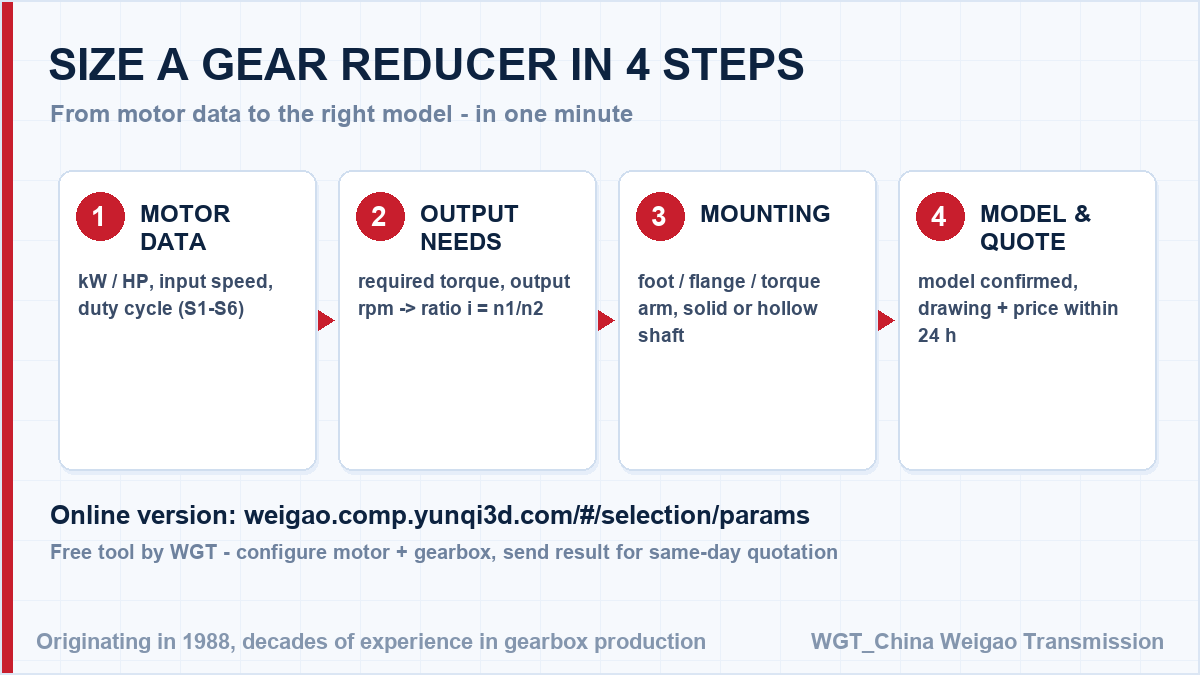
Take a 37 kW motor at 1480 rpm turning the feeder shaft at 36 rpm. The ratio follows directly: 1480 / 36 = 41.1, so a ratio near i=41 is selected from the two-stage right-angle band, and the frame is confirmed against the torque swing of a starve-fed screw rather than the average load, with the wet and dry fuel envelope declared beside the ratio. In this case frame five holds the fuel-yard duty on a dust-tight seal package breathing through a filtered breather, a paint and oil grade chosen for the boiler house atmosphere, and margin sized for the bridge collapse the yard eventually gets. Use the same method for any frame in the series, then confirm the service factor with us - it is the one number buyers most often get wrong.
![speed reducer selection process diagram]()
The selection path we follow when checking your enquiry.
Technical Q&A
What documentation comes with an industrial gear unit?
Every shipment carries an installation manual, a dimension drawing, the nameplate data and a bench test record covering noise, temperature rise and backlash. Material certificates for shafts and gearing are available on request.
How is the unit transported and lifted on site?
Units ship in export wooden crates with lifting points on the housing clearly marked. On site, lift only from these points with the specified slings - lifting from shafts or covers is expressly forbidden in the manual.
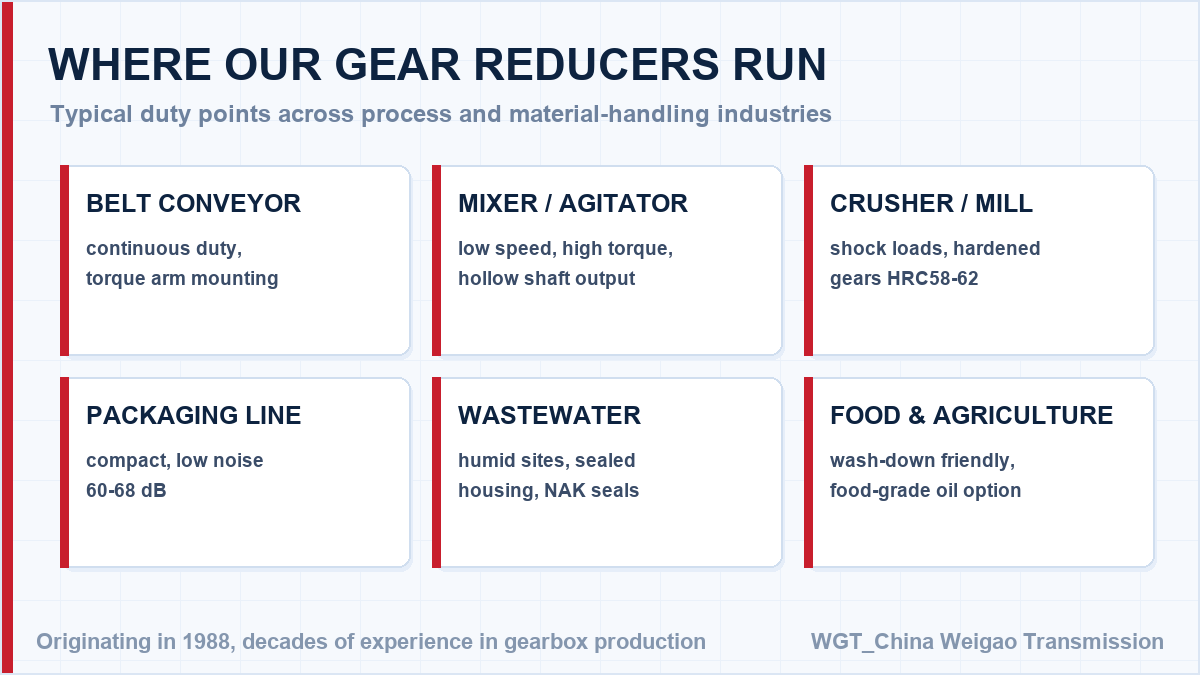
![speed reducer use cases across sectors]()
Typical installation environments for this gearbox family.
Your Selection, Cross-Checked by an Engineer
Send the numbers, get the model. One screen in the WGT Motor & Gearbox Online Selection System is usually enough to pin down the frame size; we confirm the service factor afterwards.
Every enquiry is checked by an engineer against the rating tables before it is quoted, so the unit we recommend carries a real torque margin - not just a catalogue guess. Spare-unit and OEM volumes are both welcome. Looking for a speed reducer for bucket elevator? Tell us the duty point and we will confirm the model in writing.