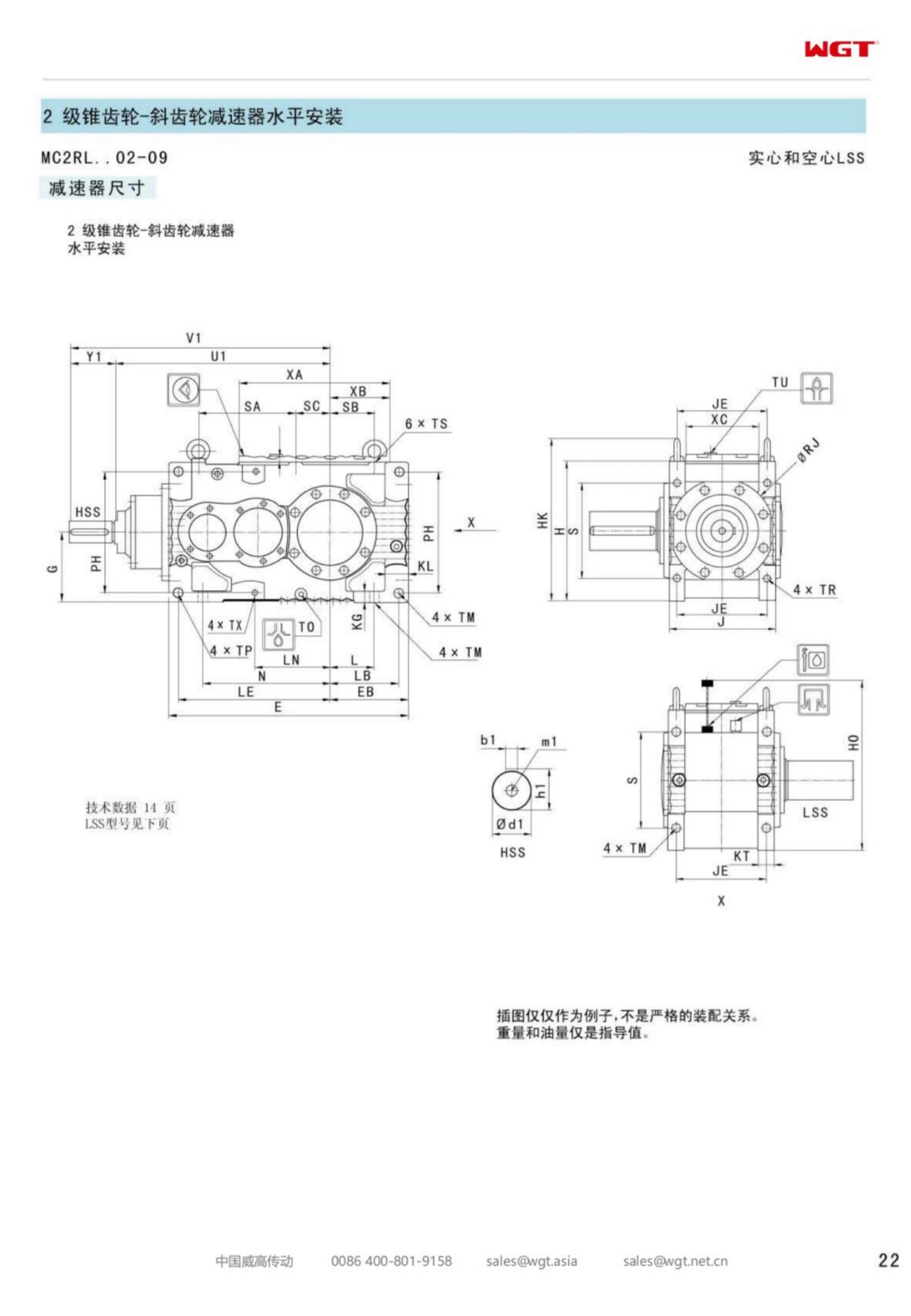
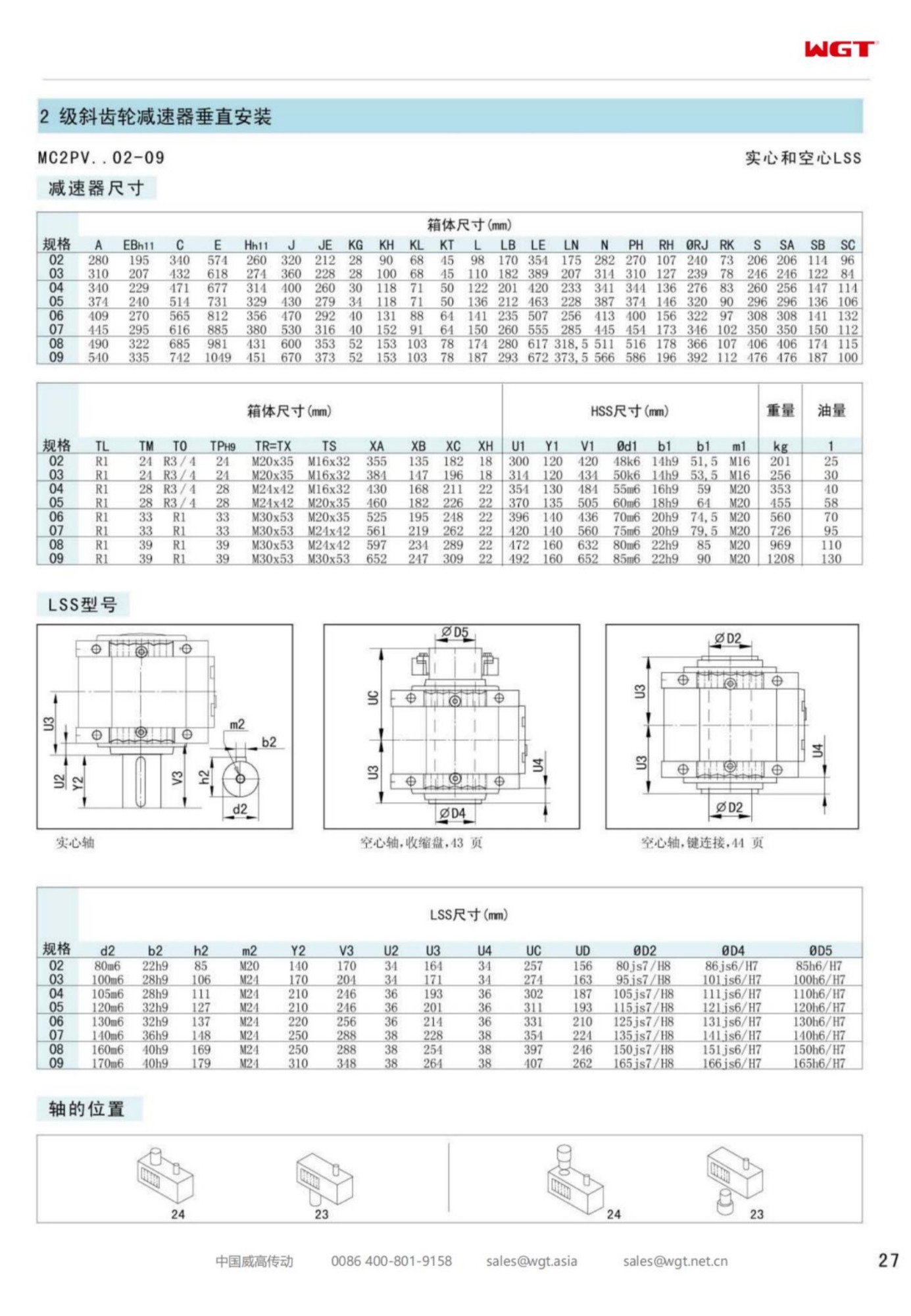
A grain leg is a tall, thin building full of moving belts, and the drive that turns its head pulley sits in a gallery barely wider than a man's shoulders. There is no room for a footed unit with a coupling and a bedplate, which is exactly the problem the MC2RLHF02 right-angle hollow shaft gearbox was shaped to solve: the output bore slides straight onto the pulley shaft, the case hangs from it, and the input motor stands at ninety degrees to the belt, out of the walkway.
This page is written for the people who specify and keep those drives: how a small right-angle hollow-bore unit is read, why the head shaft rather than the gearbox decides half the details, what organic dust does to seals and breathers over a season, and how a two-litre sump behaves when the leg runs eight hours and stands sixteen. Frame two is the smallest rung of this ladder, and small rungs are where most of the world's conveyors actually live.
Frame Two at the Head of a Grain Leg
Frame two serves the light end of the horizontal range: head pulleys on elevator legs, gallery belts that carry grain from bin to bin, and the short transfers that move product between cleaning and milling. Torque demand is modest, but the installation conditions are not - a gallery is a confined space, the pulley shaft is already fixed, and the drive arrives after the steelwork is up.
What this frame offers is proportion. A case small enough to be carried up a ladder by two people, a bore sized for the pulley shaft it will sit on, and a reaction arm that pushes against the leg structure instead of demanding a foundation. In a building where every kilogram of steel has to be lifted into place, that proportion is the whole argument.
Unpacking MC2RLHF02
The type string is a compressed drawing, and reading it in order tells the buyer what arrives in the crate.
| MC | Industrial gear unit family built for continuous plant duty |
| 2 | Two gear stages, one helical pair and one bevel pair in a right-angle case |
| R | Right-angle layout, input shaft at ninety degrees to the output axis |
| L | Horizontal build, output axis lying parallel to the ground |
| H | Hollow output bore, the machine shaft passes through the unit |
| F | Footed housing with reaction pads that take the torque on the structure |
| 02 | Second frame, the lightest rung quoted for gallery and leg conveyors |
Read as an order document, the string promises a compact right-angle drive with a through bore and a foot pattern small enough to fit existing steelwork. What it does not state is the part the buyer must supply: the shaft diameter and keyway it will slide onto, the reaction point the arm can push against, and the environment the case will breathe. Those three answers decide whether the unit fits on the first attempt.
Why a Right-Angle Layout Suits a Gallery
In-line drives are efficient and awkward. On a conveyor head they put the motor directly behind the pulley, which in a narrow gallery means the motor occupies the walkway, the belt guard has to be extended, and the maintenance route runs past a spinning fan cowl at hip height. Turning the drive ninety degrees moves the motor to the wall side where there is nothing to walk around.
The cost of that turn is one bevel stage, and on a small frame the cost is small: a few percent of efficiency, one more mesh to lubricate, and a case that grows slightly in one dimension while shrinking in another. For a gallery drive those are cheap trades. The bevel pair also gives the layout a natural place to put the input above or below the output axis, which is how a drive ends up sitting neatly under a handrail instead of blocking it.
The Hollow Bore and the Head Shaft
The bore is the interface that matters most, and it is the one most often measured carelessly. The unit slides onto the pulley shaft, so the shaft's diameter, tolerance, keyway and usable length all become gearbox dimensions. A shaft that is undersized at the seat lets the bore rock; a keyway cut short of the bore's length puts load on a fraction of the key; a shaft with no shoulder leaves nothing for the end plate to pull against.
On a small frame the bore is short and the shaft is usually generous, which is the good case. Where the head shaft is worn - common on legs that have run for a decade - the honest options are a new shaft, a machined sleeve, or a unit with a larger bore and a bushed adapter. Choosing among them at order time costs an email. Choosing after the drive is on site costs a crane and a shut-down window, because the leg cannot run with the pulley in pieces.
Dust in a Grain House: What It Does to a Drive
Organic dust is patient. It settles on the case top, works into the gap around the breather, and turns into a paste wherever a little oil weeps out of a seal. None of that stops a gearbox on its own. What stops it is the second-order effect: a breather crusted over stops breathing, internal pressure finds the weakest lip, and the oil that escapes collects dust until the case looks like a different colour of the building.
The practical defence is unglamorous. A breather positioned where dust falls away rather than into it, wiped at every inspection rather than changed after a failure, and a case top kept free of settled flour so that a leak is visible as a wet patch instead of a clean one. Grain houses that treat the weekly walk as a dust audit catch both problems in the same five minutes.
Sealing a Small Right-Angle Case
A right-angle frame carries seals in three places that matter: the input shaft, the output bore, and the joint faces of a case split into more pieces than an in-line unit needs. Each has its own failure habit. The input seal runs fast and wears on the shaft land; the output seal on a hollow bore runs slow and spends its life under the machine shaft where nobody looks; the joint faces weep when the case has been opened and closed with the old gasket reused.
Specification is simple to write and easy to skip: seal material suited to the oil and the ambient temperature, a dust lip where the gallery is dirty, and a rule that case joints get a new gasket and a torque wrench rather than a bead of sealant and a guess. On a small unit these choices cost very little, and they are the difference between a drive that leaks a spoonful a year and one that marks its territory on the floor below.
Reaction Torque and the Steel Around It
A shaft-mounted unit wants to rotate with the shaft, and the reaction arm is the part that politely refuses. On this build the pads are footed, which means the arm can push against a bracket welded to the leg structure, a floor-level pad, or a purpose-made torque plate. What it must not do is push against sheet cladding, a handrail stanchion, or a length of angle iron chosen for looks.
The load in the arm is the output torque divided by the arm's length, and on a small frame the number is friendly - a few hundred newtons, reachable with one hand. Friendly numbers still fatigue thin steel. A bracket that is welded to a structural member, checked for vibration, and painted before the drive arrives is a fifteen-minute job that prevents a crack appearing behind a dust layer three years later.
Oil in a Two-Litre Sump
Small sums have less oil to absorb the same heat, so they live closer to their temperature limit than large ones. A two-litre case running a gallery conveyor at part load is comfortable; the same case run at full rating in a hot week with a dusty case is working. The oil's job is not only to lubricate the bevel mesh but to carry heat to the case walls, and the walls can only give up what the air around them will take.
The routine that keeps this honest is short: check the level at the mark when the unit is cold, look at the oil colour on the dip, change on the interval written for the ambient band rather than the calendar year, and never top up with a different grade because that is what the store had. A gearbox that gets the right oil on time outlives one that gets premium oil late.
Motor Choice on a Small Grain Drive
Above a frame two case the motor is usually a standard foot-mounted machine on a top-mounted bracket, and the choice that matters is not the brand but the duty match. A grain leg starts loaded and stops loaded, so the motor needs starting torque rather than a big service factor, and the bracket needs enough stiffness that belt tension does not walk the motor out of alignment over a season.
Where a variable frequency drive is used - common on legs that must match a downstream rate - the benefits are real and the pitfalls are known: a fan-cooled motor run slowly cools poorly, so either the motor is oversized or the speed range is bounded, and the inverter cable should be screened with the gland earthed properly. Both are decisions for the electrical drawing, not for the commissioning visit.
Starting a Loaded Leg After a Wet Night
Grain that sat in a belt overnight is heavier than grain that is moving, and a leg started cold on a damp morning asks more of the drive than the running rating suggests. The unit has the torque; what it does not have is a warm sump. Thick oil at low ambient means the first minute runs on less-than-ideal film, and repeated cold starts are the quiet reason some small drives wear faster than their hours suggest.
Three habits fix it cheaply. A start sequence that brings the leg up empty where the process allows, an oil grade chosen for the lowest ambient the site actually sees rather than the average, and a short warm-up run before loading on the coldest mornings. None of these needs hardware, and together they remove the worst of what a winter does to a small right-angle drive.
What the Mill Should Put in the Enquiry
A useful enquiry for this frame fits on one page: head shaft drawing with diameter, keyway and usable length; pulley or sprocket diameter and the belt speed required; running torque or absorbed power; hours per day and starts per shift; ambient range and whether the gallery is heated; the reaction point available; and the motor mounting arrangement the plant prefers.
The reply should mirror that page: bore and keyway confirmed against the drawing, ratio and speed at the pulley, reaction arm length and bracket sketch, oil grade for the ambient band, and the accessories - breather type, dust lip, backstop if the incline demands one. Two pages exchanged properly at enquiry stage save the site visit that otherwise happens with the drive already on the gallery floor.
A Frame Two Through Its First Harvest
Harvest is the honest test of a grain-house drive: weeks of long shifts, dust everywhere, and no tolerance for a stop that backs up a line of trucks. The frame two units that come through it well share a short biography - fitted to a true shaft, pushed against real steel, given the right oil, and wiped down once a week by somebody who knows what the case top is supposed to look like.
Nothing in that list is a specification item, and all of it is what the buyer controls. The gearbox contributes its torque quietly for years; the plant contributes the five minutes a week that let it. Frame two is a small unit with a long working life available to it, and the harvest is where that life is either earned or quietly spent.
Grain galleries, leg head shafts and the dusty weeks of harvest - frame two keeps its head down:
- Head pulley drive on a country grain elevator leg
- Gallery belt transfer between storage bins at a feed mill
- Cleaning house intake conveyor at a flour mill
- Dock intake belt at an inland grain terminal
- Screening deck feed conveyor at an oilseed plant
- Bag closing line take-away belt at a feed compounder
Available Frames and Their Typical Duty
| Model | Centre distance | Output | Typical duty |
|---|
| M3PSF50 | size 50 | solid shaft, foot | conveyors, feeders |
| M3PSF60 | size 60 | solid shaft, foot | crushers, mixers |
| M3PSF70 | size 70 | solid shaft, foot | ball mills, shredders |
| M3PSF80 | size 80 | solid shaft, foot | kilns, heavy conveyors |
| M3PSF90 | size 90 | solid shaft, foot | mill and kiln drives |
| M3RSF50 | size 50 | solid shaft, foot, right-angle | inclined conveyors, elevators |
| M3RSF60 | size 60 | solid shaft, foot, right-angle | screw classifiers, feeders |
| M3RHF70 | size 70 | hollow shaft, foot, right-angle | agitators, drum drives |
| M3PHT80 | size 80 | hollow shaft, torque arm, parallel | shaft-mounted conveyors |
| M3RHT90 | size 90 | hollow shaft, torque arm, right-angle | heavy shaft-mounted drives |
Note that PSF and RSF frames of the same size share the mounting footprint; the R build simply inserts a bevel stage, so switching layout rarely forces a foundation change.
Questions and Answers
What ratio range does an industrial gear unit cover?
The range spans from low single-digit reductions to very high ratios by combining stage counts: two-stage builds for the lower band and up to five-stage builds for the highest reductions, with intermediate ratios available between catalogue steps on request.
Which lubrication system does the unit use?
Small and medium frames run on splash lubrication with mineral or synthetic oil. Larger frames or high ambient temperatures can be ordered with forced-feed circulation and cooling coils; the lubricant grade is stated on the nameplate and in the manual.
How often should the oil be changed in heavy duty?
With mineral oil, plan an initial change after the running-in period and then roughly every 5,000 hours. Synthetic oil stretches the interval to around 10,000 hours. Hot environments, dust or frequent starts shorten the interval - we advise the schedule with the quotation.
Installation Examples
Overland conveyor system
A mining company drives a two-kilometre overland conveyor with heavy-duty helical gear units at the head station. Continuous 24-hour duty, frequent starts under full load and minimal maintenance windows were all part of the specification.
Cement plant bucket elevator
A cement works renewed the gear units on its bucket elevators during a kiln shutdown. The new units bolted onto the old foundations without modification, and the elevator was back in service within the planned window.
![gear box application map for industry]()
From quarries to food plants - one right-angle drive concept.
Selection Example: Head pulley drive on a country grain elevator leg
Take a 15 kW motor at 1465 rpm turning the head shaft at 78 rpm. The ratio follows directly: 1465 / 78 = 18.8, so a ratio near i=19 comes out of the two-stage right-angle band, and the bore and keyway are checked against the measured head shaft before the frame is confirmed, since a gallery drive hangs on that fit rather than on a bedplate. In this case frame two carries the leg duty with the bore doing the alignment work, the reaction arm pushing against a bracket on the leg steel, and the oil grade chosen for the coldest morning the gallery actually sees. The ratio is the easy part. The service factor for the shock level is what makes the selection safe, and we check that for you at no charge.
![how to choose a speed reducer model]()
Ratio first, then torque, then frame size: the standard selection route.
Size It, Quote It, Ship It
One minute, one model. The WGT Motor & Gearbox Online Selection System covers motor power, ratio and mounting on one screen - enter your numbers and see the model immediately.
Give us the driven machine, the required output speed and the daily running hours, and we return a confirmed model number with torque margin and a firm price - no obligation, no charge for the selection work. Looking for a gearbox for belt conveyor? Tell us the duty point and we will confirm the model in writing.