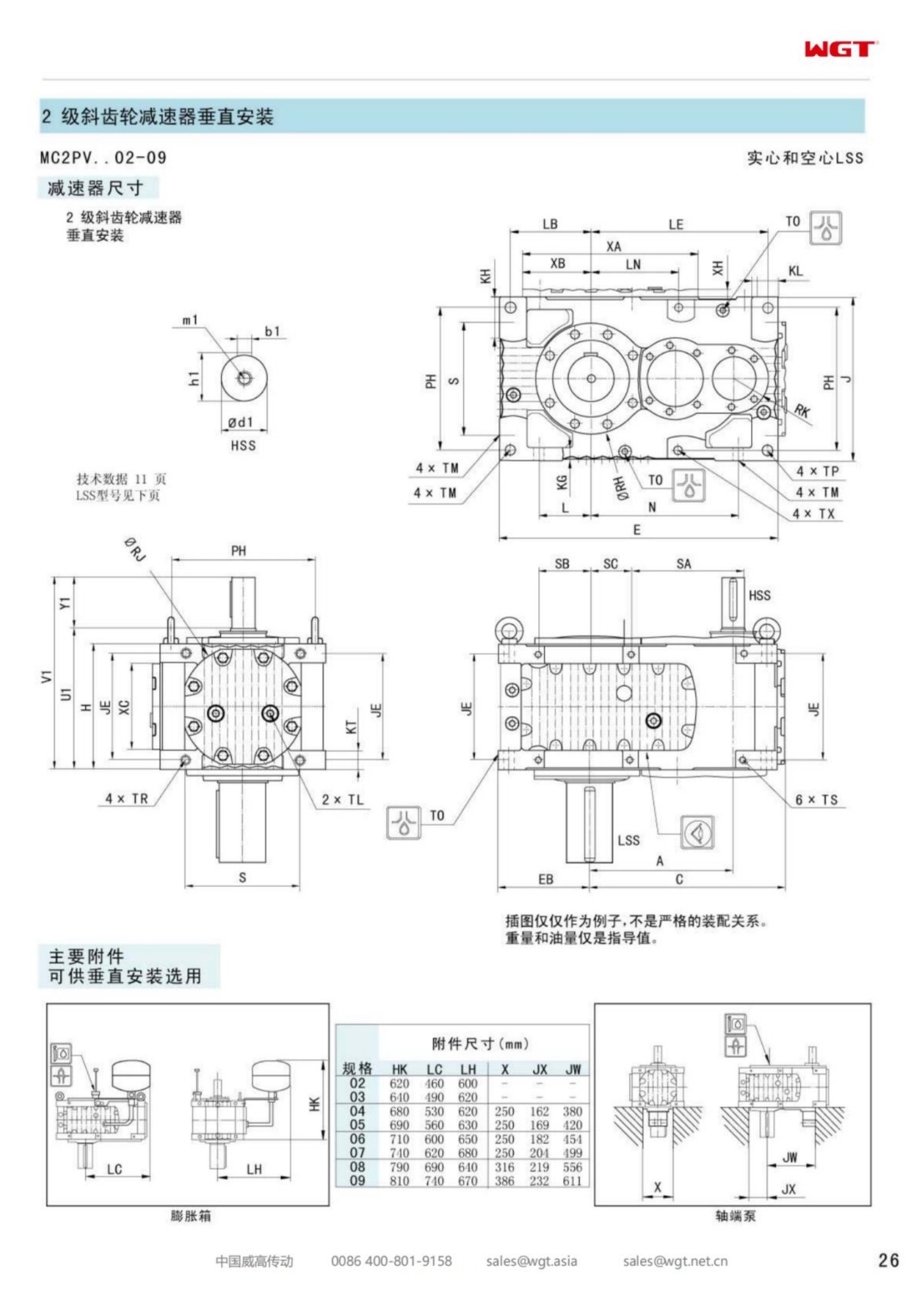
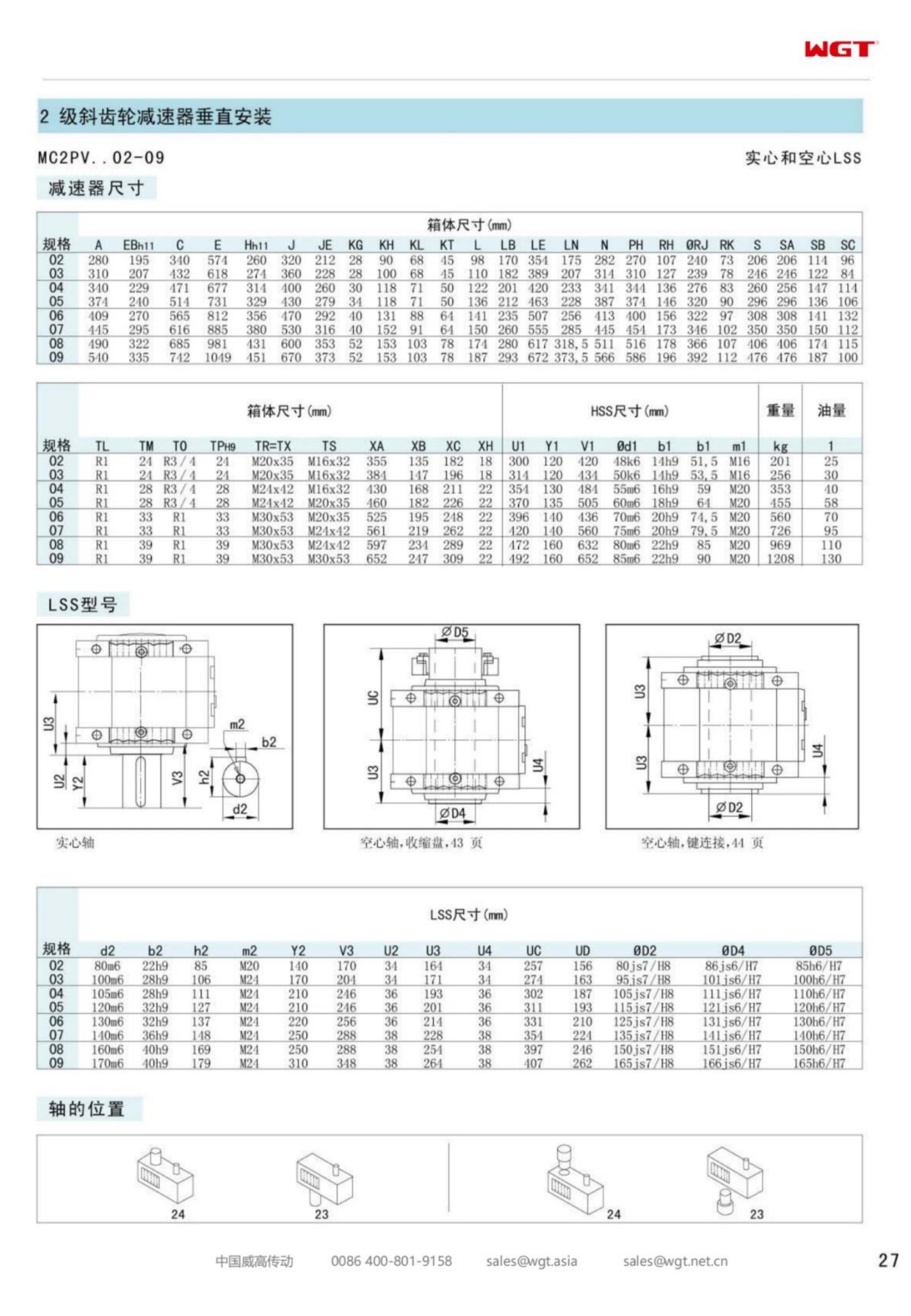
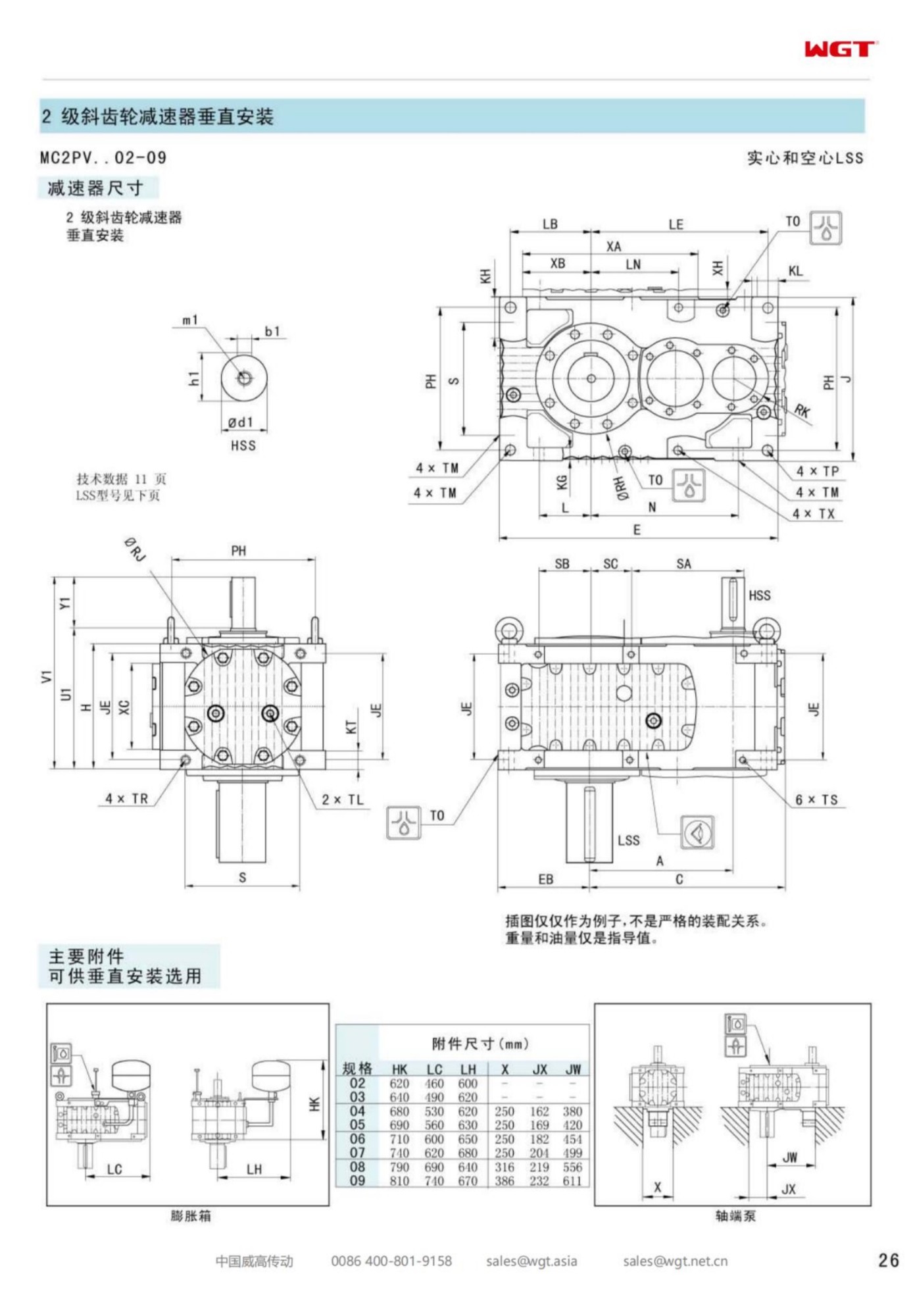
Two frames below the top of the vertical band, a drive stops behaving like a catalogue purchase and starts behaving like a piece of plant. The MC2PVSF08 vertical parallel shaft gearbox keeps the arrangement every smaller frame in this family uses - two helical stages in one plane, a footed case standing upright, a solid output shaft delivering torque into the process below - but at this size the figures on the outline drawing begin to govern other people's drawings too: the plate designer's, the crane contractor's, the electrical engineer's start-current budget.
Nobody arrives at the eighth frame by accident. The step up from the seventh is taken deliberately, because every additional frame brings mass, oil volume and a foundation bill with it. What the extra size buys is the kind of margin that is expensive to add later: thermal room on a duty that runs through summer afternoons, bearing life on a shaft that seldom stops turning, and torque reserve that a plant discovers it needs the first time the process is pushed past its design point.
The Penultimate Frame and the Work It Attracts
Frame families have a point where the units stop being held on the shelf and start being built against an order. In this vertical line that point sits somewhere around the sixth and seventh frames; the eighth is firmly in built-to-order territory. Lead times are honest rather than instant, drawings are issued for approval rather than for information, and the buyer's own organisation usually has a project engineer attached to the purchase rather than a stores clerk.
That shift in procurement style is not a complication - it is protection. A drive this size is nearly always installed where its failure stops a whole tank, a whole line or a whole works section, and the paperwork that feels heavy at order time is exactly what makes the commissioning day boring. Boring commissioning days are the objective.
The Designation, Character by Character
The type code reads as a sentence for anyone who has seen it once with the letters explained. Only the final field changes between neighbours in the band.
| MC | Industrial multi-stage gear unit family |
| C2 | Compact two-stage parallel-shaft series |
| P | Parallel stages - both gear planes horizontal |
| V | Vertical build with the output facing downward |
| S | Solid output shaft joined through a coupling |
| F | Foot mounting onto a bridge or top plate |
| 08 | Eighth frame of the vertical band |
Site engineers use the code diagnostically long after delivery. A complaint about vibration on an upright unit points first at plate level and case squareness because of the V; a complaint about the coupling points at the S build's connection register; a machine delivered with the wrong frame digit is usually the result of a quotation taken down over the telephone. Thirty seconds spent confirming the code in writing prevents all three conversations.
Bearings at the Top Carry the Story
On an upright case the bearing nearest the output does the least glamorous and most consequential work in the machine: it takes the radial load of a long shaft, frequently a measurable share of axial thrust, and it does so at the position where contamination and temperature swings arrive first. Bearing life is therefore the number to discuss at quotation, not the gear rating alone.
A well-prepared enquiry asks for the calculated life of each bearing position at the actual duty - hours per day, starts per shift, driven element mass - rather than accepting a single service factor. Suppliers who can produce those figures at quotation stage have done the design work; suppliers who answer with a catalogue page have not. The difference shows up years later as a scheduled swap rather than an unscheduled stop.
Choosing Where the Motor Sits
An upright parallel-shaft unit accepts its motor in more than one way, and the choice shapes the maintenance story for decades. A motor bolted vertically on top keeps the whole drive train in one tall column above the vessel and frees floor space, at the cost of a longer lifting operation whenever the motor comes down. A horizontally mounted input keeps the motor at a height where coupling work is ordinary scaffold work instead of crane work.
Neither answer is wrong; what is wrong is leaving the choice to the shipping department. Decide it against the site: what the crane over the vessel can reach, where the scaffold goes, how often the motor is realistically removed. State the decision in the order, and the delivered machine matches the maintenance plan instead of arguing with it.
Duties That Ask for the Eighth Frame
The penultimate vertical frame is chosen where margin cannot be added later:
- Secondary clarifier rake drives at a municipal treatment works
- White liquor storage tank agitators at a kraft pulp mill
- Gypsum slurry agitators at a flue gas desulphurisation plant
- Mash tun and fermenter drives at a large brewery
- Caustic storage vessel agitators at an alumina refinery
- Brine holding tank drives at a coastal food processing plant
The common thread through all of them is consequence. These are vessels whose contents punish a stopped impeller with setting, separation or a lost batch, and whose geometry makes side-entry arrangements awkward or impossible. Holding the entire drive above the liquid line, on a case that can be inspected without draining anything, is the quiet argument for the vertical habit at this size.
The First Hundred Hours Set the Baseline
Every large drive tells its owner how it intends to age, and it tells them early. The first hundred running hours are when a machine that will misbehave begins to: an oil temperature that drifts instead of plateauing, a vibration note that appears at one particular speed, a current draw that sits above the expected band. Caught during the run-in period, each of these is a small adjustment; caught two years later, each is an investigation.
The discipline is cheap: temperature at the marked patch, vibration at three fixed points, running current and oil level, recorded at commissioning, at one week, at one month and at the first scheduled stop. Four short records turn every later reading into a trend, and trends are what allow a bearing to be changed at a time the plant chooses.
Oil Volume Is Now a Maintenance Line
Above a certain size, lubrication stops being a background habit and becomes a line in the maintenance budget. The eighth frame holds enough oil that a top-up is a purchase order, that a grade error follows the machine for its whole life, and that a slow leak can run for weeks before the level glass confesses. The countermeasures are administrative rather than mechanical: a logged reading on a fixed day, one person accountable for the log, and the oil delivered in sealed containers of known volume.
Standing upright also changes how the oil behaves. Galleries and dams inside the case carry lubricant up to bearings that gravity would happily starve, and the level glass is calibrated for a plumb case on a level plate. Two degrees of tilt under the feet is enough to move oil away from its design path, which is one more reason the plate under the unit is machined or grouted with the same care as the drive itself.
Slurry Lines and the Seal at the Shaft
Where the driven shaft passes into an abrasive or crystallising product, the seal below the gearbox becomes the component with the shortest calendar. Enquiries for duties like these should say so plainly: a flush or lantern-ring arrangement specified at order time costs little, while a seal environment discovered after start-up costs a shutdown.
Service access deserves the same foresight. A spacer in the drive line lets the shaft drop clear so the seal can be reached while the case stays bolted to the bridge, and a split housing lets the new seal enter without lifting anything. Plants that have drained and cleaned a large vessel for the sake of a lip seal order both features on the next machine without discussion; the saving was never in the seal, it was in the product that stayed in the tank.
Getting the Case to the Plinth in One Piece
At this mass the transport and rigging plan belongs in the order, not in the week of delivery. The case ships upright, arrives on a skid or cradle designed for its centre of gravity, and should be lifted only at the points the drawing marks. Every year a perfectly good gearbox is bent by a sling passed wherever it was convenient, and the damage rarely shows until the machine has been running for a month.
Storage before installation has its own rules. A unit standing for months should be filled to the correct level with the specified oil or a storage grade, shafts and flanges protected, and - where the site allows - the shaft turned by hand on a fixed interval so the bearings do not take a set. Fifteen minutes a month during storage protects a machine designed for fifteen years of service.
A Test Certificate Worth Reading
A built-to-order drive should arrive with more than a packing list. Ask for a no-load test run at the works: temperature after a defined period, vibration readings at the bearing positions, and a noise observation, all recorded on the certificate. The document costs the supplier a morning and gives the buyer a birth record against which every later measurement can be judged.
The same certificate should state the oil grade and charge volume, the fitted bearing types, and the torque figures used for the rating. Filing it with the general arrangement and the bolt template produces, in three sheets, the core of the machine file that the next maintenance crew will one day ask for.
Telling the Works What the Drive Must Survive
The enquiry that produces a firm quotation without a second round is unglamorous and complete: vessel diameter and depth; driven element type, diameter and mass; shaft length from plate to element; where the thrust is meant to land; motor power, speed and starting method; required output speed and its tolerance; duty hours and batch pattern; atmosphere above the liquid; plate drawing with bolt pattern and thickness.
Send that set and the reply contains an outline drawing the fabricator can build from, a drilling template, the bearing life figures and a delivery date that fits the shutdown calendar. The eighth frame is not a difficult machine to buy. It simply refuses to be bought carelessly, and the plants that respect that are the plants whose bridges stay quiet for thirty years.
Selection Example: Gypsum slurry agitator drive at a flue gas desulphurisation plant
Take a 75 kW motor at 1480 rpm turning the agitator at 24 rpm. The ratio follows directly: 1480 / 24 = 61.7, so a ratio near i=62 is drawn from the two-stage band, and the frame is checked against the abrasive slurry duty - sealing, bearing life at the true duty cycle and the annual oil sample all carry it. In this case the penultimate vertical frame runs that duty with thermal room in hand, and the solid output shaft is coupled below a spacer so the shaft seal can be opened while the absorber vessel stays in service. The same three numbers - motor speed, target output speed, required torque - are all you need; our engineers (or the online selector below) cross-check the service factor for your duty cycle.
![gear reducer selection flow chart - ratio and frame size]()
Figure: from motor data to a confirmed gearbox model in four steps.
Common Models in the M3 Series
| Model | Centre distance | Output | Typical duty |
|---|
| M3PSF50 | size 50 | solid shaft, foot | conveyors, feeders |
| M3PSF60 | size 60 | solid shaft, foot | crushers, mixers |
| M3PSF70 | size 70 | solid shaft, foot | ball mills, shredders |
| M3PSF80 | size 80 | solid shaft, foot | kilns, heavy conveyors |
| M3PSF90 | size 90 | solid shaft, foot | mill and kiln drives |
| M3RSF50 | size 50 | solid shaft, foot, right-angle | inclined conveyors, elevators |
| M3RSF60 | size 60 | solid shaft, foot, right-angle | screw classifiers, feeders |
| M3RHF70 | size 70 | hollow shaft, foot, right-angle | agitators, drum drives |
| M3PHT80 | size 80 | hollow shaft, torque arm, parallel | shaft-mounted conveyors |
| M3RHT90 | size 90 | hollow shaft, torque arm, right-angle | heavy shaft-mounted drives |
The table below shows the M3 industrial range: P builds are all-helical on parallel axes, R builds add a bevel input stage for a right-angle drive; S / H describe the low-speed shaft and F / T the mounting.
Application Cases
Mining slurry pump drive
At a mineral processing site, hollow-shaft reducers drive slurry pump agitators. The hollow bore takes the pump shaft with no coupling, so a pump change-out no longer means re-aligning a separate drive.
Palm oil mill fruit elevator
A palm oil mill powers its fruit elevator with reducers. The humid, oily atmosphere is handled by FKM seals, and the compact frame fits between the steriliser and the threshing drum.
![industrial gearbox applications - conveyor mixer crusher wastewater]()
Figure: typical industries that use the WGT S-series gear reducers.
Frequently Asked Questions
What ambient temperature range can the unit work in?
Standard units suit -10 to +40 deg C ambient with the supplied mineral oil. For lower temperatures we fill with synthetic oil; for higher ambient or frequent starting we advise the next larger frame or an oil cooler.
What are the delivery lead times and shipping terms?
Standard lead time is 5-10 weeks ex-works, with popular ratios often available sooner. We quote EXW, FOB NINGBO / SHANGHAI or CIF, and urgent units can be air-freighted within 72 hours of payment.
What materials are used for the gears and shafts?
Gears are 20CrMnTi alloy steel, case-carburised to HRC58-62 over a tough HRC33-40 core. Input and output shafts are 42CrMo, quenched and tempered to HRC25-30. The housing is cast iron at HBS190-240.
Get Your Drawing and Quotation within 24 Hours
Ready to size your drive? Not sure which model fits? Try our online WGT Motor & Gearbox Online Selection System to match motor power, ratio and mounting in one minute.
Or simply send your motor data (kW, speed, duty) and driven-machine details through the inquiry button - we reply with a completed datasheet, dimension drawing and factory price the same working day. Looking for a gearbox for mixer and agitator? Tell us the duty point and we will confirm the model in writing.