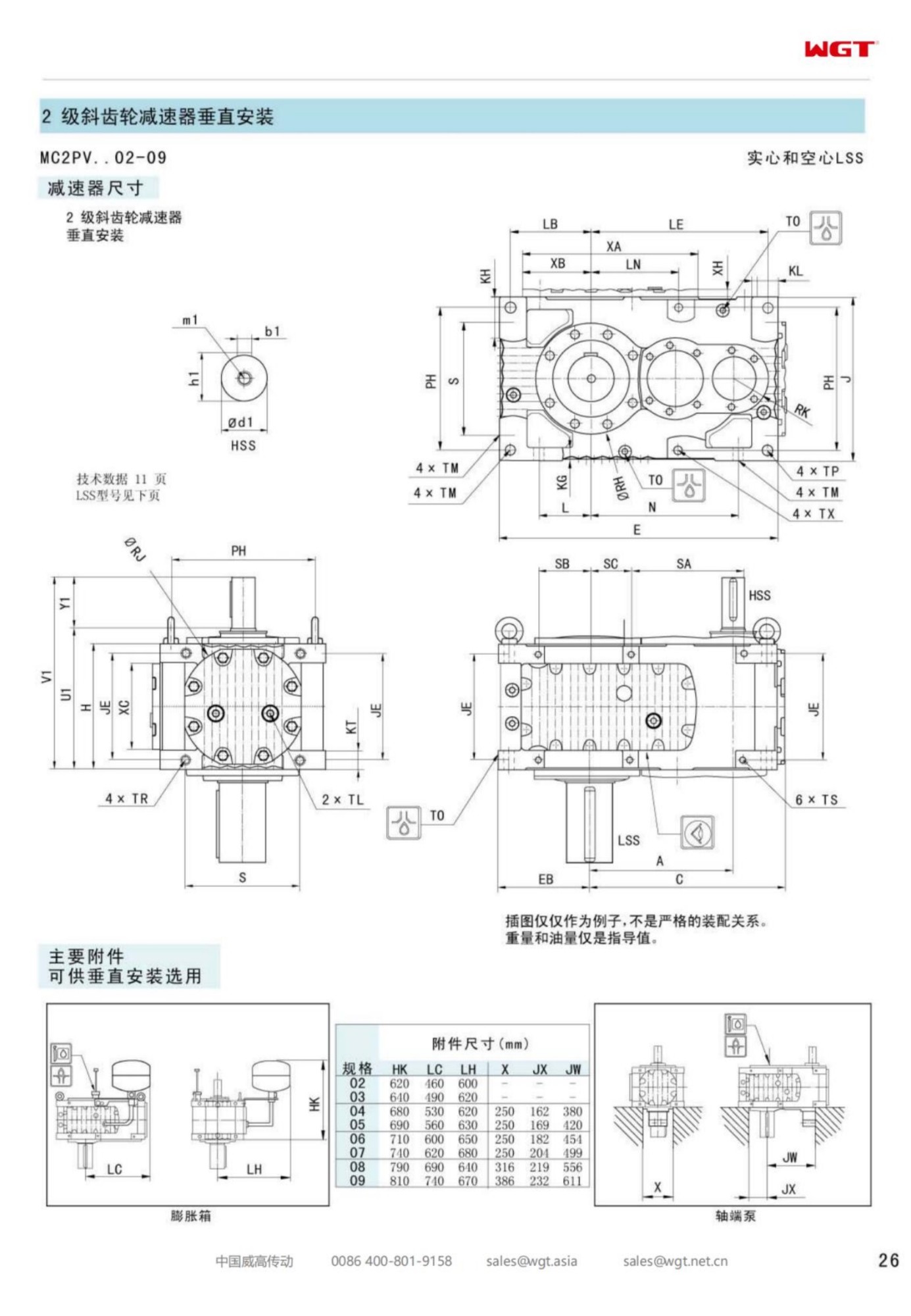
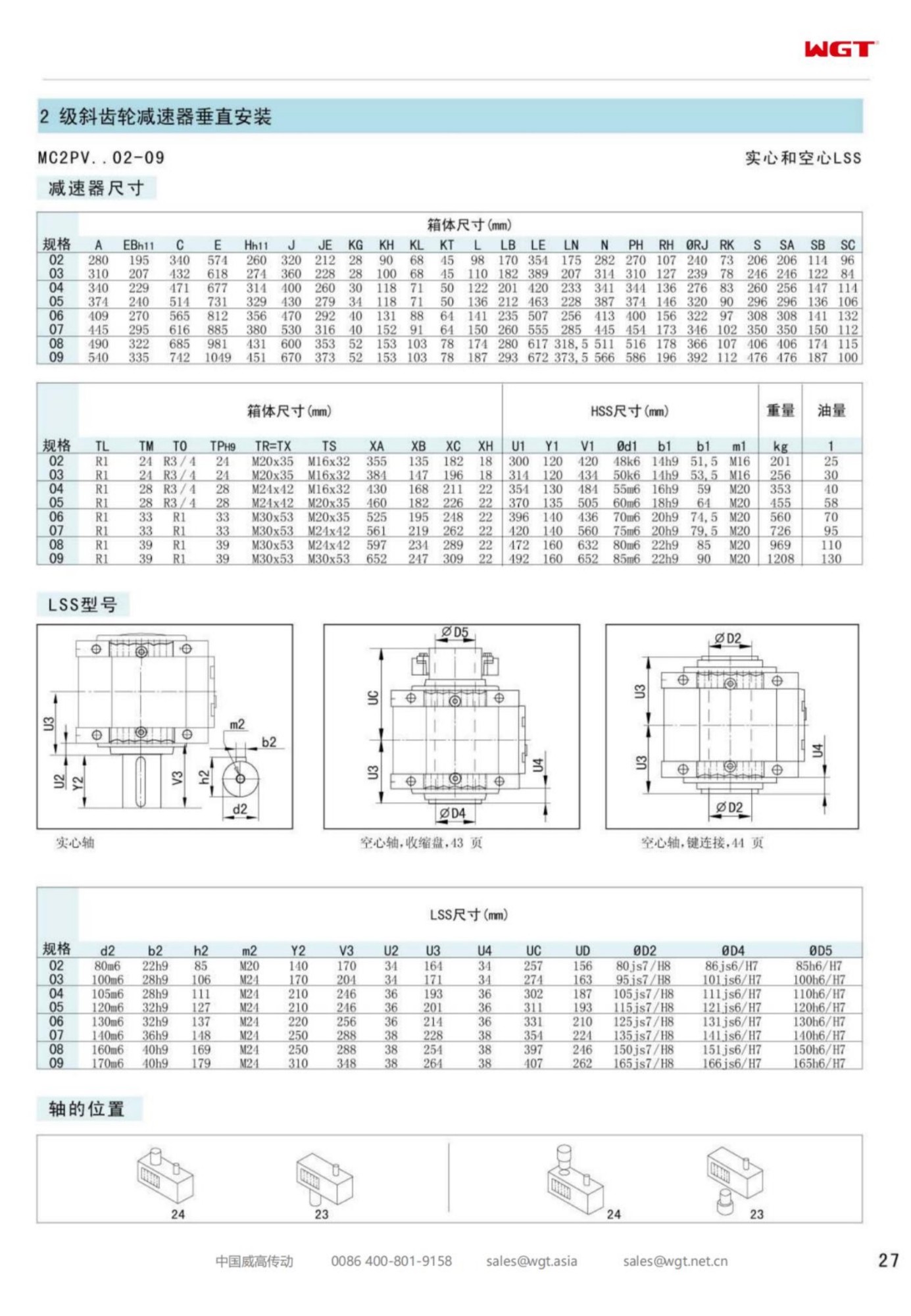
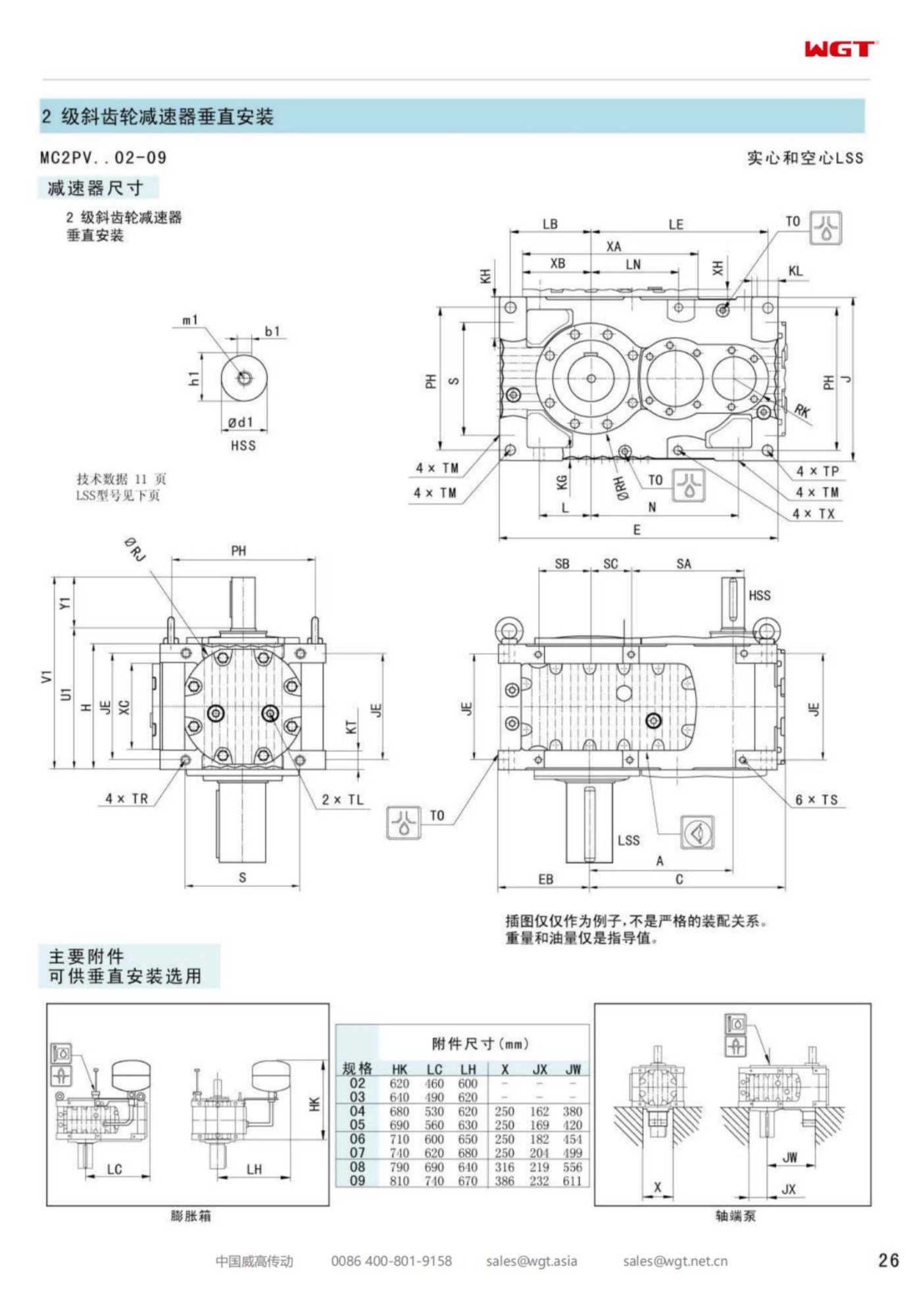
At the top of the mid-band the vertical line meets its widest customers. The MC2PVSF05 vertical gear unit is the fifth frame of the family: the same two helical stages in one plane, the same footed case standing over the vessel, the same solid coupled output pointing down - built now for tanks whose paddles are structural steel and whose contents are measured in hundreds of tonnes. The drive has not changed its philosophy; the tanks have changed their demands.
Frames at this end of a line sell on trust. The buyer is putting a rotating machine over a live process, and the questions asked before the order are the ones that decide the next thirty years. This page answers them in the order plants actually ask.
The Fifth Frame and the Widest Tanks
Scale is the whole story here. A paddle three metres across reacts to the liquid with a moment that dwarfs the torque itself, and every part of the installation - the shaft, the coupling, the bearings, the plate, the structure beneath - sees that moment before it sees anything else. The fifth frame is dimensioned for the complete picture, but the picture is only complete if the enquiry includes the shaft length and the driven element's geometry. Two identical torque duties with different shaft lengths are two different machines.
The reward for getting the picture right is the same one the smaller frames give: a drive that hangs quietly over the process for decades, inspected in minutes and serviced without emptying the tank.
Reading the Designation at the Top of the Mid-Band
The decode table holds to the end of the line; at frame five only the last character changes meaningfully.
| MC | Industrial multi-stage gear unit family |
| C2 | Compact two-stage parallel-shaft series |
| P | Parallel stages - shafts in one horizontal plane |
| V | Vertical build, output directed downward |
| S | Solid output shaft with a coupled connection |
| F | Foot mounting onto bridge or top plate |
| 05 | Fifth frame - top of the two-stage vertical band |
Buyers comparing frames sometimes ask why the family stops where it does. The honest answer is the one that helps them: above this band the bending moments of very large vertical shafts belong to a different gearbox conversation, and specifying a frame outside its natural territory is how drives acquire reputations they do not deserve. The fifth frame is the family's honest ceiling, and it is a high one.
When a Coupled Solid Shaft Beats the Alternatives
At this size the connection question matters more than anywhere below it. The solid shaft and coupling keep the mechanical responsibilities clean - torque from the gearbox, thrust from the machine's own bearing, alignment between them - and the spacer version of the coupling adds the quiet luxury of seal service without crane work. On a bridge where every lift needs a permit, a coupling that opens by hand is not a detail; it is the difference between a four-hour job and a four-day one.
The alternative arrangements each move the problem somewhere worse: a hollow-bore drive puts the machine's shaft through the gearbox and ties the two vendors' drawings together, while a bottom entry puts the seal inside the process. Plants that have lived with either usually arrive at the coupled solid shaft with the relief of people who have stopped arguing with physics.
Structural Notes for the Heaviest Vertical Build
The plate and its structure carry the fifth frame's whole argument. Torque reaction arrives as a twist in the bolt group, bending arrives through the shaft, and the case's own weight is now a load the fabricator designs around rather than ignores. The documents that make this go well are unglamorous: the torque reaction figure handed over at quotation, a plate detail with gussets and fitted bolts, and a bracing scheme checked against the paddle pass rate rather than assumed.
One habit separates the plants whose big vertical drives never sing: they re-torque the bolt group at the first planned stop and record the readings. Structures settle, gaskets relax, and a fifteen-minute wrench round in month one is the cheapest structural audit the site will ever commission.
Duties on the Widest Tanks
The fifth frame, where the widest tanks meet the mid-band:
- Flotation conditioner drives at a lead-zinc concentrator
- Lime milk agitators in a kiln gas scrubbing circuit
- Starch slurry vessel drives at a wheat processing plant
- White liquor storage agitators at a pulp mill
- Leach tank paddle drives at a gold operation
- Balancing tank mixers at a refinery wastewater utility
What joins these duties is the combination of real torque, real bending and a process that cannot stop while the drive is looked at. The fifth frame plus the vertical habit answers all three: strength where the load lands, and an installation that keeps every maintenance task above the liquid line.
Heat, Airflow and the Summer Ceiling
A big case standing in a warm building collects heat the way big things do: slowly and then all at once. Enclosed halls put the drive in the warm layer, summer pushes the ceiling up, and a duty that drifted denser over the years eats the thermal margin that was bought in winter. The rating conversation for frame five should therefore be held in degrees at the drive's own level, not in catalogue assumptions - a thermometer hung on the bridge for a week in July is worth more than any thermal calculation made from a weather station.
Where the summer trace comes back close to the limit, the fix is ordinary: cooling accessories that bolt on, a fan repositioned, a louvre cleared. What is not ordinary is discovering the ceiling during the first heatwave with the product already drifting. The plants that never do are the plants that traced it in spring.
Seals Over Hot and Corrosive Liquors
Above a hot digester or a brine tank, the atmosphere is the seal's real working environment, and the order should name it: steam, chloride mist, solvent vapour, alkaline wash-down. Each picks a lip material and a breather arrangement, and the difference between a seal chosen for the atmosphere and one chosen from a stock list is measured in service intervals.
The daily habit is unchanged and free: wipe the shaft where it passes the seal, keep the area dry, and never let a cable or scaffold strap touch the running surface. On a machine this size a scored seal journal is a shutdown item, and the cause is almost always a small piece of site hardware that should never have been there.
Spare Strategy for a Row of Vertical Drives
Works with several vertical drives soon discover the family's quiet economy: seals, breathers, sight glasses and oil grades shared across frames, one stores shelf covering the whole row. The fifth frame belongs on that same shelf logic. A spare seal set per two drives, one breather type site-wide, and a stocked coupling bolt set turn the rare failure into a half-day event rather than a procurement project.
Whether to hold a complete spare frame is a boardroom question with an engineering answer: count the cost of the tank standing still. On duties where that cost is serious, a stored fifth frame is cheap; on duties where it is not, the shelf and the trend sheet are enough. Either way, the decision is made on paper before the failure, not during it.
Alignment Records That Outlive the Crew
The commissioning file for a fifth-frame drive should read like a promise: alignment readings with the dial-indicator figures, bolt torques, running temperatures, first vibration baseline. Fifteen years later, when the third crew change has passed and the trend sheet shows a step, that file is the only honest way to know whether the machine changed or the measurement did. Plants that keep it diagnose in an afternoon; plants that kept a feeling diagnose never.
Recheck alignment at every major stop and record it again. On a vertical train the figures come quickly - the coupling register is accessible, the plate is clean standing room - and each recorded pass makes the next one faster.
Upgrades Without Moving the Tank
Processes grow, and the fifth frame is often bought mid-life by plants whose original drive was sized for a smaller ambition. Because the family shares mounting logic and the plate drilling can be adapted, the upgrade conversation is usually a plate drawing and a shutdown slot rather than a civil project. The honest sequence is short: re-check the duty against the new process figures, confirm the structure under the bigger case, and schedule the swap into a stop that already exists.
The failure mode to avoid is the silent upgrade - a denser product, a faster paddle, nobody telling the gearbox. Drives do not read process memos; they read torque. One email when the process changes keeps the frame and the duty on speaking terms.
Ordering the Fifth Frame With Confidence
The enquiry that closes in one pass names: vessel and driven element with shaft length and thrust arrangement; motor power, speed and starting method; output speed and tolerance; the start story; duty hours and batch pattern; the atmosphere above the liquid; the plate and structure drawings. It gets back a firm quotation, an outline the fabricator can build from, and a delivery date that fits the shutdown calendar.
Confidence at this size is not a feeling; it is the sum of documents. The plants that buy well are the plants that ask the questions before the order and keep the answers after it - which is, in the end, the entire craft of putting a large rotating machine over a live process and expecting it to still be there in thirty years.
Thirty Years Over the Liquid
The best compliment a fifth-frame drive ever earns is anonymity: a machine on the bridge that nobody remembers being installed because nobody remembers it failing. That record is built from ordinary things - a plate designed for its moment, a bolt group re-torqued once, an oil round logged monthly, a seal wiped on every walk-past - performed by crews who inherited the habit and passed it on.
Two meshes, one plane, a solid shaft aimed at the process, and thirty years of being ordinary: that is what the top of the vertical band is for, and it is a higher ambition than any headline.
How Customers Use This Unit
Grain terminal elevators
A grain terminal powers its bucket elevators with gear reducers. The anti-run-back option holds the loaded buckets during power cuts, and standard interface dimensions meant the old foundations were reused as they were.
Pallet lift in a warehouse
A logistics integrator selected units for pallet lifts. The hollow output bore carries the lift screw directly, and one year of three-shift operation has passed without a single seal replacement.
What Engineers Ask Us
What tooth quality and grinding finish do you apply?
Gearing is case-hardened and profile-ground to international accuracy grades, with crowning and end relief applied to avoid edge loading. This is what keeps noise and vibration stable over years of continuous duty.
Can existing motors, couplings and guards be reused?
In most upgrade projects yes: because input and output interfaces follow the common industry dimensions, the existing motor, coupling and guard usually bolt straight on. Send the old nameplate and we confirm before you order.
Model Table: Frames, Shafts and Duty
| Model | Centre distance | Output | Typical duty |
|---|
| M3PSF50 | size 50 | solid shaft, foot | conveyors, feeders |
| M3PSF60 | size 60 | solid shaft, foot | crushers, mixers |
| M3PSF70 | size 70 | solid shaft, foot | ball mills, shredders |
| M3PSF80 | size 80 | solid shaft, foot | kilns, heavy conveyors |
| M3PSF90 | size 90 | solid shaft, foot | mill and kiln drives |
| M3RSF50 | size 50 | solid shaft, foot, right-angle | inclined conveyors, elevators |
| M3RSF60 | size 60 | solid shaft, foot, right-angle | screw classifiers, feeders |
| M3RHF70 | size 70 | hollow shaft, foot, right-angle | agitators, drum drives |
| M3PHT80 | size 80 | hollow shaft, torque arm, parallel | shaft-mounted conveyors |
| M3RHT90 | size 90 | hollow shaft, torque arm, right-angle | heavy shaft-mounted drives |
Larger size numbers mean higher torque capacity and larger shafts. Because interfaces follow the common industrial dimensions, a size-for-size change is the normal upgrade route for these industrial units.
Selection Example: Typical duty point
Follow the same three steps with this frame: Motor speed divided by the target output speed gives the ratio, rounded to the nearest available step, and the required torque with the service factor then fixes the frame size. Note that the ratio comes from speeds alone, while the frame size depends on torque and service factor - never size a unit on ratio only.
![industrial helical gearbox selection chart]()
A quick visual of the selection sequence for a industrial helical unit.
![M3 series gear reducer installation examples]()
Application coverage of the the M3 series.
Talk to the Factory, Not a Catalogue
Questions before ordering? Prefer to check the figures yourself? The WGT Motor & Gearbox Online Selection System gives you the model, torque margin and ratio before you ask us.
Our technical team works beside the assembly line. Describe the application in your own words and you get a straight answer - including when a different frame or series would serve you better. Looking for a speed reducer for cement plant? Tell us the duty point and we will confirm the model in writing.