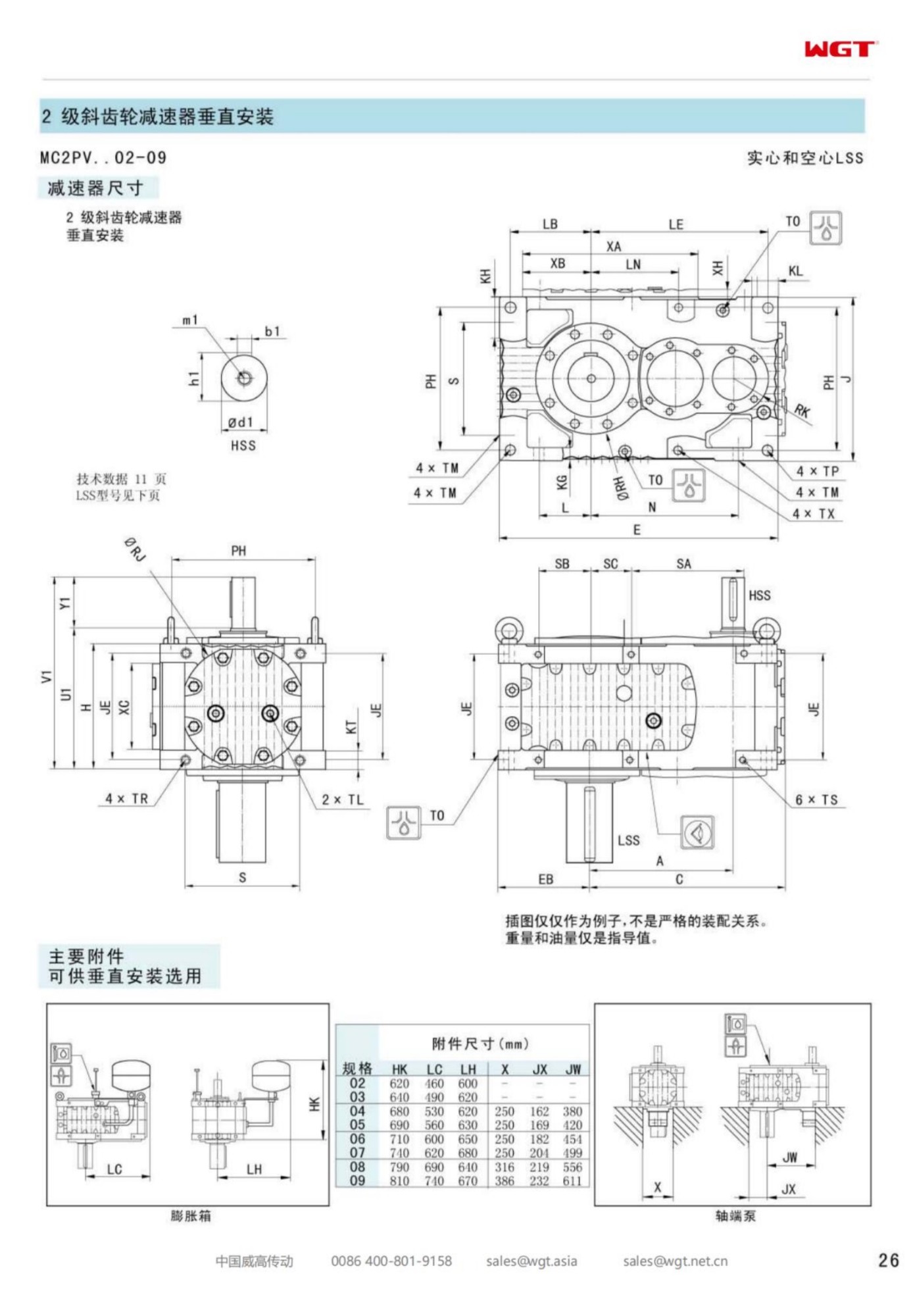
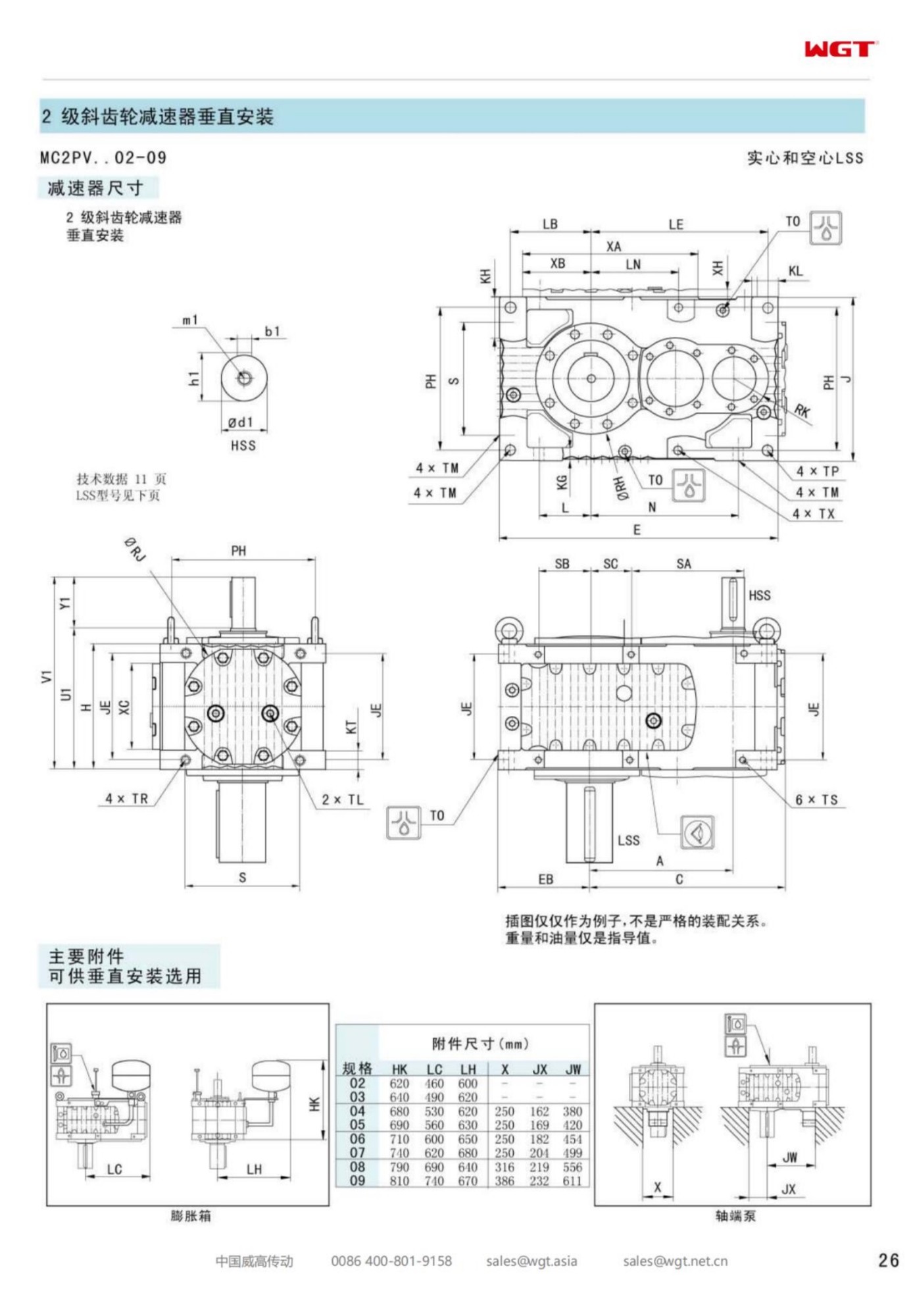
Every vertical line has a frame where the tanks stop being modest. On this family it is the fourth: the MC2PVSF04 vertical parallel shaft gearbox keeps the two-stage helical train, the footed case and the solid downward shaft of its smaller brothers, and adds the torque that thickeners, aerators and heavy slurry vessels ask for once their diameter passes the point where a paddle becomes a structure in its own right. The arrangement is unchanged; the consequences of the arrangement are not.
A bigger impeller means a bigger bending moment at the top of the shaft, a heavier geartrain reacting it, and a mounting plate whose stiffness is no longer a detail but a line item. This frame exists for plants that have drawn that arithmetic honestly and want a drive that closes the sum without excuses.
Two Frames Up, the Same Vertical Rules
Everything good about the vertical habit survives the growth in frame size. The drive still lives in the air where it can be watched, the seal still drips onto a walkway instead of into a product, and the tank still keeps no drive pocket to collect settled solids. What changes is the magnitude of everything the structure under the case must do: the bolt group sees more torque, the plate sees more bending, and the bridge sees a machine whose weight alone is now a design load rather than an afterthought.
Plants moving up from the third frame usually find the transition administrative rather than technical. The inspection routine, the oil grade, the seal sizes and the spares shelf all carry over, and the crew that ran three vertical drives well simply runs four. The unit itself asks only that its support be built as seriously as its gears.
Decoding the Fourth Vertical Frame
The type string reads exactly as the family table says; the frame number is the only character that moves.
| MC | Industrial multi-stage gear unit family |
| C2 | Compact two-stage parallel-shaft series |
| P | Parallel stages - shafts in one horizontal plane |
| V | Vertical build, output directed downward |
| S | Solid output shaft, coupled to the driven machine |
| F | Foot mounting onto a bridge or top plate |
| 04 | Fourth frame of the vertical line |
At this size the S line earns a second look from the driven-machine designer. The solid shaft and its coupling carry not just torque but the bending delivered by a long impeller shaft below, and the coupling type chosen - flanged, spacer, or gear type - should be picked with the withdrawal plan in mind: a spacer coupling lets the shaft be serviced without moving the gearbox, which on a bridge crowded with pipework is worth more than any catalogue saving.
Thrust, Bending and the Big Impeller
On the large end of a vertical line the forces stop being polite. A thickener rake ploughing consolidated sludge, an aerator throwing a sheet of water, a paddle starting through settled solids - each of these loads the train with a bending moment that travels the full height of the shaft before the gearbox sees it. The frame's bearings are dimensioned for it, but the envelope calculation only works if the duty statement is honest about the worst case: the jam, the settled start, the density excursion.
The practical protection is a written start story. A note saying how the machine is actually started - across the line, soft starter, variable speed, and whether the vessel can be filled before the paddle turns - lets the selection engineer put the right service factor on the frame. Plants that provide it buy gearboxes that last; plants that provide a brochure figure buy a story for the insurance claim.
What the Bridge Must Carry at Frame Four
The structural conversation deserves its own page of the project file at this size. The plate under the feet wants real thickness, gussets where the moment turns corners, and a bracing scheme that keeps the structure's natural frequency clear of the paddle pass rate. A bridge that hums at the paddle frequency will teach the whole plant the word resonance, and it will teach it through the gearbox bearings.
Two cheap preventions stand out. The first is giving the fabricator the torque reaction figure at quotation time, so the detail comes designed rather than guessed. The second is a bolt-torque recheck a month after commissioning, because every bolt group relaxes a little and a vertical unit that has walked a fraction of a millimetre announces it at the impeller long before a wrench finds a loose nut.
Duties That Outgrow the Third Frame
Frame four takes the vertical line into the heavier vessels:
- Thickener rake drives at a mineral sands plant
- Surface aerator drives on an aeration basin
- Agitator drives above a gypsum slurry tank
- Caustic storage mixer drives at an alumina refinery
- Digestion tank agitators at a sugar refinery
- Sludge holding tank drives at an industrial park utility
The common thread is mass in motion: vessels whose contents push back, shafts long enough to store energy, and duties where the start matters as much as the run. The fourth frame answers all three with the same two meshes and the same upright habit, simply built heavier where the heavier duty lands.
Oil Behaviour With the Case Standing Up
Vertical orientation changes where the oil wants to live, and the factory arrangement assumes the plant will respect it: galleries and dams feed the upper bearings that gravity would starve, and the level glass is set for an upright case, not a tilted one. A unit mounted two degrees off plumb will run, and will run badly, and will blame everyone but the setting-out crew.
The standing round stays two minutes: level at the glass, temperature at the marked spot, breather clear, seal area dry. At frame four the oil charge is large enough that a slow leak takes weeks to show at the glass - which is precisely why the round should be logged rather than remembered. Trends catch slow leaks; memory does not.
First Spin: Commissioning a Vertical Train
Commissioning a big vertical drive is a short, satisfying ceremony when it is planned. Alignment taken with the plate clean and bolts finger-tight; coupling bolts torqued in sequence; a bump start to watch the impeller track; then a slow run with someone at the bridge listening and someone below watching the shaft centre itself in the seal. The readings taken that day - alignment figures, running temperature, vibration velocity - become the baseline every future trend is measured against.
Skimp the ceremony and the machine collects its own data anyway, just later and less kindly. A unit that ran misaligned for its first month will have worn its first pattern into bearings and seals by the time anyone looks, and every reading after that is a conversation with a machine that started life with a handicap.
Trending a Vertical Drive Month by Month
Vertical trains tell their story slowly and in the same places: a temperature that steps up with the season, a vibration reading that follows the product change, a seal area that weeps a little more each quarter. None of these is an alarm on the day it appears; together they are the machine's biography. A single sheet, one row per month, three columns - temperature, vibration, seal condition - is all the paperwork a well-run bridge needs, and it has talked more drives out of unplanned stops than any condition-monitoring contract.
When a trend does move, the vertical arrangement pays again: inspection happens standing up, the coupling can be opened on a spacer, and the shaft comes out through the nozzle without an entry permit. The whole point of putting the drive over the vessel was that everything about it can be reached; trending is what makes reaching it rare.
Ratio Bands and the Honest Start Story
The two-stage train is happiest in the middle of its band, and the large agitator duties that choose frame four usually land exactly there: motor speed over paddle speed in the thirties and forties. Selection then proceeds on torque with the service factor the duty class demands, and the class is set by the start. A rake that breaks out of consolidated sludge once a shift writes a different specification from a stirrer that never sees a load step, even if their running points are identical.
The two numbers that close a selection first time are the worst start and the true duty hours. Everything else in the enquiry can be approximate; those two cannot, and suppliers can tell within one email which plants know it.
The Enquiry That Sizes Frame Four First Time
A quotation that comes back firm rather than conditional answers to a plain set of lines: vessel diameter and driven element with its type; impeller shaft length and the thrust arrangement; motor power, speed and starting method; output speed with the tolerance the process accepts; the start story in words; duty hours and batch pattern; atmosphere above the liquid; and the plate drawing or its thickness and bolt pattern.
Send those and the reply includes an outline drawing the fabricator can build from, a drilling template, and a delivery date the project can plan around. The fourth frame is not an exotic machine; it is the same vertical idea built to the size where the idea's advantages finally outweigh its costs, which is why plants that adopt it rarely go back.
Available Frames and Their Typical Duty
| Model | Centre distance | Output | Typical duty |
|---|
| M3PSF50 | size 50 | solid shaft, foot | conveyors, feeders |
| M3PSF60 | size 60 | solid shaft, foot | crushers, mixers |
| M3PSF70 | size 70 | solid shaft, foot | ball mills, shredders |
| M3PSF80 | size 80 | solid shaft, foot | kilns, heavy conveyors |
| M3PSF90 | size 90 | solid shaft, foot | mill and kiln drives |
| M3RSF50 | size 50 | solid shaft, foot, right-angle | inclined conveyors, elevators |
| M3RSF60 | size 60 | solid shaft, foot, right-angle | screw classifiers, feeders |
| M3RHF70 | size 70 | hollow shaft, foot, right-angle | agitators, drum drives |
| M3PHT80 | size 80 | hollow shaft, torque arm, parallel | shaft-mounted conveyors |
| M3RHT90 | size 90 | hollow shaft, torque arm, right-angle | heavy shaft-mounted drives |
Note that PSF and RSF frames of the same size share the mounting footprint; the R build simply inserts a bevel stage, so switching layout rarely forces a foundation change.
Questions and Answers
Can you supply vertical-shaft versions?
Yes. Vertical builds of the same industrial family cover the smaller size band and are common on vertical mixers, agitators and clarifier drives. State the orientation when ordering so oil levels and breathers are set correctly.
What documentation comes with an industrial gear unit?
Every shipment carries an installation manual, a dimension drawing, the nameplate data and a bench test record covering noise, temperature rise and backlash. Material certificates for shafts and gearing are available on request.
How is the unit transported and lifted on site?
Units ship in export wooden crates with lifting points on the housing clearly marked. On site, lift only from these points with the specified slings - lifting from shafts or covers is expressly forbidden in the manual.
Installation Examples
Automatic car-wash line
A car-wash equipment builder fits hollow-shaft reducers to its conveyor chains. The compact frame hides inside the wash tunnel, and FKM seal options handle the constant moisture.
Textile dyeing drums
A dyeing machine maker uses speed reducers on its fabric-turning drums. Low vibration (under 20 microns) prevents streaks in the fabric, and the 94-96% efficiency keeps the heat load down in a warm workshop.
![gear box application map for industry]()
From quarries to food plants - one right-angle drive concept.
Selection Example: Typical duty point
Take the common case - a machine that must be driven well below motor speed. Motor speed divided by the target output speed gives the ratio, rounded to the nearest available step, and the required torque with the service factor then fixes the frame size. The ratio is the easy part. The service factor for the shock level is what makes the selection safe, and we check that for you at no charge.
![how to choose a speed reducer model]()
Ratio first, then torque, then frame size: the standard selection route.
Full Documentation for Project Tenders
Bidding a project? The WGT Motor & Gearbox Online Selection System covers motor power, ratio and mounting on one screen - enter your numbers and see the model immediately.
We support tenders with complete technical files: dimension drawings, rating tables, material certificates and test record formats, in the format your client specifies. Looking for a gearbox for agricultural machine? Tell us the duty point and we will confirm the model in writing.