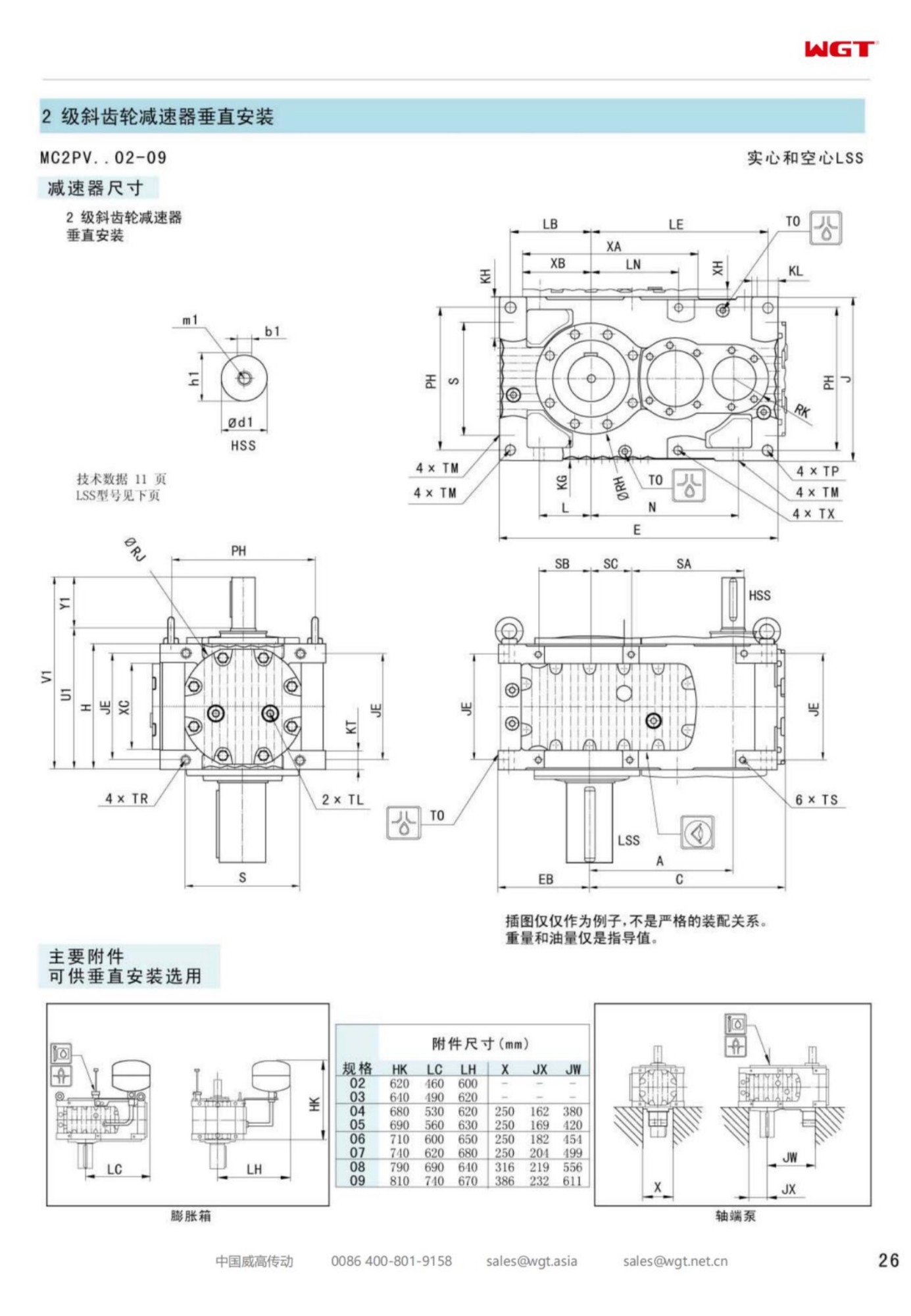
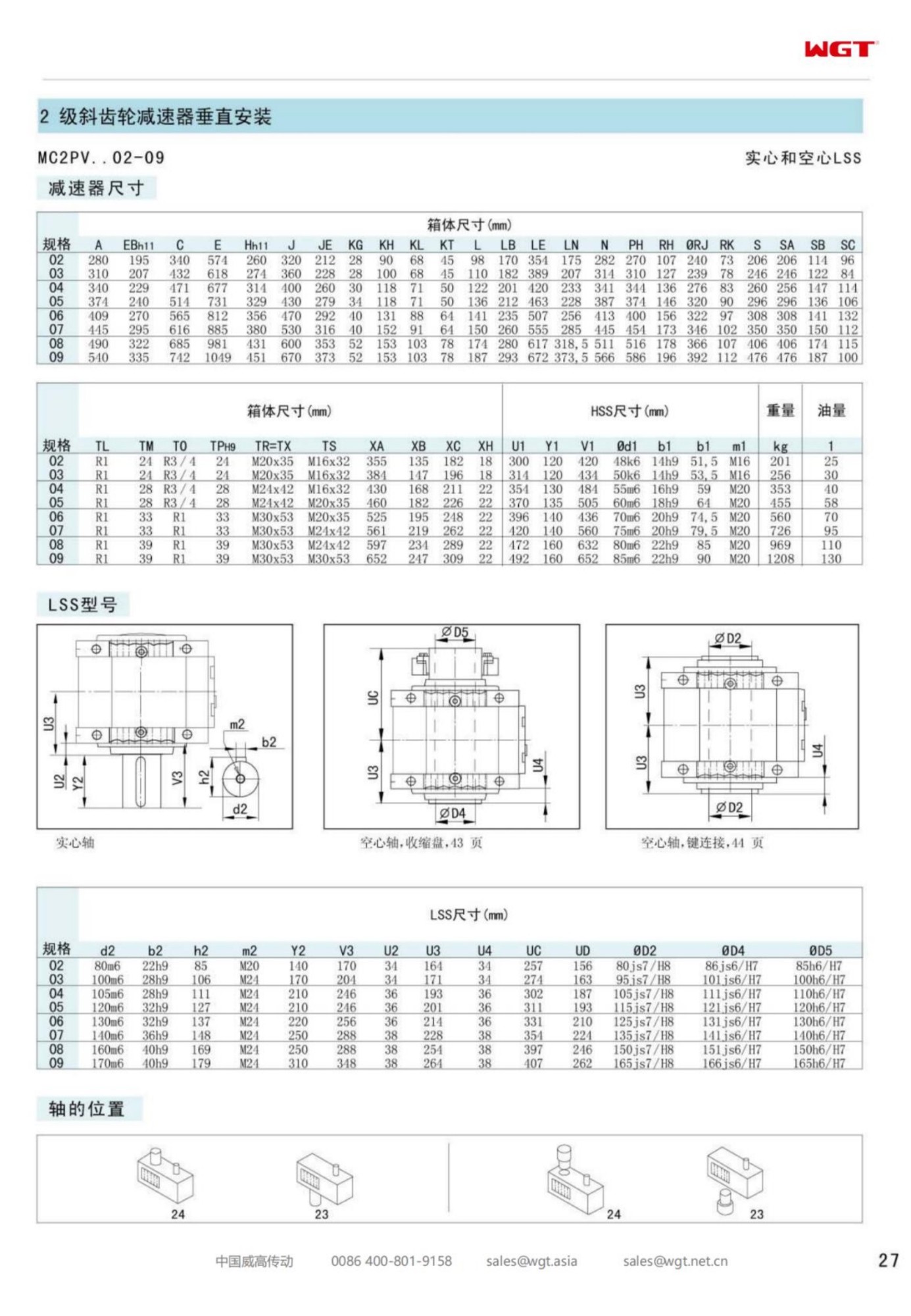
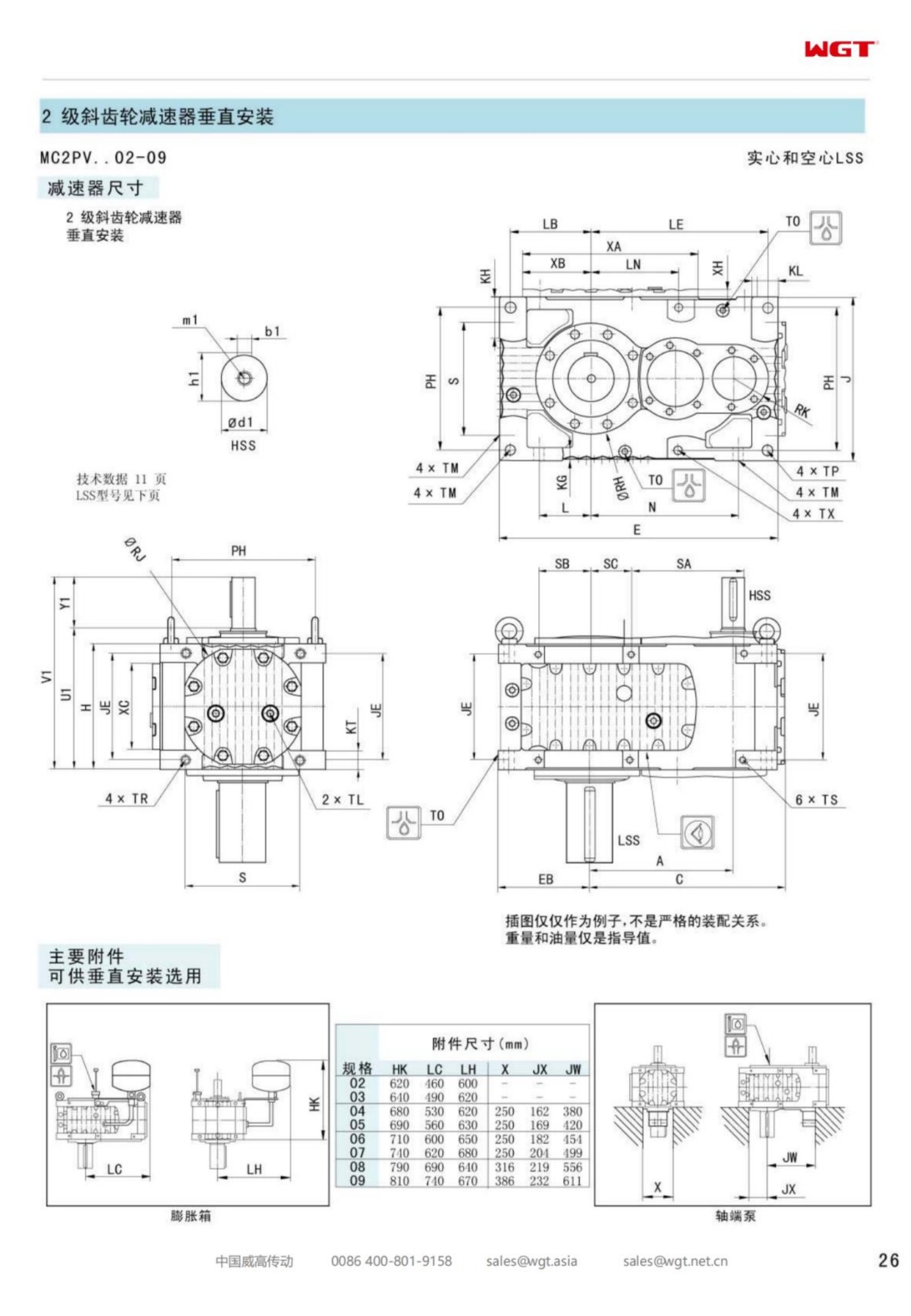
Step up one frame on the vertical line and the tanks get wider, the paddles get heavier and the starts get harder. The MC2PVSF03 vertical parallel shaft gear unit keeps the same honest arrangement - two helical stages in one plane, a footed case standing on a bridge, a solid output shaft aimed at the process below - and adds the torque head that mid-size vessels and larger rakes ask for once the batch stops being polite.
The third frame is where many plants standardise. It is big enough to drive a flotation cell or a digester agitator without apology and small enough to fit the bridges already standing, which is exactly the compromise most brownfield projects are shopping for.
The Second Frame and the Vertical Habit
Plants that run one vertical drive well tend to run a dozen, because the habits transfer. The bridge inspection round, the monthly vibration reading at the same point, the wipe of the seal journal, the oil change that happens on the walkway with a drum and a pump - once the crew owns these, every additional tank is just another entry in the same file. The third frame slots into that routine with no new learning, and the spares conversation stays within the family: same seal sizes, same breather, same oil grade.
That familiarity shows up in the failure statistics too, or rather in their absence. Vertical units that live on watched bridges, with trending notes that name dates and readings, drift for years instead of failing suddenly - and the drifts they do show are usually the structure's story, not the gears'.
Reading the Designation on a Vertical Unit
The family's decode table holds on the third frame; the characters that matter for the installation are the same ones, at a heavier torque.
| MC | Industrial multi-stage gear unit family |
| C2 | Compact two-stage parallel-shaft series |
| P | Parallel stages - shafts in one horizontal plane |
| V | Vertical build, output directed downward |
| S | Solid output shaft with a coupled connection |
| F | Foot mounting onto bridge or top plate |
| 03 | Third frame - the mid-size workhorse of the vertical line |
On a unit of this weight the F line deserves the fabricator's attention before the order, not after: the plate drilling, the register and the structural bracing under it all belong on the bridge drawing, and a plate that arrives unbored is a schedule paragraph, not a problem, while a bridge that arrives too soft is neither.
Why Agitators Prefer a Solid Stub Shaft
The solid shaft and its coupling keep the mechanical division clean: the gearbox supplies torque, the machine supplies thrust, and the coupling joins them without inventing a third job. On large agitators the machine maker's thrust bearing sits at the top of the impeller shaft, sized for the axial pull of the blades; the gearbox's vertical seals then live with radial error and contamination only, which is the job they were drawn for.
The arrangement also makes the withdrawal plan honest. An impeller shaft can come out through the vessel nozzle for seal service while the unit stays bolted to its plate above, and a gearbox swap does not ask anyone to enter the tank. On a plant whose stops are counted in hours, that separation is the whole argument for the vertical habit.
Cooling and the Enclosed Process Building
A vertical case on a bridge in a closed building lives in the warm layer. Heat from the process rises past the casing, airflow is whatever the ventilation provides, and the oil temperature settles where those facts put it. The rating conversation should therefore happen in building terms: summer ceiling at the drive's own level, not the weather station outside, and any duty drift - a denser product, a faster paddle - checked against the thermal margin that was actually bought.
Where the margin is thin, the family's cooling accessories exist and bolt on without re-engineering the installation. What does not work is discovering the ceiling during the first hot week, with the product already drifting; a temperature trace taken in April does not speak for August.
Duties the Third Frame Carries
The third frame of the vertical line, and the duties that keep it busy:
- Absorber agitator drives on a flue gas scrubbing plant
- Flotation cell drives at a copper concentrator
- Blender vessel drives in a food ingredients plant
- Crystallizer stirrer drives at a fine chemicals works
- Neutralization tank drives at a steelworks water plant
- Effluent conditioning mixer drives at a treatment works
The common thread is a vessel whose contents must be kept moving against a real torque, from above, on a structure that already exists. The third frame answers with mid-band ratios, a solid coupled shaft and the vertical installation that keeps the wet end simple for the life of the machine.
Torque Reaction and the Top-Plate Design
Every newton-metre the drive makes is reacted somewhere, and on a vertical unit the somewhere is the plate and the structure under it. Starts against settled slurry, paddle pass pulses and the occasional jam all arrive at the bolt group as a twisting load, and the fabricator's detail - gussets, bracing, bolt edge distances - decides whether those pulses are carried quietly or sung back into the train. Sharing the torque figure with the structural engineer at quotation time costs an email; discovering a singing bridge at commissioning costs a season.
The bolt group itself deserves the ordinary discipline: fitted bolts where the drawing shows them, torque in sequence, recheck after the first month. A vertical unit that has walked even a little on its plate will show it as an impeller wobble long before it shows as a bolt.
Lubrication in a Vertical Position
Upright over a tank, the case's oil behaviour is arranged for at the factory: galleries and dams feed the bearings that gravity would otherwise starve, and the sight glass and fill points sit where a person on the bridge can reach them. What the plant owes the design is the grade written on the guard and the interval written in the file - vertical units forgive many things, but not a sump that quietly halves.
A monthly two-minute round covers it: level at the glass, temperature at the same spot, breather clear, seal area dry. The plants that never open a vertical gearbox unexpectedly are not lucky; they are round-covered.
Aligning a Coupled Vertical Line
Alignment above a tank is a short job done once, and it wants the right conditions: plate clean, bolts finger-tight, coupling half bolts out, dial indicator on the register. The coupling maker's figure is the target, and the vessel axis is the reference - not the motor's convenience, not the walkway's geometry. Once torqued and grouted-free, the line is recorded: a note of the readings in the commissioning file gives every future crew a number to compare against instead of a feeling.
Recheck after the first month of running. Structures settle, bolt groups relax a few per cent, and a fifteen-minute verification on a planned stop keeps the impeller track and the seal life where the design put them.
Ordering for a Vertical Future
A works that expects to add tanks should buy the third frame with the future in mind: same oil grade and seal sizes as the frames already in service, a breather and sight-glass arrangement the crews know, and mounting details that a plate shop can copy without a new drawing. The family's commonality is worth money at exactly this point - one stores shelf and one maintenance routine covering a whole row of vessels.
The enquiry that enables that future names the driven element and its thrust arrangement, motor data and starting method, output speed with tolerance, duty hours and batch pattern, the atmosphere above the liquid, and the plate drawing. In return it gets a firm quotation, a drilling template and an outline the fabricator can build from in the same shutdown as the tank's other work.
The Handover File for a Vertical Drive
The file that keeps a vertical train healthy for decades is short: commissioning alignment readings, oil grade and first-change date, monthly round sheet with a column for temperature and vibration at a fixed point, and the escalation note that says who is called when the trend moves. Add the coupling drawing and the seal part numbers and the file carries the unit through crew changes intact.
Units on bridges are seen by hundreds of eyes and serviced by few hands, and the difference between the two is documentation. A third frame with such a file is the dullest asset on the plant - which, for a drive hanging over a live vessel, is precisely the ambition.
When the Process Changes Under an Old Drive
Vertical drives outlive their original duty more often than horizontal ones, because the vessels they hang over are re-purposed: a blender hall becomes a specialty line, a clarifier train takes a denser sludge, a treatment works doubles its throughput without moving a brick. Each of those changes arrives at the gearbox as new torque, new bending and a new start story, and the honest engineering response is to re-check the selection rather than to hope. The rating table has a column for exactly this conversation, and filling it in costs one email.
The signs that the duty has drifted are visible before the failure is: a temperature trace that climbs a few degrees each product change, a vibration reading that steps up with a new paddle speed, starts that now take a beat longer. None of these is urgent on the day it appears, and all of them are cheaper to answer with a frame review than with a failure investigation. Works that treat a process change as a gearbox question keep the same drive for decades; works that treat it as nobody's business buy the same frame twice.
Site Lessons the Third Frame Has Collected
A few habits keep appearing in the commissioning notes of units that run well. The first is the walk-through with a tape measure before the crane day: bridge loading, doorway widths, the route from laydown to plate. The second is the spare-parts shelf organised by frame rather than by purchase order, so the seal for any tank is found in a minute. The third is the rule that nobody slings a vertical unit by its output shaft, the lifting points being the only points. None of these is written in the instruction book, and all of them show up in the service histories of the drives that never make headlines.
That is the quiet character of the third vertical frame: ordinary in the best sense, carried by its structure, kept dull by its people, and still turning paddles thirty years after the crane that set it left the site.
Selection Example: Flotation cell drive at a copper concentrator
Take a 22 kW motor at 1465 rpm turning the flotation impeller at 30 rpm. The ratio follows directly: 1465 / 30 = 48.8, so a ratio near i=49 is drawn from the upper two-stage band, and the frame is sized by the torque a froth-loaded cell asks of the impeller at restart, not by the steady running load alone. In this case the third frame sits on the cell bridge with the solid shaft pointed down into the tank, so the impeller alignment is set once at the machined plate register and the wet end keeps its own thrust bearing. Work through the same three steps - speed, output speed, torque - and the model number falls out; we verify it against the duty class before quoting.
![gear reducer ratio calculation steps]()
From duty point to model number - the same four steps every time.
Applications in Industry
Stone quarry conveyor
A stone quarry runs reducers on its primary conveyor. Shock loads from oversized rock are absorbed by the case-hardened gears (surface HRC58-62), and after two years of continuous duty the units still run within their original 68 dB noise spec.
Flour mill screw conveyors
A flour mill standardised on gear reducers for its screw conveyor network. One spare-part pool now covers fifteen drives, and the smooth helical input stage keeps noise low in the packing hall.
![gear reducer industries served - WGT]()
Industry map: the sectors where the M3 series is most common.
Buyer Questions and Answers
Do you supply the unit with an electric motor fitted?
We deliver the bare gear unit with an input suitable for your motor, or as a complete motor-gearbox assembly aligned and tested at the works. For upgrade projects many customers keep the existing motor and order the unit alone.
How is the gear unit protected against dust and moisture?
Housings are gasket-sealed with labyrinth or lip seals at both shafts as standard. Dusty plants, washdown areas and outdoor installations are covered by coating and sealing options specified together with the order.
M3 Series Model Overview
| Model | Centre distance | Output | Typical duty |
|---|
| M3PSF50 | size 50 | solid shaft, foot | conveyors, feeders |
| M3PSF60 | size 60 | solid shaft, foot | crushers, mixers |
| M3PSF70 | size 70 | solid shaft, foot | ball mills, shredders |
| M3PSF80 | size 80 | solid shaft, foot | kilns, heavy conveyors |
| M3PSF90 | size 90 | solid shaft, foot | mill and kiln drives |
| M3RSF50 | size 50 | solid shaft, foot, right-angle | inclined conveyors, elevators |
| M3RSF60 | size 60 | solid shaft, foot, right-angle | screw classifiers, feeders |
| M3RHF70 | size 70 | hollow shaft, foot, right-angle | agitators, drum drives |
| M3PHT80 | size 80 | hollow shaft, torque arm, parallel | shaft-mounted conveyors |
| M3RHT90 | size 90 | hollow shaft, torque arm, right-angle | heavy shaft-mounted drives |
The series is sized for continuous heavy duty rather than by motor power alone: the required torque with the service factor decides the frame, and the stage count (2 to 5) decides the ratio band.
Site Survey Data? We Size It for You
Have the machine data but not the model? Run your duty point through the WGT Motor & Gearbox Online Selection System first: it saves a round of emails and gets you to a firm price faster.
Send the conveyor length, belt speed, drive pulley diameter or the machine duty description. We run the full selection - ratio, frame, service factor - and return the datasheet with the quote. Looking for a gear reducer for textile machinery? Tell us the duty point and we will confirm the model in writing.