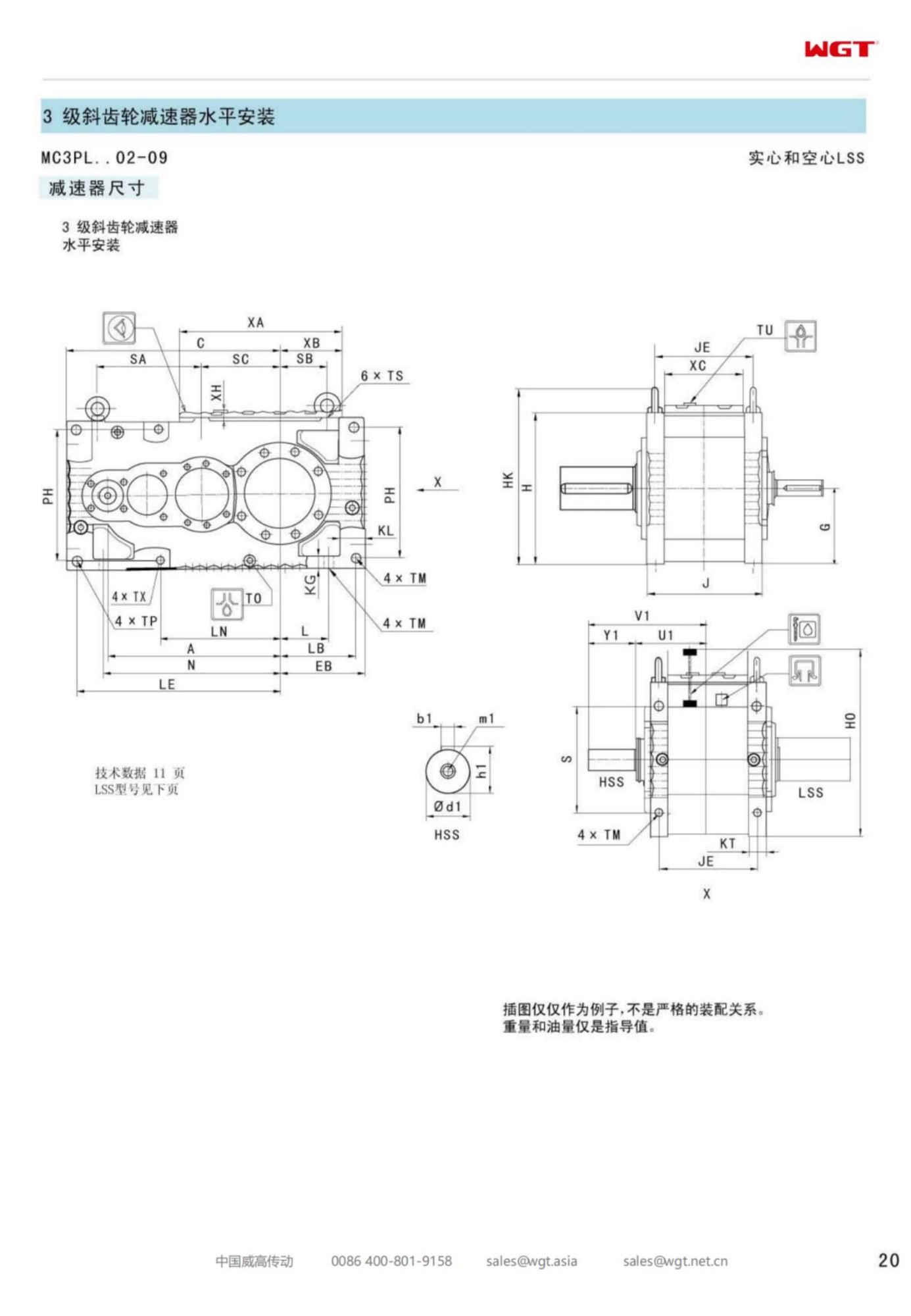
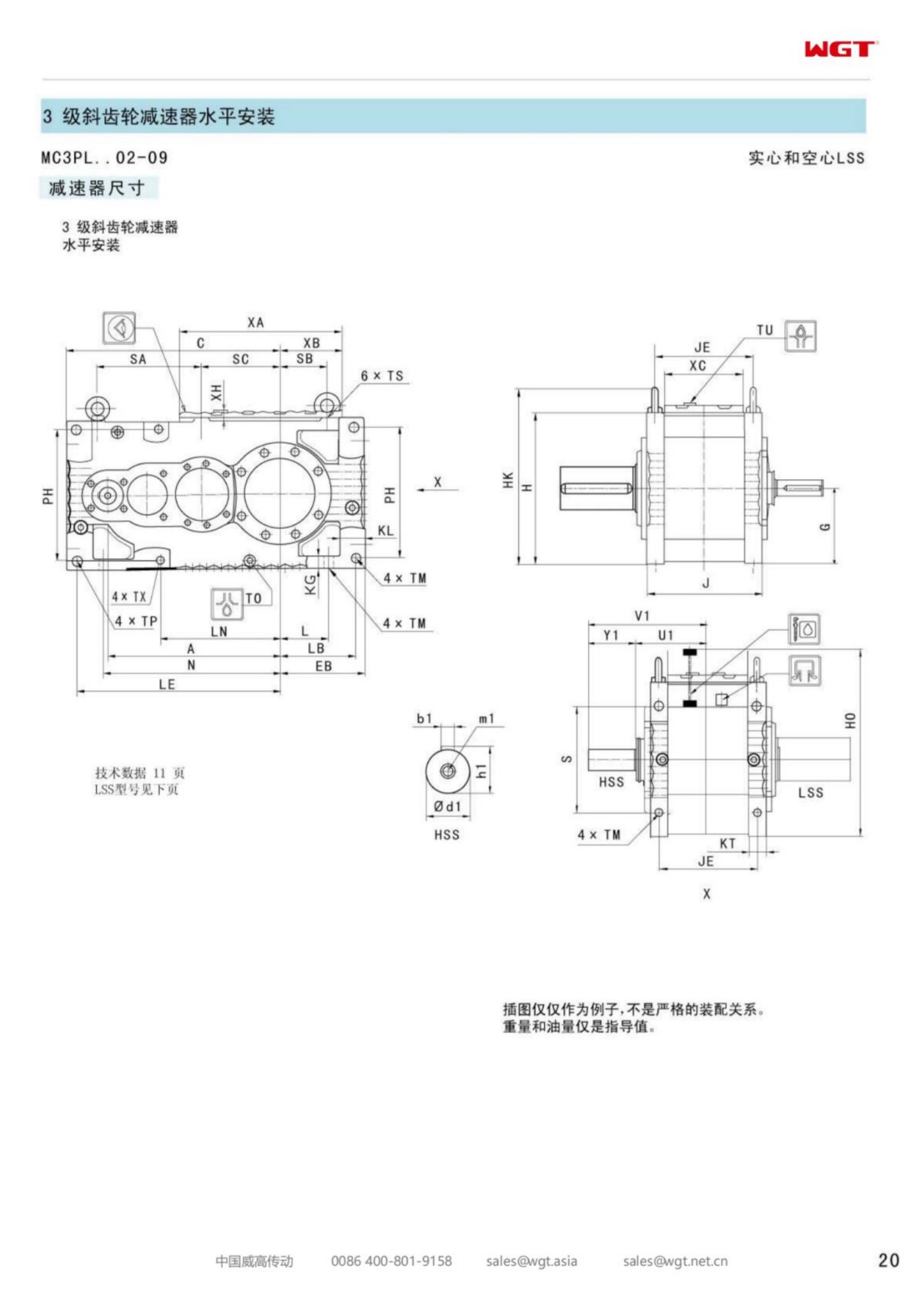
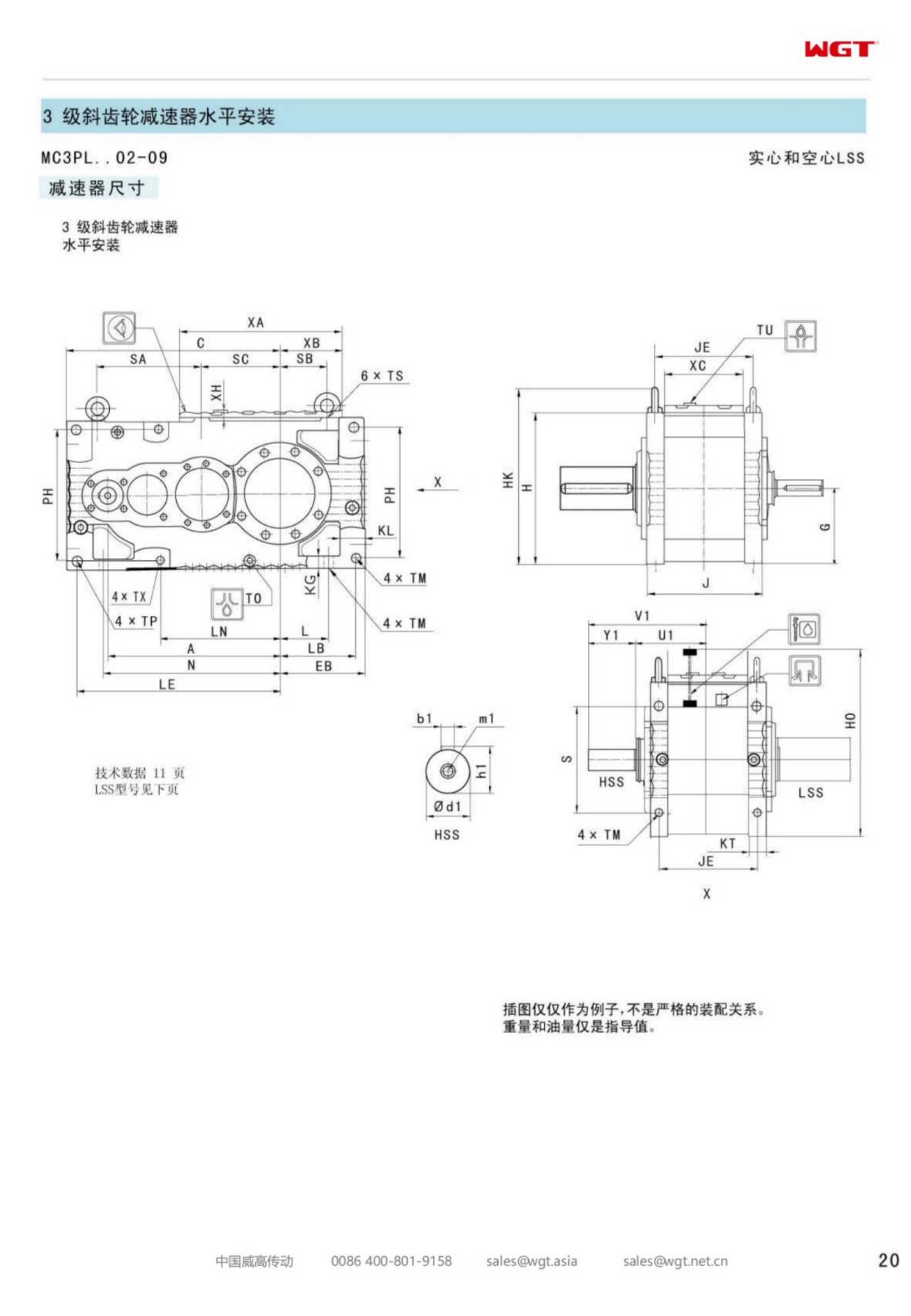
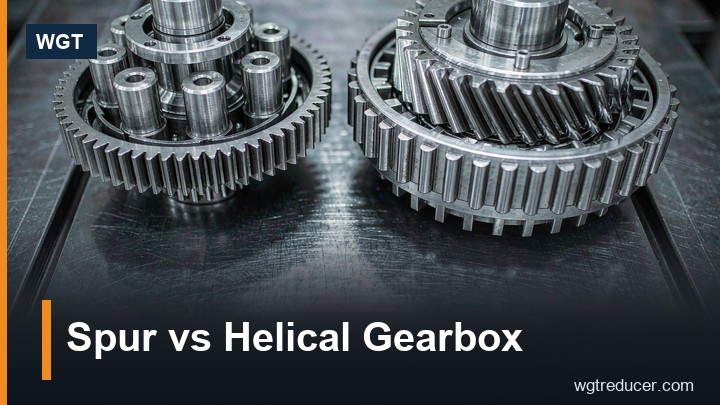
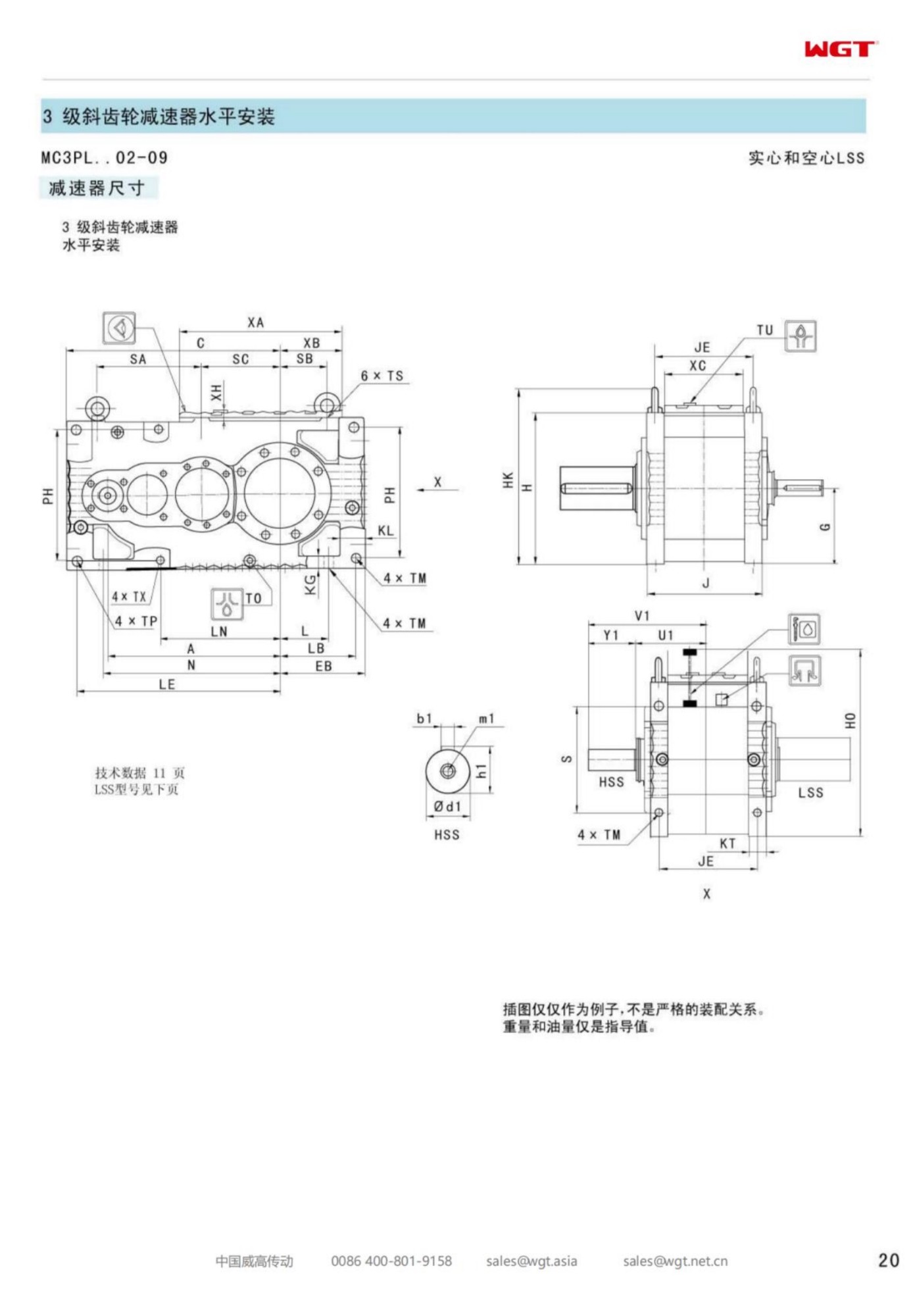
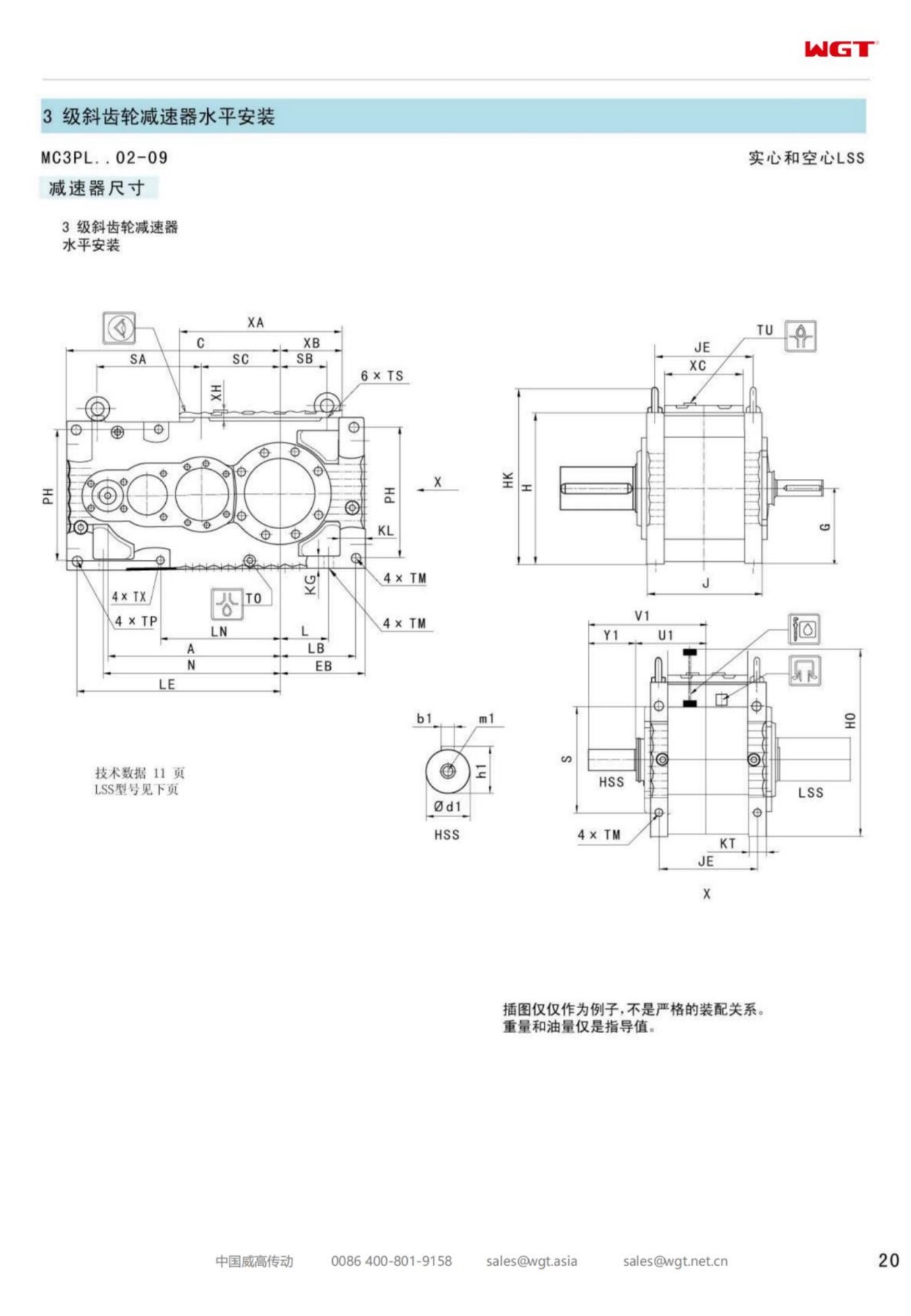
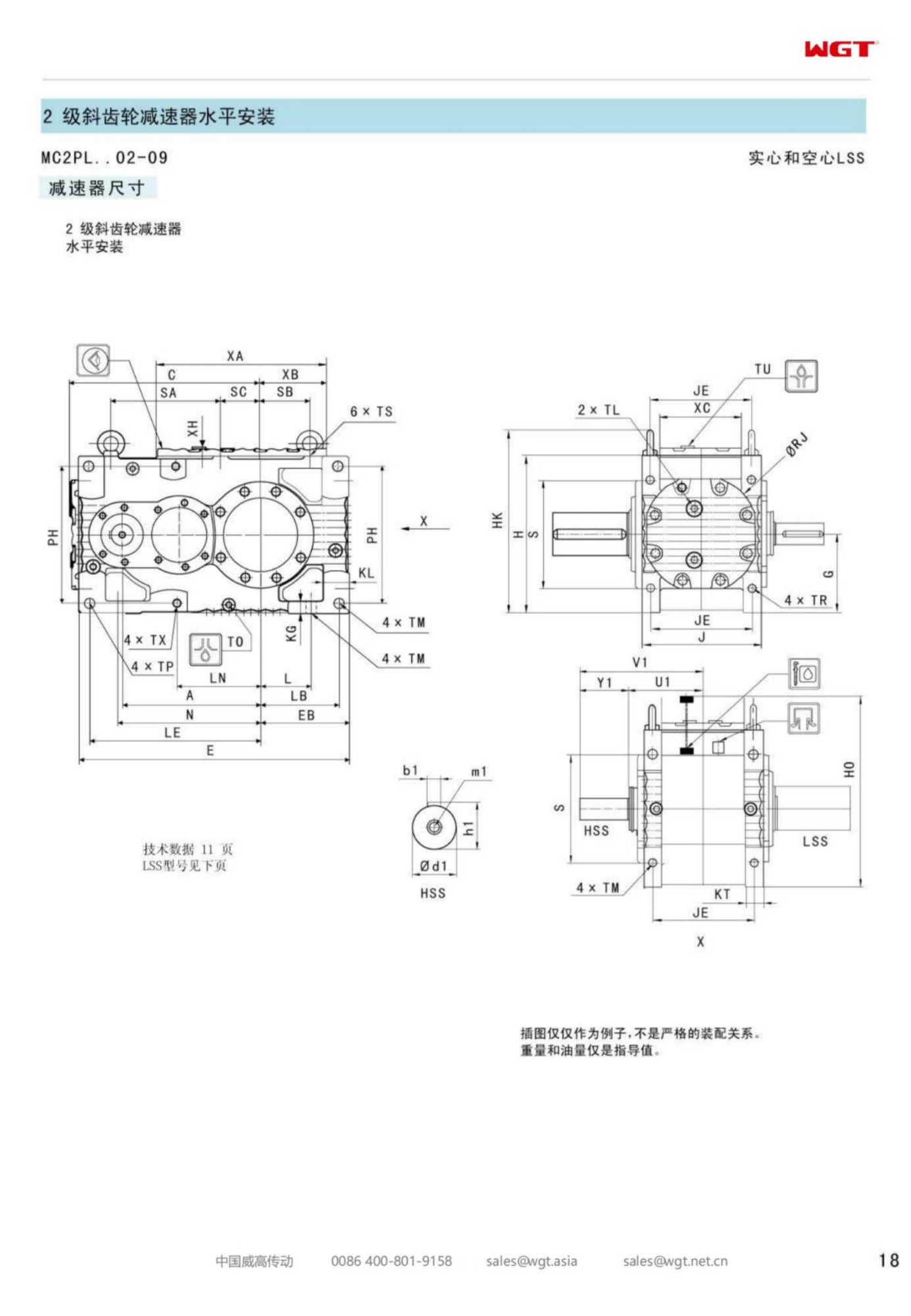
Every gearcase in a plant is bought twice: once as machinery, and again - many times over - as the small parts that keep it running. The MC2PLST08 solid shaft gearbox sits in the upper part of its band, where duties run long enough that the second purchase becomes a line item the plant can either plan or be surprised by. This page is about the planned version: the parts that wear on purpose, the oil that doubles as an instrument, and the calendar that turns wear from an event into a schedule.
Frames at this level rarely fail in their first years. What distinguishes the installations that run cleanly for decades is not the iron but the discipline around it - who samples the oil, who greases the arm pins, who owns the shutdown calendar, and whether the answers survive the people who wrote them down. A buyer who treats these as order-time questions pays a fraction of what a buyer who treats them as year-five discoveries will pay.
Frame Eight and the Cost of Wearing Out
Frame eight carries tonnage that smaller frames cannot, and with tonnage comes a simple truth: everything that transmits it wears. The gears inside the case are sized for decades of proper lubrication; the seals, breathers, bushings and coupling elements around them are consumables by design. The economics of the frame are therefore decided less by its purchase price than by how predictably its wear parts are renewed.
The honest way to buy a frame eight is with its afterlife included. That means a wear-parts schedule written from the gear unit's own documentation, an oil programme with actual sampling behind it, and shutdown dates the plant defends against production pressure. None of this is romantic engineering. It is the difference between a drive that is maintained and one that is merely repaired.
Decoding MC2PLST08
The type string follows the family's grammar, with the frame digit now marking the upper band where long campaigns gather.
| MC | Industrial gear unit family built for continuous plant duty |
| 2 | Two helical reductions in one level case |
| P | Parallel-shaft layout, input and output on parallel axes |
| L | Level build, both shafts horizontal |
| S | Solid output shaft, torque leaves through a coupling |
| T | Torque arm reaction, no feet, no foundation, no grout |
| 08 | Eighth frame: upper-band duties with long, planned service lives |
Read as an order document, the string fixes the geometry and the frame. What it cannot fix is the maintenance culture the frame lands in, and that culture - not the gearing - decides whether the twentieth year looks like the second. A complete order therefore travels with the small print of longevity: oil grade and interval, breather type, seal set, arm pin bushings and the coupling element, each with its date and its owner.
The Parts That Wear on Purpose
A well-designed gearcase concentrates its wear into a short list of deliberately consumable parts, precisely so the iron lasts. On this construction that list is stable across the band: the output seal, the breather, the arm pin bushings, the coupling's flexible element, and the oil itself. Each is inexpensive, each fails on a schedule rather than a catastrophe, and each is cheap to hold and expensive to await.
The design intent deserves respect in return. When a bushing is worn, the reaction path is telling the truth about its service; when a coupling element hardens, it has spent its designed flex. Plants that answer these signals with like-for-like parts on a planned date keep the gearcase's internal condition sealed off from the site's dust, water and haste. Plants that run consumables to destruction invite the wear into the places it was designed never to reach.
Oil as an Instrument, Not Just a Lubricant
On a frame of this size, an oil sample is the cheapest inspection the plant owns. The sample reports particle counts, water content and additive health - the three numbers that precede nearly every gear failure by months. A quarterly sample on a continuous duty turns the oil programme from a calendar guess into a trend line, and the trend line is what justifies stretching or shortening the interval with evidence instead of habit.
The sampling discipline is simple and non-negotiable: same point, same procedure, after the oil is warm and circulated, labelled with hours as well as dates. A laboratory report that cannot be compared with its predecessors is a receipt, not an instrument. Plants that keep five years of comparable samples can usually name the quarter in which a drive's character changed; plants that cannot keep samples at all are naming failures instead.
Building the Shutdown Calendar
The shutdown calendar is where wear management stops being theory. It gathers the small service items - grease the arm pins, check the breather, read the oil level and temperature, inspect the seal lips, verify the coupling element - and binds them to dates the plant has already committed to for other reasons. A drive whose items ride on the plant's planned stoppages never accumulates the deferred list that kills drives in their second decade.
Two habits make the calendar real. First, every item is checked off by someone with a name, not a department. Second, the calendar is reviewed after each shutdown against what was actually found, so intervals tighten where wear runs faster and relax where it does not. A calendar that never learns is a document; one that learns is a maintenance programme.
The Spares Shelf That Pays for Itself
A frame eight argues for a deliberate shelf: one seal set, one breather, two sets of arm pin bushings, one coupling element, and oil for a full change held on site. The cost of that shelf is rounding error against the freight and production loss of a single unplanned stop on a conveyor this size, and every item on it fails on the hall's schedule rather than the warehouse's.
The shelf needs an owner and an audit line like any other inventory: consumed on a shutdown, reordered the same week, and checked annually against the gear unit's documentation so part numbers survive personnel changes. Plants that skip the audit discover at the worst moment that the seal on the shelf belongs to a different frame - a discovery that converts a two-hour job into a two-week one.
Baseline Records That Do the Arguing
Every measurement taken on a new frame eight is worth double later, because it establishes the baseline the future will be argued from: the commissioning temperatures, the first vibration readings at fixed points, the first oil sample, the coupling's fitted position, the arm's as-installed geometry. Recorded properly, these numbers let year six answer its own questions - has this bearing drifted, is that temperature new, did the alignment move - without a survey crew and a shutdown to find out.
The format matters less than the persistence. A bound log kept at the drive, a shared spreadsheet, or a condition-monitoring database all work, provided the entries carry dates, hours and the same measurement points every time. The plant that can produce ten years of comparable numbers buys its next gearbox with evidence; the one that cannot buys it with hope and usually pays the difference.
Duties That Belong on Frame Eight
Duties judged not by their first year but by their tenth - wear parts, oil discipline and a shutdown calendar:
- Overland trunk conveyor at a copper mine, planned as a twenty-year campaign
- Clinker apron conveyor under the kiln at a cement works
- Sinter machine feed belt at an integrated steel plant
- Primary crusher discharge belt at an aggregate quarry
- Trunk belt in a salt mine running three shifts year-round
- Wood-chip reclaim conveyor at a pulp mill
What these duties share is horizon: campaigns measured in decades, where the cost of a stopped conveyor dwarfs the cost of looking after the drive that turns it. Frame eight rewards that care with a service life the purchase order never promised - the iron was always capable of it; the calendar is what delivers it.
Seals, Breathers and the Small Consumables
The output seal deserves its own line in the wear plan, because it is the boundary between a clean gearcase and the site's worst dust or washdown water. Its life is extended by conditions the installer controls - a shaft free of dressing marks, a guard that keeps grit off the lip, a grease path where the design provides one - and ended on a schedule that hot or wet positions should shorten deliberately. The breather belongs beside it: a filtered type in dusty air, checked at the same rhythm as the filters anywhere else in the hall, since a plugged breather turns every thermal cycle into a seal test.
Neither part announces its condition from a distance. Both are read at the coupling service and the oil change, which is why the shutdown calendar, the oil programme and the wear-parts shelf are one system wearing three names. Split them between departments and the drive loses the thread; keep them together and the small consumables do exactly what they were designed to do - wear so the gears do not.
Arm Pins, Bushings and the Reaction Path
The torque arm is this construction's signature, and its pins and bushings are the most neglected items in the wear plan. They carry the full reaction of every stop, start and surge the conveyor delivers, usually with a grease path that a busy crew forgets. Worn bushings show first as play at the arm, then as vibration that gets blamed on the coupling, and finally as elongated holes in steel that is not cheap to mend.
The programme is short: grease on the calendar, play checked at each shutdown, bushings renewed on wear rather than failure, and the bracket welds inspected annually with the same seriousness as the pins. A frame's reaction path is a chain of inexpensive parts holding an expensive one in place, and it deserves to be inspected as a chain rather than item by item.
Life-Cycle Arithmetic for the Buyer
Set against a twenty-year campaign, the wear programme for a frame eight is a rounding error: seals, breathers, bushings, elements, oil and sampling across two decades cost less than the freight on one brand-new gearcase - to say nothing of the production behind it. The arithmetic is worth writing into the justification for the drive, because the alternative spending is not avoided by silence; it is merely rescheduled to arrive unscheduled.
The same arithmetic answers the quiet question every buyer eventually asks: when is a drive worth overhauling and when is it worth ordering anew. With comparable oil histories, vibration trends and wear records, that question becomes a calculation. Without them it becomes an opinion, and opinions at budget time favour whatever is cheapest this year regardless of what it costs next decade.
The Enquiry That Includes Year Ten
A frame-eight enquiry reads like the family's standard document with one extra page: the afterlife. Alongside duty, ratio, service factor and mounting survey, it states the oil programme intended, the breather and sealing package the position needs, the spares to ship with the first order, and the documentation set that will keep all of it legible in year ten. Suppliers answer this page gladly - it tells them the buyer intends to keep the drive alive, which is the best signal a gearbox order can carry.
The drives that embarrass their owners are rarely the ones that were undersized. They are the ones whose tenth year arrived with no calendar, no shelf, no samples and no baseline, so every small wear signal landed as a surprise. Frame eight is built to be boring for twenty years; the buyer's half of that promise fits on a single page, and it belongs in the order.
Available Frames and Their Typical Duty
| Model | Centre distance | Output | Typical duty |
|---|
| M3PSF50 | size 50 | solid shaft, foot | conveyors, feeders |
| M3PSF60 | size 60 | solid shaft, foot | crushers, mixers |
| M3PSF70 | size 70 | solid shaft, foot | ball mills, shredders |
| M3PSF80 | size 80 | solid shaft, foot | kilns, heavy conveyors |
| M3PSF90 | size 90 | solid shaft, foot | mill and kiln drives |
| M3RSF50 | size 50 | solid shaft, foot, right-angle | inclined conveyors, elevators |
| M3RSF60 | size 60 | solid shaft, foot, right-angle | screw classifiers, feeders |
| M3RHF70 | size 70 | hollow shaft, foot, right-angle | agitators, drum drives |
| M3PHT80 | size 80 | hollow shaft, torque arm, parallel | shaft-mounted conveyors |
| M3RHT90 | size 90 | hollow shaft, torque arm, right-angle | heavy shaft-mounted drives |
Note that PSF and RSF frames of the same size share the mounting footprint; the R build simply inserts a bevel stage, so switching layout rarely forces a foundation change.
Questions and Answers
What is the service factor and how is it applied?
The service factor is a multiplier applied to your required torque to cover shocks and duty class - typically 1.0 for uniform duty, 1.25 for moderate shocks, 1.5 or more for heavy shock loads. Send us the driven machine and duty and we will apply the correct factor.
What ambient temperature range can the unit work in?
Standard units suit -10 to +40 deg C ambient with the supplied mineral oil. For lower temperatures we fill with synthetic oil; for higher ambient or frequent starting we advise the next larger frame or an oil cooler.
What are the delivery lead times and shipping terms?
Standard lead time is 5-10 weeks ex-works, with popular ratios often available sooner. We quote EXW, FOB NINGBO / SHANGHAI or CIF, and urgent units can be air-freighted within 72 hours of payment.
Installation Examples
Grain terminal elevators
A grain terminal powers its bucket elevators with gear reducers. The anti-run-back option holds the loaded buckets during power cuts, and standard interface dimensions meant the old foundations were reused as they were.
Pallet lift in a warehouse
A logistics integrator selected units for pallet lifts. The hollow output bore carries the lift screw directly, and one year of three-shift operation has passed without a single seal replacement.
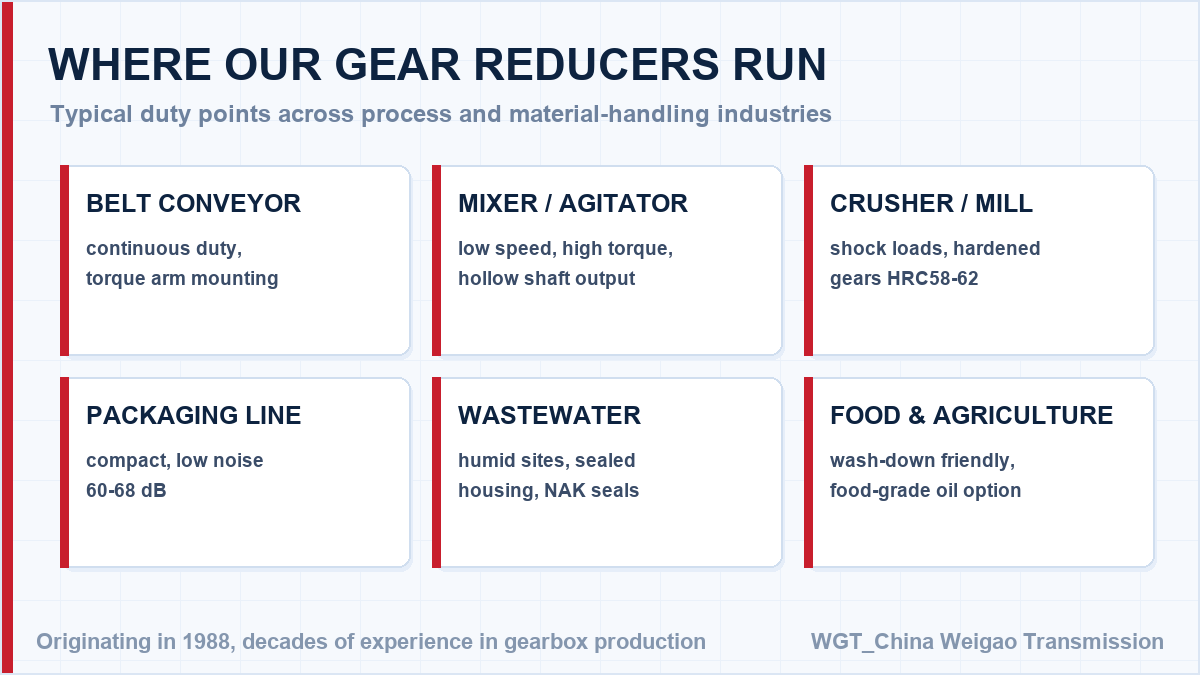
![gear box application map for industry]()
From quarries to food plants - one right-angle drive concept.
Selection Example: Overland trunk conveyor at a copper mine planned as a twenty-year campaign
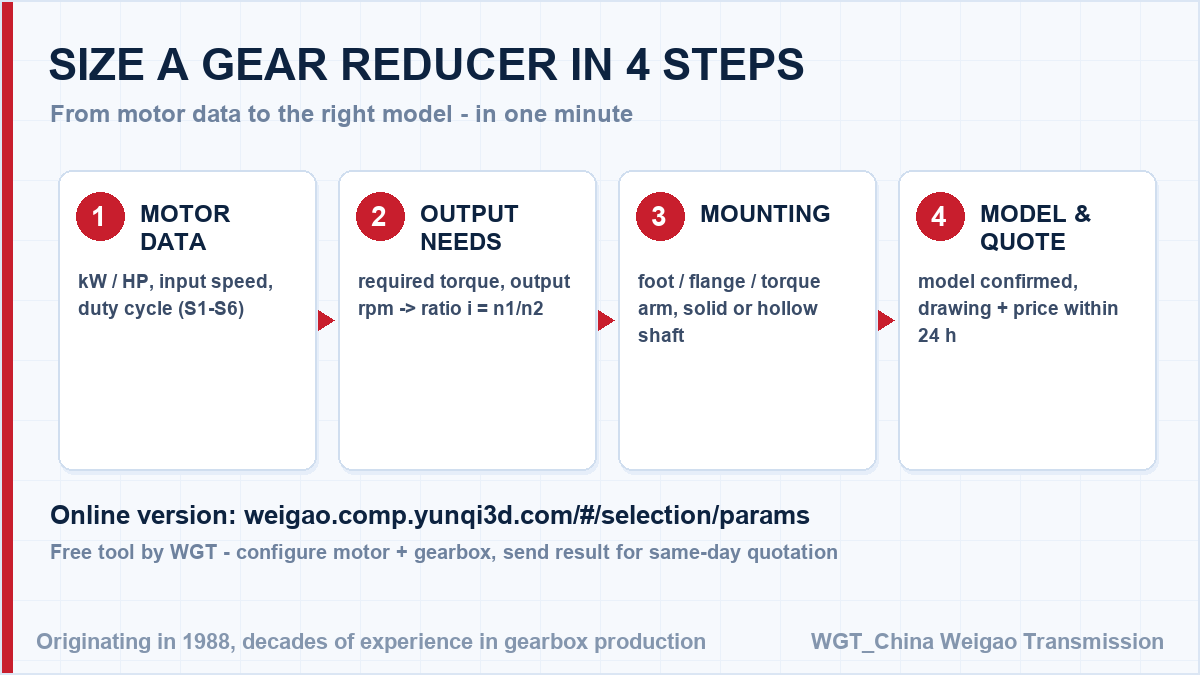
Take a 90 kW motor at 1485 rpm turning the head shaft at 24 rpm. The ratio follows directly: 1485 / 24 = 61.9, so a ratio near i=62 comes from the top of the two-stage band, and the frame is confirmed against the campaign hours rather than the peak alone, with the wear-parts schedule and oil-sampling programme attached to the order from the first day. In this case frame eight runs the long campaign on scheduled consumables - seal set, breather, arm pin bushings and coupling element - and the shutdown calendar keeps the drift near zero for two decades. The ratio is the easy part. The service factor for the shock level is what makes the selection safe, and we check that for you at no charge.
![how to choose a speed reducer model]()
Ratio first, then torque, then frame size: the standard selection route.
From RFQ to Dispatch - One Account Manager
Tired of chasing suppliers? The WGT Motor & Gearbox Online Selection System covers motor power, ratio and mounting on one screen - enter your numbers and see the model immediately.
One account manager follows your enquiry from selection to dispatch, with lead times and test dates confirmed in writing. Urgent unit needs and project volumes are handled on the same route. Looking for a gearbox for wastewater treatment? Tell us the duty point and we will confirm the model in writing.