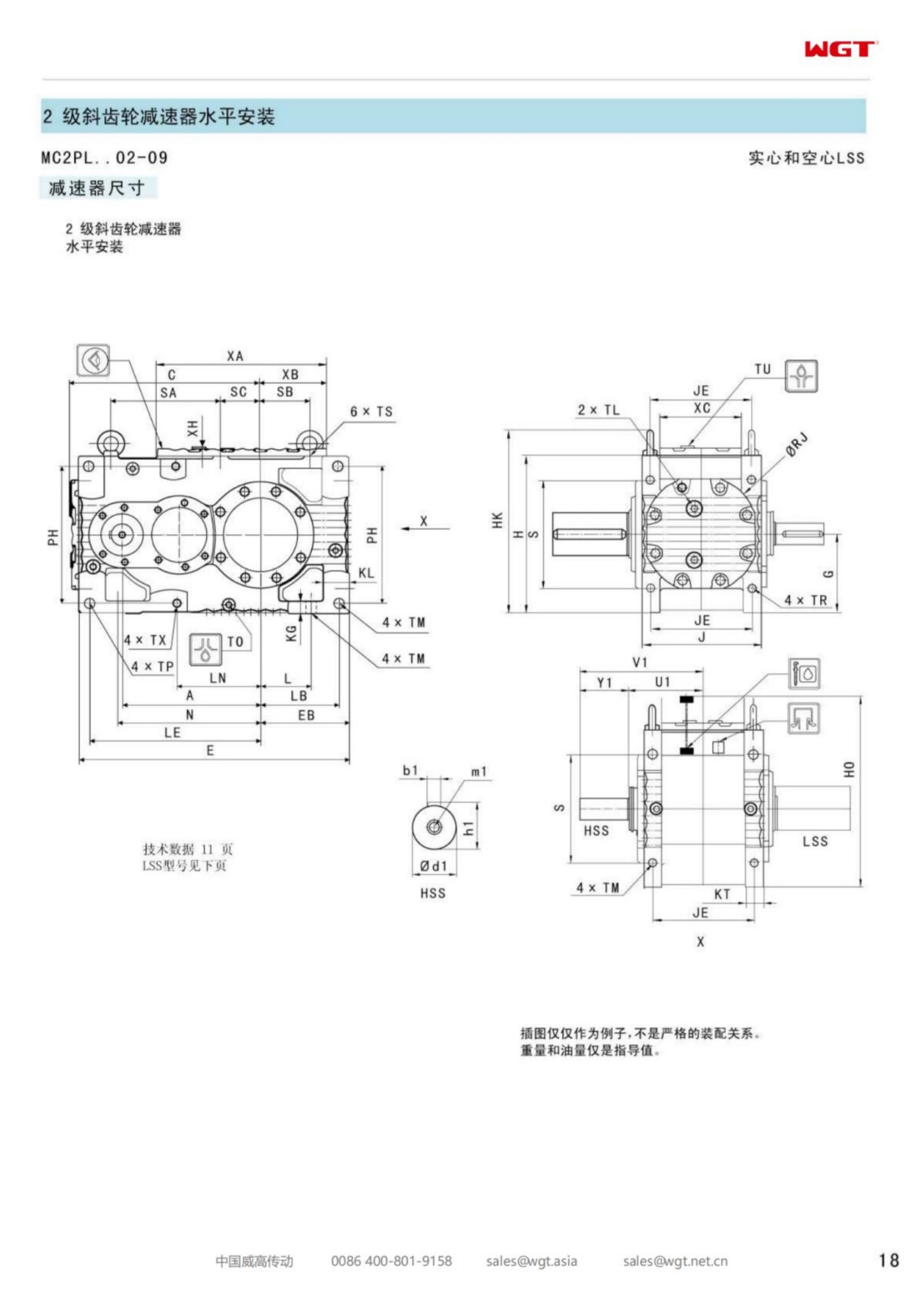
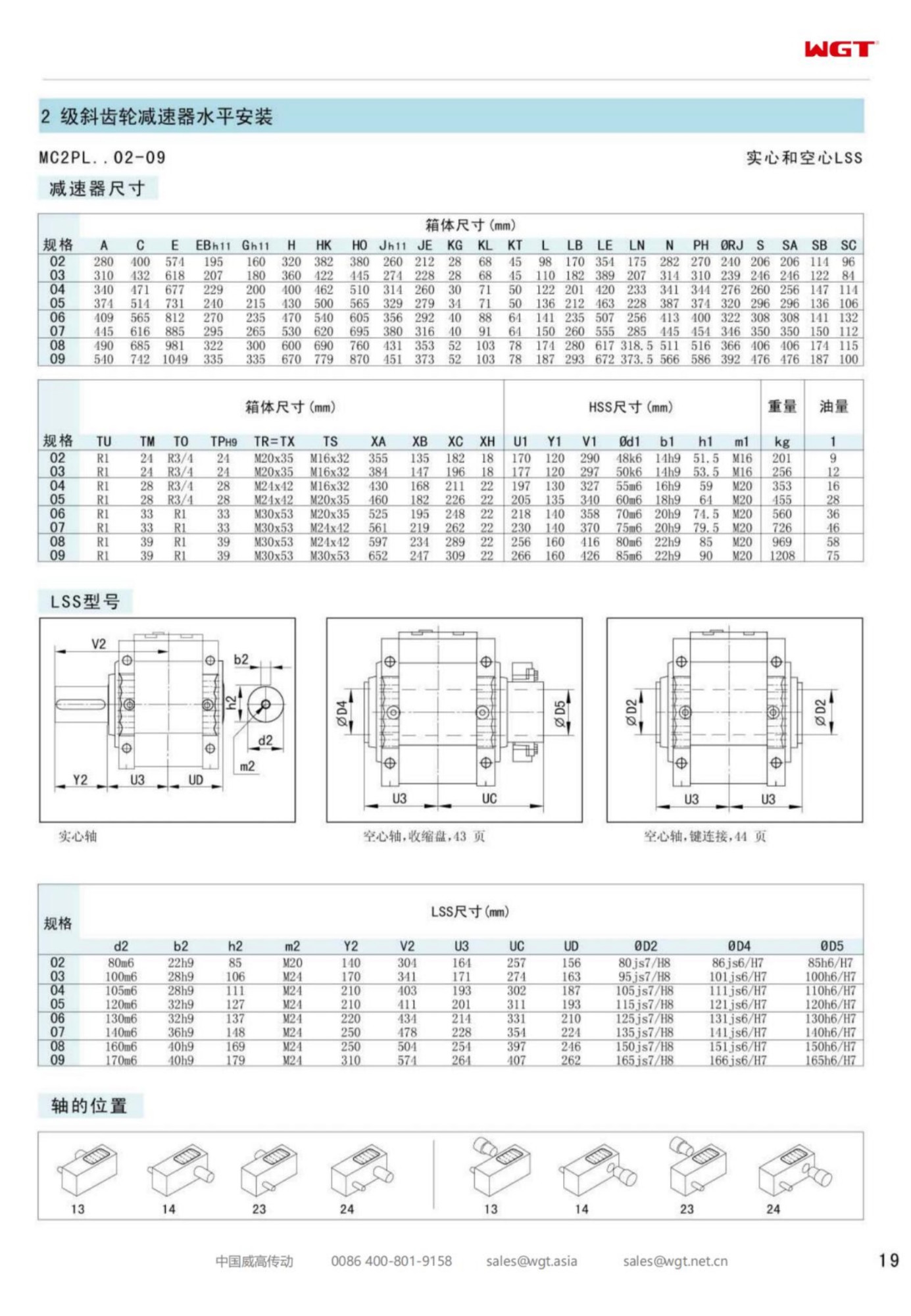
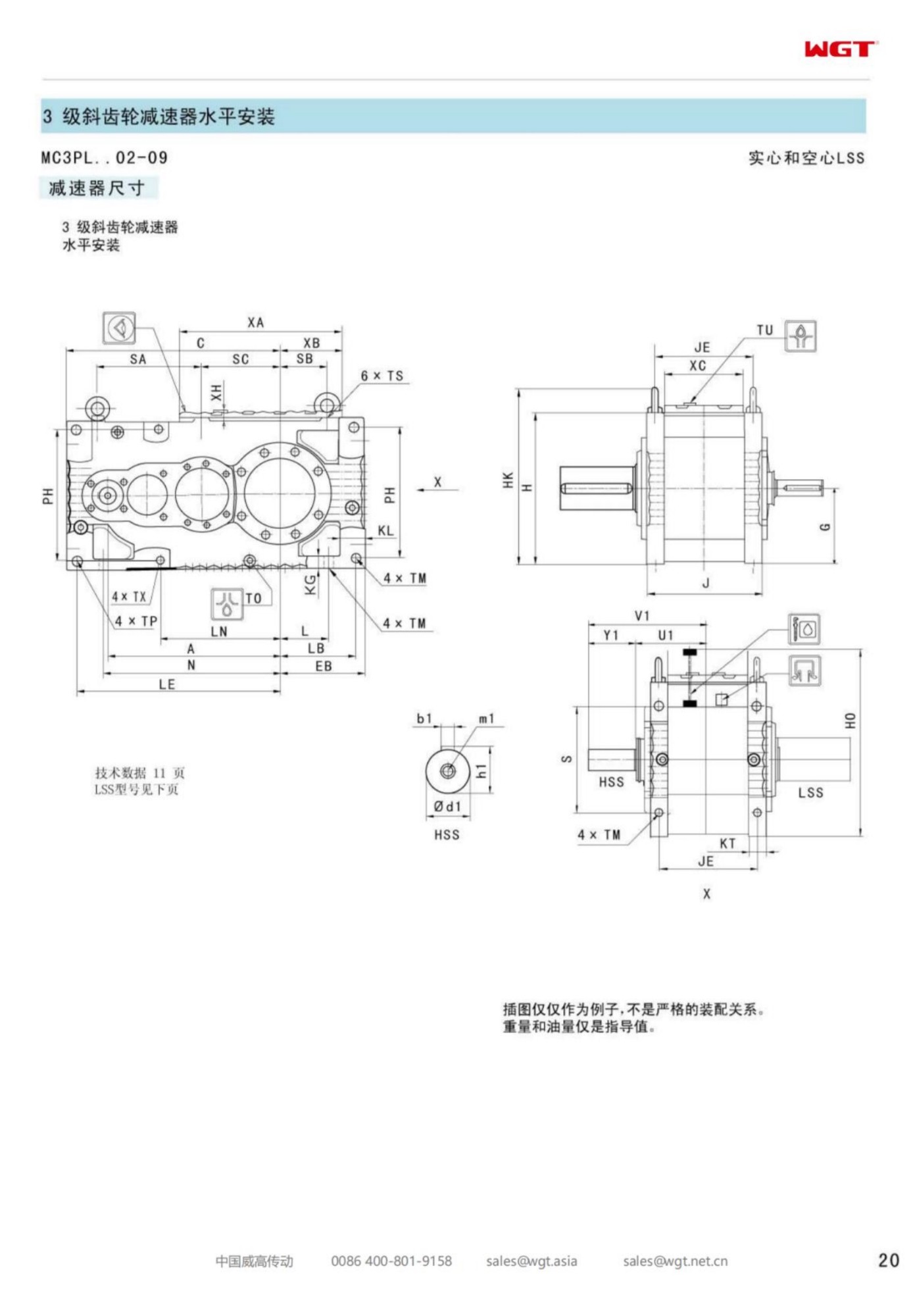
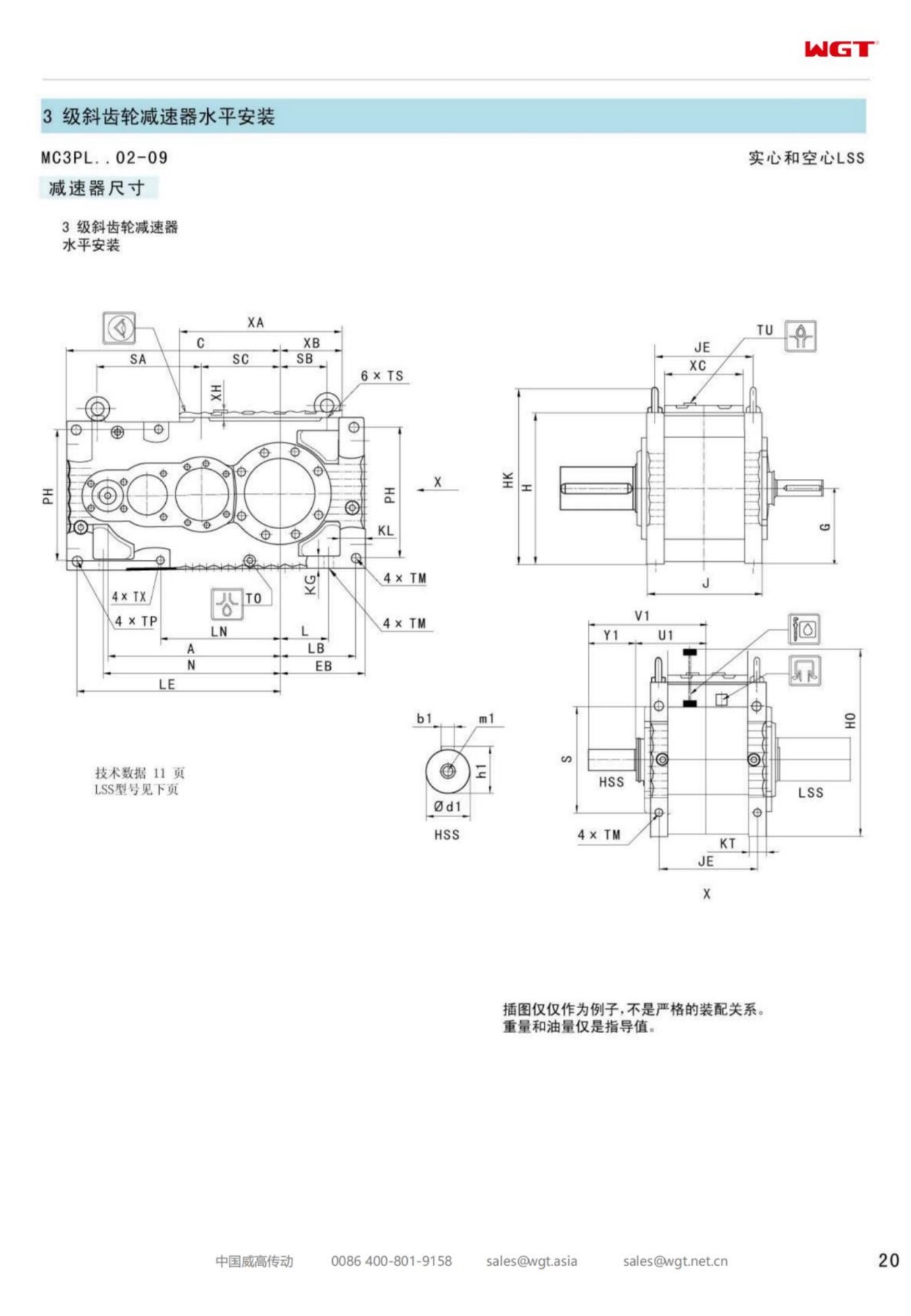
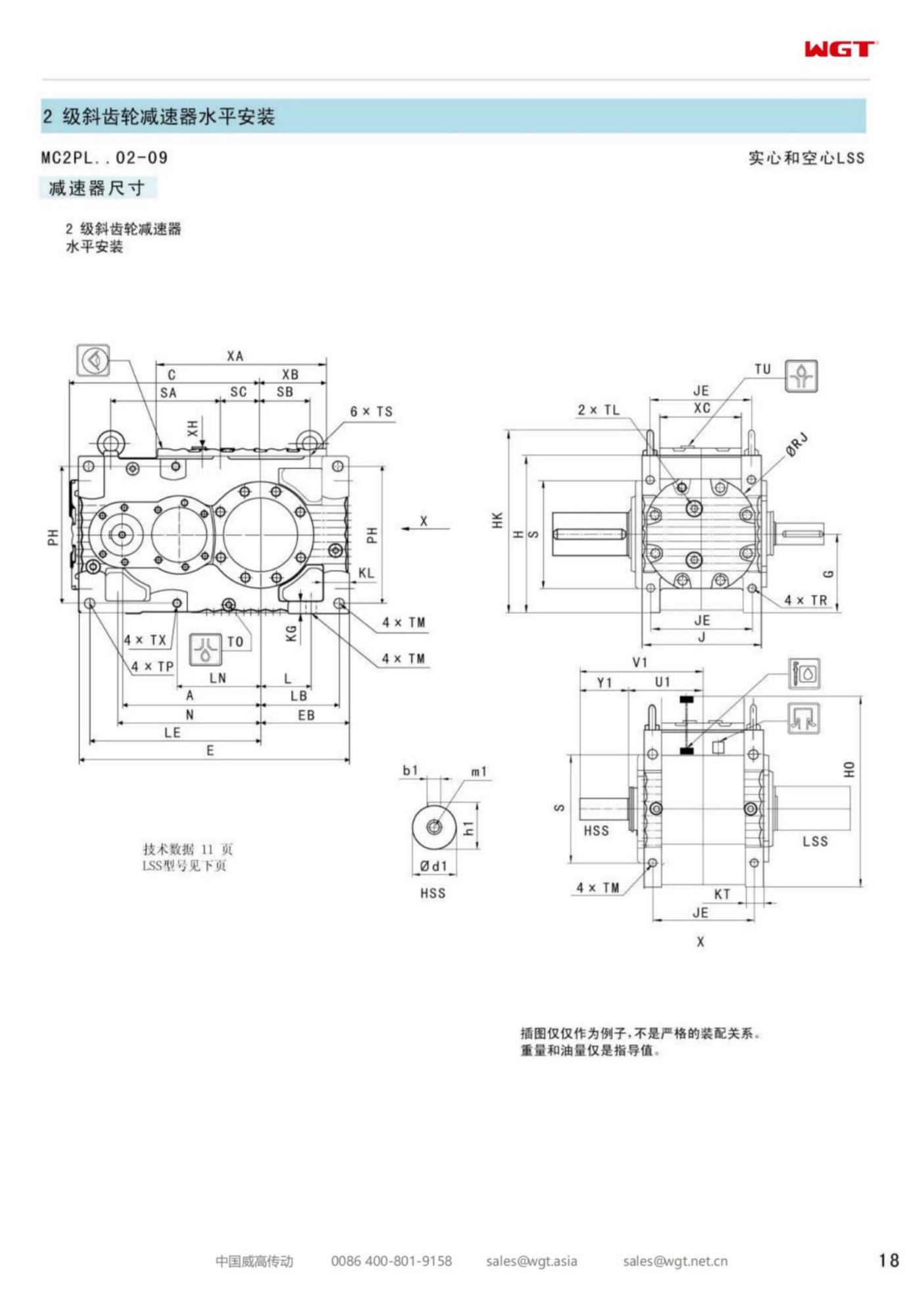
There is a frame in every band where the drive stops being a component and starts being part of the plant's daily rhythm. The MC2PLST04 solid shaft gearbox sits exactly there. Below it, gearcases serve machines that run a shift and stop for a washdown; at it, the duty is usually a conveyor that the whole process leans on, turning through two shifts, sometimes three, with a motor that is started once in the morning and stopped once at night.
That change of habit changes what the frame is asked to do. A drive running four hours out of twenty-four never really reaches thermal equilibrium, and its oil never gets the hours that make long-term wear visible. A drive running sixteen hours does both. It also spends most of its life at a steady torque, which is kind to the gearset and unforgiving to everything around it: the coupling, the bracket, the alignment, and the habits of whoever is supposed to look at it. This page is about those surroundings rather than the gears, because the gears in a level two-stage case are the least interesting part of a long-run installation.
Frame Four in the Band's Arithmetic
The frames of this family step in a way that follows torque rather than any neat multiplier. Frame two exists for the drives where a coupling is needed at all; frame three absorbs the duties that grew accessories. Frame four is the step where the duty's hours become the dominant variable. A plant moving from frame three to frame four is usually not chasing a big jump in power - often it is the same motor, the same ratio, the same machine - it is chasing a frame whose thermal and bearing reserves match a conveyor that now runs the plant's schedule rather than an annex of it.
The distinction matters at order time because two engineers can specify the same kilowatt and land on different frames. The one who sized against running torque and a light duty class gets a frame that is technically adequate; the one who wrote down the hours, the ambient, the starting frequency and the fact that this conveyor feeds the kiln gets a selection with reserve behind it. Both will run. Only one will still be running quietly in the eighth year, and the price difference at the quotation stage is a small percentage of a number that nobody remembers later.
Decoding MC2PLST04
The type string is the family's grammar with a frame digit on the end, and reading it field by field is worth thirty seconds of any buyer's morning.
| MC | Industrial gear unit family built for continuous plant duty |
| 2 | Two helical reductions in one level case |
| P | Parallel-shaft layout, input and output on parallel axes |
| L | Level build, both shafts horizontal |
| S | Solid output shaft, torque leaves through a coupling |
| T | Torque arm reaction, no feet, no foundation, no grout |
| 04 | Fourth frame: the step where long running hours and thermal reserve drive the choice |
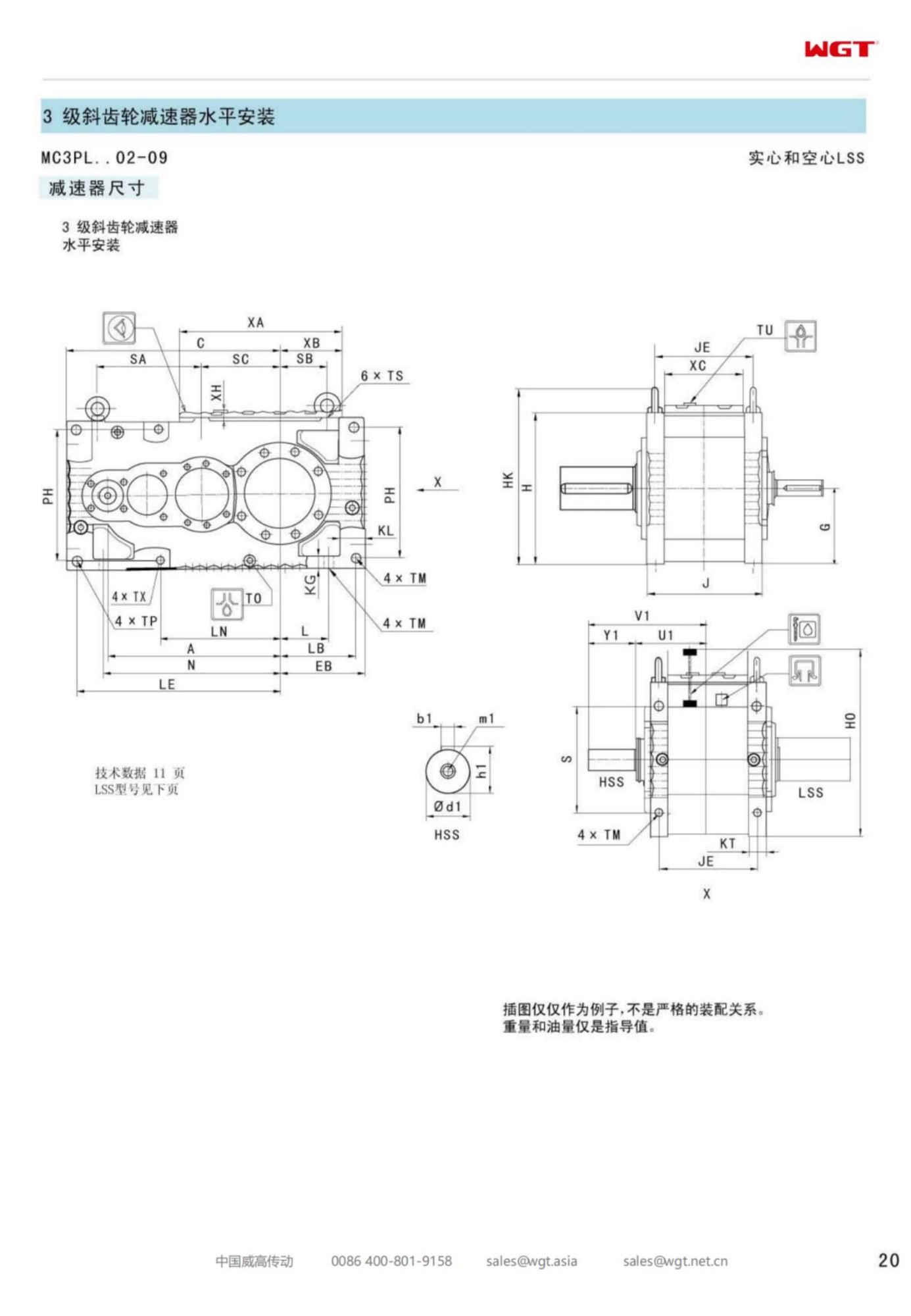
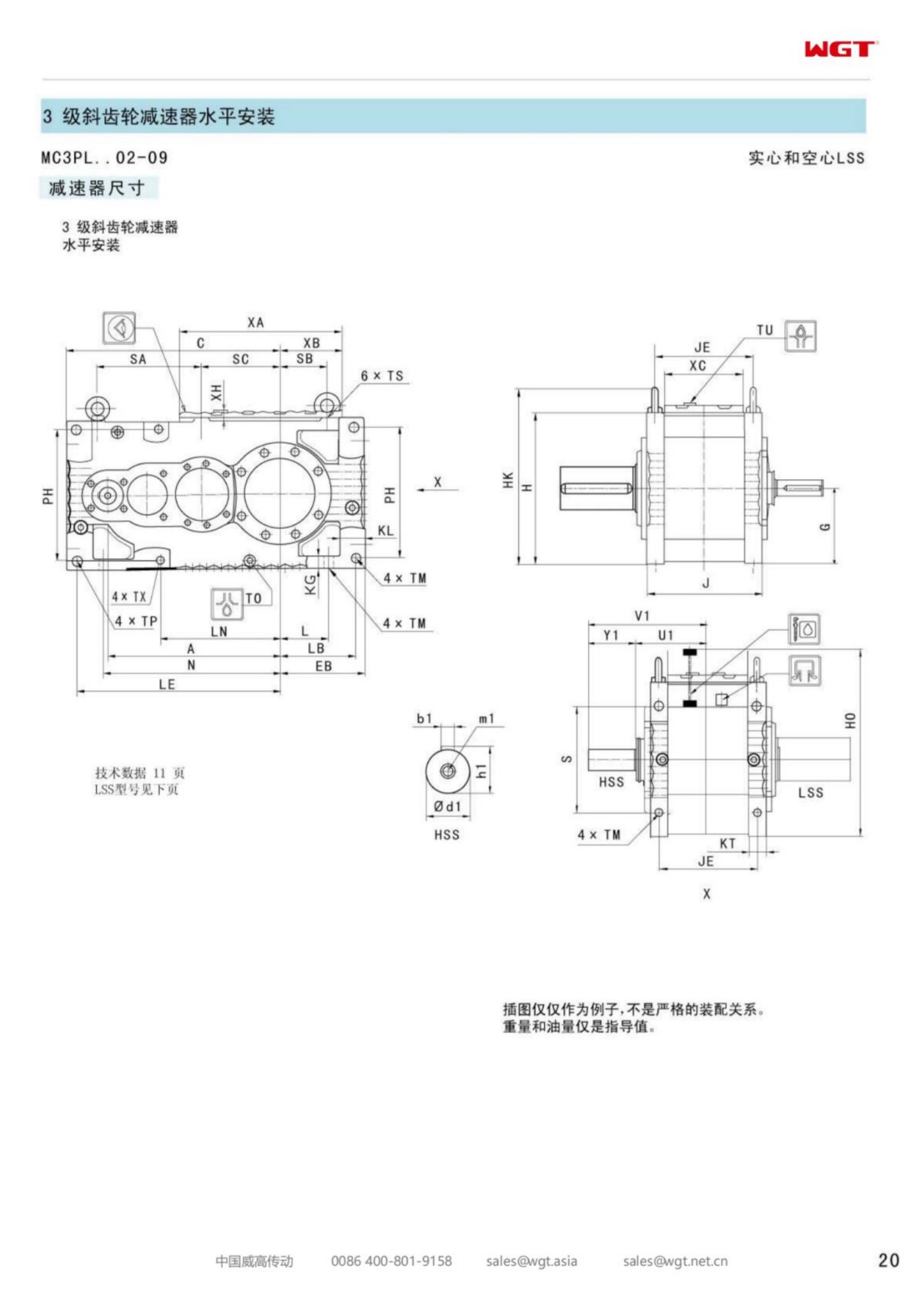
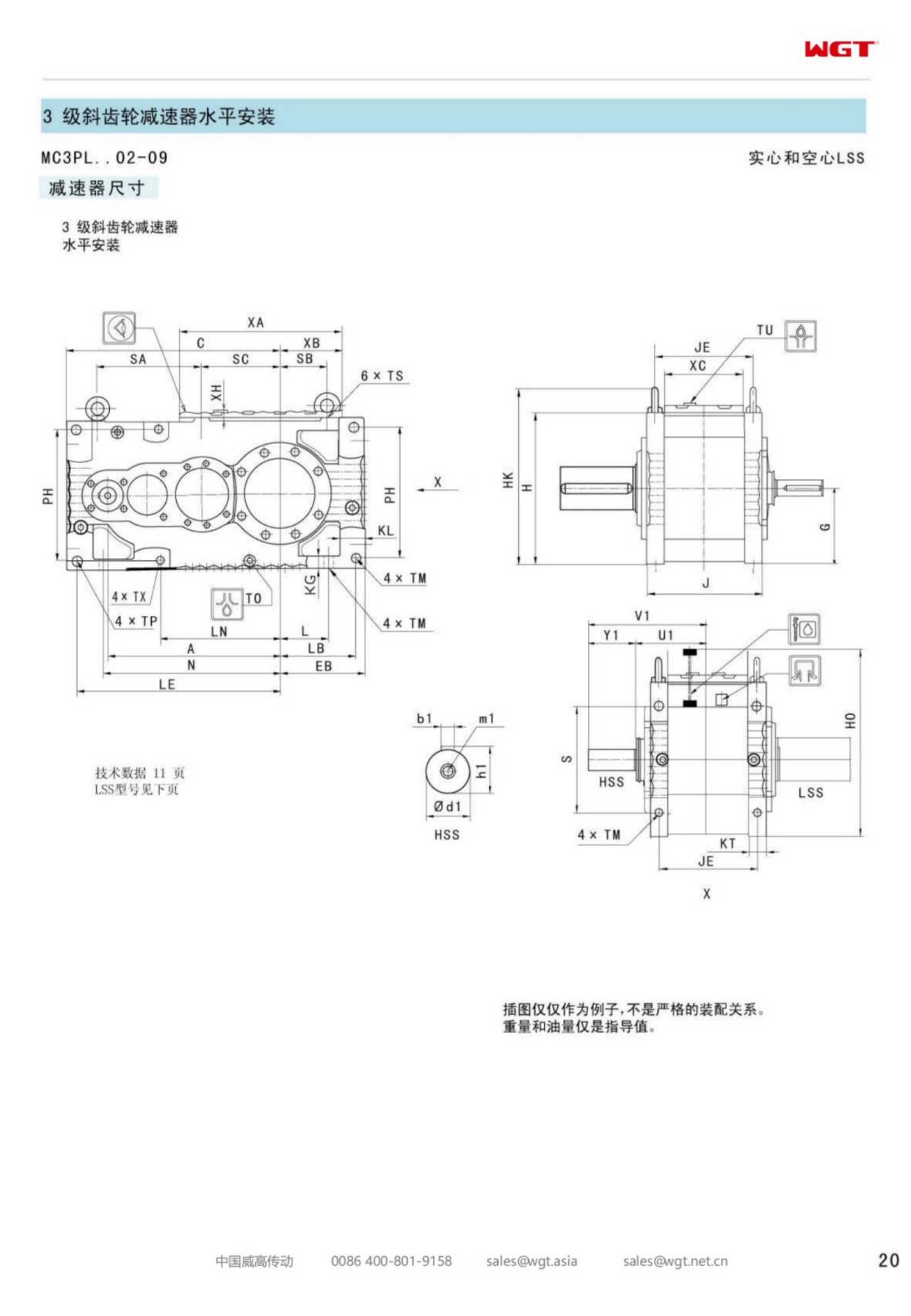
Read as an order document, the string settles the geometry and hands the rest to the lines beneath it: the exact ratio, the service factor argued from the duty, the coupling size and type, the bracket drawing, any brake or backstop, and the lubrication note for the ambient the drive actually lives in. A buyer who sends only the string receives a correct gearcase and a set of assumptions that the site will discover one at a time.
Why Long Belt Lines End Up With a Torque Arm
Conveyors that run the plant's schedule tend to be the ones with the least room around them. Their head stations sit in transfer towers where the structure is already crowded with chutes, walkways, pull cords and the next conveyor's tail. A foot-mounted gearcase needs a bedplate and a pad, and that pad has to be somewhere, usually in the one place the structural engineer had reserved for a stair. The arm-mounted construction removes the argument: the case hangs on a bracket off the tower steel, the arm takes the reaction into the same steel, and the floor stays clear.
There is a second reason that shows up later. A bedplate is a promise about flatness that nobody re-checks after the tower has been loaded and has settled. A grouted pad that was level in the workshop year can be a source of soft-foot and case distortion by the time the plant is at full production, and both of those end up as bearing life. An arm-mounted case does not care about the pad, because it does not sit on one. It cares about the bracket's stiffness and the arm's pins, both of which are inspectable, adjustable and within reach of a fitter with a torque wrench.
Converting a Foot-Mounted Drive to an Arm
Many frame-four orders are conversions rather than new installations. The conveyor exists, its original foot-mounted gearcase has reached the end of a life spent on a settling pad, and the maintenance department wants the next one to avoid the same history. The conversion is genuinely simple, and it is simple in a way that tempts sites to skip the survey. Three numbers decide whether the bracket can be built: the height of the existing input shaft above the tower floor, the distance from the machine's shaft end to the nearest structural member, and the space the coupling needs to come out without lifting the gearcase.
Two more decide whether the conversion is pleasant. The first is the direction the arm can reach - an arm needs a structural member roughly opposite the reaction, and on a crowded tower that member may be a brace rather than a column, which changes the bracket design. The second is access for the oil drain, since a case that was drained from a pit in its previous life may now be hanging over a walkway. Both are drawing-board questions, cheap to answer before the order and expensive to discover when the crane is booked and the tower is open.
Choosing the Coupling for a Long, Level Run
A steady, level duty looks like the easiest coupling specification in the plant, and that impression is the trap. Long runs accumulate small misalignments: a tower that moves under wind load, a head shaft that grows with product temperature, a bracket that settles a millimetre over two years. A coupling that is generous in torque but stiff in misalignment converts all of that into bearing load at both ends of the line. The choice is therefore usually a flexible element type sized on torque with a service factor for the duty class, checked for the misalignment the installation will realistically see, and confirmed against the shaft diameters at both ends.
The detail that decides whether the arrangement stays healthy is the hub fixing and its concentricity. A parallel key with a properly fitted hub is entirely adequate on a steady duty, and it is the option a plant's fitters will already understand. Taper bushes are faster to fit and remove, and they ask for a hub condition check whenever the coupling is opened. Either way, the coupling's installed length, its removal clearance and the guard's split line belong on the same drawing as the bracket, because those three dimensions are what the site actually works with when the drive has to come apart on a Sunday.
Thermal Behaviour Across a Twelve-Hour Shift
Thermal rating is where long-run duties separate frames that look identical on a data sheet. A gearcase reaches a steady oil temperature when the heat it generates equals the heat it sheds through its case, its shaft extensions and its surroundings, and a drive that runs twelve or sixteen hours a day spends most of its life at that equilibrium rather than on the way to it. The number that matters is not the peak reached in a test cell but the equilibrium the drive holds in the ambient it actually occupies, in the worst month, with whatever cladding and dust the plant has accumulated around it.
The practical ladder of remedies has not changed in decades and is worth following in order. Clean the case and give it free air before considering anything mechanical. Add a shaft fan where the ambient and the air quality allow one. Increase sump volume where dwell time helps. Go to forced cooling only when the first three have been exhausted, because a fan coil adds a maintenance item and a failure mode to a drive whose virtue was supposed to be that it needed neither. Whatever combination is chosen, the selection should be argued against the hottest week the plant records rather than the average of the year - the average is what makes a drive marginal, and the hottest week is what makes it stop.
Oil Volume, Level and Service Intervals
Long-hour duties make lubrication a routine rather than an event, and routine is exactly what plants drift away from. The frame's oil volume is fixed by the case, but the interval is a decision: mineral oil in a clean, temperate plant can hold its interval comfortably, while a dusty site running three shifts and a warm ambient will want shorter changes or a synthetic fill argued from the oil maker's data. The first change is usually pulled forward deliberately, because the first few hundred hours are when running-in debris is highest and when a sample tells you the most per unit of cost.
Three habits carry the rest. Check the level at a fixed point in the shift, with the drive stopped long enough for oil to drain back, so the reading is comparable week to week. Keep the breather clean, since a blocked breather pressurises the case and pushes oil past the seals. And read samples as a trend rather than as a verdict - a single iron number means little, three numbers climbing together mean a gearset telling you something. On a frame that runs the plant's schedule, the oil record is the cheapest condition monitoring the site will ever own.
Output Bearing Life on a Coupled Shaft
A solid output shaft through a coupling is gentler on the output bearing than a bore lifting the whole case over a machine shaft, but it is not free of load. The coupling's mass sits on the shaft end, and on a long level run the coupling is often the largest single overhung item on the machine. Add a brake disc or a torque limiter outboard of it and the lever arm grows with every component. Frames of this size carry the load comfortably; the discipline is simply to tell the supplier what hangs where, and to keep heavy items as close to the case as the arrangement allows.
Bearing life on these drives is more often decided by alignment than by load. A coupling that runs with parallel offset forces the output bearing to carry a side load on every revolution, and that load does not appear on any torque calculation. Setting alignment to the coupling maker's figures, recording the numbers and re-checking after the first weeks of running is worth more to bearing life than a step up in frame size, and it costs a dial indicator and an afternoon.
What the Bracket Has to Do
The bracket is the component that makes an arm-mounted drive possible and the one most likely to be improvised on site. Its job is to hold the case in a position where the coupling lines up, to carry the case's weight without deflecting under it, and to do both while the arm takes the reaction somewhere else. That combination asks for stiffness in the plane of the belt pull and adjustability in the plane of alignment, which in practice means a fabricated bracket with slotted or shimmed feet rather than a welded assumption.
Two habits keep brackets honest. Torque the fasteners to a figure and record it, so the next inspection has something to compare against. And keep the shim stack labelled, because a bracket that has been re-shimmed twice by two different crews is a bracket whose geometry nobody knows, and the alignment check that follows starts from an unknown. On long-running drives the bracket is touched more often than the gearcase, since it is where guards, calipers and sensors get bolted; treating it as structure rather than as a mounting accessory is how it stays accurate.
Run-In, First Sample and the Baseline
The first month of a long-run drive is its most informative. Temperatures settle, alignment reveals itself, and the oil carries the debris of every surface that has just started working together. A short run-in schedule - a few hours unloaded where the process allows, then a stepped build to full duty with temperature noted at each step - turns that month into data instead of impressions. Notes taken at those steps are what the plant will compare against for the next decade.
The baseline is more than a temperature. It is a vibration reading at the case and at the machine bearing, an oil sample at the first change, an alignment record at commissioning and a note of the ambient the readings were taken in. With those four, a change in behaviour becomes a comparison; without them, every future problem starts as an argument about whether the drive was always like that. On a frame serving a conveyor the plant depends on, that argument costs more than the measurement ever would.
Duties That Belong on Frame Four
Long-running conveyor positions where thermal reserve and a specified coupling decide the frame:
- Head drive of the plant-wide belt conveyor at a cement grinding station
- Raw material transfer conveyor at a gypsum wallboard plant
- Long wash-plant incline conveyor at a hard-rock quarry
- Fuel feed conveyor serving the boiler house at a biomass power station
- Sand classifying conveyor at a foundry sand reclamation plant
- Pallet handling chain conveyor at a brick and block works
What these positions have in common is hours. They are not the heaviest drives in their plants, and they are rarely the most dramatic; they are the ones whose stoppage is felt within the hour. A frame chosen for that reality - with thermal reserve, a coupling specified rather than assumed, and a bracket that can be re-aligned - is worth more than a step up in nominal rating bought without any of those three.
Writing the Enquiry and Reading the Offer
The enquiry that gets a frame-four drive right is short but specific: machine and material, motor power and speed, target output speed, hours per day and days per week, ambient and whether the drive sits under cladding, the starting regime, the shaft measurements at the coupling, the gap available, and whatever the duty needs in the line - brake, backstop, limiter. Add a photograph of the head station. That last item settles more bracket questions than any drawing the buyer could produce.
Reading the offer back is the other half of the exercise. Confirm the ratio and the actual output speed rather than the nominal one, the service factor and what duty class it was argued from, the thermal position and whether a fan or coil is included, the coupling make and size, the bracket scope and whether it is supplied or built locally, and the lubrication fill and ambient assumption. A quotation that answers all six is a selection; one that answers the first two is a price. On a conveyor that runs the plant's schedule, the difference between those documents is measured in years of quiet operation.
Field Applications
Sugar mill bagasse conveyor
A sugar mill moves wet bagasse on conveyors driven by industrial gear units. High moisture, fibrous material and sticky residue are the daily conditions, and the sealed housings have kept lubricant clean between oil changes.
Slag handling crane
A steelworks drives the long-travel motion of a slag-handling crane with industrial gear units on torque arms. Heat radiation from the slag pot is handled by the increased clearance and standard high-temperature paint.
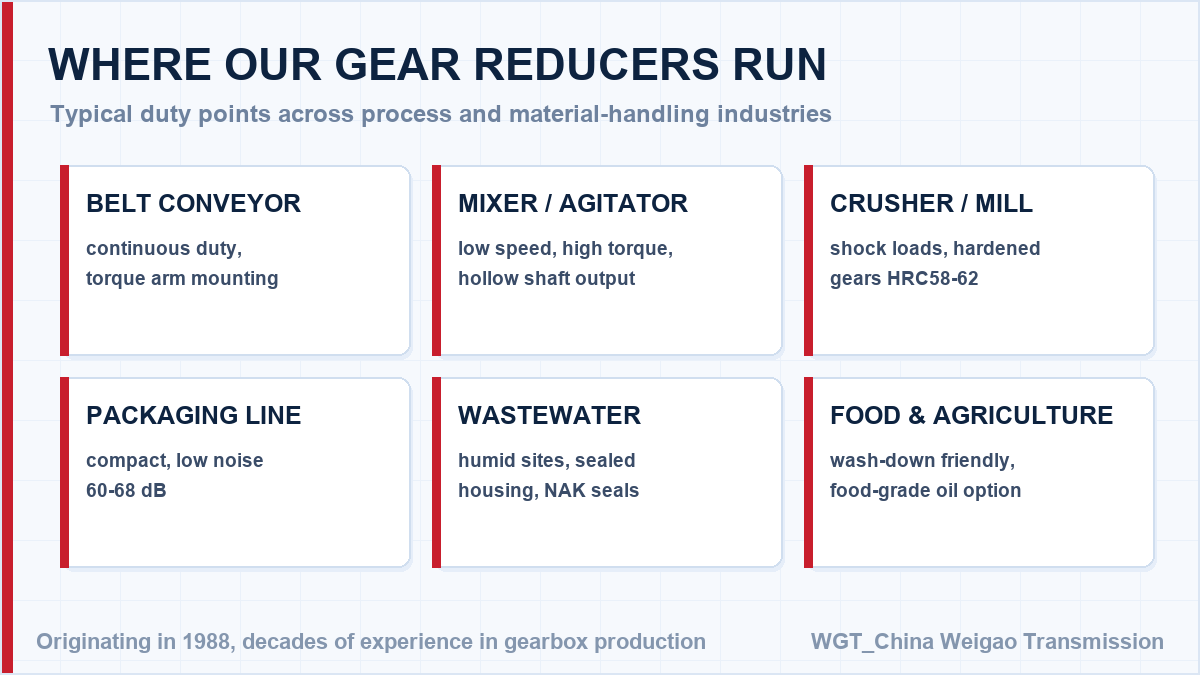
![where gear reducers are used in industry]()
Where these units are installed across industry.
Selection Example: Head drive of the plant-wide belt conveyor at a cement grinding station
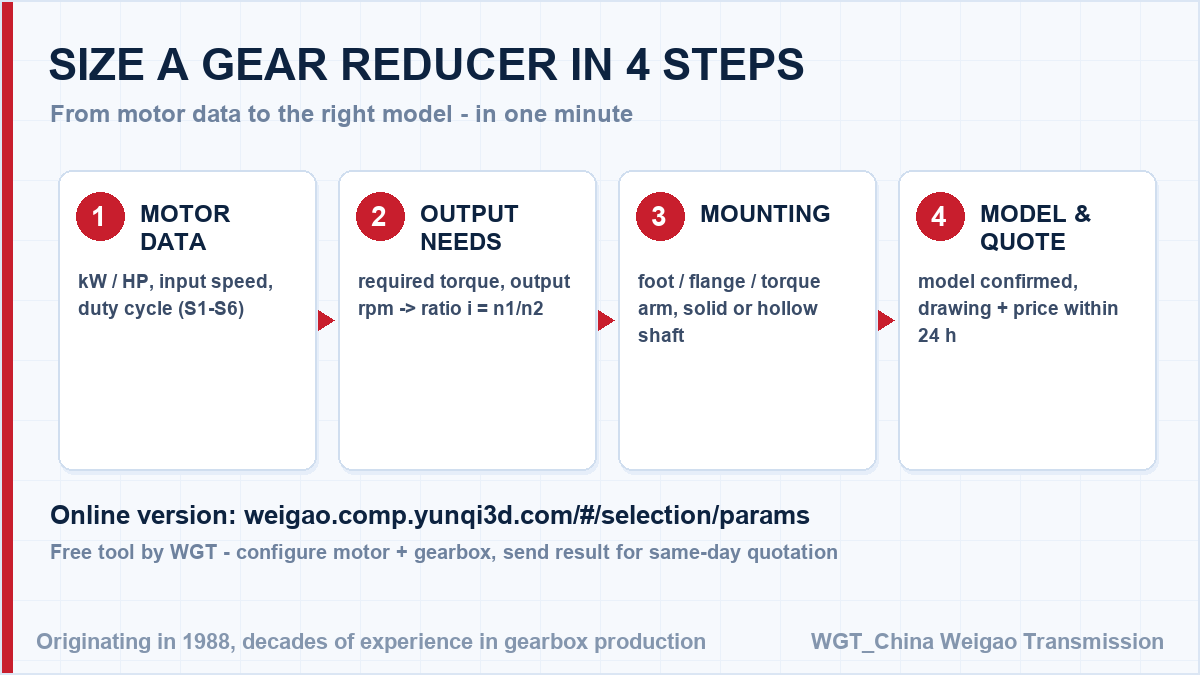
Take a 30 kW motor at 1480 rpm turning the head shaft at 47 rpm. The ratio follows directly: 1480 / 47 = 31.5, so a ratio near i=31 comes out of the two-stage band, and the frame is checked for sixteen-hour running and the summer ambient inside the transfer tower rather than for torque alone. In this case frame four holds its thermal position through back-to-back shifts, and the arm bolts to tower steel so no bedplate has to be squeezed into a crowded head station. Once the ratio is fixed, check the required output torque against the rating table with the service factor applied - that is what decides the frame, not the ratio alone.
![gearbox selection guide: speed, torque, service factor]()
How a ratio and a frame size are determined, step by step.
Frame Sizes and Typical Duties
| Model | Centre distance | Output | Typical duty |
|---|
| M3PSF50 | size 50 | solid shaft, foot | conveyors, feeders |
| M3PSF60 | size 60 | solid shaft, foot | crushers, mixers |
| M3PSF70 | size 70 | solid shaft, foot | ball mills, shredders |
| M3PSF80 | size 80 | solid shaft, foot | kilns, heavy conveyors |
| M3PSF90 | size 90 | solid shaft, foot | mill and kiln drives |
| M3RSF50 | size 50 | solid shaft, foot, right-angle | inclined conveyors, elevators |
| M3RSF60 | size 60 | solid shaft, foot, right-angle | screw classifiers, feeders |
| M3RHF70 | size 70 | hollow shaft, foot, right-angle | agitators, drum drives |
| M3PHT80 | size 80 | hollow shaft, torque arm, parallel | shaft-mounted conveyors |
| M3RHT90 | size 90 | hollow shaft, torque arm, right-angle | heavy shaft-mounted drives |
The size number is the key dimension that steps up torque capacity through the range: 50 to 90 in horizontal builds, 10 to 90 in vertical builds. Gearing philosophy is shared across the family.
Shutdown Planned? Order Ahead of the Window
Beat the shutdown window. Engineers can size the unit themselves in the WGT Motor & Gearbox Online Selection System - input speed, torque and duty, get the model instantly.
For planned maintenance windows we reserve production capacity and ship the unit ahead of the shutdown date, so the swap takes hours instead of days. Tell us the window and we work back from it. Looking for a gearbox for belt conveyor? Tell us the duty point and we will confirm the model in writing.
Common Questions from Buyers
What inspection access does the housing provide?
The horizontally split housing opens along the shaft centreline, so gearing and bearings can be examined without removing the unit from its foundation. Covers give access to the oil galleries and bearing seats during service.
Can you supply vertical-shaft versions?
Yes. Vertical builds of the same industrial family cover the smaller size band and are common on vertical mixers, agitators and clarifier drives. State the orientation when ordering so oil levels and breathers are set correctly.
What documentation comes with an industrial gear unit?
Every shipment carries an installation manual, a dimension drawing, the nameplate data and a bench test record covering noise, temperature rise and backlash. Material certificates for shafts and gearing are available on request.