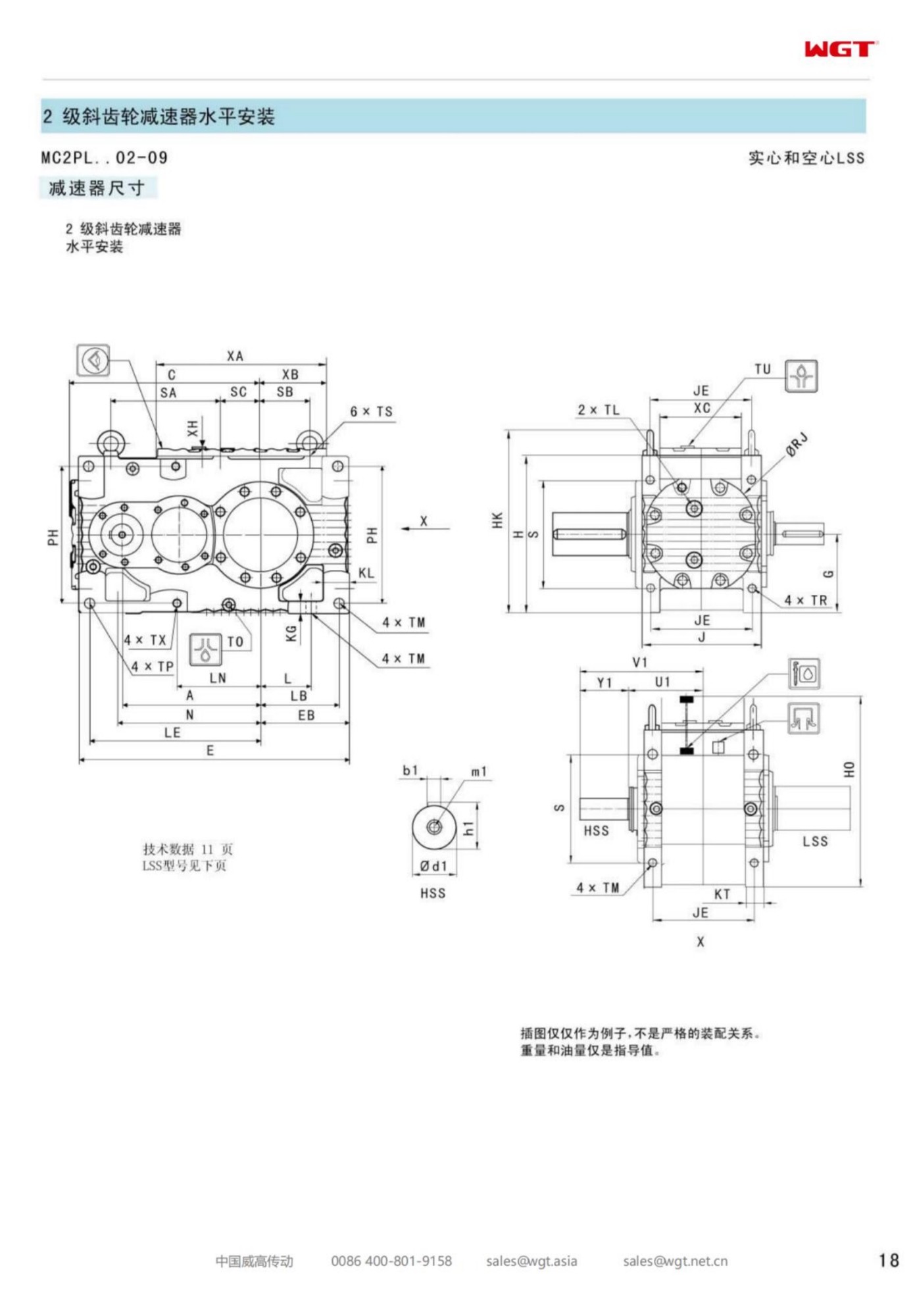
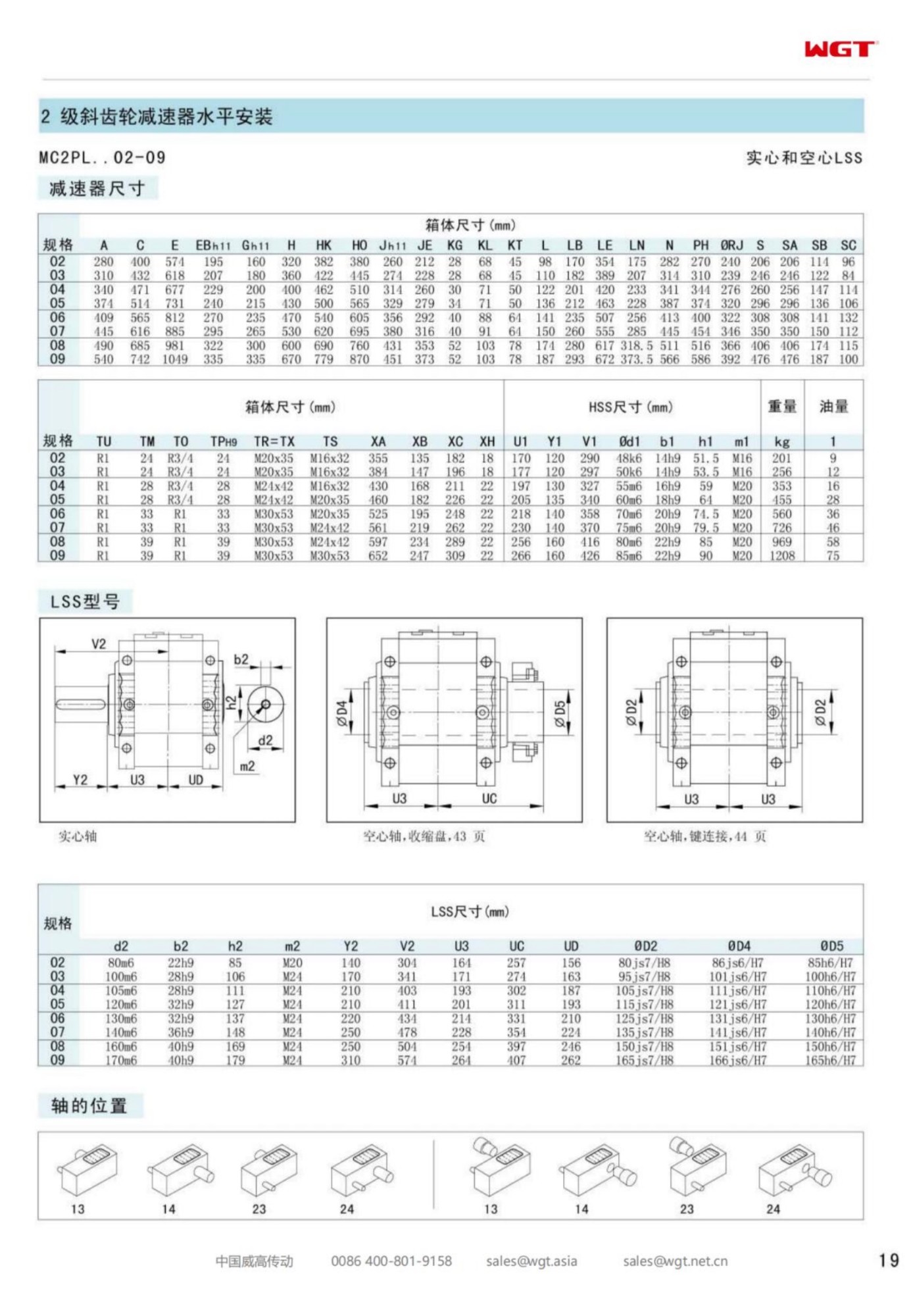
The MC2PLSF02 parallel shaft industrial gearbox is the small end of the two-stage parallel line: a squat cast housing, two helical stages, input and output shafts sitting in one horizontal plane, and a footed base that bolts straight onto a plinth. Where a bevel unit would add height and a shaft-mounted build would need a torque arm, this layout keeps the whole drivetrain low and short - which is why it turns up so often under conveyors, elevators and feeders where the drive sits between stringers rather than above them.
A Short Box with Two Stages Inside
Two stages are enough for most belt and screw duties: a ratio band wide enough to match a standard four-pole motor to the 20-90 rpm zone where most slow conveying lives, without the extra losses of a third mesh. Fewer stages also mean fewer bearings and seals, so the unit has a shorter list of wearing parts to stock. The trade-off is honest: very slow, very high-torque duties drop below the practical ratio of two stages, and those belong on the larger three-stage frames in the same family.
The 02 frame is deliberately compact. It fits between conveyor stringers with clearance to spare for the motor on the side, and its small oil volume warms up fast - which is an advantage on intermittent duty and a sizing question on continuous ones.
How the Marking Breaks Down
| M | Industrial multi-stage gear unit family |
| C2 | Compact two-stage parallel-shaft series |
| P | Parallel arrangement - input and output in one plane |
| L | Long-centre build, leaving room for a side-mounted motor |
| S | Solid output shaft with parallel key |
| F | Foot-mounted housing for plinth bolting |
| 02 | Frame size, the small end of the series |
Read that way, the code tells the whole mounting story before a drawing is opened: a low, footed, side-motor box with a keyed solid output. The ratio itself is not in the code - it is chosen per order, which is why two units with the same marking can run entirely different process speeds.
Choosing the Ratio Around the Motor
On a steady conveying duty the sensible order is: fix the required belt or screw speed, subtract the losses of the head pulley or the screw bearing, and only then pick a ratio that lets the motor run in its efficient band rather than at either edge of it. A ratio chosen just to hit catalogue numbers often leaves the motor lightly loaded and the gearbox running its meshes at an inefficient point. Because the ratio is ordered, not built in, it costs nothing extra to state the duty precisely - the factory selects the gear set that lands the absorbed torque in the middle of the frame's rating.
Heaviest drives that call for this frame: Screw conveyor and drag-chain drives in cement and lime plants Belt press and filter feed duties in wastewater works Bucket elevator heads handling grain and aggregate Extruder and paddle mixer drives in brick and clay works Kiln side fans and rotary valve feeds in minerals processing Feeder and scraper drives on salt and fertilizer handling lines
Mounting on the Foundation Plinth
Foot mounts forgive less than they look like they do. Scrape the plinth clean, check it with a straight edge in both directions, and shim under the feet until the housing sits level before any bolt is pulled tight - pulling a foot down onto a hollow spot twists the case and shows up later as a bearing that runs warm on one side. Torque the hold-down bolts in a criss-cross sequence, then fit the motor slide rails if the build uses them, so belt or coupling alignment is done by moving the motor, not by bending the gearbox feet.
Before the first start, bar the unit over by hand through one full revolution. A tight spot at one angle usually means a packing fault under a foot or a coupling misalignment, not an internal problem, and it is far cheaper to find with a bar than with a temperature gun a week later.
Grease, Oil and First-Service Intervals
Fill to the level plug with the oil grade named on the plate, run the unit unloaded for a short period, then stop and re-check the level - air worked out of the housing during the first run drops the level visibly. The first oil change comes early, at a few hundred hours, to remove the running-in wear particles that every new gear set sheds; after that, the change interval follows the duty calendar, with hotter or dustier plants on the short side of the range. The small oil volume is the reason the interval matters more here than on larger frames: the same contamination load shares a smaller sump.
What to Send With an Enquiry
A complete enquiry for this frame has five lines: the absorbed power or torque at the output, the required output speed, the daily running pattern, the mounting orientation - horizontal footed with the output on the left or the right - and the shaft diameters to be coupled. A photograph of the old nameplate, if there is one, settles the rest. With those facts the factory can confirm a build and quote in a single reply, and the unit that arrives matches the plinth that was poured for it.
Questions We Hear Most Often
What tooth quality and grinding finish do you apply?
Gearing is case-hardened and profile-ground to international accuracy grades, with crowning and end relief applied to avoid edge loading. This is what keeps noise and vibration stable over years of continuous duty.
Can existing motors, couplings and guards be reused?
In most upgrade projects yes: because input and output interfaces follow the common industry dimensions, the existing motor, coupling and guard usually bolt straight on. Send the old nameplate and we confirm before you order.
What happens if my duty changes after installation?
Send us the new duty point. A revised torque and service-factor calculation is free of charge, and the answer is usually one of three: the unit is fine, add an oil change interval, or plan a frame change at the next shutdown.
Choosing the Right Frame Size
Selecting inside this series follows the usual three steps: motor speed divided by target output speed gives the ratio, the required torque with the service factor gives the frame. We confirm both before quoting.
Selection Example: Typical duty point
A quick worked example using this frame: Motor speed divided by the target output speed gives the ratio, rounded to the nearest available step, and the required torque with the service factor then fixes the frame size. It always comes down to those three figures. Send them over and we confirm the frame, ratio and service factor in writing.
![online gearbox selection system workflow]()
Selection workflow used by our engineers for every quotation.
Real-World Duty Points
Stacker-reclaimer travel drive
A bulk terminal drives the travel gear of a stacker-reclaimer with units. Long-travel duty with frequent direction changes is smoothed by the ground gearing, and backlash stays within 20 arcmin over the full rail length.
Automatic parking system
A parking equipment manufacturer uses reducers on its puzzle-type car stackers. The hollow shaft takes the drive axle directly, and the quiet 60-68 dB operation suits installations inside residential buildings.
![right angle gearbox duty points overview]()
An overview of the duty points this series is built for.
Your Selection, Cross-Checked by an Engineer
Send the numbers, get the model. Use the WGT Motor & Gearbox Online Selection System to turn your motor data into a model number, and we will quote that exact unit within the day.
Every enquiry is checked by an engineer against the rating tables before it is quoted, so the unit we recommend carries a real torque margin - not just a catalogue guess. Spare-unit and OEM volumes are both welcome. Looking for a gearbox for agricultural machine? Tell us the duty point and we will confirm the model in writing.