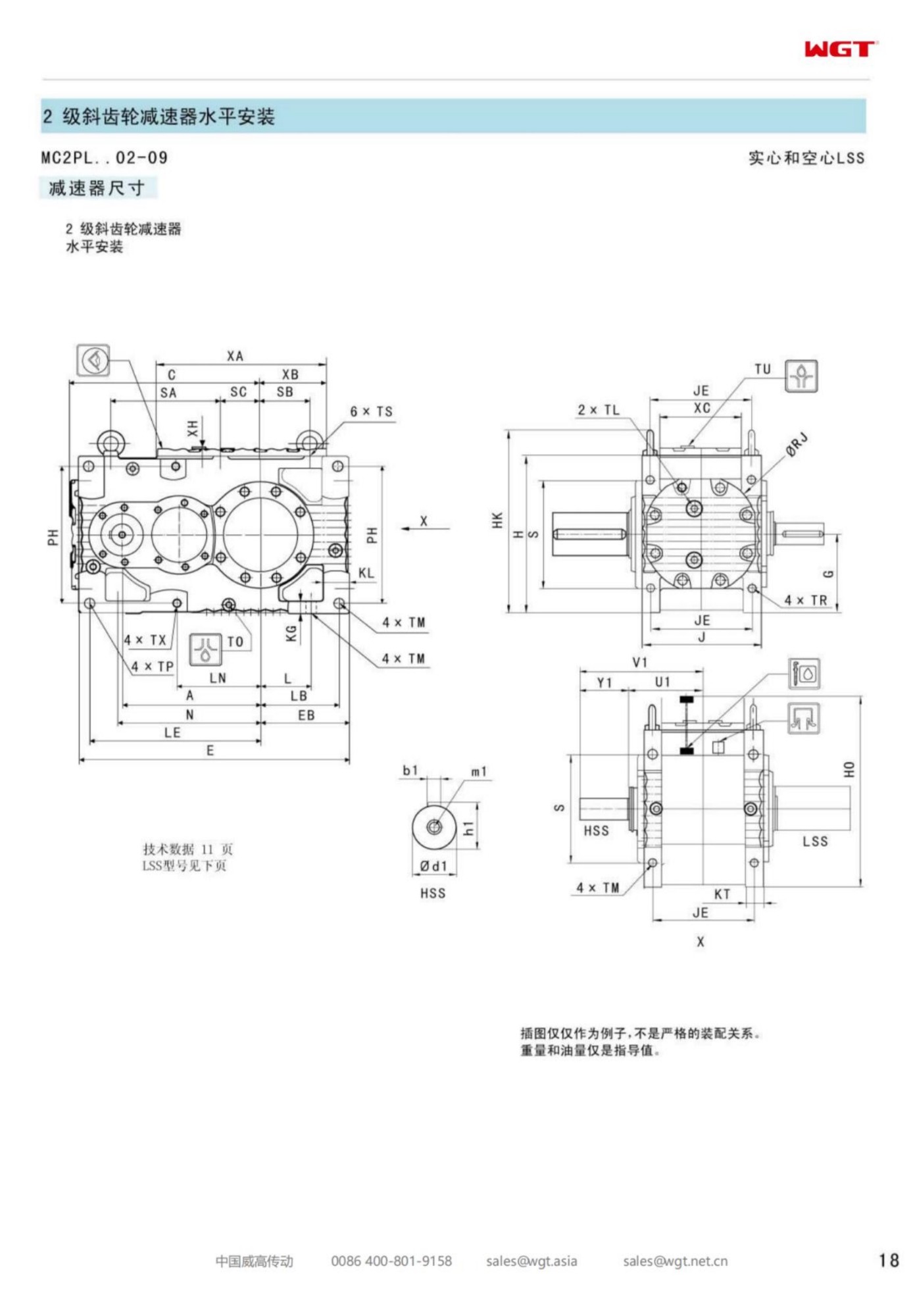
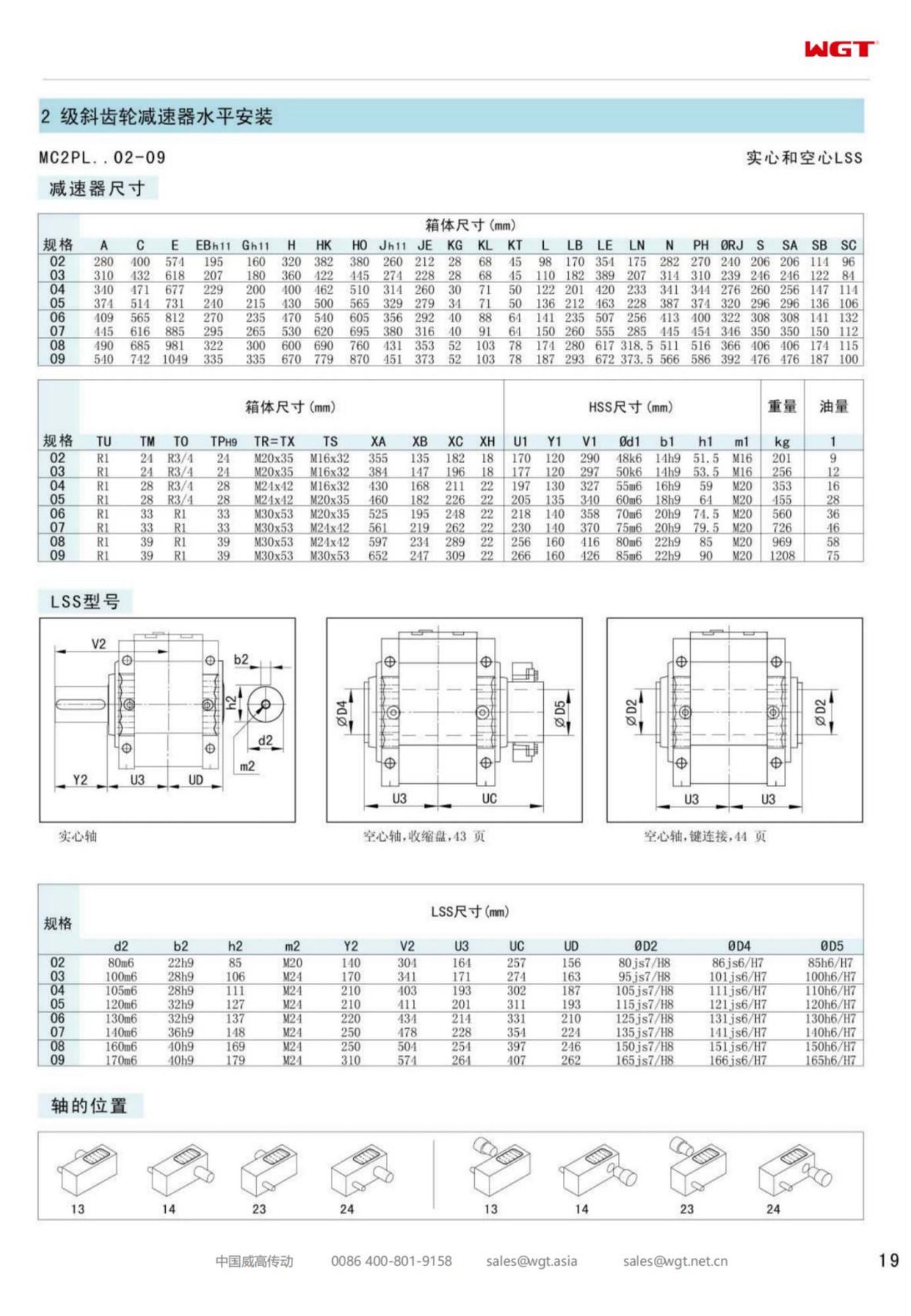
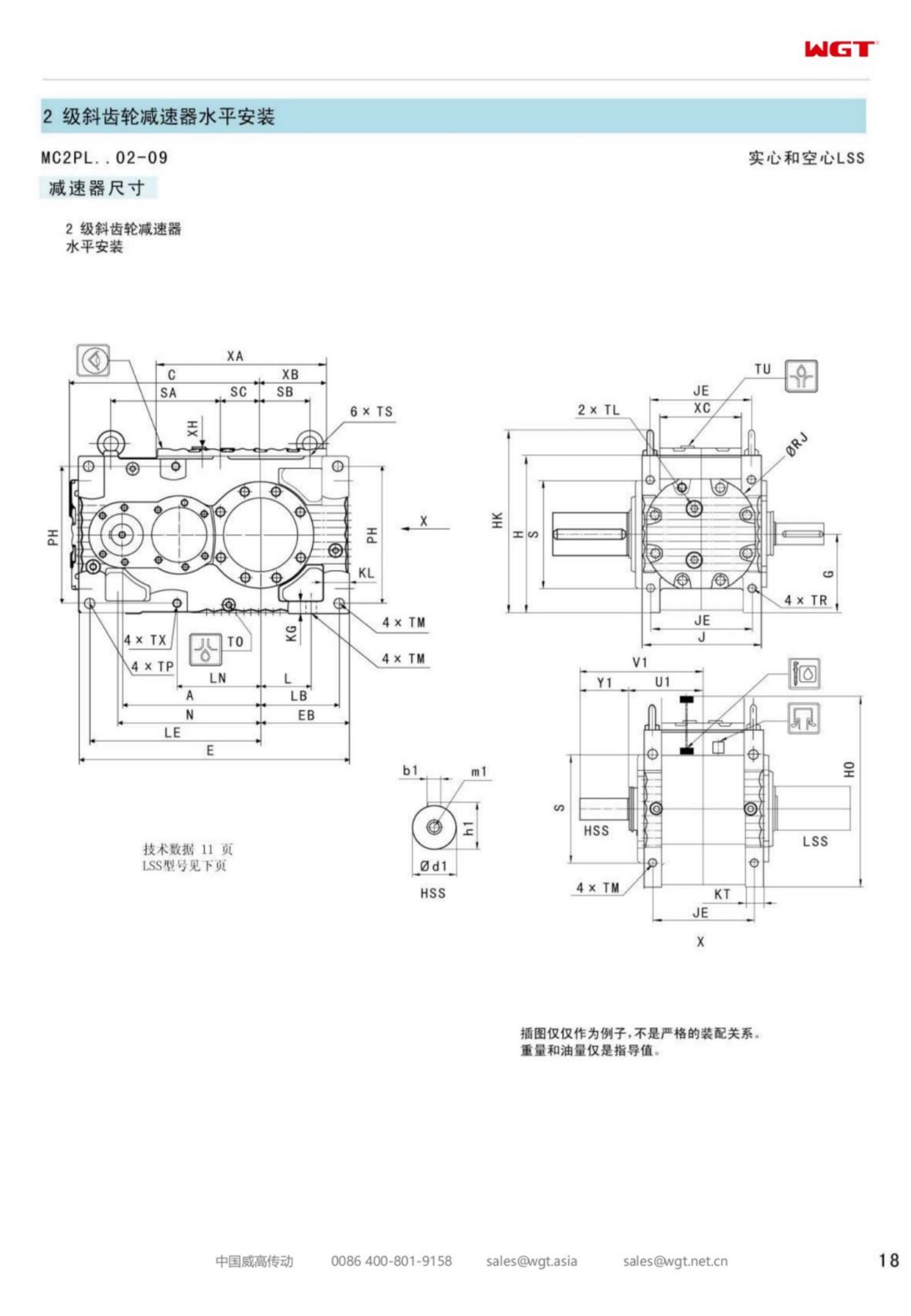
Every band of shaft-mounted frames ends somewhere, and the last step is the one that carries the plant's throat: the head drive of the conveyor that everything upstream feeds and everything downstream waits for. The MC2PLHT09 torque arm gearbox is that step in this family. It exists because at some tonnage and some length, the selection stops being a question of picking a frame and becomes a question of proving one.
The construction is familiar - two helical stages, a level case, a hollow bore over the driven shaft, an arm handing the reaction to the machine structure. What is different at this size is the cost of being approximately right. A frame here is a procurement event, a lifting plan and a shutdown entry, and the arithmetic that justifies it is worth doing with the plant's own measurements rather than with a catalogue's assumptions.
The Last Frame in the Band
Bands are built so that a plant can stay inside one family as duties grow. The top frame is where that convenience is tested: it must carry the largest torque the family offers while keeping the mounting logic that made the family attractive - no bedplate, no coupling, no alignment programme, an installation that fits a shutdown window.
That combination is why the last frame is usually specified for the position nobody can afford to lose, and why the specification meeting tends to include people who do not normally attend gearbox meetings: production planning, structural engineering, the crane contractor. Their questions are not about ratio. They are about when the drive can be changed, what it weighs, and what the structure behind it can take. A supplier who can answer those questions with documents is worth more at this size than one who can only answer with a torque figure.
Decoding MC2PLHT09
The string follows the band's grammar; the final pair of digits marks the largest frame in it.
| MC | Industrial gear unit family for continuous plant service |
| 2 | Two helical reductions in a single gear plane |
| P | Parallel-shaft layout, input and output parallel |
| L | Level build, both shafts horizontal in one case |
| H | Hollow output bore slipping over the driven shaft |
| T | Torque arm reaction, no feet and no foundation |
| 09 | Ninth frame: the band's ceiling, for primary drives and long-haul head shafts |
As an ordering document the string settles geometry and leaves the engineering to the text around it: ratio, service factor, thermal position, cooling method, holdback, sealing for the site air, and the instrumentation if the plant intends to watch the drive rather than inspect it. At the top of a band those lines are most of the order's value, and omitting them is how a correct frame becomes an expensive argument.
Why the Largest Case Is Not Simply Scaled Up
It is tempting to imagine the top frame as the smallest one enlarged. In practice three things change character rather than scale. Gear width grows faster than shaft diameter, so the load spreads along the mesh and the case must hold that spread without letting the shafts walk. Bearing span grows, so deflection at mid-span matters more than at the ends. And case stiffness stops being a housing question and becomes a load-path question, because the reaction the arm delivers is now large enough to flex a bracket that would have been generous below.
The practical reading is that alignment, seating and bracket stiffness deserve as much attention as the gear data at this size. A case sitting on a bracket that yields a few tenths of a millimetre under peak load has, in effect, a misalignment built into its duty. Nothing in the ratio table warns about it, and the symptom - a mesh that runs warm and speaks at load - looks like a gearbox problem for a long time before anyone measures the structure.
Cooling Choices Above the Fan
Thermal rating decides more selections at the top of a band than mechanical rating does, because the largest frames are usually the ones asked to run the longest hours. The options below are the ordinary ladder, and each step trades cost against headroom.
| Shaft fan and a clean case | Cheapest, effective where the air around the drive is cool and moving |
| Larger sump | Buys dwell time and costs nothing in maintenance attention |
| Oil-to-air cooler | Handles high ambient or a cladded gallery, needs airflow and a clean fin pack |
| Oil-to-water cooler | Compact and quiet, depends on a water supply the plant will actually maintain |
| Cooling coil in the sump | Fits tight spaces, limited capacity, needs a disciplined water circuit |
| Synthetic lubricant | Raises the ceiling modestly and widens the margin everywhere else |
The mistake at this size is to accept a thermal margin that only works in the design month. A drive running a plant's throat in a hot climate, under cladding, with a fouled fin pack, is a drive that will tell the story through its oil. Ask what the ambient reaches on the worst afternoon, not on the average one, and select against that number.
Measuring the Duty Before the Order
At this frame the difference between an estimated duty and a measured one is worth money. A week of logged motor current on the actual conveyor, converted through the known speed and efficiency, gives a torque profile that includes the peaks. Where a portable torque transducer can be fitted during a planned stop, so much the better. What the data usually reveals is that the average is lower than the designer's figure and the peaks are higher - which is exactly the shape that punishes a frame chosen for the average.
The same log answers the awkward questions. How long does a loaded start last? How often does the belt run empty, and does it run faster then? Is there a shift pattern that loads the drive harder than the others? Those are numbers a plant can produce in a week and cannot argue with afterwards, and they make the selection a documented decision rather than a defensible guess.
Two Drives on One Head Shaft
Long or heavily loaded belts sometimes carry two drives on the same head shaft, one at each end or both at one end through a split pulley. The arrangement is legitimate and it changes what the gearbox is asked to do. Load sharing between the two units depends on how the shaft twists and how the pulleys are toleranced, so one frame routinely carries more than half. A selection made by halving the total torque will therefore be optimistic for one of the two positions.
Two points follow. The enquiry should say plainly that the drive is one of a pair and give the total and the arrangement. And the installation should be treated as a matched set: same ratio, same frame, same condition, commissioned together, with the load share checked by current measurement after the first loaded week. A pair that drifts apart in condition becomes a pair that fights, and the fight shows up as heat in one case and noise in the other.
Instrumented Monitoring on a Critical Frame
A drive that cannot be lost is usually worth watching with instruments rather than ears. The minimum set is small: a vibration point on the case near the high-speed bearing, a temperature probe in the sump, and an oil condition routine that samples on a calendar. Add motor current and the plant has a picture of load, heat and mechanical health that can be trended rather than remembered.
The value is not in the sensors but in the baseline. The first month of readings, taken while the drive is known to be healthy, defines what normal looks like; everything afterwards is compared with it. A drive monitored from its first week can be repaired on evidence. A drive instrumented after a failure is instrumented too late, and the data it produces will be argued about rather than used.
Duties That Land on Frame Nine
The plant's throat positions where the band reaches its ceiling:
- Head drive of the main raw-material receiving conveyor at a large cement works
- Primary crushed ore conveyor from gyratory to stockpile at a copper concentrator
- Overland conveyor head drive at a bauxite mine
- Main incline belt drive at an open-pit coal operation
- Raw mill feed conveyor head at a high-capacity kiln line
- Discharge conveyor head drive under a bulk ship unloader
The common thread is that every one of these positions is somebody's bottleneck, and the cost of an unplanned stop has been calculated at least once in a meeting. That number is the real justification for specifying at the top of the band with margin, and for spending the extra week on measurement before the order rather than the extra month on diagnosis after it.
The Structural Interface at the Largest Size
A torque arm removes the foundation but it does not remove the reaction. At this frame the arm delivers a load into a bracket that is often welded to a conveyor gallery built decades earlier, and the bracket is the part nobody re-analyses when the drive is upgraded. The check is worth doing explicitly: what the arm pushes against, how stiff that member is, how the load reaches a primary structure, and whether the bolts are in tension, shear, or both.
Two practical habits help. Mount the bracket so it can be shimmed and re-torqued rather than welded into a position that cannot be adjusted. And inspect the bracket line for fretting and flex at every planned stop, because a bracket that moves by a fraction of a millimetre announces itself as vibration that balancing will never cure. The frame is only as rigid as the thing it leans on.
Planning the Swap as a Project
Changing out a frame this size is a small project with a hard deadline, and the plants that do it well run it as one. Weight and centre of gravity known before the crane is booked. Access route walked, including the doorways and the handrails that will have to come off. Old case supported before the arm is released. Withdrawal path along the plain shaft confirmed by measurement, not by eye. New bore protected during the lift. Key, retaining hardware and bracket bolts staged in a box that arrives with the crate rather than with a separate order.
The document that makes this work is a one-page sequence agreed by maintenance, lifting and production, with the shutdown length written on it. Suppliers can support that document with drawings, weights and tightening figures; they cannot write it for the plant, because half of it is about the building rather than the gearbox.
What the First Year of Records Should Show
A frame of this class should spend its first year proving three things. Temperatures that settle to a stable band rather than climbing month by month. Oil samples whose wear metals stay flat after the first change. A bore joint that stays dry at the mouth, with no rust-coloured dust and no movement under peak load.
If all three hold, the drive has been selected and installed correctly and the records become the baseline for the next decade. If one of them drifts, the first year is when the cause is still cheap: a breather in the wrong place, a bracket flexing, a cooling circuit that was never commissioned properly. A plant that keeps the record can act in month eight. A plant that keeps only opinions usually acts in year four, during a stop it did not plan.
The Enquiry Behind a Frame This Size
The enquiry that gets this order right is long, and every line in it is cheaper than a wrong frame. The conveyor as it now runs: motor, speed, hours, tonnage, material and how it changes through the year. The measured torque profile if one exists. The starting scheme and the worst restart described in words. The holdback question. A single drive or one of a pair. The measured shaft and the bracket drawing. Ambient, dust, washdown and elevation. Access for lifting and the shutdown window the swap must fit.
Sent complete, it returns a frame with a factor, a thermal position, a cooling method, a documentation pack and a delivery plan that fit the plant. Sent as a kilowatt figure, it returns questions, and each round costs a week of a window that was tight before the first email. At the top of a band the enquiry is the engineering; the frame that follows is the straightforward part.
Full Frame Range of the M3 Series
| Model | Centre distance | Output | Typical duty |
|---|
| M3PSF50 | size 50 | solid shaft, foot | conveyors, feeders |
| M3PSF60 | size 60 | solid shaft, foot | crushers, mixers |
| M3PSF70 | size 70 | solid shaft, foot | ball mills, shredders |
| M3PSF80 | size 80 | solid shaft, foot | kilns, heavy conveyors |
| M3PSF90 | size 90 | solid shaft, foot | mill and kiln drives |
| M3RSF50 | size 50 | solid shaft, foot, right-angle | inclined conveyors, elevators |
| M3RSF60 | size 60 | solid shaft, foot, right-angle | screw classifiers, feeders |
| M3RHF70 | size 70 | hollow shaft, foot, right-angle | agitators, drum drives |
| M3PHT80 | size 80 | hollow shaft, torque arm, parallel | shaft-mounted conveyors |
| M3RHT90 | size 90 | hollow shaft, torque arm, right-angle | heavy shaft-mounted drives |
Every frame in the table can be ordered with alternative shaft and mounting styles. If you are matching an existing installation, send the nameplate details and we confirm the equivalent frame in writing.
Installation Snapshots
Ship loader slew drive
A port terminal selected heavy-duty gear units for the travel drives of its ship loader. Salt-laden air is handled by the heavy-duty coating option, and spare seal kits are held on site for the annual service.
Sugarcane carrier drive
A sugar mill drives its cane carriers with industrial gear units sized for fully loaded starts. The generous torque margin covers cane jams, and the right-angle build keeps the motor clear of the carrier slat path.
Selection Example: Primary crushed ore conveyor from the gyratory to the stockpile at a copper concentrator
Take a 110 kW motor at 1490 rpm turning the head shaft at 19 rpm. The ratio follows directly: 1490 / 19 = 78.4, so a ratio near i=78 is taken from the top of the two-stage band, and the frame is checked against measured starting torque and a thermal position that has to hold in the hottest month. In this case frame nine is the ceiling of the family, sized with margin for the loaded starts and long loaded hours that a plant throat position delivers. Use the same method for any frame in the series, then confirm the service factor with us - it is the one number buyers most often get wrong.
![speed reducer selection process diagram]()
The selection path we follow when checking your enquiry.
Technical Q&A
Should I choose a solid or hollow output shaft?
A solid shaft with a keyed coupling is the flexible, conventional choice. A hollow shaft takes the driven shaft directly with a key or shrink disc, removing one coupling and one alignment step; it is preferred where space or alignment access is limited.
How do I match the gear unit to my existing foundation?
Send the nameplate or the outline drawing of the unit being replaced. Frame dimensions follow the common industry dimension ladder, so foot holes, shaft heights and flange bolt circles normally match without redrilling foundations.
![speed reducer use cases across sectors]()
Typical installation environments for this gearbox family.
Sample Units Available for Performance Testing
Validating before you commit? One screen in the WGT Motor & Gearbox Online Selection System is usually enough to pin down the frame size; we confirm the service factor afterwards.
Sample units can be supplied for bench or field testing so your team can confirm noise, temperature rise and backlash before a production order. Tell us the test conditions and we will prepare the documentation. Looking for a gear reducer for textile machinery? Tell us the duty point and we will confirm the model in writing.