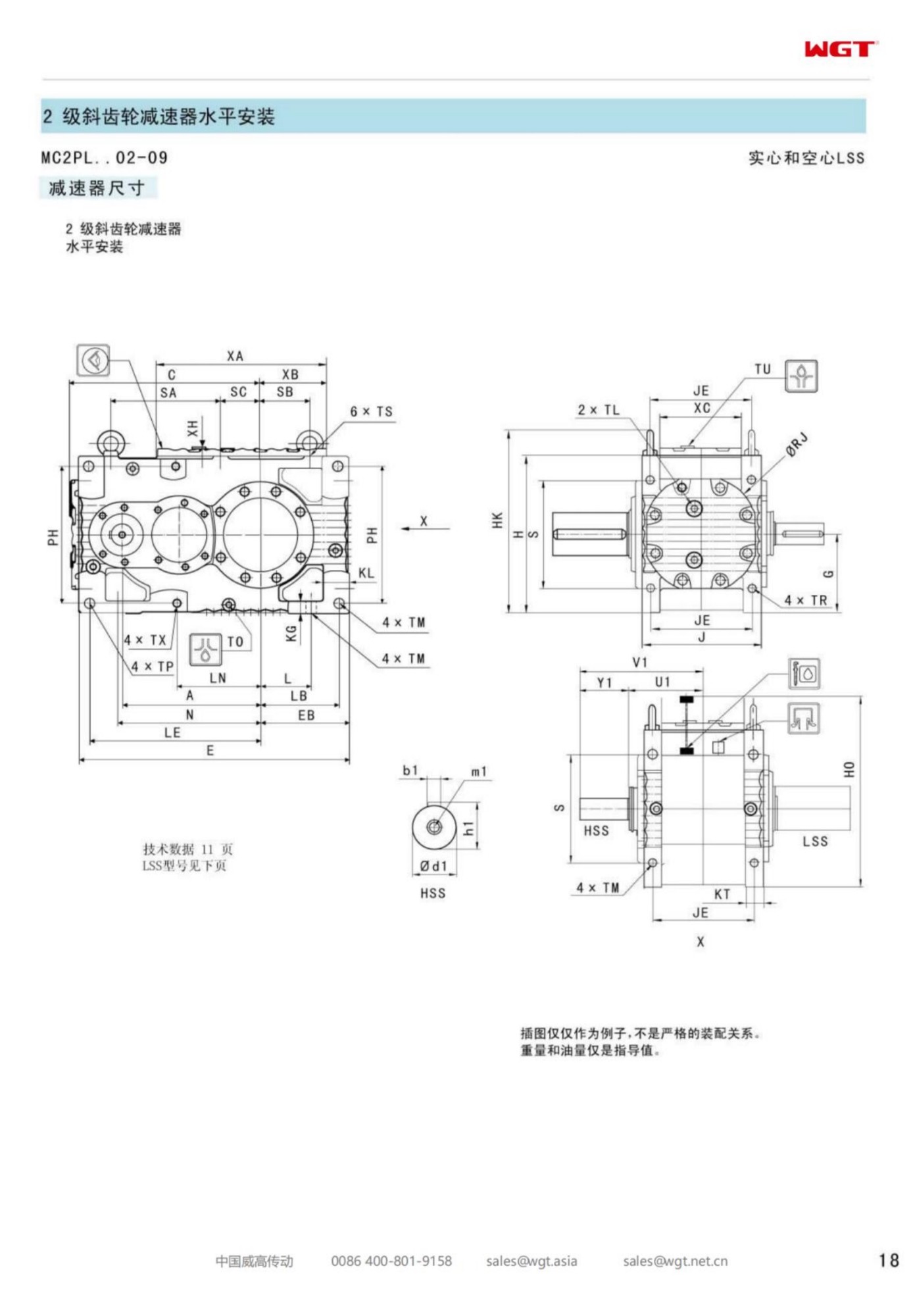
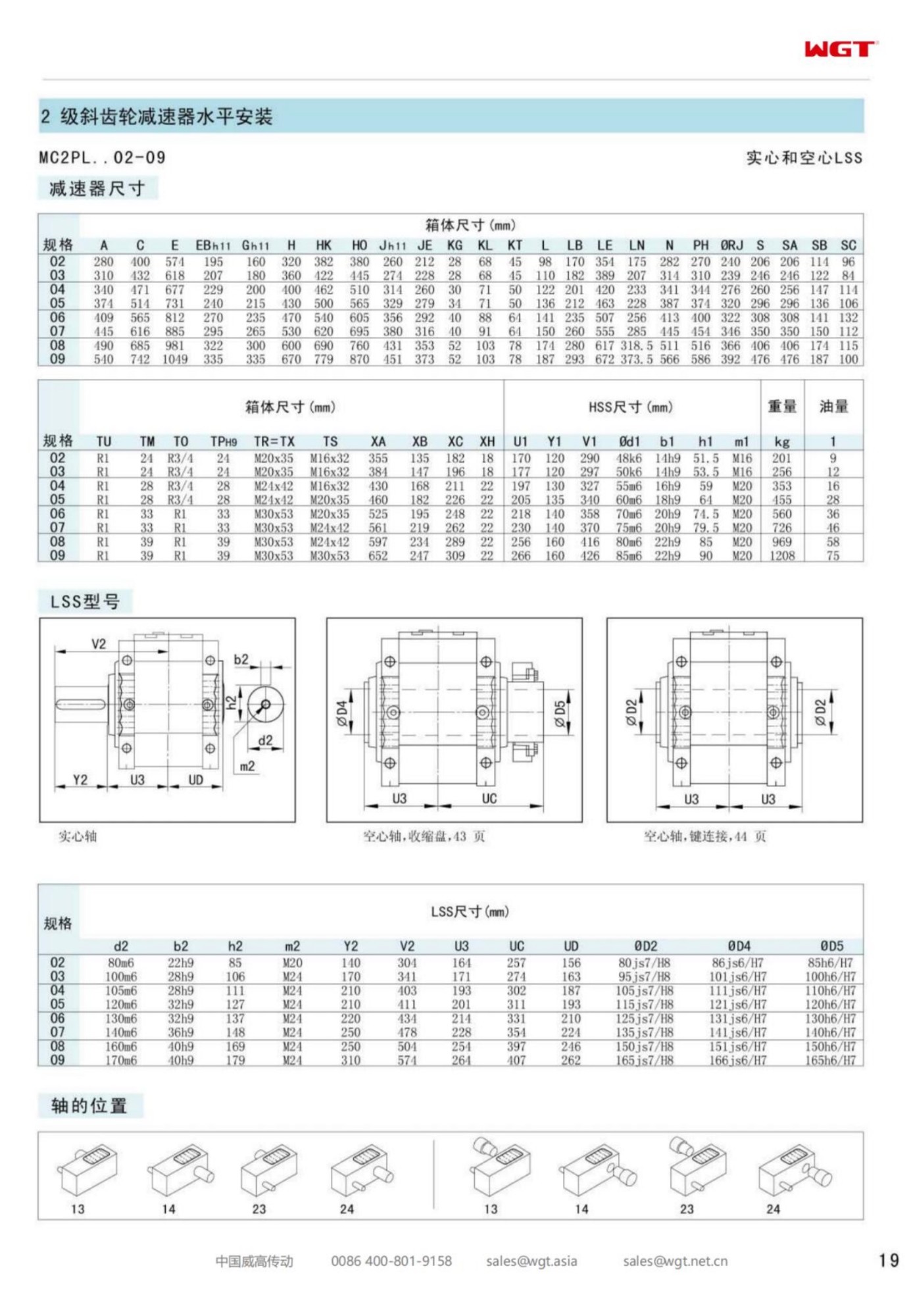
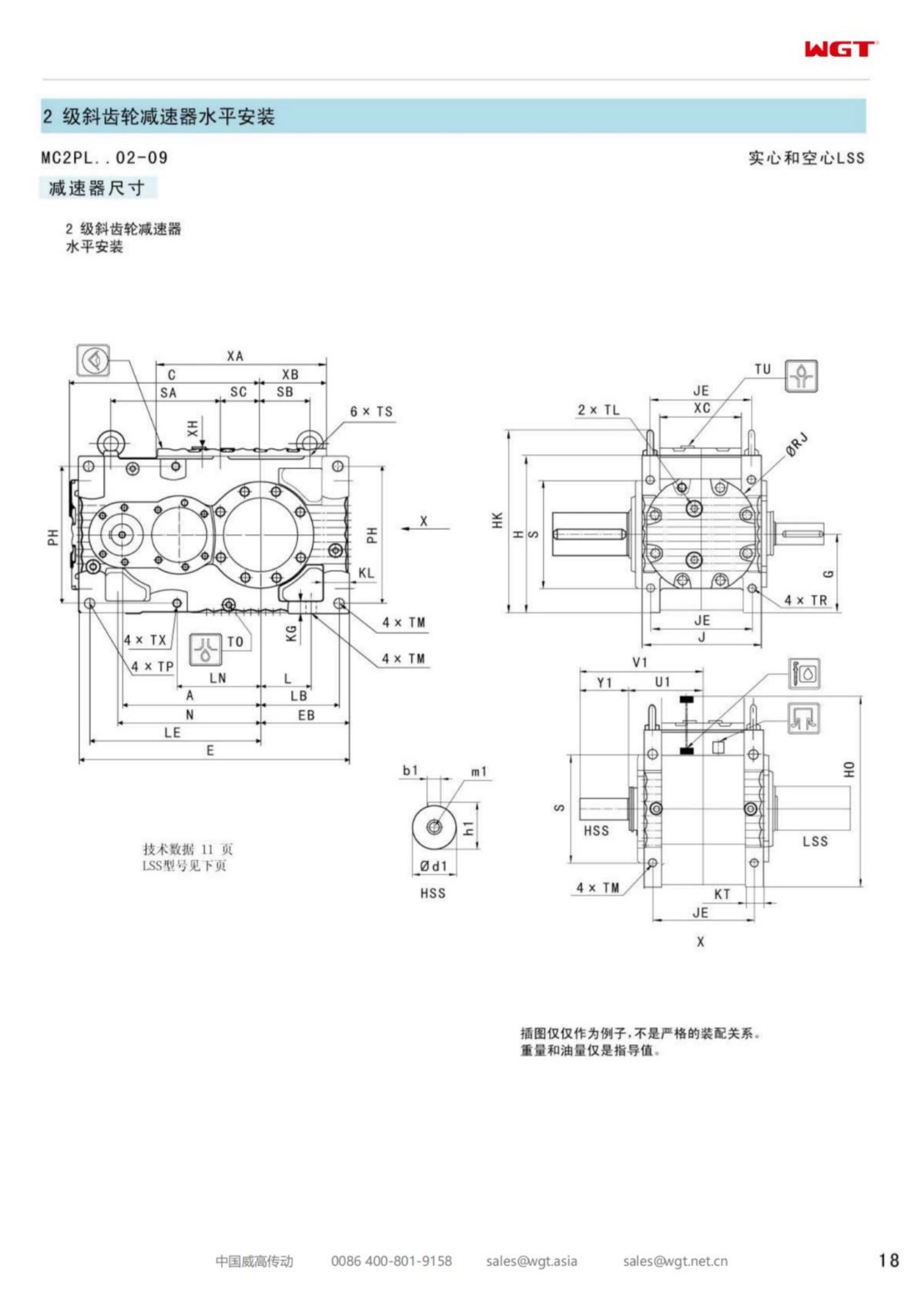
Ask a maintenance planner which drives give the least trouble and the answer rarely involves the biggest machine in the plant. It is usually the drive standing in dry air, under a roof, with a clean motor behind it. The frames that age fastest tend to stand where water is part of the process: washing bays, dewatering decks, slurry lines, and the transfer points where wet material drops from one belt to the next. The MC2PLHT08 shaft-mounted gearbox is the frame in this band that plants specify when that is the environment it has to survive.
The arrangement is the family standard - two helical stages, a level case, a hollow bore over the driven shaft, a torque arm taking the reaction into the structure. Nothing about the geometry changes because the floor is wet. What changes is the list of details worth arguing about before the order: seal material, breather position, paint system, plug and fastener grades, and whether the duty can run backwards on an incline. Those are the lines that decide whether a frame gives eight years of quiet service or four years of small arguments.
Wet Plants Ask Different Questions of a Gear Unit
In a dry plant, dust is the enemy and it arrives slowly. In a wet plant the attack comes from two directions at once: water from outside, and water vapour from the air the case breathes. Both find the same weak points - seal lips, breather elements, gasket faces, the bore mouth - and both do their damage in a way that reads as normal wear until a sample bottle says otherwise.
The practical consequence is that selection conversations in a wet plant start earlier than torque. Which washdown routine does the area receive? Is the water clean or does it carry process liquor? Does the drive sit in a spray shadow or directly under a hose point? Is the atmosphere warm and humid year-round, or does it swing between a hot day and a cold night? Each answer moves the specification, and none of them appears on a torque table.
Decoding MC2PLHT08
The type string reads field by field, as across the whole band, and the frame digit places the unit inside it.
| MC | Industrial gear unit family for continuous plant service |
| 2 | Two helical reductions in a single gear plane |
| P | Parallel-shaft layout, input and output parallel |
| L | Level build, both shafts horizontal in one case |
| H | Hollow output bore slipping over the driven shaft |
| T | Torque arm reaction, no feet and no foundation |
| 08 | Eighth frame: the step plants use where wet air and washdown set the specification |
The string fixes geometry and says nothing about the atmosphere. That is deliberate: the same frame serves a dry transfer tower and a washdown deck, and the difference between those two installations is written in the enquiry, not in the type code. A buyer who sends only the code and the kilowatts will receive a correct gearbox for the wrong room.
How Water Reaches the Oil
Water almost never arrives through a failed casting. It arrives as vapour. Every time the case warms under load and cools at a stop, it breathes: air out when hot, air in when cold. Humid air drawn in at night condenses on the cool inner walls, runs down, and joins the oil. A plant running two shifts and standing idle at weekends does this more often than one running flat out, because the breathing cycles are what count.
The second route is pressure washing aimed at the seal area, which drives water past a lip that was never designed to resist a jet. The third is a blocked or wrongly placed breather that turns the case into a pump on every thermal cycle. None of the three announces itself. The oil simply turns cloudy, then milky, then the bearings start speaking in a slightly different tone and someone orders a sample.
Seals and Breathers in a Washdown Bay
Two components carry most of the wet-duty outcome, and both are cheap relative to what they protect. The table below is the practical way to think about them.
| Light spray, indoor bay | Standard lip seal, shielded breather at the high point away from spray |
| Direct hose and foam | Heavy-section lip or a protective sleeve over the seal journal, breather extended to dry air |
| Process liquor with fines | Seal material chosen for the chemistry, labyrinth or slinger ahead of the lip, drain-back path kept clear |
| Warm and humid year-round | Breather with a desiccant element, inspected on a calendar rather than on complaint |
| Freezing nights, wet days | Seal lip grade that stays flexible cold, breather positioned where ice cannot block it |
The pattern is consistent: keep the water away from the lip, keep the breather out of the spray, and give anything that does get in a path back out. A breather mounted on the top face directly under a hose point is a design error that no seal can compensate for, and moving it is a five-minute decision at order time and a hose-and-fitting job later.
Corrosion Starts at the Fittings
Case paint is visible and gets attention. The parts that fail first are the ones nobody photographs: plug threads, breather bases, drain fittings, fastener heads, the nameplate rivets, the key and the bore mouth. A stainless plug in a painted case costs little and removes a recurring maintenance argument. A drain point placed where a hose can reach it without stripping guarding turns an oil change into a scheduled task instead of a project.
The same logic applies to the reaction hardware. A torque arm bracket that rusts into a solid block cannot be adjusted, and bushings that have seized no longer absorb the small angular travel the shaft makes under load. In a wet plant, hardware selection is not cosmetic - it decides whether the frame can still be maintained in year five by the crew that inherited it.
The Bore on a Wet Duty
A hollow bore on a wet duty has one advantage and one risk. The advantage is the absence of a coupling and its guards, which removes a place where water collects and a place where alignment drifts. The risk is that the bore-to-shaft joint is now the whole interface, and water that reaches it does its work quietly.
What to watch is specific: rust-coloured dust at the bore mouth means fretting has started, and fretting plus water produces a paste that accelerates the wear it came from. The defences belong at installation - correct fit class measured on the actual shaft, key steel of the right grade, retaining hardware fitted and torqued, and a chamfer that lets water run off rather than sit. The shaft itself should be measured and photographed before the frame goes on; a wet plant's shaft often carries pitting from previous service, and pitting under a bore is a fit problem waiting to be discovered at the worst moment.
Inclines and the Load That Waits at Standstill
Wet material on an incline is a heavier duty than the same material dry, and the reason is not only mass. Water lubricates the belt surface, so the load can slide back when the drive stops; a wet belt also drains poorly, so the material that stays on it has time to settle and compact. The drive then faces a restart against a load that has changed shape since it stopped.
Where the route rises, the holdback question belongs in the enquiry in plain words: does the conveyor run back, has it ever, and what stops it today? A backstop inside the frame, a brake on the motor, or a mechanical device on the head shaft are all legitimate answers, and each one changes the ordering lines. A frame specified without that conversation tends to discover the answer during a power failure, which is the least convenient time available.
Duties That Land on Frame Eight
Wet working areas where the frame has to live with water:
- Sand washing plant discharge conveyor head drive
- Dewatering screen feed conveyor at a dredge processing deck
- Belt filter discharge conveyor at a phosphate beneficiation works
- Wet scrubber sludge transfer conveyor at a foundry
- Pulp reject conveyor under a paper mill pulper
- Washdown deck transfer conveyor at a food processing plant
What these positions share is water in the working area rather than water in the product. The duty's real severity is written in the washdown routine and the drainage of the floor around the drive, and both are known to the people who clean the area every shift.
Washdown Routines Worth Writing Down
A washdown is not the enemy; an unplanned washdown is. Three habits make a large difference. First, keep the jet off the seal and breather zone - a plant that washes the frame from above and from a distance gets the same hygiene result without pressurising the lip. Second, run the drive briefly after washing so the case warms and sheds the moisture it took on, rather than standing wet overnight. Third, write the routine down and put it where the cleaning crew can see it, because the crew that washes the area is rarely the crew that owns the gearbox.
The routines that cause trouble are the ones invented locally: a steam lance used to shift caked material, a hose left playing on a hot case, a pressure washer aimed at a breather to clear it. Each of these is somebody solving an immediate problem well. Each one ends up in the gearbox. A short written routine, agreed with the cleaning team, removes most of the wet-duty failures that get blamed on the equipment.
Reading Oil Samples From a Wet Plant
In a wet plant the oil sample is the primary instrument, and its value depends on consistency rather than sophistication. Same point, same method, same interval. Water content read as a trend tells a clearer story than any single number: a slow climb through the humid season is breathing, a step change after a washdown is ingress, and a reading that falls after an oil change and climbs again at the same rate is a breather doing nothing.
Wear metal in a wet case deserves a second look, because water changes what the numbers mean. Emulsified oil carries particles differently, and a slightly elevated iron count in a cloudy sample is a different finding from the same count in a clear one. The practical rule is to treat cloudiness as a finding in its own right: find the water before interpreting the metal, or the interpretation will be about the wrong problem.
When the Plant Runs Seasonally
Seasonal plants concentrate wet-duty risk into the start-up weeks. A drive that stood still through a humid off-season has breathed its way through every temperature cycle without ever warming enough to drive the moisture out. The first loaded week then runs on oil that has been quietly degrading since the last shutdown.
The counter-measures are ordinary. Drain and refill before the season rather than after the first month. Check the breather element before the first start, not at the first complaint. Turn the drive over by hand or on a short no-load run before loading it. Inspect the bore mouth and seal area after the first loaded shift, when the evidence is still fresh. A plant that does these four things spends its season producing instead of diagnosing.
Ordering for a Wet Duty
A wet-duty enquiry reads differently from a dry one, and the difference is mostly nouns. The machine and its material. Running power, output speed, ratio and hours. The washdown reality: frequency, method, water quality, who does it. The atmosphere: indoor or exposed, humid or dry, hot or freezing, any process liquor in the air. The incline question. The driven shaft measured, with its condition described honestly, and the bracket drawing. Then the maintenance reality: who will change the oil, from where, with what access.
Sent that way, the frame arrives with seals, breather, plugs and paint chosen for the room it will live in, and the first oil change happens on schedule instead of after a failure. The same frame ordered on kilowatts alone will still run - for a while - and then begin to consume attention at a rate nobody budgeted for.
Selection Example: Discharge conveyor head drive at a sand washing plant
Take a 37 kW motor at 1480 rpm turning the head shaft at 30 rpm. The ratio follows directly: 1480 / 30 = 49.3, so a ratio near i=49 comes out of the two-stage band, and the frame is checked for the wet air and the washdown the drive lives with rather than for torque alone. In this case frame eight carries the duty with sealing, breather and hardware chosen for a washdown deck, and the arm leaves the floor around the drive clear for cleaning. That is the whole calculation. If your duty involves heavy starting, frequent reversing or many stops per hour, tell us and we raise the service factor.
Which Frame Size Do You Need?
| Model | Centre distance | Output | Typical duty |
|---|
| M3PSF50 | size 50 | solid shaft, foot | conveyors, feeders |
| M3PSF60 | size 60 | solid shaft, foot | crushers, mixers |
| M3PSF70 | size 70 | solid shaft, foot | ball mills, shredders |
| M3PSF80 | size 80 | solid shaft, foot | kilns, heavy conveyors |
| M3PSF90 | size 90 | solid shaft, foot | mill and kiln drives |
| M3RSF50 | size 50 | solid shaft, foot, right-angle | inclined conveyors, elevators |
| M3RSF60 | size 60 | solid shaft, foot, right-angle | screw classifiers, feeders |
| M3RHF70 | size 70 | hollow shaft, foot, right-angle | agitators, drum drives |
| M3PHT80 | size 80 | hollow shaft, torque arm, parallel | shaft-mounted conveyors |
| M3RHT90 | size 90 | hollow shaft, torque arm, right-angle | heavy shaft-mounted drives |
Foot-mounted frames are listed below; torque-arm (T), hollow-shaft (H) and vertical (V) variants are available across the size range. Ask for the outline drawing to check the interface before ordering.
Answers to Common Questions
What is a service factor and which value should I use?
The service factor multiplies your required torque to cover shock and duty class: around 1.0 for uniform conveyors, 1.25 for moderate shocks and 1.5 or higher for crushers, shredders and reversing drives. Tell us the driven machine and we apply the correct value before quoting.
Can the gear unit hold a load on an inclined conveyor?
For inclined belts a backstop prevents the loaded belt from driving the unit backwards when power is cut. Specify the incline angle when ordering so the backstop and the oil level are matched to the actual mounting position.
What is the difference between foot and torque-arm mounting?
Foot mounting bolts the housing to a foundation and suits most fixed installations. A torque-arm lets the housing swing on the driven shaft, so no base frame is needed - common on shaft-mounted conveyors where the reaction rod absorbs the torque.
![gearbox sizing steps for engineers]()
Four steps from your application data to a firm model number.
Case Notes from the Field
Steel mill transfer car
A rolling mill drives its slab transfer cars with industrial gear units mounted on torque arms. Reversing duty every few minutes is handled without complaint, and the hollow-shaft connection keeps the wheel axles free of couplings.
Rotary dryer drive
A minerals processor powers a rotary dryer with a large foot-mounted gear unit. Slow rotation with high torque is the natural duty band, and the housing stays within its temperature limits without auxiliary cooling.
![industrial gear unit application overview]()
A cross-section of the installations we supply every month.
Request the Datasheet and Dimension Drawing
Need documentation for approval? Try the WGT Motor & Gearbox Online Selection System, then send the result sheet - we return a complete datasheet, drawing and price the same day.
We issue complete technical files on request: dimension drawing, rating table, test record format and material certificates, in English and ready for your engineering or purchasing approval package. Looking for a gearbox for steel mill? Tell us the duty point and we will confirm the model in writing.