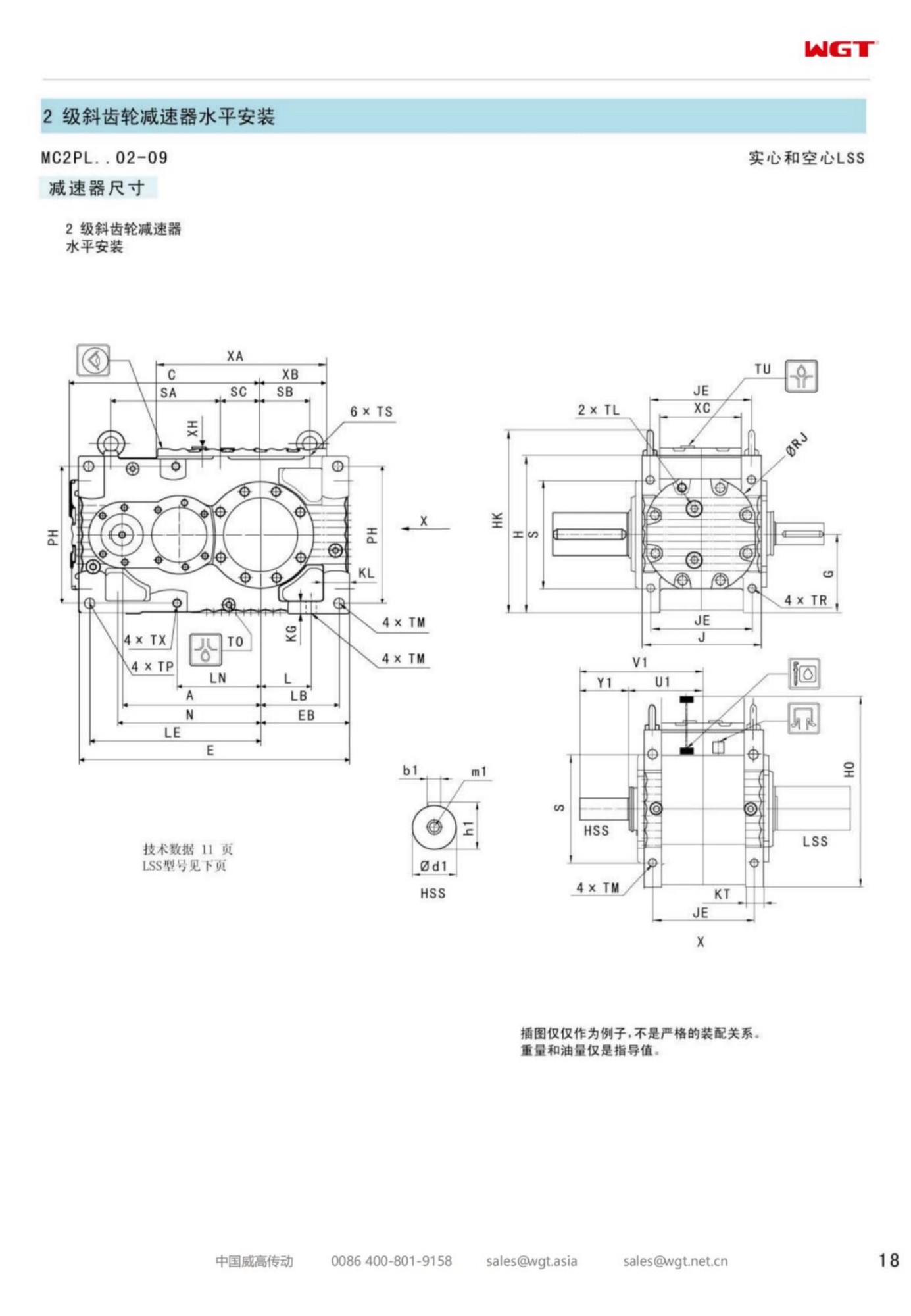
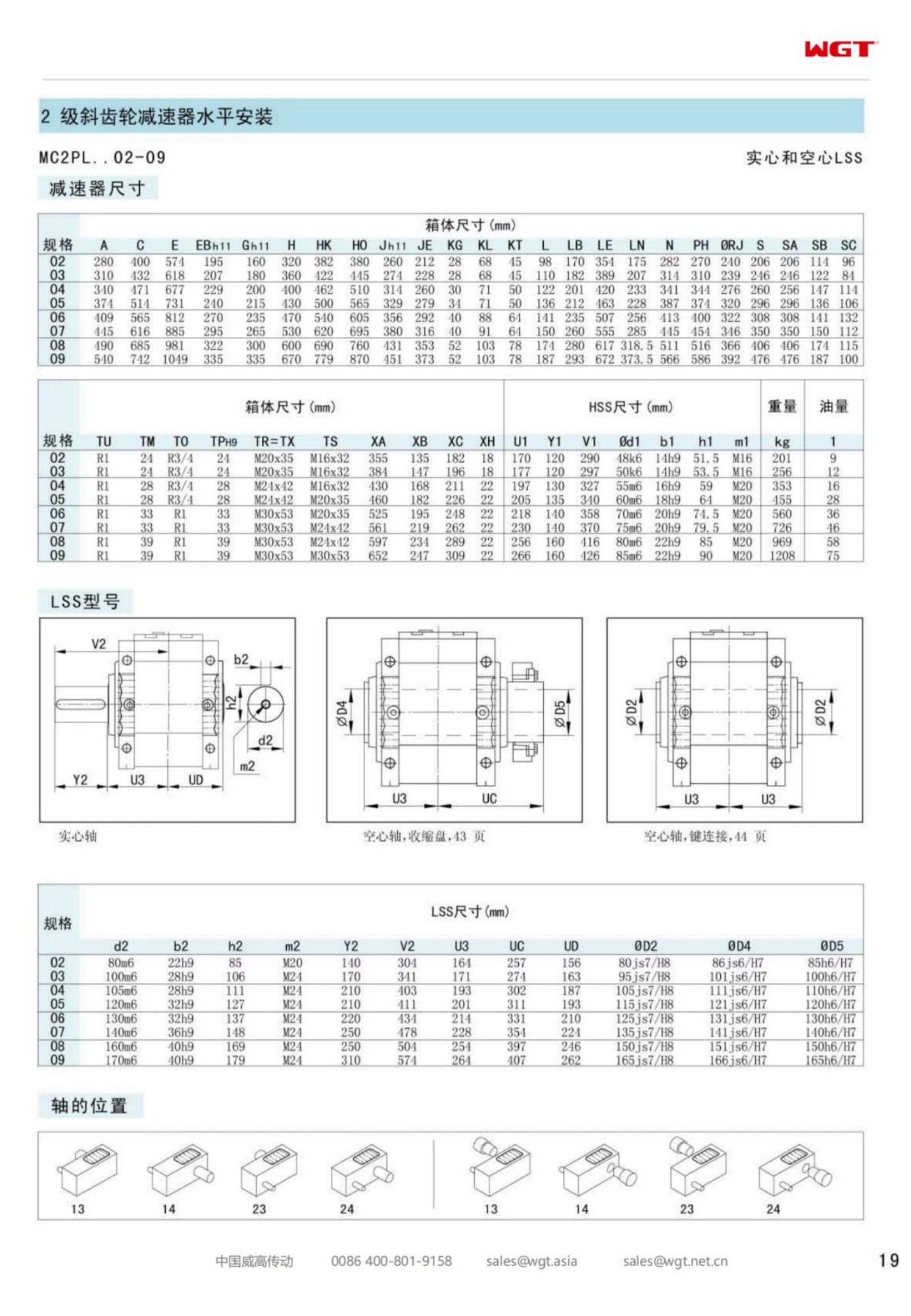
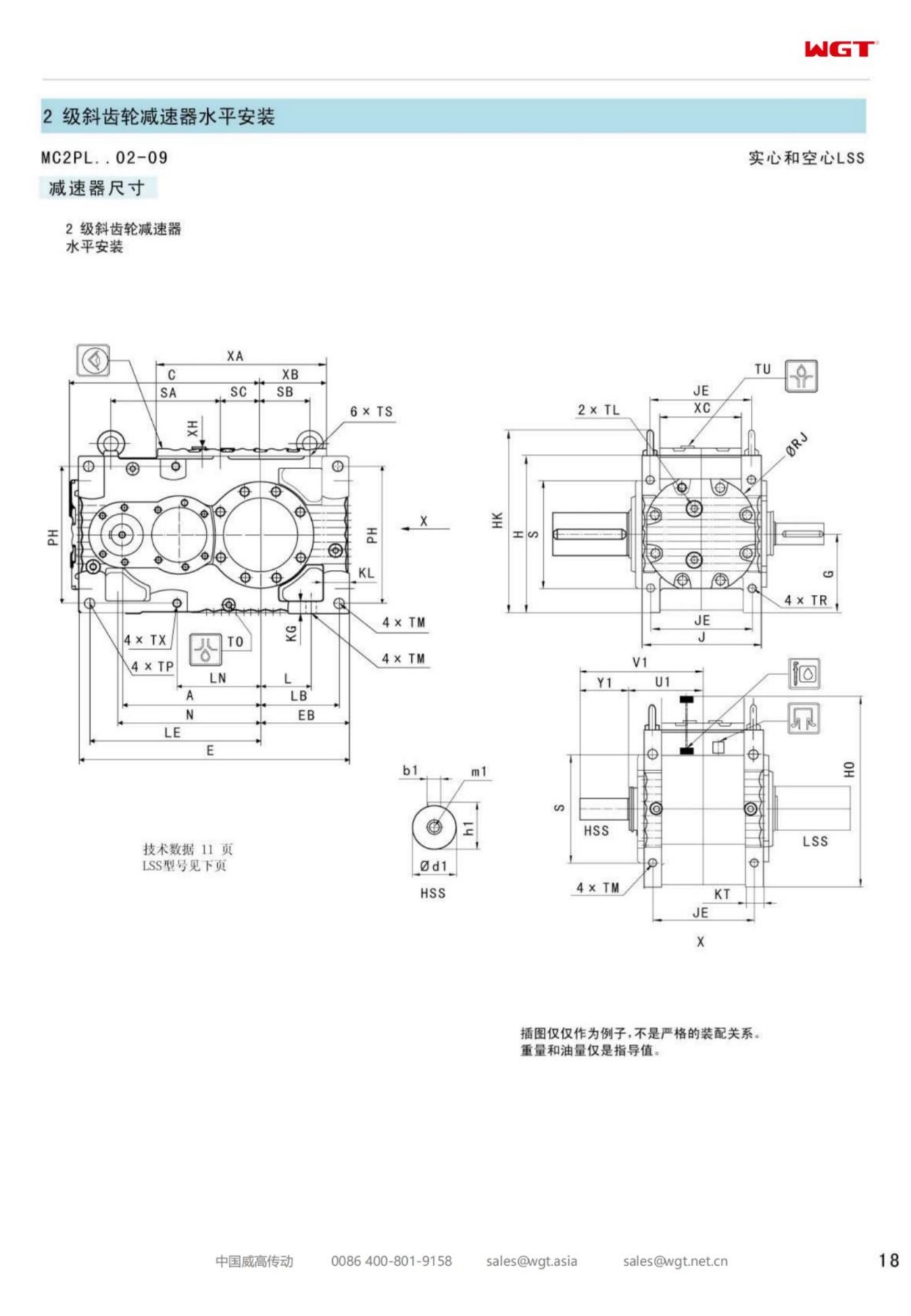
Some positions in a plant are chosen by tonnage and others are chosen by what the air is like. By the fifth frame of this shaft-mounted band, the duties arriving are usually both: drag chains carrying clinker away from a cooler, conveyors in dust collection bays, drives at salt terminals and scale pits where the case lives in air that attacks whatever it touches. The MC2PLHT05 torque arm gearbox is the frame that gets specified when the load is serious and the environment is not polite about it.
What changes at this level is not the arrangement - two helical stages, a level case, a hollow bore over the driven shaft and an arm handing the reaction to the frame. What changes is the margin the duty needs in every direction at once: torque for the tonnage, thermal room for the heat the process brings back, and a sealing and hardware plan drawn for the air rather than for the catalogue photograph.
The Frame Where the Environment Starts to Decide the Order
Below this frame, buyers mostly ask how much a unit carries. At frame five they start asking what it will survive, and the two questions are not separable. A case running close to its thermal limit in clean air is a different machine from the same case beside a hot conveyor in dusty air, because the dust blocks the very surfaces the heat escapes through and the heat thins the oil film the teeth rely on. Rating sheets assume neither. The site supplies both.
This is why enquiries for hostile positions are judged as much on their description as on their numbers. The temperature next to the drive in the hottest month, the nature of the dust, whether washdown water reaches the case, how many hours a day the machine actually turns - these turn a quotation from a price into an engineering position. The frame is the same steel in both cases; the factor and the fittings are not.
Decoding MC2PLHT05
The designation carries the arrangement in the same fields as its stablemates, and the last field marks where in the band the duty sits.
| MC | Industrial gear unit family for continuous plant service |
| 2 | Two helical stages carried in one gear plane |
| P | Parallel-shaft geometry, both shafts running parallel |
| L | Level arrangement, input and output horizontal in one case |
| H | Hollow bore mounting directly over the driven shaft |
| T | Torque arm reaction into the machine frame, no feet |
| 05 | Fifth frame: the step where duty hours and environment both size the order |
Read as a delivery check, the fields are quick: the 2 counts the meshes the oil must reach, the H says the machine's shaft is the output, the T promises an arm and an anchor pattern. What the string stays silent on - sealing spec, breather type, paint system, the attitude the case will actually hang at - is exactly the list a hostile-duty order has to put in writing.
Dust, Heat and the Sealing Plan That Answers Them
Dust does its work slowly and at the seals first. Abrasive particles ride the shaft surface into the lip, wear a groove, and the weep that follows marks the shaft and lowers the oil level one top-up at a time. Where the air carries clinker dust, stone dust or salt, the sealing arrangement is a specification item rather than a default: lip material suited to the temperature, a labyrinth or clearance sleeve where the dust is worst, and shaft surfaces finished and protected before the unit ever goes on.
Heat and dust compound each other, which is why the sealing plan and the thermal plan are written together. A case running hot holds its oil film thinner; a clogged cooling surface makes it run hotter still; the first seal to soften starts the leak that ends in a bearing. None of it is dramatic on any single day. It is a year of small regressions, and the way to buy against it is to describe the air honestly and let the fittings be chosen for it.
Reading the Code Against a Hostile Duty
Every field in the designation maps onto something the environment will test. The two stages mean two meshes to oil and two bearing sets to keep fed from a sump that may be hung at an angle the drawing never anticipated. The hollow bore means the machine's own shaft carries the case - so the fit, the key and the fretting protection at the bore matter more here than anywhere, because this is a drive that will not come off for inspection often.
The torque arm, meanwhile, lives in the same air as everything else. Its bushings, its bolts and the bracket it pushes against are all part of the drive's load path, and on a hot or corrosive duty they are inspected on the same route as the oil. A drive whose case is sound but whose arm bracket has rusted thin is not a sound drive. The environment does not read nameplates; it works on whatever steel is present.
Thermal Rating at the Temperature the Site Actually Has
Catalogue thermal ratings assume an ambient that most hostile positions do not offer. A drive beside a cooler discharge, above a hot clinker belt or inside a mill building in summer sees an ambient the brochure never met, and the difference comes straight off the thermal margin. The check costs almost nothing: a thermometer left at the drive position for a working week in the worst month settles the argument before the order instead of after it.
Where the figure comes back high, the answers are ordinary and cheap at specification time. A larger sump, a synthetic oil held in sealed containers, airflow across the case, the breather moved off the hot face - any of these may close a modest gap. A gap that will not close is a frame-size answer, and it is far better to hear that from a selection engineer holding honest numbers than to discover it as a recurring entry in the maintenance log.
Breathers, Paint and Hardware in Aggressive Air
The small fittings decide how a drive ages in bad air. A breather that filters is worth having; a breather positioned where dust settles into it is worth swapping at installation with one mounted where the air is cleaner. Plugs and hardware in the right material, a paint system specified for the atmosphere rather than the standard shop finish, and drain points reachable without stripping guarding - each is one line on an order, and each is expensive once the case is painted and hung.
Washdown and steam change the picture again, because water finds every joint a case has. Where the duty includes hosing, the order should say so: sealed breathers, drain plugs that hold their seal, cable entries above the oil line. Plants that standardise this on the first order never have to think about it again; plants that leave it to chance meet it as a leak with no obvious origin.
Holding a Loaded Incline
A great many frame-five duties are inclined, because hot material travels upward on belts and chains more often than intuition suggests. An inclined, loaded machine that stops wants to run backwards, and a shaft-mounted drive with no coupling sits directly in that path. The answer is specified with the frame or not at all: a holdback built into the drive, or a braking arrangement on the shaft, sized against the loaded rollback of the actual machine.
Rollback is not a theoretical event. It arrives the day a power dip stops a full belt, and it drives the gear train from the output side with the plant watching. Plants that specified the holdback have a non-event; plants that did not have a story. One line in the enquiry - the machine can back-drive under load - is all it takes to make sure the hardware arrives with the unit.
Duties That Land on Frame Five
Positions where heat, dust and long hours decide the frame as much as price does:
- Drag chain conveyor carrying hot clinker away from a grate cooler
- Belt conveyor in a dust collection bay at a cement works
- Screw conveyor at a coastal salt handling terminal
- Filter cake conveyor at a pigment plant
- Conveyor drive in a steel mill scale pit area
- Head shaft drive on a foundry sand reclamation line
What the list shares is hours and hostility in equal measure. These are drives that run through heat, dust and night shifts with little attention, and they are chosen by people who have been called out to their predecessors at bad hours. The frame, the fittings and the factor all come from that experience - and from the willingness to write it into the enquiry.
Lubrication on a Duty That Rarely Stops
Oil is the part of a hostile-duty drive that ages fastest, because heat and contamination both shorten its working life. On a duty that turns most hours of the day, the first change comes early and every change after that is an opportunity to read the drive's condition in the sample: wear metal, water, the viscosity drift that says the sump has been running hot. One grade, kept in sealed containers and stored where the dust is not, beats a shelf of incompatible part-drums every time.
Level checks follow the same logic as anywhere, with one addition a shaft-mounted case imposes: the level plug is correct for the attitude the case was set for, and a hung case may sit at an angle. Confirm the plug position against the actual installation, put the breather at the high point, and write both on the commissioning sheet. The cheapest way to ruin a new frame in a week is to fill it against the wrong plug.
Inspecting a Drive Nobody Can Reach Easily
Many frame-five positions sit in galleries, over pits or beside machines that make access a planned event rather than a stroll. That is precisely why the inspection points must stay reachable without tools: level plug, breather, drain, arm bushings, temperature patch. A guard that has to come off for every check becomes a guard that stays off, and the drive then runs for years with its early warnings hidden behind steel.
The routine itself is short and belongs on the same walk-round as the other drives: oil at the glass or plug, temperature at the marked patch, arm bushings intact and free, bore edges clean of fretting dust, seal area dry, noise steady at the usual load. Five minutes a week produces a history, and a history is what turns a failure into a planned swap during a scheduled stop instead of a surprise during a production run.
Ordering Against the Environment
A hostile-duty enquiry is mostly a description. The machine and its load pattern, starts per hour and the worst starting condition in words. Output speed and the tolerance the process accepts. Hours per day, and whether the machine can run back under load. Ambient in the hottest month at the drive position, the nature of the dust, washdown or steam, the driven shaft's measured diameter, key and plain length, the mounting attitude, and the paint and documentation standards the site holds.
Sent complete, that description comes back as a frame with fittings chosen for the air, a thermal position that holds at the real ambient, and a delivery that suits the shutdown. Sent as a power figure, it comes back as questions - and each round of questions costs a week while the shutdown date stands still. On this frame the description is the engineering; the power figure is only its headline.
A Spares Plan for One Frame
Plants running several frame-five positions in similar air discover the same economy the smaller frames offer: the mounting interface is the machine's shaft and a bracket pattern, so one spare case can back several positions if the bores and ratios are ordered with that in mind. Against it hold the consumables the air attacks first - seals, breathers, arm bushings, keys - in a box labelled for the frame rather than for the plant.
The calculation is an afternoon: count the positions, cost one unplanned week honestly, and compare it with the holding cost of a case and a crate of fittings. On duties where the environment is the enemy, the spare is not a luxury; it is the difference between a planned swap in a shutdown window and a drive improvised from whatever the stores had, hanging in air that will start working on it immediately.
None of this is exotic. It is the ordinary discipline of matching a machine to the air it lives in, written down before the order instead of learned from the logbook afterwards - and on a frame chosen as much for where it hangs as for what it carries, that discipline is the whole difference between a drive that lasts and one that is perpetually discussed.
Selection Example: Drag chain conveyor carrying hot clinker away from a grate cooler
Take a 55 kW motor at 1480 rpm turning the chain at 25 rpm. The ratio follows directly: 1480 / 25 = 59.2, so a ratio near i=59 sits at the slow end of the two-stage band, and the frame is sized by the heat the conveyor brings back to the case as much as by torque. In this case frame five carries the tonnage with sealing and thermal margin to spare, and the hollow bore hangs the drive on the head shaft of a gallery where floor space does not exist. Work through the same three steps - speed, output speed, torque - and the model number falls out; we verify it against the duty class before quoting.
![gear reducer ratio calculation steps]()
From duty point to model number - the same four steps every time.
Applications in Industry
Cold-store conveyor
A cold-store operator uses reducers on freezer-room conveyors. Low-temperature synthetic oil and moisture-resistant seals keep the units running below -20 deg C ambient.
Bakery spiral cooler
A bakery equipment builder fits units to spiral cooler drives. The compact right-angle layout fits under the spiral cage, and food-grade lubrication was specified for the hygienic area.
![gear reducer industries served - WGT]()
Industry map: the sectors where the M3 series is most common.
Buyer Questions and Answers
What is the maximum overhung load on the output shaft?
The permissible overhung load depends on frame size, output speed and the distance from the shaft shoulder - all listed in the catalogue. If you drive a chain sprocket or V-belt pulley direct on the output shaft, send us the load and pitch diameter and we will confirm the limit.
Do you offer a version with an integrated gear motor?
We can supply the unit as a complete gear motor with an IEC motor bolted on and tested as one assembly. That saves you the alignment and coupling work, and the whole assembly carries the same one-year warranty.
M3 Series Model Overview
| Model | Centre distance | Output | Typical duty |
|---|
| M3PSF50 | size 50 | solid shaft, foot | conveyors, feeders |
| M3PSF60 | size 60 | solid shaft, foot | crushers, mixers |
| M3PSF70 | size 70 | solid shaft, foot | ball mills, shredders |
| M3PSF80 | size 80 | solid shaft, foot | kilns, heavy conveyors |
| M3PSF90 | size 90 | solid shaft, foot | mill and kiln drives |
| M3RSF50 | size 50 | solid shaft, foot, right-angle | inclined conveyors, elevators |
| M3RSF60 | size 60 | solid shaft, foot, right-angle | screw classifiers, feeders |
| M3RHF70 | size 70 | hollow shaft, foot, right-angle | agitators, drum drives |
| M3PHT80 | size 80 | hollow shaft, torque arm, parallel | shaft-mounted conveyors |
| M3RHT90 | size 90 | hollow shaft, torque arm, right-angle | heavy shaft-mounted drives |
The series is sized for continuous heavy duty rather than by motor power alone: the required torque with the service factor decides the frame, and the stage count (2 to 5) decides the ratio band.
Fast Quotation for OEM and Repeat Orders
Buying one unit or one hundred? Run your duty point through the WGT Motor & Gearbox Online Selection System first: it saves a round of emails and gets you to a firm price faster.
Single units ship on the same production route as batch orders, with no minimum-order surcharge. For OEM programmes we hold framework pricing and reserve capacity for your scheduled call-offs. Looking for a reducer for woodworking machine? Tell us the duty point and we will confirm the model in writing.