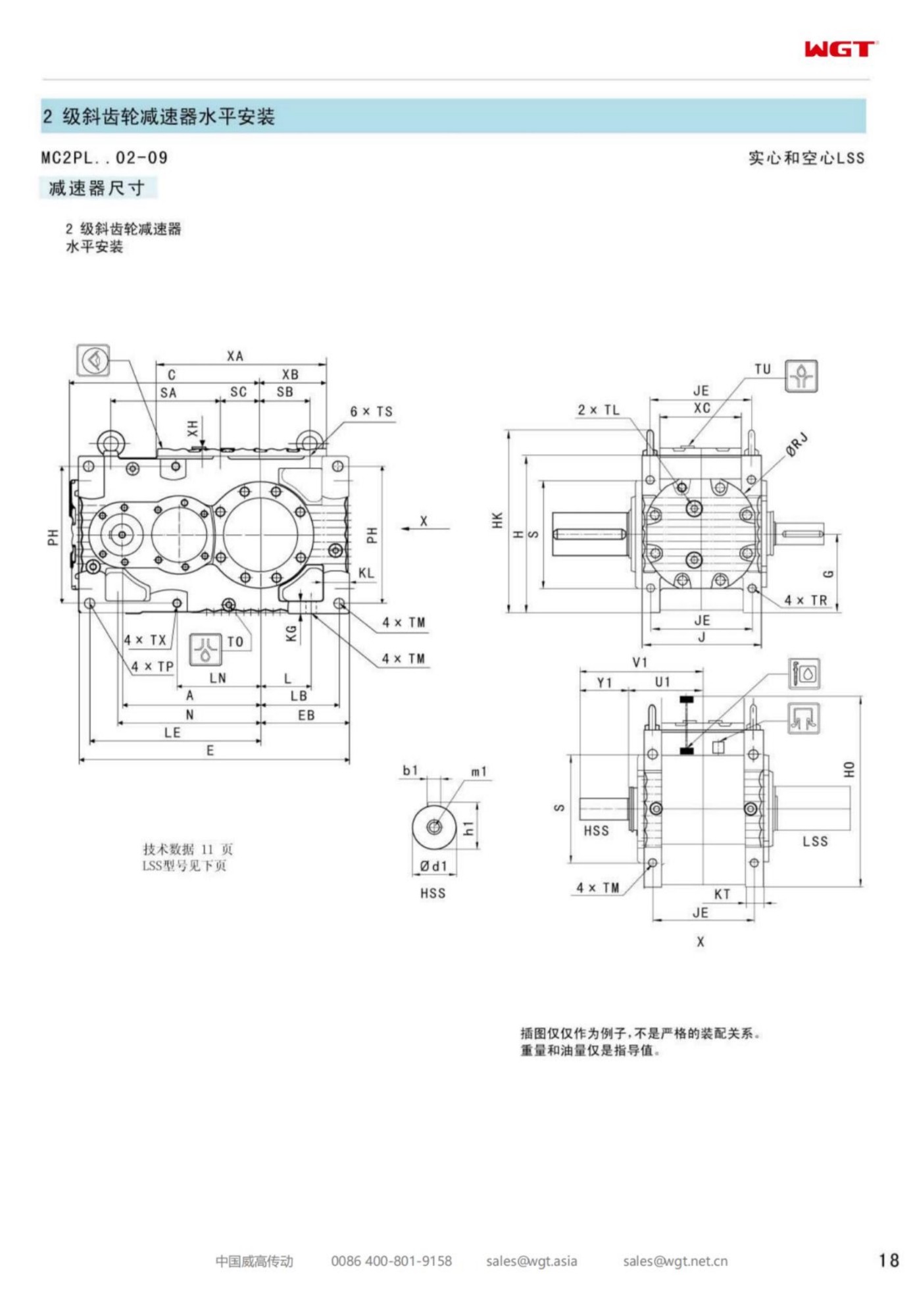
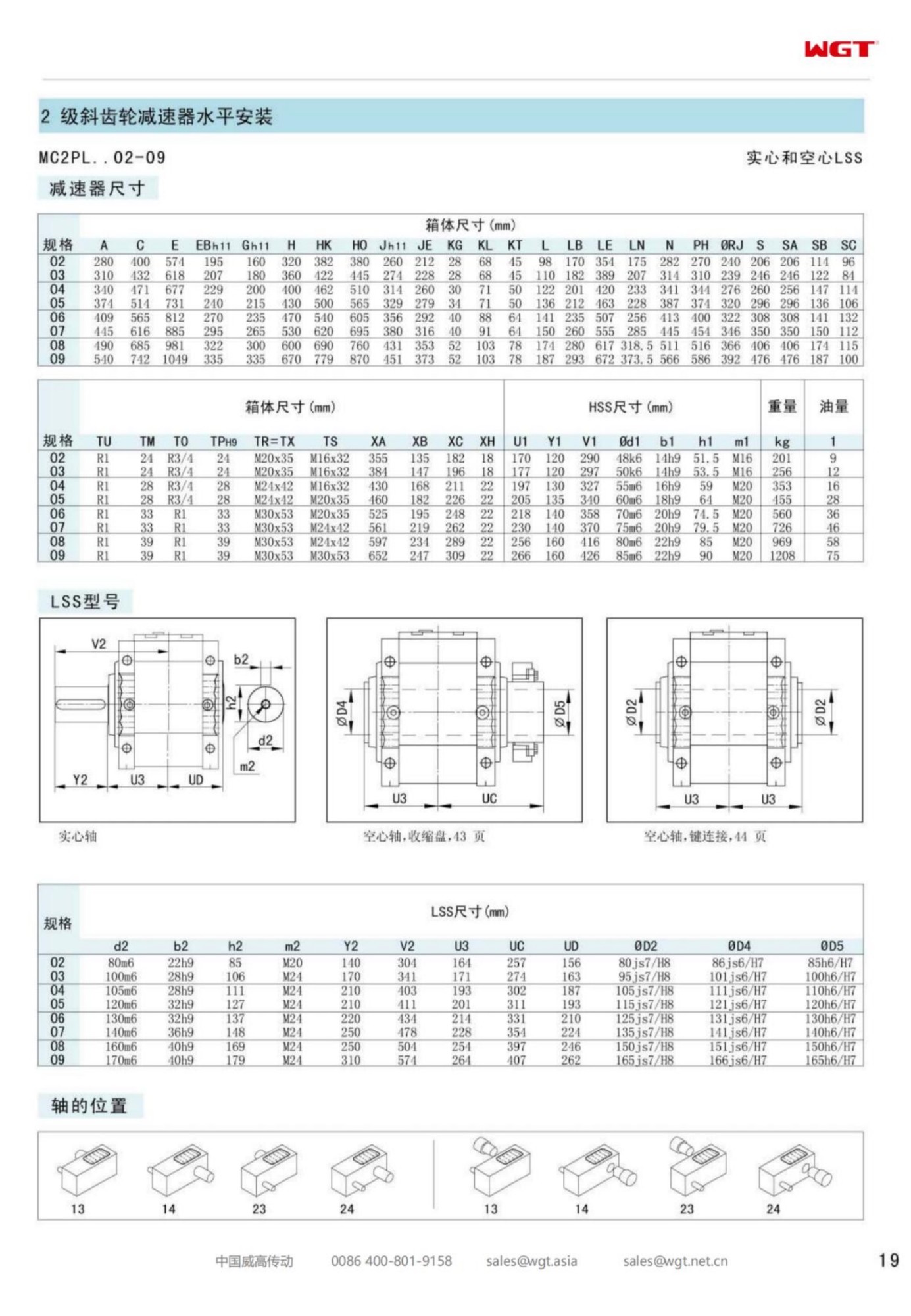
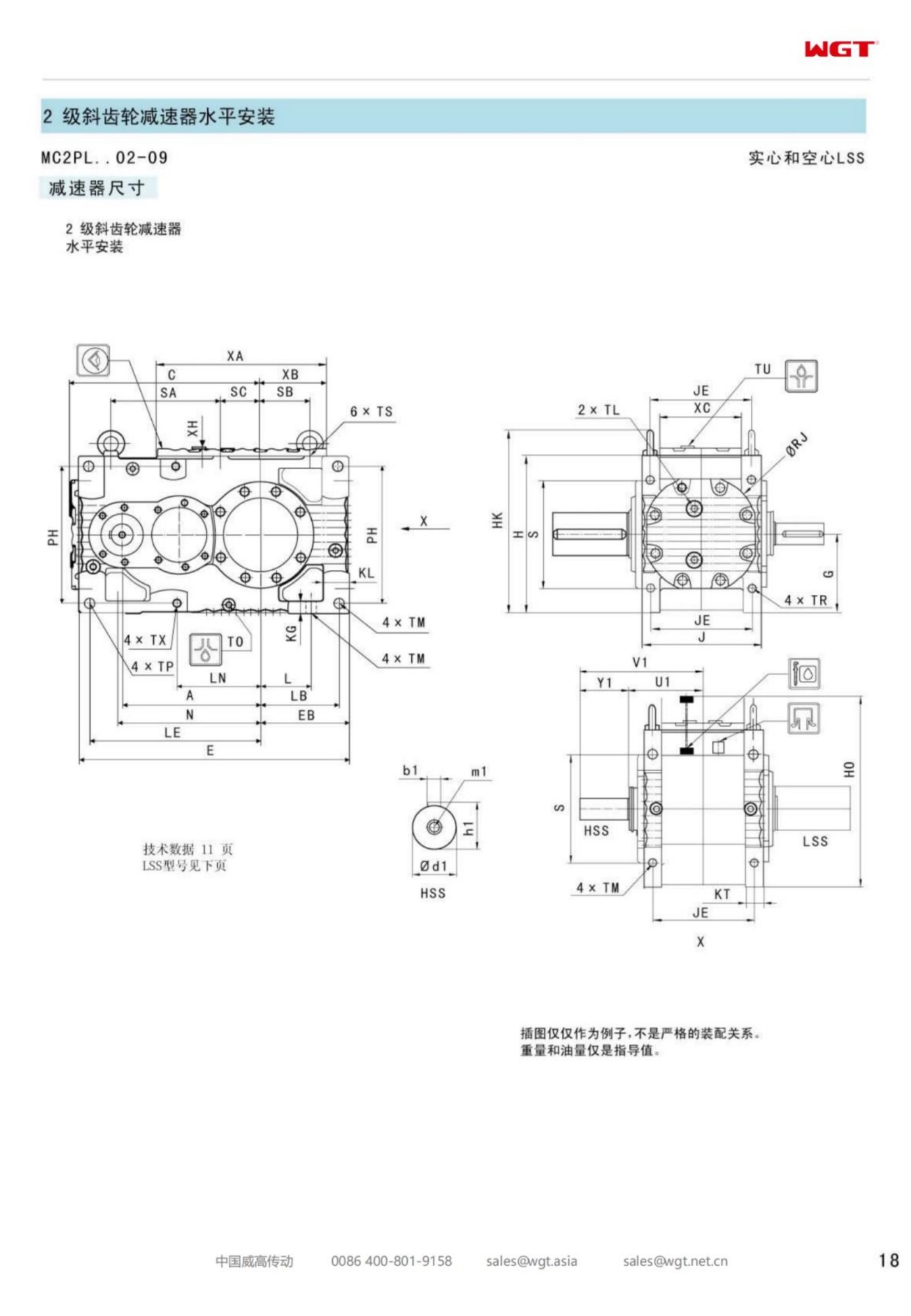
Somewhere in every shaft-mounted family there is a frame where the arrangement stops being a convenience and starts carrying the plant's tonnage. In this two-stage parallel band it is the third. The MC2PLHT03 torque arm gearbox is specified on conveyor head shafts and process shafts where a footed unit would need a platform, a coupling and a foundation the layout cannot afford, and where a smaller shaft-mounted frame would run out of service factor before the duty ran out of hours.
The build is the family's: two helical stages in one plane, a horizontal case, a hollow output bore over the driven shaft, and a torque arm handing the reaction to the machine frame. What the third frame adds is the margin continuous tonnage asks for - wider bearings, more oil, a heavier arm and an anchor pattern a fabricator can work to without inventing anything.
Frame Three, Where the Shaft-Mounted Band Starts to Work
Frames below this one turn machines that can stop for a shift without anybody calling the production manager. The third frame more often turns a step in a continuous line: the conveyor that feeds the next process, the screw that empties a silo the plant is sized around, the mixer a batch schedule depends on. The duty cycle hardens accordingly - more starts, longer runs, less forgiveness for a factor chosen hopefully.
That is why this is the smallest frame in the range that should be selected against measured duty rather than a catalogue guess. A table will happily accept a frame two for many of the same ratings on paper. The difference appears in the second year of three-shift running, as a case that sits ten degrees warmer than the day it arrived and a seal that has started to mark the shaft.
The Code, Field by Field
The designation carries the arrangement, and the arrangement is what the installation crew actually has to build to.
| MC | Industrial gear unit family for continuous plant service |
| 2 | Two helical stages in a single gear plane |
| P | Parallel-shaft geometry, both shafts running parallel |
| L | Level arrangement with the input shaft horizontal |
| H | Hollow bore that mounts over the driven shaft |
| T | Torque arm reaction, no foot pads on the case |
| 03 | Third frame: continuous line duties sized by duty cycle, not by peak torque |
Read it as a delivery check and the sequence is quick: the frame digit fixes the mounting drawing, the T promises an arm and an anchor pattern instead of feet, the H says the machine's own shaft is the output, the 2 says how many meshes the oil has to reach. A disagreement in any field is a unit that goes back on a lorry, and the cause is almost always a specification taken down over the telephone.
Conveyor Head Shafts and the Arithmetic Behind Them
Most of these frames end up on a head shaft, and the selection arithmetic is worth walking through because it is where buyers and suppliers most often talk past each other. The belt speed and pulley diameter give the output speed. The motor speed divided by that figure gives the ratio, and the ratio is the easy part. The frame then follows from the torque at the pulley, multiplied by a service factor that reflects how the belt is loaded rather than how the motor is rated.
The honest numbers come from the conveyor, not from the motor nameplate. A 30 kW motor on a belt that is started empty every morning and a 30 kW motor on a belt that is started full after every weekend maintenance are two different specifications for the same drive. State which one applies, and state the worst case you have actually seen - a wet load, a frozen lump, a chute left open - and the factor stops being a guess.
Hanging the Reaction on Steel
On a head shaft the reaction is large and it is steady, and the arm that carries it is bolted to whatever the fabricator provided. That bracket is the part most often under-designed, because it is drawn by whoever has the machine in front of them rather than by anyone who has seen the reaction figure. Reaction torque, its direction and the bolt pattern should all be on the quotation drawing, and the fabricator should build to them rather than to the gear case outline.
Two site habits pay for themselves. Fit the arm so its bushings sit at mid-travel with the machine at rest, leaving room for the small angular movement the shaft makes under load. And check the bracket for stiffness by eye before the unit arrives - a plate that flexes under a hand push will flex under a torque, and the movement will be read at the gear case as vibration. A gusset costs an hour; a warranty conversation about a vibration that is not the gearbox costs a month.
Bore Fit on a Larger Shaft
The third frame carries a bigger bore than the small frames, and bigger bores forgive less. Measure the shaft in two planes at three positions along the length that will sit inside the bore, because a shaft that has been in service for years is rarely round and rarely straight. Check the keyway for a burr, check the key for length, and confirm the shaft end will not bottom in the bore before the retaining hardware is fitted.
Fitting follows the drawing rather than the habit of the fitter. A dry bore and a dry shaft will fret; a bore hammered home over a high spot will never sit true. Where the assembly uses a clamp ring or a shrink disc, follow the tightening sequence and the torque figures exactly, and record them - the next crew will want them, and the file is the only place they survive. Where the fit is keyed, check the key contact pattern after the first month of running; a key carrying load on one corner is a key that will fail quietly.
Shock, Stall and the Factor That Covers Them
A shaft-mounted drive has no coupling to soften a start, so the shock arrives whole. Two situations deserve to be written into the enquiry rather than assumed away. The first is the loaded start: a belt, chain or screw that begins its run full of material, where breakaway torque can be two or three times the running figure. The second is the jam, where something solid stops the machine and the drive is expected to survive until the motor protection acts.
Neither is unusual in a plant, and both are cheap to cover at the selection stage. The costly mistake is to size on running torque and rely on the motor's overload setting to look after the rest. Motor protection is there to protect the motor; the gear teeth see the same event and are not covered by the same curve. Say what the machine will be asked to start, and how often, and the factor can be set with the plant in view.
Duties That Land on Frame Three
Head shafts and process shafts that carry this frame as a matter of routine:
- Troughed belt conveyor head pulley at a cement packing plant
- Screw reclaim conveyor under a flat storage silo
- Continuous mixer drive on a sand reclamation line
- Drag chain conveyor at a biomass fuel yard
- Bucket elevator head shaft at a fertiliser granulation plant
- Rake drive on a rectangular settling tank
The list is unglamorous and it is where the hours go. Every one of these positions sits downstream of a decision someone made about layout, and every one of them will be judged in five years by whether the drive is still quiet rather than by what it cost. A frame with margin in hand at the start of its life is the only kind that reaches that point.
Thermal Behaviour in an Enclosed Frame
The third frame holds more oil than the small ones but sits in the same crowded corners, and enclosed corners trap heat. A case beside a steam main, under a roof in a humid summer, or inside a cladded conveyor gallery will run above the workshop ambient its rating assumed. That is not a reason to buy a bigger unit; it is a reason to check the thermal rating at the temperature the unit will actually see.
The measurements are simple and worth taking before the order rather than after. A thermometer left at the drive position for a working week in the hottest month settles the argument. Where the figure comes back near the limit, the answers are ordinary - a breather moved away from the hot face, a fan directed at the case, a louvre opened, or a cooling arrangement specified with the machine instead of improvised a year later.
Lubrication When the Case Is Not Level
A torque arm build often hangs at an angle the catalogue drawing did not anticipate, and the oil has to reach the bearings from wherever the sump ends up. That is a question for the supplier, answered with the mounting position and the angle, and answered in writing well before the unit is filled. Filling to a plug that is wrong for the installed attitude is one of the few ways to destroy a new gearbox in a week.
The routine after that is short: level at a fixed interval, one grade of oil kept in sealed containers, a sample at the first change and yearly after. For a unit that may be inverted or tilted, add one check that foot-mounted drives never need - confirm the breather is the highest point in the attitude it is actually installed in. A breather at the low side becomes an oil leak with a filter on it.
Guarding and the Weekly Walk-Round
A rotating case with an exposed shaft end and an arm under load attracts the same safety obligations as any other transmission, and the guard is usually fabricated on site. Design it so the level plug, the breather, the drain and the arm bushings stay reachable without tools. A guard that has to be unbolted for every oil check becomes a guard that is left off, and the drive then runs for years with its inspection points hidden.
What the walk-round should catch is short: oil at the glass, temperature at the marked patch, arm bushings intact and free, no fretting dust at the bore, seal area dry, guard secure, noise steady at the usual load. Five minutes a week, on the same route as the other drives, produces a history. Histories are what turn a failure into a planned swap, and planned swaps are the only maintenance events that do not make the production meeting.
A Spare on the Shelf Without a Second Foundation
Plants that standardise on a shaft-mounted frame discover an unexpected economy: the spare does not need a foundation, a plinth or a reserved floor area. It sits on a pallet, protected, and it fits every position where that frame is used, because the mounting interface is the machine's own shaft and a bracket pattern rather than a set of cast-in bolts.
That economy is worth planning rather than stumbling into. Count how many positions in the plant run this frame, look honestly at the consequence of each stopping, and hold one unit plus the consumables - seals, keys, arm bushings - against the worst of them. The holding cost of one case is a fraction of the production lost to a single unplanned week, and the calculation takes an afternoon rather than a consultant.
Commissioning the First Fortnight
Commissioning a shaft-mounted unit is mostly a matter of checking that the installation matches the drawing before load is applied. Rotation direction against the driven machine. Oil level at the plug for the installed attitude, with the breather at the high point. Arm bushings at mid-travel and free. Guard fitted and secure. Coupling-free by design, so no alignment record is needed - but the bore fit, the key and the retaining hardware all deserve a second look with a torch.
Then run it and write down what it says. Temperature after the first loaded hour, again after a day, again after a week. Oil level at the same intervals, with any top-up volume recorded. Noise and vibration noted in words at the usual load rather than as a single number. Two weeks of that record turns the next five years of maintenance from guesswork into comparison, and costs less time than a single unplanned stop.
None of it is exotic engineering. It is the ordinary discipline that separates a drive which runs until somebody notices it is twenty years old from one that appears in the maintenance log every quarter - and on a frame chosen for tonnage rather than for margin, that discipline is the whole difference between a good purchase and an expensive one.
Model Range and Centre Distances
| Model | Centre distance | Output | Typical duty |
|---|
| M3PSF50 | size 50 | solid shaft, foot | conveyors, feeders |
| M3PSF60 | size 60 | solid shaft, foot | crushers, mixers |
| M3PSF70 | size 70 | solid shaft, foot | ball mills, shredders |
| M3PSF80 | size 80 | solid shaft, foot | kilns, heavy conveyors |
| M3PSF90 | size 90 | solid shaft, foot | mill and kiln drives |
| M3RSF50 | size 50 | solid shaft, foot, right-angle | inclined conveyors, elevators |
| M3RSF60 | size 60 | solid shaft, foot, right-angle | screw classifiers, feeders |
| M3RHF70 | size 70 | hollow shaft, foot, right-angle | agitators, drum drives |
| M3PHT80 | size 80 | hollow shaft, torque arm, parallel | shaft-mounted conveyors |
| M3RHT90 | size 90 | hollow shaft, torque arm, right-angle | heavy shaft-mounted drives |
Frame sizes in this series follow a widely used industrial dimension ladder: foundations, couplings and guards of the existing installation are reused as they are.
Proven Installations
Glass batch charger
A float-glass line drives its batch charger with units. Abrasive raw material demands a robust drive, and the case-hardened gears show minimal wear after years of continuous operation.
Battery slurry mixer
A battery materials plant uses reducers on slurry mixers. High shear loads are absorbed by the 42CrMo shafts, and the 94-96% efficiency keeps motor sizing and running cost down.
![gearbox applications in quarry food and water plants]()
Conveyor, mixer, crusher and wastewater duties share the same gear family.
Selection Example: Head pulley drive on a cement packing plant belt
Take a 45 kW motor at 1475 rpm turning the head pulley at 33 rpm. The ratio follows directly: 1475 / 33 = 44.7, so a ratio near i=45 is drawn from the upper two-stage band, and the frame is sized by the start of a belt left loaded overnight rather than by the steady running torque. In this case the third frame carries that start with the factor continuous tonnage asks for, and the hollow bore mounts straight onto the head shaft so the drive needs no platform beside the conveyor. Motor speed over target speed gives the ratio; the driven machine decides the service factor, and the two together decide the model.
![industrial gear unit sizing procedure diagram]()
The four inputs the online selector asks for.
Tell Us the Torque, We Confirm the Model
Not sure where to start? Work out the ratio, torque and frame size yourself with the WGT Motor & Gearbox Online Selection System, then send the result - we confirm it in writing.
A photo of the nameplate, the motor power and the output speed you need are enough to start. We confirm the frame size, ratio and mounting style and return a written quotation the same day. Looking for a gear reducer for food processing machine? Tell us the duty point and we will confirm the model in writing.
FAQ: Selection, Mounting and Maintenance
What paint finish and corrosion protection is applied?
Housings are shot-blasted and finished with a two-component industrial paint in RAL colours, giving good protection for indoor and sheltered outdoor duty. For aggressive or coastal sites, ask for the heavy-duty coating option.
Do you supply spare parts such as seals and bearings?
Seal kits, bearings, output shafts and covers are available from stock or on short lead time. We keep the drawings for every unit we ship, so a replacement part ten years from now is still traceable to your original order.