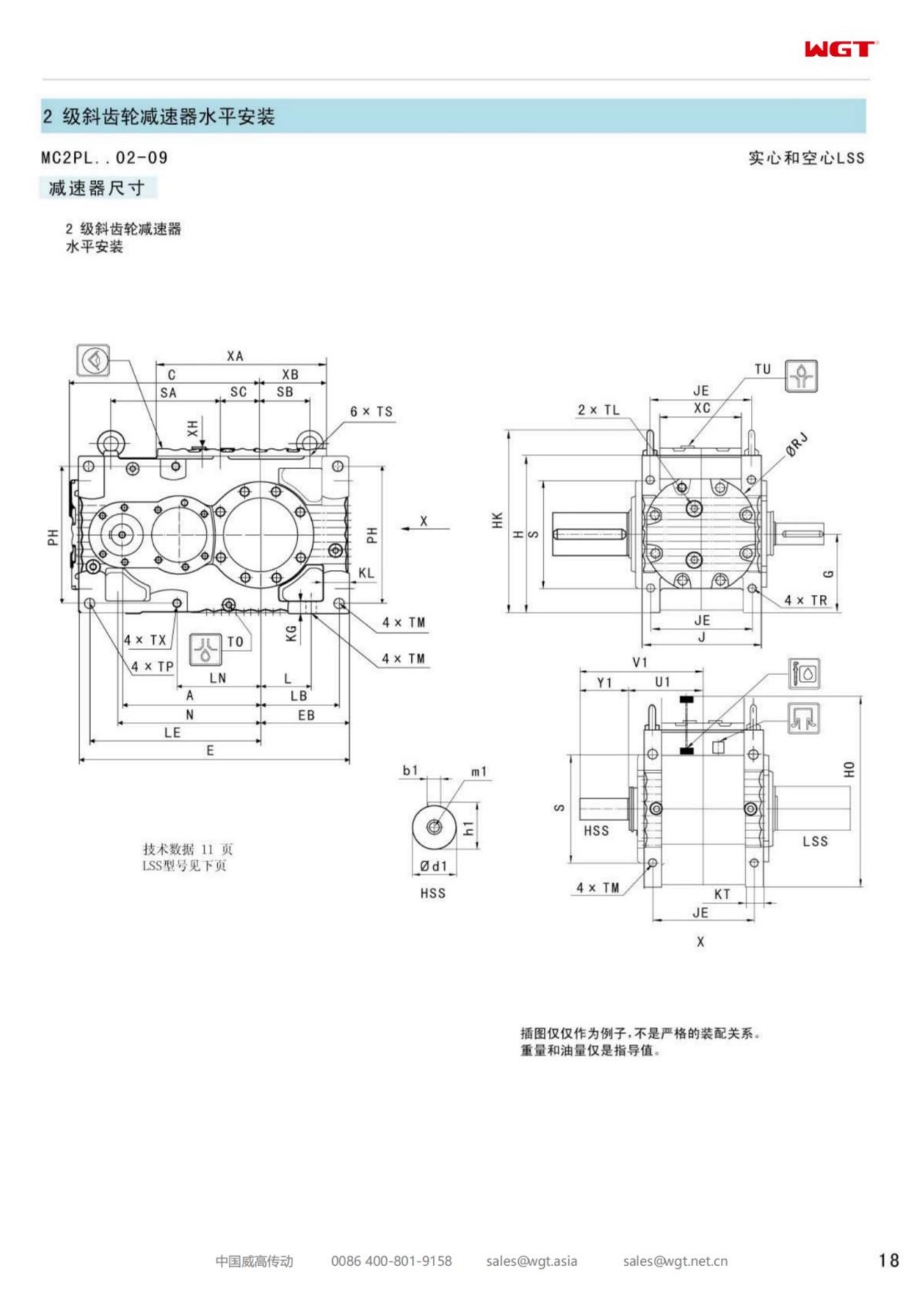
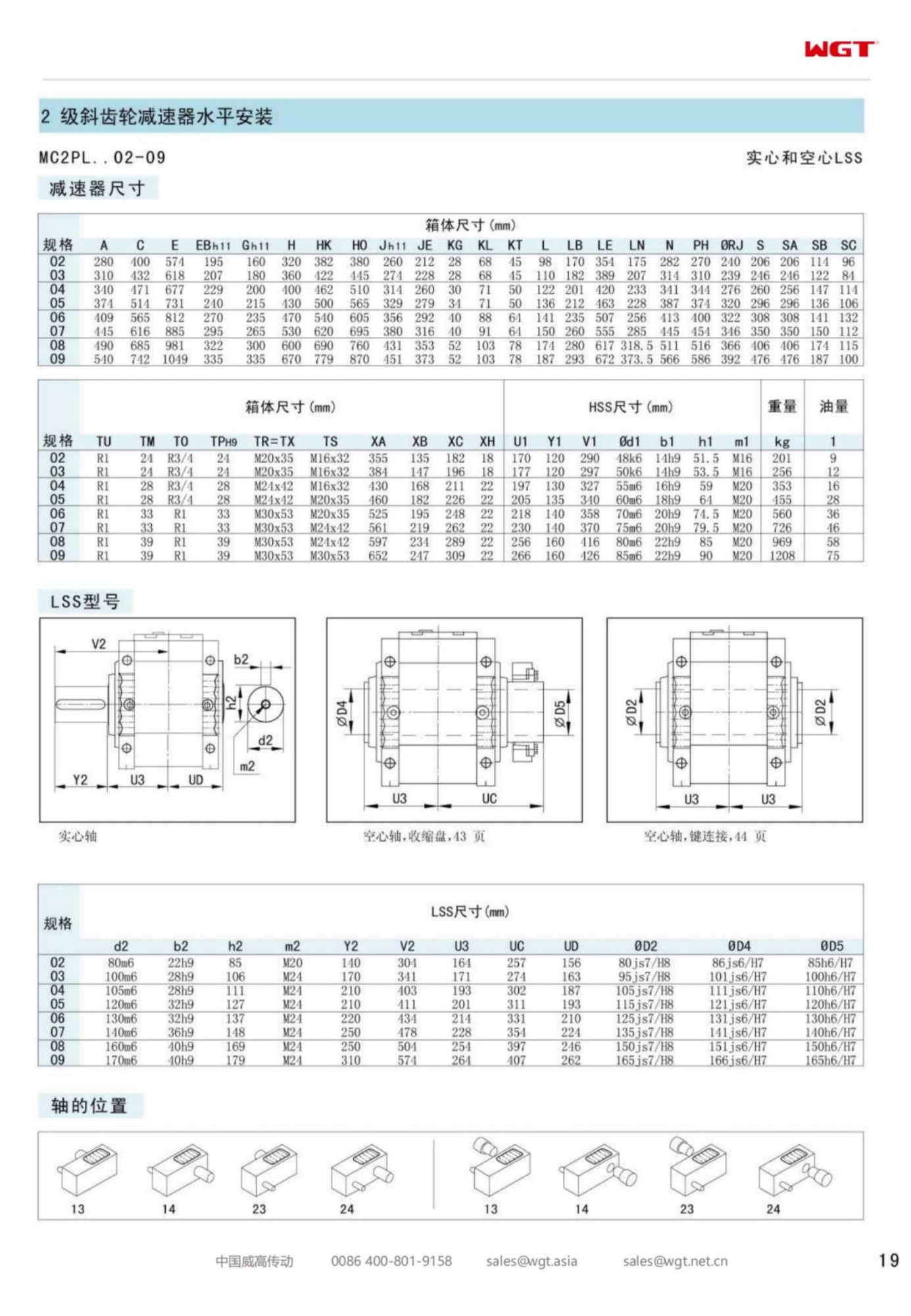
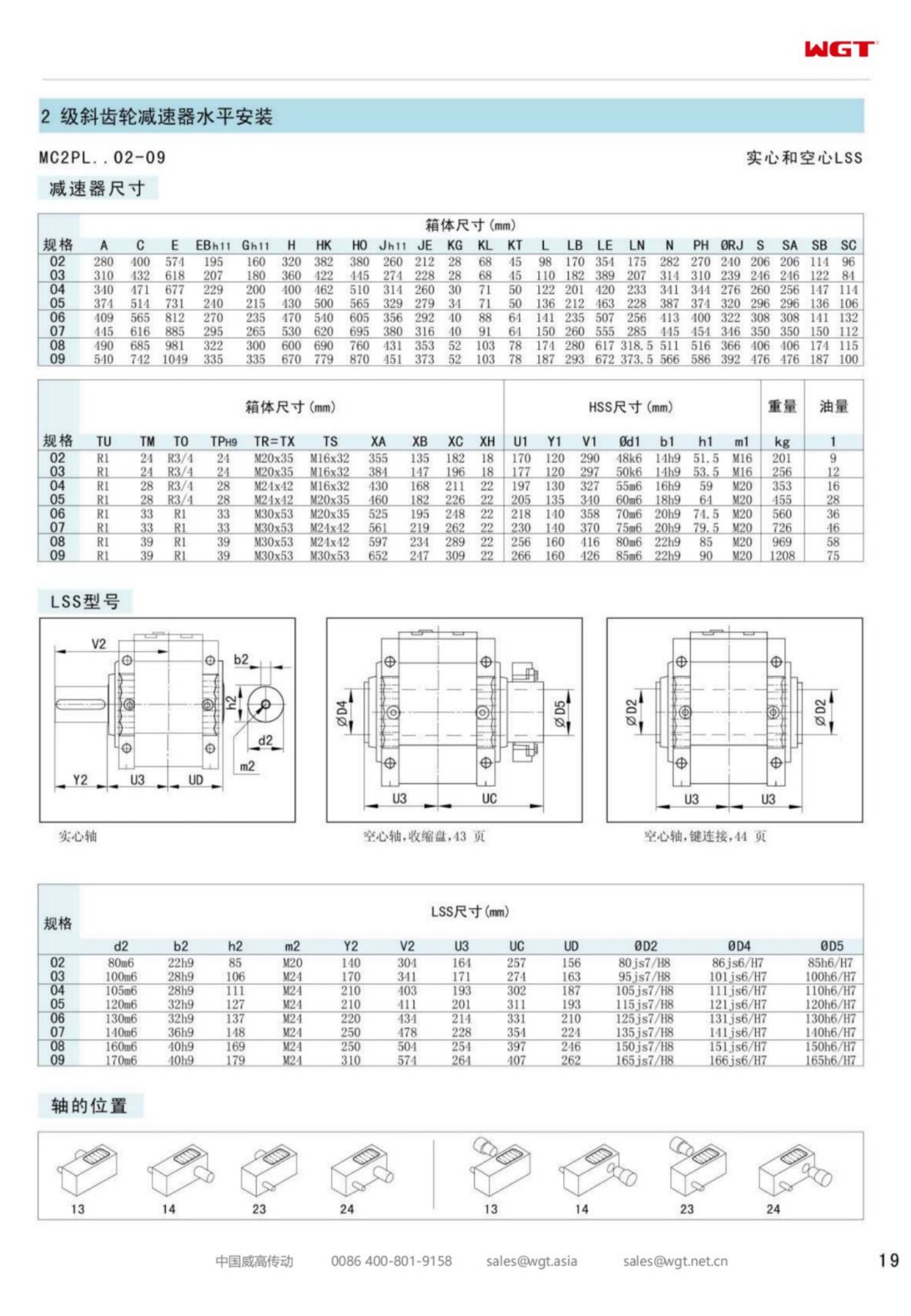
Every gear family has a quiet order to its frames, and by the sixth of them the catalogue has stopped describing machines and started describing plants. The MC2PLHF06 parallel shaft helical gearbox sits at the big end of the two-stage band: two helical stages in one horizontal plane, a footed case that takes up floor space honestly, and a hollow output bore that still does the thing that defines the line - it drops over a shaft that is already there, and the drive is made without adding a coupling to maintain.
What the sixth frame trades for its torque is simply size. Everything a crew knows from the smaller hollow-bore units carries over - the mounting sequence, the end plate, the torque arm, the oil routine - but the weights double, the bores widen, and the lifting plan stops being a formality. This is a frame for drives that run the plant's main material flow, where the cost of a stoppage has long outgrown the cost of the gearbox.
The Big End of a Two-Stage Band
A two-stage train holds an honest span of ratios, and the sixth frame sits near the upper boundary of what two stages can carry with good contact and reasonable wheel sizes. Below this point, most duties fit the line without strain; above it, three stages begin to earn their extra mesh. Knowing which side of that boundary a duty falls is the whole selection question, and it is answered by torque and hours rather than by preference.
The practical signature of the big end is headroom. A duty that runs this frame at a relaxed load factor leaves margin for jams, sticky starts and the slow growth of a process that always arrives a year after the gearbox is ordered. Sizing the sixth frame with that growth in mind is not generosity; it is how the plant avoids buying the same project twice.
What the Wider Centres Buy
As the frames climb, the distance between shaft centres grows, and everything benefits from that room. Bearings sit further apart and carry the mesh loads with less angle error. Gear wheels get wider and turn slower for the same output speed. The case ribs spread over a larger panel, and the sump holds enough oil that a shift of load swings barely ripples the running temperature.
The same room has a site-side benefit that rarely gets mentioned: access. There is space to reach the end plate bolts, to read a thermometer without undressing the drive, and to fit the torque arm without working through a hatch. On a machine intended to run for twenty years, that access is maintenance policy, not comfort.
The Plate, Decoded Once More
The type string reads the same way as every unit in the family, and a purchasing clerk can translate it with the same table - only the last character has changed.
| MC | Industrial multi-stage gear unit family |
| C2 | Compact two-stage parallel-shaft series |
| P | Parallel stages in a single horizontal plane |
| L | Horizontal build, feet flat on the plinth |
| H | Hollow output bore over the driven shaft |
| F | Foot mounting with holding-down bolts |
| 06 | Sixth frame - the big end of the two-stage band |
Two consequences follow from the H and the F together on this frame. The hollow bore means the driven shaft is machined to the bore drawing while the unit travels, so the drawing request belongs in the first letter, not the last. And the feet mean the plinth work - pockets, level, grout - is civil time that starts weeks before the crate arrives. Both are calendar items, and both are cheap when they are started early.
Guarding a Shaft That Carries Its Own Gearbox
A hollow-bore drive turns a plain line shaft into a guarded machine, and the guarding has to follow it. The rotating assembly now includes the case, the end plate and the torque arm, and any guard that was drawn for a bare shaft and a coupling no longer covers the real geometry. The guard belongs on the machine's structure, not on the gearbox case, so that removing the unit for bench work never removes the protection the shaft still needs.
Access windows are part of the design: a guard that must be unbolted completely for every temperature reading will be unbolted once and left off. Hinged panels, captive fasteners and a clear sight line to the sight glass cost little at fabrication and return their price in the first month of rounds. On this frame the guard also carries weight - it is big enough to need a hinge worth having.
Duties the Upper Frames Absorb
The upper frames and the work that finds them:
- Overhead chain conveyor drives along a foundry finishing line
- Limestone feeder drives under a power station raw coal bunker
- Screw reclaim conveyors at a salt processing works
- Cooler and clinker feeder drives at a small cement line
- Head shafts of raw juice elevators at a sugar mill
- Transfer car and turntable drives at a steel service centre
The common thread is a heavy, slow line shaft doing the plant's main flow, with a position where a low parallel build fits the structure better than any right-angle or shaft-mounted arrangement would. The sixth frame gives those machines the torque they need while keeping the mounting a slide-and-bolt job.
Oil Volume and the Summer Ceiling
A case this size holds a serious quantity of oil, and that volume changes the thermal story. The big sump buffers short overloads the way a flywheel buffers shock - the temperature needle barely moves across an afternoon of hard running. But the same mass holds heat, and a unit that has been pushed past its rating for a day does not cool back to baseline in an hour. The summer ceiling - ambient at the drive's own position, in the hottest week, with the machine at full duty - is the number that decides whether the standard case is enough or a fan or coil belongs on the order.
Change intervals stretch with volume, but never beyond the maker's figure, and the sample bottle stays annual. Oil in a big, slow case rarely fails by wear-out; it fails by water, dust or the wrong grade poured by a helpful contractor. The label on the fill point is a specification, not a suggestion.
Commissioning a Large Two-Stage Unit
The commissioning sequence for this frame is the small unit's list with more hands on it. Oil level verified cold, on the level, at the right port. Rotation checked by hand where possible and then by a bump of the motor against the declared direction. Backstop confirmed against the runback arrow if the order carried one. Torque arm pinned at both ends at the drawn angle, and the anchor structure inspected for the stiffness the drawing assumed.
Then the load comes on in stages. A first hour at part duty with the thermometer and the ears working, a note of the temperature at every quarter hour, and a look at the shaft fit after the first full day. The unit that starts its life with a written baseline gives every later year of rounds something solid to compare against.
The Spares Shelf for a Line of Units
Plants that standardise a hollow-bore line across several frames learn to keep one spares shelf that serves them all. Seals for the common bore sizes, the end plate gaskets, breather caps, sight glasses and a stock of the correct oil grade cover ninety per cent of first-line work. What does not go on the shelf is optimism about bearings: a bearing for this frame is a planned order with the maker's designation on it, bought against the unit's serial, not whatever the local counter has in a drawer.
The shelf earns its place during a shutdown, when the difference between a forty-minute seal renewal and a two-day wait is a part that was bought a year before anyone needed it. One audit of the shelf per year, against the actual units on site, keeps it honest.
Vibration Points and What They Say
On a frame this size, vibration readings earn their keep, and the measurement points decide their value. Case points close to each bearing housing, taken radially and axially, taken at the same spot with the same transducer every visit - that discipline is what turns a string of numbers into a trend. The mesh frequency of a two-stage train is known from the tooth counts and the speed, so a line that grows there points at the gears; a line at shaft frequency points at the rotating fit; broadband noise that rises with load is the case answering for looseness somewhere.
The readings are cheap; the discipline is the whole cost. A route sheet with fixed points and a baseline from commissioning week makes the sixth frame just another machine on the route - and a machine that announces its problems a season early.
An Enquiry Shaped for the Big Frames
An enquiry at this level is quoted well when it carries the plant's worst hour and the shaft's true dimensions together. Driven machine, load pattern, jam and stall conditions; motor power, speed and starting method; output speed and the tolerance the process accepts; hours per day across a real week and the summer ambient at the drive's position. Then the fitting facts: bore and keyway, usable length, shoulder, torque arm side and anchor point, rotation direction, backstop yes or no in writing, and the guarding arrangement the site intends to build.
With those lines filled, the reply is a firm quotation and an outline drawing the machine shop can schedule from. The sixth frame is not a complicated purchase; it is a large one, and the difference between an easy project and a slow one is usually one missing dimension on day one.
Selection Example: Overhead chain conveyor drive along a foundry finishing line
Take an 18.5 kW motor at 1465 rpm turning the overhead chain at 38 rpm. The ratio follows directly: 1465 / 38 = 38.6, so a ratio near i=39 is drawn from the two-stage band, and the frame is checked against the dust-laden foundry air - breathing, sealing and the annual oil sample all carry that duty. In this case the sixth frame runs that duty with thermal room in hand at the big end of the band, and the hollow bore drops over the line shaft from a footed case that leaves the guarding to be built on the machine structure. The same three numbers - motor speed, target output speed, required torque - are all you need; our engineers (or the online selector below) cross-check the service factor for your duty cycle.
![gear reducer selection flow chart - ratio and frame size]()
Figure: from motor data to a confirmed gearbox model in four steps.
Common Models in the M3 Series
| Model | Centre distance | Output | Typical duty |
|---|
| M3PSF50 | size 50 | solid shaft, foot | conveyors, feeders |
| M3PSF60 | size 60 | solid shaft, foot | crushers, mixers |
| M3PSF70 | size 70 | solid shaft, foot | ball mills, shredders |
| M3PSF80 | size 80 | solid shaft, foot | kilns, heavy conveyors |
| M3PSF90 | size 90 | solid shaft, foot | mill and kiln drives |
| M3RSF50 | size 50 | solid shaft, foot, right-angle | inclined conveyors, elevators |
| M3RSF60 | size 60 | solid shaft, foot, right-angle | screw classifiers, feeders |
| M3RHF70 | size 70 | hollow shaft, foot, right-angle | agitators, drum drives |
| M3PHT80 | size 80 | hollow shaft, torque arm, parallel | shaft-mounted conveyors |
| M3RHT90 | size 90 | hollow shaft, torque arm, right-angle | heavy shaft-mounted drives |
The table below shows the M3 industrial range: P builds are all-helical on parallel axes, R builds add a bevel input stage for a right-angle drive; S / H describe the low-speed shaft and F / T the mounting.
Application Cases
Ship loader slew drive
A port terminal selected heavy-duty gear units for the travel drives of its ship loader. Salt-laden air is handled by the heavy-duty coating option, and spare seal kits are held on site for the annual service.
Sugarcane carrier drive
A sugar mill drives its cane carriers with industrial gear units sized for fully loaded starts. The generous torque margin covers cane jams, and the right-angle build keeps the motor clear of the carrier slat path.
![industrial gearbox applications - conveyor mixer crusher wastewater]()
Figure: typical industries that use the WGT S-series gear reducers.
Frequently Asked Questions
Can I reuse my existing couplings and foundations?
Yes. Centre distances, shaft dimensions and flange bolt patterns follow the common industry standards, so couplings, guards and foundations do not have to be redesigned. Send the nameplate details and we confirm the equivalent frame in writing.
Can the reducer be used outdoors or in a washdown area?
Standard paint and NAK seals suit sheltered outdoor duty. For washdown or coastal sites specify the heavy-duty coating, FKM seals and stainless fasteners; for humid rooms we recommend the breather and oil-check routine in the manual.
What if the ratio I need falls between two catalogue steps?
Choose the next available step and adjust the driven speed, or ask us for a special pair of gears. Trimming the driven machine is normally cheaper than ordering a special ratio, and a slightly higher ratio never hurts the drive.
Drawings, Ratings and Test Records on Request
Need the paperwork first? Not sure which model fits? Try our online WGT Motor & Gearbox Online Selection System to match motor power, ratio and mounting in one minute.
We issue dimension drawings, rating tables and sample test records in English for your approval package, before the order is placed. Engineering and purchasing sign-off without delays. Looking for a gearbox for crusher? Tell us the duty point and we will confirm the model in writing.