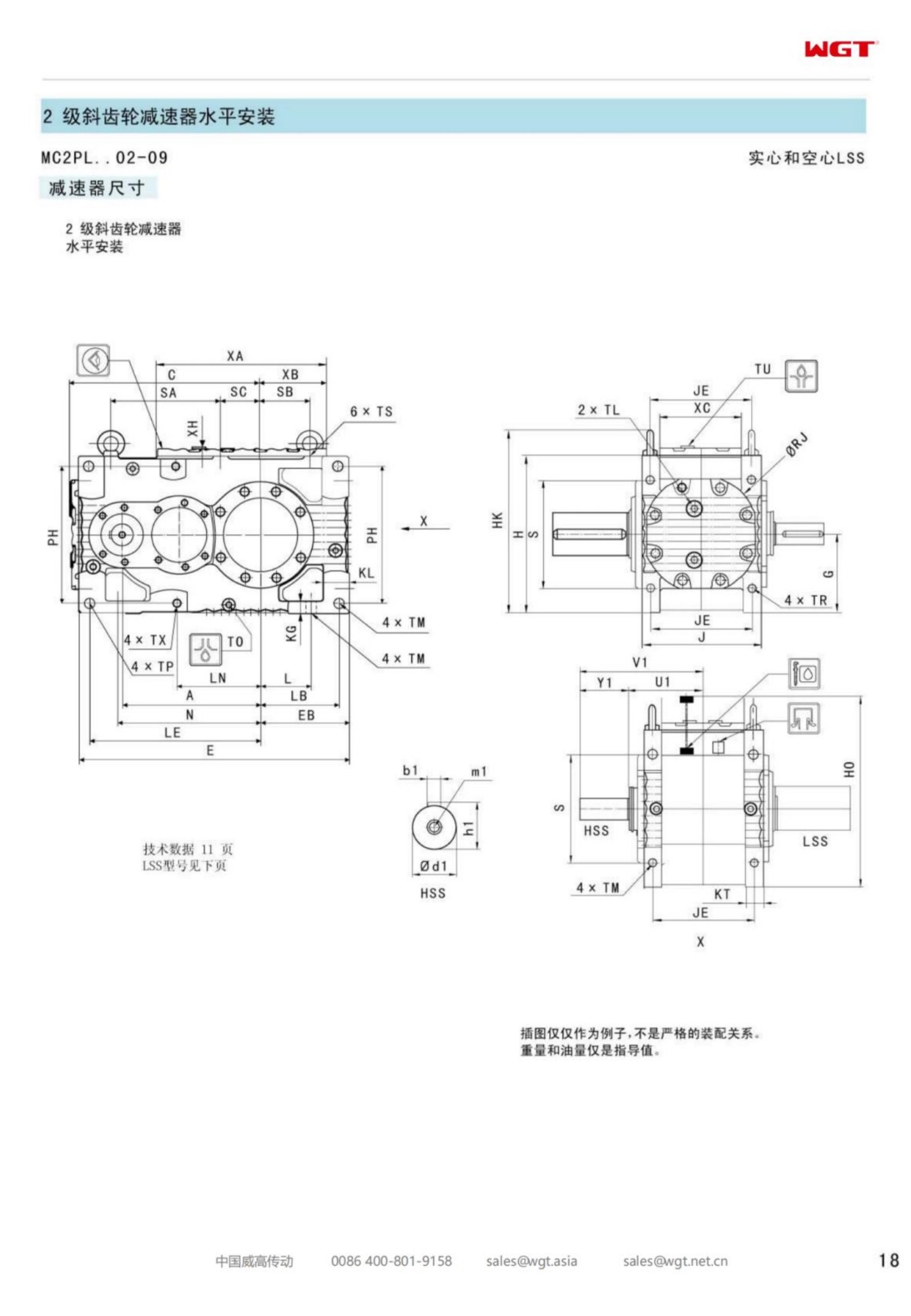
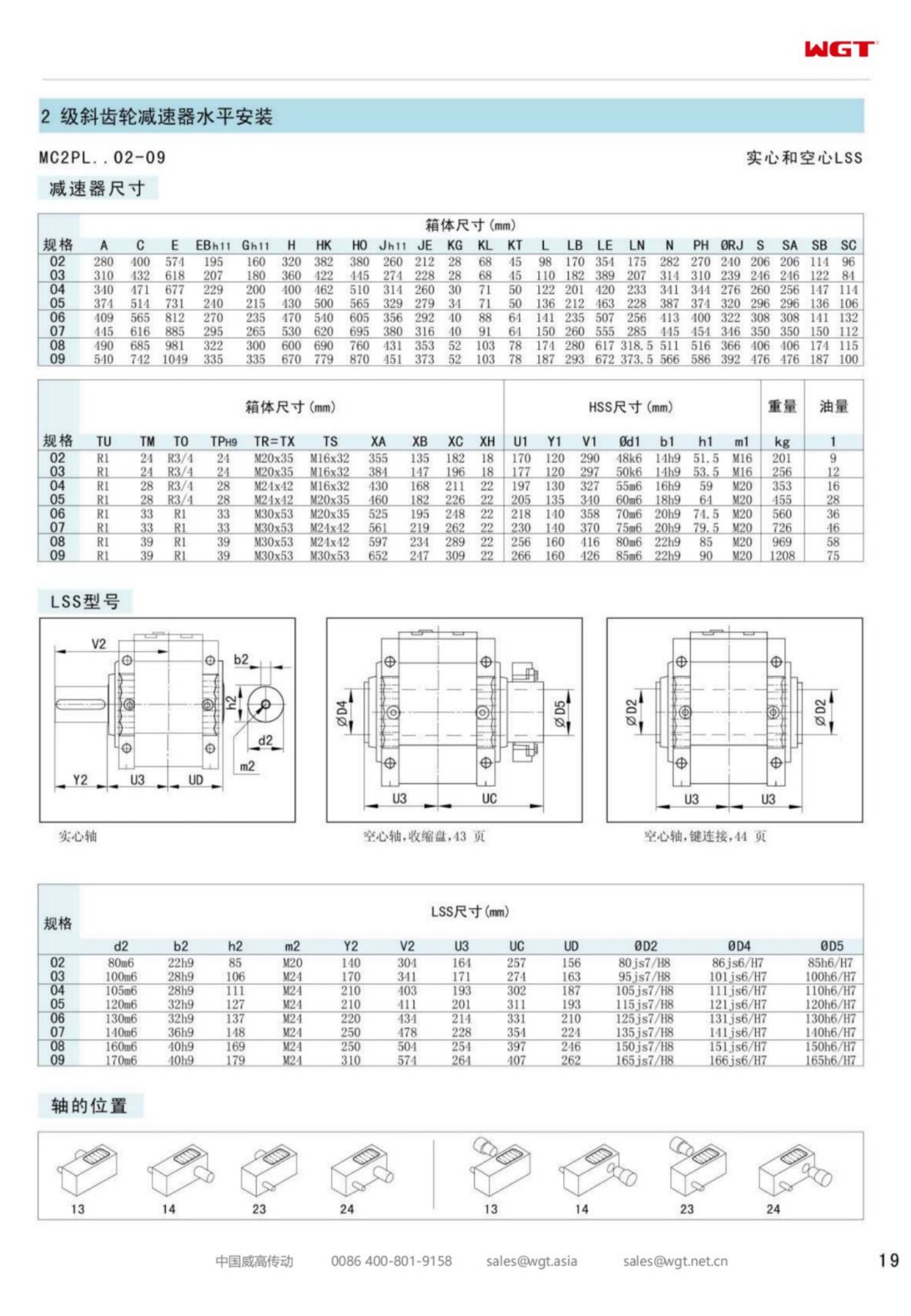
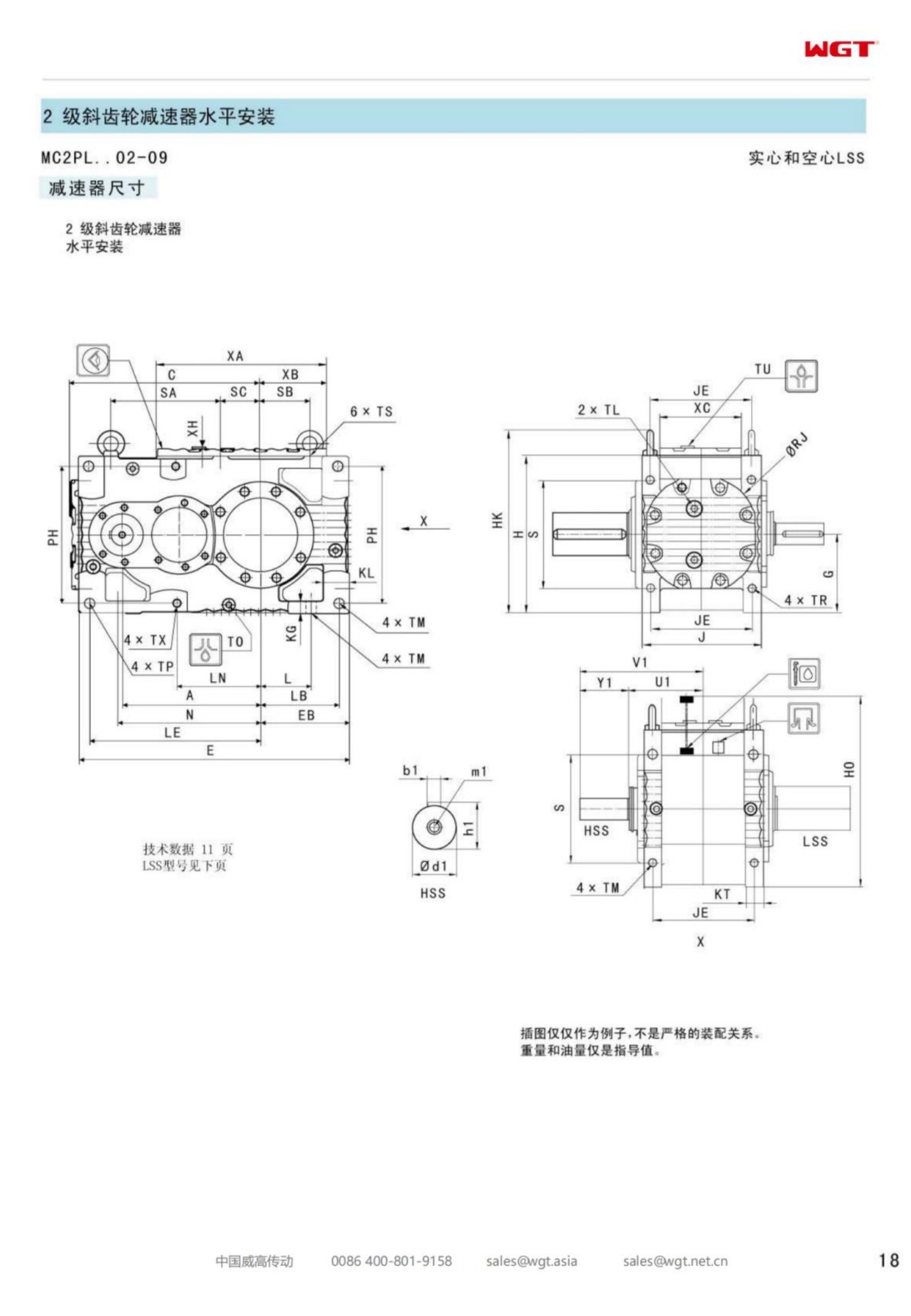
At the top of a hollow-bore parallel line, the questions change. The MC2PLHF05 parallel shaft helical gearbox still slides over the driven shaft like every frame below it, but the torques it carries, the shafts it accepts and the machines it drives are of a different order. This is the frame for a plant's main conveyors, its heavy mixers and the machines whose stoppage the whole shift notices within minutes.
Nothing in the layout has moved from the frames below - two helical stages in one plane, feet on the plinth, motor alongside, torque arm out to the structure. What has grown is everything the torque passes through: case section, bearing centres, bore diameter, sump depth. A crew that knows the line will recognise every feature. They will simply need better lifting gear to reach it.
Handling and Lift Points
A fifth-frame unit is moved by crane, and the crane plan is written before the unit leaves the store. Lifting points are the eyes or lugs the maker provides, used with slings at sane angles or with a spreader beam when the geometry asks for one. The unit is never lifted by the output bore, the input shaft or the cooling tubing, and it does not travel balanced on the corner of a forklift tine because the correct forks were on another truck.
Most transit damage on units this size happens in the last fifty metres, not the first five hundred. A bore dented by a chain, a machined foot scored against a plinth edge, a cast eye used as a tie-down - each is avoidable with half an hour of care, and none of them is visible in the crate. Unpack with the fitting sheet open and inspect the machined faces before the unit leaves the pallet it arrived on.
The Nameplate and the Lift Plan
The type string on the plate is short, and every character in it feeds either the lift plan or the machining order for the driven shaft.
| MC | Industrial multi-stage gear unit family |
| C2 | Compact two-stage parallel-shaft series |
| P | Parallel stages - shafts in one horizontal plane |
| L | Horizontal build on feet |
| H | Hollow output bore mounting over the driven shaft |
| F | Foot mounting with holding-down bolts |
| 05 | Fifth frame - the top of the hollow-bore band |
The H is the character with a lead time attached. The driven shaft is machined to the bore drawing while the unit is in transit, so the drawing request belongs in the enquiry and the machining slot belongs on the shutdown schedule. Plants that treat the shaft as a day-one item commission on the planned day; plants that treat it as a fitting-day discovery hand the schedule to a lathe queue.
Heavy Starts and the Service Factor
Machines at this frame size rarely start light. A trunk conveyor may begin its day loaded from head to tail; a mixer may break through settled material every time the batch changes. These events decide the frame more than the running load does, which is why the service factor is chosen from the duty class - the starts, the jams, the reversals, the stops per hour - and never from the ratio alone.
Starting method belongs in the conversation too. A soft start or a variable drive shapes the torque spike and lets the frame work closer to its steady rating; a across-the-line start hands the motor's full breakaway torque to the train and asks the gears to take it as designed. Both are legitimate. The specification only has to say which one the site intends to use, because the difference is a frame size in the wrong direction when it is guessed.
Driven Shafts Worth This Frame
The bigger bores and the machines that ask for them:
- Main trunk conveyor drives at a quarry pit head
- Raw meal and clinker drag chain conveyors in a cement works
- Heavy pug mill drives at a clay brick works
- Log and chip reclaim conveyors at a wood yard
- Sludge cake conveyor drives at a large treatment works
- Breaker and feeder drives under a primary crusher house
What these duties share is weight, consequence and a shaft that is already there. Mounting the unit over the shaft removes a coupling from a drive that cannot afford one more joint to maintain, and the fifth frame gives the machine the reserve its worst hour demands.
Foundations, Bolts and First Alignment
At this size the foundation does real work, and its preparation is the project's quiet critical path. The pad is finished flat to the drawing, bolt pockets are set out and grouted to level before the unit travels, and the holding-down bolts are pulled in the specified sequence to the specified torque. The first thermal cycle after commissioning relaxes every joint on the machine, so the re-torque and the level re-check are part of the installation, not an optional extra.
The torque arm's anchor point gets the same respect. It belongs on primary structure, sized for the reaction with margin, and it is checked for deflection the way a beam is checked - because a soft anchor turns a correctly fitted arm into a vibration source that no amount of re-shimming the feet will cure.
Thermal Life on Long Shifts
A frame chosen for round-the-clock duty lives or dies by its thermal margin. The rating table assumes a stated ambient and a stated duty cycle, and the two figures most often misjudged are summer ambient at the drive's actual position - inside a gallery is not the same as the general works reading - and the true hours of loaded running per day. Checked honestly, the fifth frame usually has the margin. Checked generously, it does not, and the oil tells the truth by August.
The routine is short: temperature read at the same point each visit, trended against the commissioning baseline; an oil sample each year, trended the same way; and any change investigated while it is still a number in a log rather than a bearing in a crate. Long-shift machines reward exactly this dullness, and punish improvisation, without exception.
The Bore at Full Torque: Fits and Contact
A hollow bore carrying serious torque concentrates its work in a short length of steel-to-steel contact, and the quality of that contact is decided before fitting day. The bore's surface finish, the shaft's finish within its tolerance band, the keyway's width, depth and squareness, and the shoulder's perpendicularity to the shaft axis are inspection items with numbers attached. A fit made carelessly does not usually fail at once; it frets, and fretting announces itself as rust-coloured dust at the bore mouth and a knock that grows with every month.
On the first planned withdrawal, inspect the bore and the shaft fit under good light. Polished, even contact is the target. Bright scoring at one edge says the shoulder let the unit tilt; dust at the keyway says the key is working in its seat. Both are corrected cheaply at the first withdrawal and expensively at the third.
The Monitoring Round for a Key Machine
Units at this level justify a place on the plant's route-based monitoring, and the round is simple: a temperature reading, a listening check, a glance at the sight glass and the breather, and an oil sample on the annual visit. Where vibration routes exist, the unit takes its measurement points on the case near the bearing positions, and the history accumulates like any other machine on the route.
The value of the round is not any single reading but the pattern. Gearbox deterioration is nearly always gradual, and a drive watched monthly gives months of notice. A drive visited only when something sounds wrong gives one notice, and it is usually delivered during a shift that had other plans.
Withdrawal, Bench Attention and Return
Planned withdrawals are part of this frame's life, and the design anticipates them. The end plate provides the puller provision; the withdrawal sequence is the fitting sequence in reverse; and the moment the unit leaves the shaft, the exposed fit is greased, wrapped and capped. Bench attention - seal renewal, gasket work, an oil change - happens with the unit supported properly and the bore protected throughout.
On return, the bore and shaft fit are inspected as at first fitting, the key is seated square, the unit slides home against the shoulder, and the assembly closes exactly as the fitting sheet describes. A unit that came off for seals should go back on looking factory-fresh at the fit; anything less is a defect carried forward into the next service interval.
Quoting the Fifth Frame
A fifth-frame enquiry is quoted cleanly when the worst hour travels with the average one. Driven machine and load pattern, with stall, jam and runback conditions named in writing. Motor power, speed and starting method - soft start, variable drive or across the line. Output speed and tolerance. True hours per day across a real week, and the summer ambient at the drive's own position. Then the fitting facts: shaft diameter, keyway, usable length and shoulder dimension; torque arm side and anchor structure; rotation direction; backstop yes or no; and the documentation the project file expects.
Complete, the enquiry returns a firm quotation, an outline drawing the machine shop can cut from, and a delivery date the shutdown can be planned around. The frame is straightforward heavy machinery - the only thing that has ever made it complicated is an enquiry that stopped halfway.
Full Frame Range of the M3 Series
| Model | Centre distance | Output | Typical duty |
|---|
| M3PSF50 | size 50 | solid shaft, foot | conveyors, feeders |
| M3PSF60 | size 60 | solid shaft, foot | crushers, mixers |
| M3PSF70 | size 70 | solid shaft, foot | ball mills, shredders |
| M3PSF80 | size 80 | solid shaft, foot | kilns, heavy conveyors |
| M3PSF90 | size 90 | solid shaft, foot | mill and kiln drives |
| M3RSF50 | size 50 | solid shaft, foot, right-angle | inclined conveyors, elevators |
| M3RSF60 | size 60 | solid shaft, foot, right-angle | screw classifiers, feeders |
| M3RHF70 | size 70 | hollow shaft, foot, right-angle | agitators, drum drives |
| M3PHT80 | size 80 | hollow shaft, torque arm, parallel | shaft-mounted conveyors |
| M3RHT90 | size 90 | hollow shaft, torque arm, right-angle | heavy shaft-mounted drives |
Every frame in the table can be ordered with alternative shaft and mounting styles. If you are matching an existing installation, send the nameplate details and we confirm the equivalent frame in writing.
Installation Snapshots
Steel mill transfer car
A rolling mill drives its slab transfer cars with industrial gear units mounted on torque arms. Reversing duty every few minutes is handled without complaint, and the hollow-shaft connection keeps the wheel axles free of couplings.
Rotary dryer drive
A minerals processor powers a rotary dryer with a large foot-mounted gear unit. Slow rotation with high torque is the natural duty band, and the housing stays within its temperature limits without auxiliary cooling.
Selection Example: Drag chain conveyor drive at a wood panel mill
Take a 30 kW motor at 1470 rpm driving the chain at 36 rpm. The ratio follows directly: 1470 / 36 = 40.8, so a ratio near i=41 is drawn from the two-stage band, and the frame is checked against a restart with the return flight loaded after a jam has been cleared by hand. In this case the fifth frame carries that restart with genuine reserve, and the hollow bore mounts over the head sprocket shaft so chain tension can be taken up without moving the gearbox. Use the same method for any frame in the series, then confirm the service factor with us - it is the one number buyers most often get wrong.
![speed reducer selection process diagram]()
The selection path we follow when checking your enquiry.
Technical Q&A
Do you offer a version with an integrated gear motor?
We can supply the unit as a complete gear motor with an IEC motor bolted on and tested as one assembly. That saves you the alignment and coupling work, and the whole assembly carries the same one-year warranty.
How do I know when the unit needs maintenance?
Beyond routine oil checks, watch for oil weeping at the seals, unusual noise or vibration, and any rise in housing temperature. A seal kit is inexpensive; catching a weeping seal early avoids damage to the bearings and gears.
![speed reducer use cases across sectors]()
Typical installation environments for this gearbox family.
OEM Framework Pricing and Reserved Capacity
Building machines in series? One screen in the WGT Motor & Gearbox Online Selection System is usually enough to pin down the frame size; we confirm the service factor afterwards.
For OEM programmes we hold framework prices and reserve production slots for scheduled call-offs, so your line never waits on a gearbox. Ask for the framework terms with your first enquiry. Looking for a gear reducer for food processing machine? Tell us the duty point and we will confirm the model in writing.