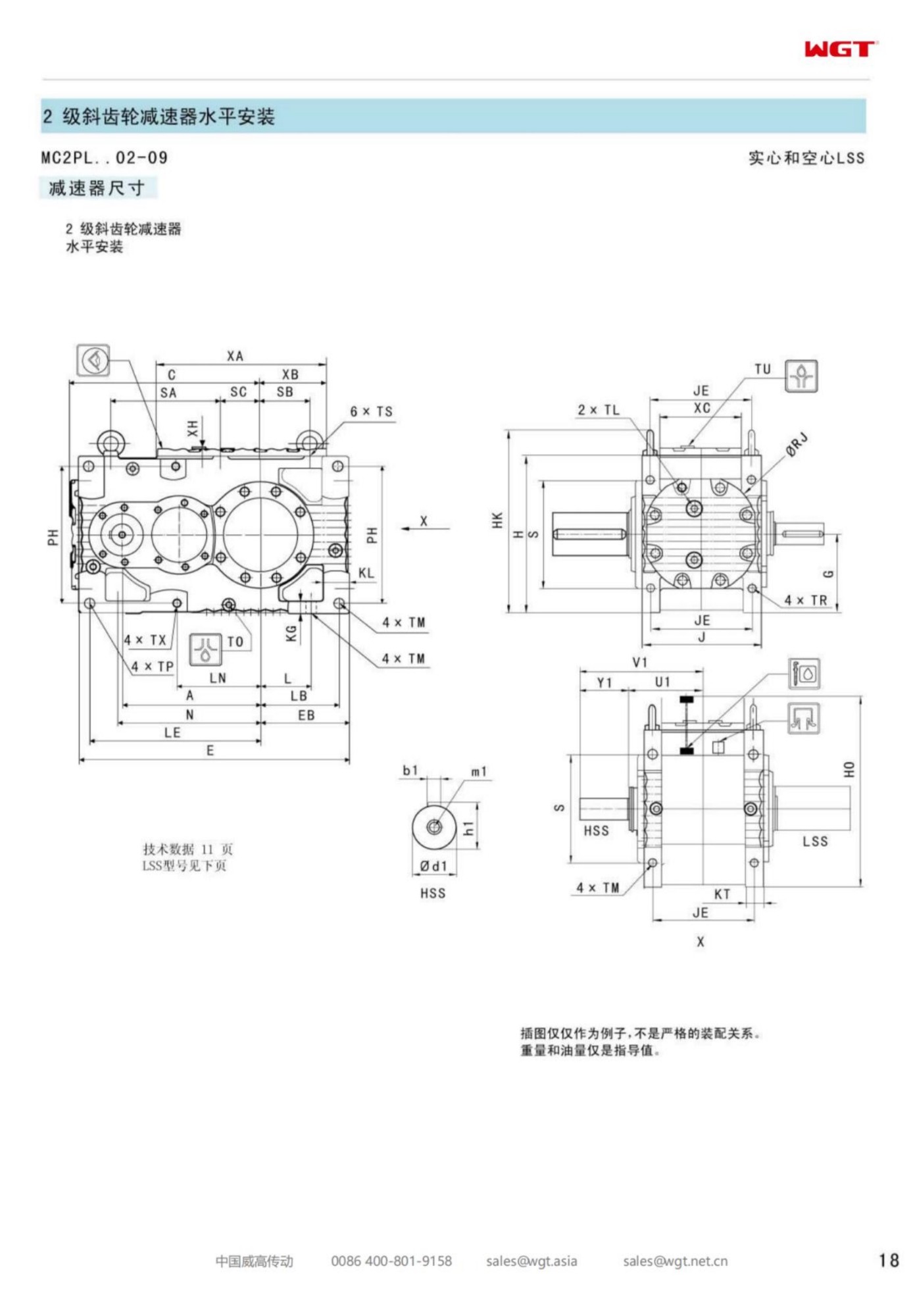
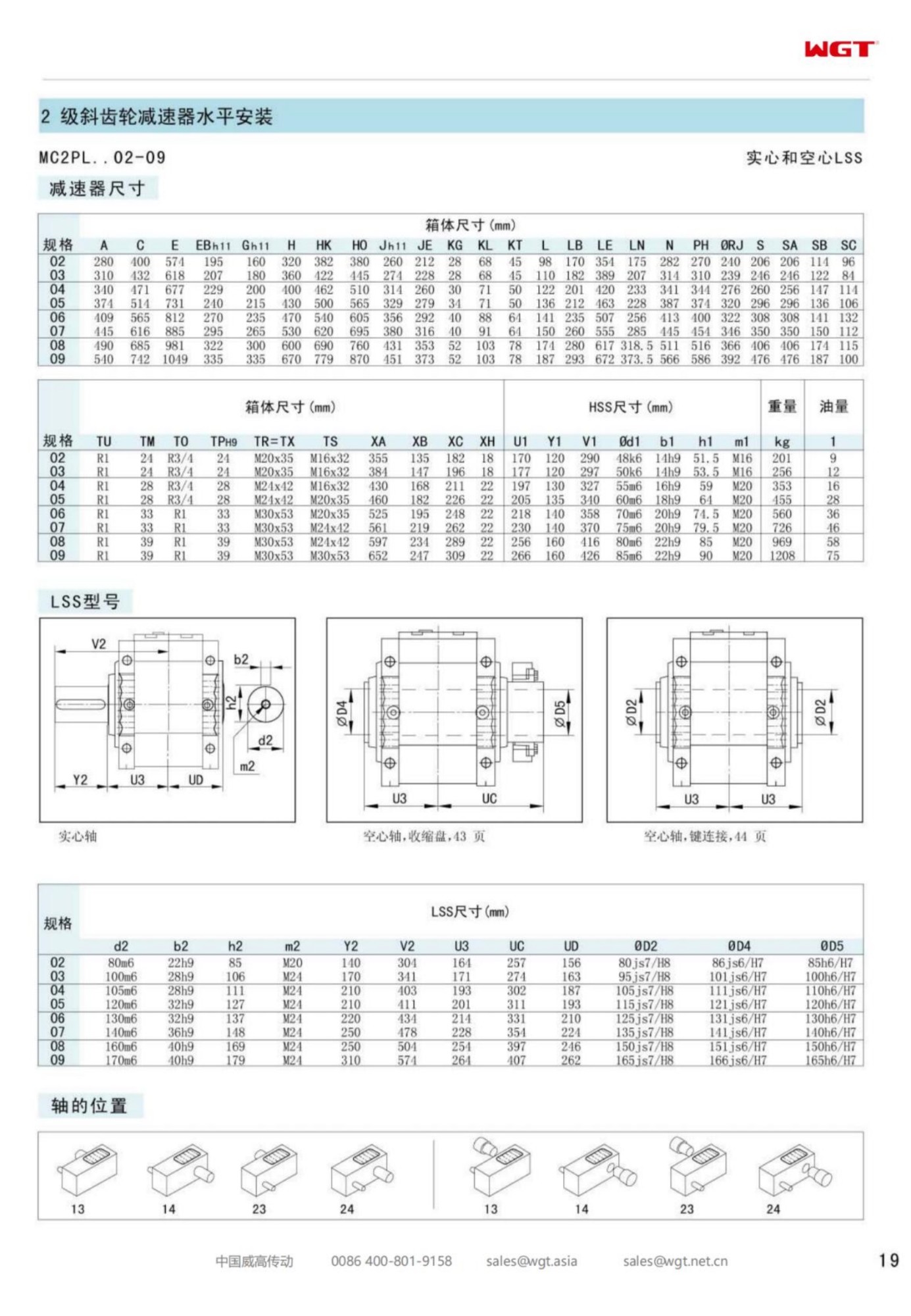
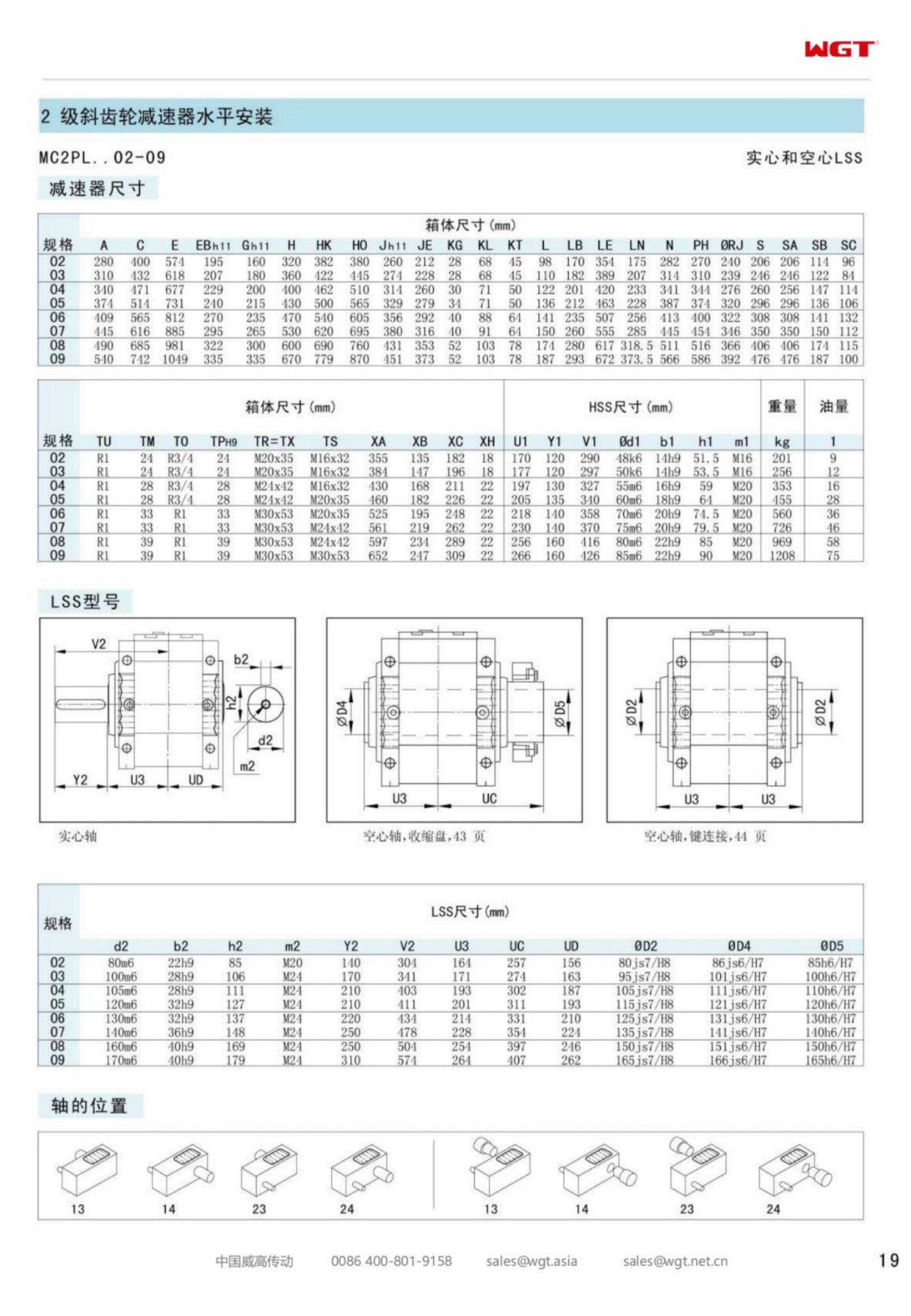
Every hollow-bore parallel line has a frame where the duties stop being light, and on this family that is the MC2PLHF03 parallel shaft helical gearbox. The layout is unchanged from the frame below it - two helical stages in one plane, a footed case, a hollow output that mounts over the driven shaft - but the 03 casting carries more torque at the same ratio band, takes a larger driven shaft, and holds a deeper sump. It is the frame plants settle on when the screws get longer, the elevators get taller and the shifts get longer with them.
What the third frame buys, above all, is margin. A duty that keeps a 02 frame warm on a continuous shift runs on a 03 with room to spare, and that difference is what absorbs the start-up peaks, the occasional jam and the slow torque creep that comes when a process adds tonnage over the years. The footprint grows only modestly, so the larger frame often fits in the same space the smaller one occupied.
One Frame Up, the Same Mounting Logic
The 03 keeps everything that makes the hollow-bore line easy to live with. The unit still slides over the driven shaft, so there is still no coupling to align, no spacer to store and no joint to guard. The torque arm still takes the reaction. The feet still bolt to a plinth that the machine builder has usually already prepared for the series.
What changes is the scale of the fit. The bore is larger, the driven shaft is heavier, and the handling deserves a second pair of hands or a light hoist rather than muscle. The fitting sequence is identical to the smaller frame's - offer up, slide home against the shoulder, close the end plate, level the feet, set the torque arm - and a crew that has fitted a 02 will find nothing new except the weight.
The Letters on the Nameplate
Read in order, the type string on the plate answers the stores clerk's questions before the crate is opened, and one character in it decides the whole shape of fitting day.
| MC | Industrial multi-stage gear unit family |
| C2 | Compact two-stage parallel-shaft series |
| P | Parallel stages - shafts in one horizontal plane, motor alongside |
| L | Horizontal build, feet flat on the plinth |
| H | Hollow output bore - the driven shaft passes through and takes the torque |
| F | Foot mounting with holding-down hardware to the frame drawing |
| 03 | Third frame - the first with genuine continuous-duty margin |
The H in that string is why the driven shaft arrives as loose goods with the machine, not as part of the gearbox. The drawing that travels with the unit gives the shaft its dimensions, and the machine shop that works to it saves the project the classic delay: a gearbox on site, a shaft that does not fit, and a crane standing idle between them.
Margin, and Where the 03 Shows It
The reserve in the third frame shows itself in three ordinary situations. The loaded start - a screw buried under settled material, an elevator stalled with grain on the head - draws a torque spike a 03 shrugs off and a smaller frame survives unhappily. The jam that stops the machine entirely puts the motor's stall torque through the train, where the 03's gear faces and bearings take it as a design case rather than an accident. And the growth years, when a line's throughput creeps up shift by shift, are absorbed silently instead of being paid for in oil temperature.
None of this argues for oversizing every duty one frame. It argues for knowing which duties carry peaks and which do not, and putting the 03 where the honest answer is that the load sometimes pushes back.
Driven Shafts This Frame Suits
One frame up, where the hollow-bore line starts to carry real margin:
- Screw reclaimer drives across a gypsum store floor
- Sludge cake screw press drives at municipal waterworks
- Gallery belt conveyor drives between stringers at a cement plant
- Central column drives for small clarifier rake mechanisms
- Cooler and dryer drum drives at a minerals processing site
- Chip and bark screw feeds at a small panel-board mill
The common thread is a driven shaft that already exists and a drive position where a coupling would be a maintenance item for the machine's whole life. Mounting over the shaft turns that liability into a one-time fitting job, and the third frame's margin keeps the drive relaxed while it does it.
Shaft Preparation and Keyway Care
At this frame the shaft fit carries real torque, and the machining deserves real inspection. Diameter and tolerance are checked with a micrometer at two points on the fit; runout is checked near the shoulder; the keyway's width, depth and squareness are checked against the drawing rather than against the key that happens to be in the fitter's pocket. A key that is loose sideways in its seat will fret, and fretting at the key is the classic hollow-bore fault that shows up as a knock at every revolution.
The shoulder deserves its own look. It positions the unit axially and takes the thrust of every start; a shoulder that is out of square lets the unit sit slightly tilted, loads one end of the bore and announces itself later as seal wear on one side. Straightness, squareness and cleanliness cost nothing at the lathe and cannot be added afterwards.
End Float, Alignment and the First Run
Once the unit is home on the shaft, axial position is set by the end plate against the shoulder - but the driven machine's own bearings also have their float, and the two floats must not fight each other. The fitting sheet states the clearances; honouring them takes a feeler gauge and five minutes. Then the feet come down onto shims in a levelled, unforced sequence, and the torque arm is set at its drawing angle with both ends free of preload.
The first run is a listening job. A correct fit runs with a single even note; a knock at shaft frequency says key or bore; a rising whine says alignment or load. Twenty minutes of attention at commissioning, with temperatures and sound written down as a baseline, gives every later inspection something to compare against - and the comparison is what turns a vague impression into a planned repair.
Seals, Breathers and Dust
The positions this frame serves are rarely clean. Dust works into every joint, washdown water finds every lip, and the case breathes in whatever atmosphere surrounds it. The defence is ordinary and effective: seal lips inspected at every oil change, a breather sited out of the dust stream or upgraded to a desiccant type on wet positions, and flange paint kept unbroken so rust never starts under a gasket edge. A case that breathes dry air stays dry inside; one that inhales through a clogged or rain-filled breather will eventually show a milky sample no matter how sound the gearing.
Condensation gets particular respect in humid seasons, when the cooling case draws moisture in overnight. The breather is a maintenance item, not a fitting accessory, and the monthly walk that includes a glance at it is the cheapest insurance in the plant.
The Service Calendar
The routine that suits this frame is deliberately boring. Level checked cold on the monthly round. First oil change early in the unit's life, clearing running-in debris. An annual sample after that, trended year on year: water names a breather path, bronze names a mesh wearing faster than its share, a rising dust count names a seal or a breath path that has opened. Temperatures read at the same point each visit, against the commissioning baseline.
Because the frame shares oil grades, seal families and fasteners with the smaller units in the series, the calendar can be one routine across the whole plant's hollow-bore line. The store room holds one drum, one drawer of kits, and a crew that learned the drill once.
Spares Worth Holding
A small drawer covers the likely events of a decade: a seal kit against the frame number, a breather, a gasket set, a torque arm bushing, and a spare end plate hardware set. None of it is expensive; all of it turns a weeping seal from a shutdown into a round of the monthly walk. Plants that hold the drawer plan their maintenance; plants without it attend theirs.
The one spare that must not wait for a failure is the driven shaft's protection - grease, wrap and a cap for the exposed fit whenever the unit is withdrawn. A bore left open on a live shaft in a dusty plant collects exactly the wrong kind of history, and the next fitting will pay for it.
Sending the Enquiry
The third frame quotes cleanly when the duty and the fitting both travel with the request. Driven machine and load pattern, with stall and jam conditions named in writing. Motor power, speed and starting method. Output speed and the tolerance accepted. Hours per day over a real week. Ambient - dust, moisture, washdown - stated plainly. Driven shaft diameter, keyway and usable length with the shoulder dimension. Torque arm side, mounting position, rotation direction, and the documentation the project file expects.
Complete, that enquiry returns a firm quotation and an outline drawing the machine shop cuts the shaft from the same week. Thin, it returns questions, and each round of questions is a week the schedule had already spent. The 03 frame is straightforward machinery; a half-written enquiry is the only thing that ever makes it complicated.
How Customers Use This Unit
Airport baggage conveyor
An airport baggage-handling integrator uses reducers on check-in conveyors. Thousands of start-stop cycles a day are absorbed without overheating, and the low noise level matters in a public terminal.
Quarry primary crusher
A quarry operator fits industrial gear units on its primary jaw crusher feeders. The shock of rock dumped straight from the haul truck is covered by the service factor, and the cast-iron housing shrugs off years of dust and vibration.
What Engineers Ask Us
Do you supply spare parts such as seals and bearings?
Seal kits, bearings, output shafts and covers are available from stock or on short lead time. We keep the drawings for every unit we ship, so a replacement part ten years from now is still traceable to your original order.
How is each unit tested before shipment?
Every unit is run in on the bench before packing. Noise, temperature rise and backlash are recorded and the test sheet travels with the shipment, so you can file it with your incoming-inspection records.
Model Table: Frames, Shafts and Duty
| Model | Centre distance | Output | Typical duty |
|---|
| M3PSF50 | size 50 | solid shaft, foot | conveyors, feeders |
| M3PSF60 | size 60 | solid shaft, foot | crushers, mixers |
| M3PSF70 | size 70 | solid shaft, foot | ball mills, shredders |
| M3PSF80 | size 80 | solid shaft, foot | kilns, heavy conveyors |
| M3PSF90 | size 90 | solid shaft, foot | mill and kiln drives |
| M3RSF50 | size 50 | solid shaft, foot, right-angle | inclined conveyors, elevators |
| M3RSF60 | size 60 | solid shaft, foot, right-angle | screw classifiers, feeders |
| M3RHF70 | size 70 | hollow shaft, foot, right-angle | agitators, drum drives |
| M3PHT80 | size 80 | hollow shaft, torque arm, parallel | shaft-mounted conveyors |
| M3RHT90 | size 90 | hollow shaft, torque arm, right-angle | heavy shaft-mounted drives |
Larger size numbers mean higher torque capacity and larger shafts. Because interfaces follow the common industrial dimensions, a size-for-size change is the normal upgrade route for these industrial units.
Selection Example: Bucket elevator head shaft drive at a grain terminal
Take a 7.5 kW motor at 1450 rpm driving the head shaft at 62 rpm. The ratio follows directly: 1450 / 62 = 23.4, so a ratio near i=23 is drawn from the two-stage band, and the frame is checked against the snub load of a belt stalled full of grain at the head. In this case the third frame carries that stall with margin, and the hollow bore mounts over the head shaft from a footed case that keeps the elevator legs running true. Note that the ratio comes from speeds alone, while the frame size depends on torque and service factor - never size a unit on ratio only.
![industrial helical gearbox selection chart]()
A quick visual of the selection sequence for a industrial helical unit.
![M3 series gear reducer installation examples]()
Application coverage of the the M3 series.
Shutdown Planned? Order Ahead of the Window
Beat the shutdown window. Prefer to check the figures yourself? The WGT Motor & Gearbox Online Selection System gives you the model, torque margin and ratio before you ask us.
For planned maintenance windows we reserve production capacity and ship the unit ahead of the shutdown date, so the swap takes hours instead of days. Tell us the window and we work back from it. Looking for a speed reducer for bucket elevator? Tell us the duty point and we will confirm the model in writing.