


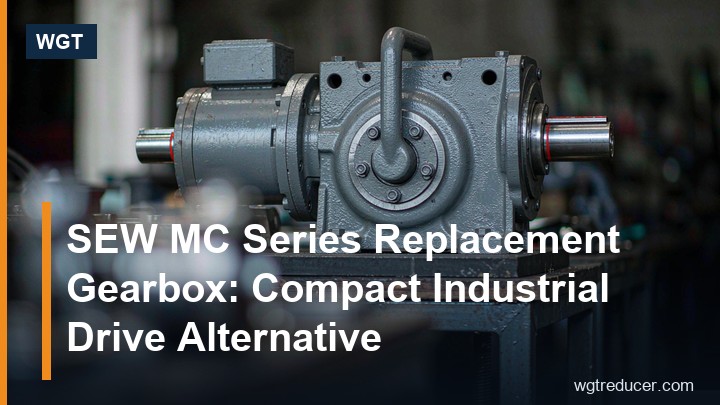
SEW MC Series Replacement Gearbox: Compact Industrial Drive Alternative
Plants that standardized on the MC series decades ago keep running into the same two problems today: the original supplier's lead time has stretched, or the frame they need is no longer stocked in the region. A sew replacement gearbox does not have to be an identical part number. It has to land on the same shafts, carry the same torque, mount into the same space and stay serviceable for the next decade. This article walks through how a compact industrial gearbox from WGT's M series range is matched to an MC-series duty, what the code letters mean for your installation, and the exact data a supplier needs to confirm the fit in writing.
What the MC Duty Actually Demands
The MC series sits in the compact parallel-shaft industrial class: multiple helical stages in a tightly proportioned housing, intended for conveyor work, process lines and general plant drives where space along the machine axis is scarce. Three characteristics define the duty class:
- Helical gearing throughout. All stages are helical, which keeps the drive quiet and lets it absorb moderate shock loads without tooth damage. Any substitute must be ground or shaved helical gearing, not spur.
- Three-stage reduction in one housing. Ratios deep enough for slow conveyor and screw speeds come from three meshes, not from a belt stage or an added pinion.
- A modular output interface. Solid or hollow shafts, foot or flange mounting, and in some builds a torque-arm reaction - the family is configured per drive point rather than sold as one fixed shape.
Those three points are the acceptance criteria. Everything else - paint color, nameplate layout, the exact casting pattern - is secondary, and insisting on cosmetic identity only narrows the supply base without improving uptime.
Reading the Series Code Before You Search for a Substitute
Before contacting any supplier, decode the unit that is on the machine. The designation encodes the answers a supplier needs first:
| Code element | What it fixes on your machine |
|---|---|
| Series letters | Gear layout: parallel-shaft helical versus right-angle bevel-helical input |
| Frame size number | Torque class, housing dimensions and the bolt pattern |
| Output letter | Solid shaft, hollow shaft with key, or shrink-disc seat |
| Mounting letter | Foot on a foundation, flange to the motor or machine, or torque arm |
| Ratio | Exact speed relationship between motor and driven shaft |
Photograph the nameplate and the installation from two angles. The nameplate gives the ratio and serial context; the photos show how the unit actually mounts, which is the detail most often miscommunicated in a written enquiry.
Matching a WGT Industrial Frame to the Duty
WGT's industrial range (the M series described on the M3 bevel helical gear unit page) is built to the same functional recipe: three all-helical stages, case-hardened ground wheels, a split or monobloc cast-iron housing, and a configurable output end. Matching it to an existing MC position follows a fixed sequence:
- Confirm the torque class by frame size. The substitute frame is chosen so its rated torque at the working ratio meets or exceeds the original, with the duty service factor applied.
- Confirm the interface, not the casting. Output bore and keyway, foot pattern or flange diameter, shaft height and motor interface are checked against the outline drawing. Small adaptations - a taller foot pad or an adapter flange - are normal and cheap; an unverified bore is not.
- Confirm the mounting behavior. If the original was shaft-mounted with a torque arm, the substitute should be too, because the reaction path is part of the installation's structure.
- Confirm ratios. Standard ratio bands are close across manufacturers, but the exact decimal is not always identical. A two-percent speed change at the driven machine is usually harmless - a twenty percent change never is, and must be caught at selection.
Where the machine shaft is short and stiff, a hollow-shaft build removes the coupling entirely - the approach used on the M3RHT50 torque arm gearbox, which rides the machine shaft and takes its reaction through an anchored arm.
The Selection Math That Decides the Frame
Three numbers drive the whole choice: motor speed, target output speed and required torque. The ratio falls out of the first two:
| Input | Typical value | What it gives you |
|---|---|---|
| Motor speed | 1450 - 1500 rpm at 50 Hz | The numerator of the ratio |
| Output speed | From the driven machine's process need | The denominator |
| Ratio | Motor speed ÷ output speed | The ratio band to select from |
| Required torque | From absorbed machine power ÷ output speed | Compared against the rating table |
| Service factor | Duty class and shock level | Multiplies the torque before frame selection |
Worked example: a 30 kW motor at 1470 rpm driving a screw conveyor shaft at 42 rpm needs a ratio near i=35. The absorbed torque at the screw shaft, multiplied by the service factor for moderately shocky duty, picks the frame out of the rating table - the ratio alone never sizes the unit. If you would rather run the arithmetic interactively, the online gear reducer selection system takes motor power, speed and target output speed and proposes candidate frames.
Mounting and Installation Points That Decide Success
Most field problems with substituted gearboxes trace back to installation details, not tooth strength. Four points deserve attention on every changeover:
- Reaction path. Foot-mounted units need a foundation flat within tolerance; torque-arm units need an anchor point positioned so the arm sits close to its neutral line at working torque.
- Overhung and axial loads. V-belt pulleys and chain sprockets load the output shaft sideways. The substitute's permitted overhung load must cover the actual belt pull, including the tightening allowance.
- Backstop requirement. Inclined conveyors that can run back under load need a backstop or an external holdback. Confirm whether the original unit contained one - it is invisible from outside.
- Lubrication changeover. Different manufacturers specify different oil. Run the first fill with the new supplier's grade and log the change date; mixing legacy oil with a different additive package is a common cause of early bearing wear.
What to Send a Supplier for a Written Match
A complete enquiry fits in one email and shortens the quote cycle from weeks to days:
- Nameplate photo plus the series code and ratio.
- Driven machine type and the duty description (hours per day, shock level, reversing or not).
- Motor power, speed and mounting arrangement.
- Machine shaft diameter, keyway size and the distance to the nearest bearing.
- Whether a backstop, shrink disc or special paint is required.
- Two installation photos showing mounting and the space envelope.
WGT verifies the selection with a rated-torque check against the duty service factor and returns an outline drawing with the quotation, so the fit is confirmed on paper before anything is machined.
Common Questions from Buyers
Can a substitute gearbox match the original bolt pattern exactly?
Usually yes within the same frame class, because industrial housing patterns follow long-established dimension ladders. Where the pattern differs, an adapter plate or a machined foot riser solves it - the outline drawing shows both options before the order is placed.
Is the service factor different from the original supplier's tables?
Service-factor conventions are broadly similar across industrial gearbox makers, but the exact multiplier for a given duty class can differ slightly. The safe approach is to state the duty in physical terms - shock level, starts per hour, reversing or not - and let the supplier apply their own table, rather than quoting a service factor from the old catalogue.
How long does a substitute order take?
Standard frame sizes with common ratios are typically available within five to ten weeks including factory test and export packing. Non-standard bores or special shaft ends add machining time, which is why confirming the interface early in the enquiry matters.
Do I need to change the motor when changing the gearbox?
Not normally. The substitute is selected around the existing motor's speed and power, and the motor interface (IEC flange size or C-face) is matched at selection. A motor change is only worth considering if the original is inefficient beyond economic repair - a separate decision from the gearbox swap.
Summary
An MC-series duty does not lock a plant to a single supplier. Decode the nameplate, fix the interface and the reaction path, run the ratio-and-torque arithmetic with the duty service factor, and confirm the result with an outline drawing. A compact helical industrial frame from WGT's M series covers the same torque classes and mounting styles, ships with a one-year warranty, and - because the selection is documented in writing - keeps the next changeover just as routine.
