


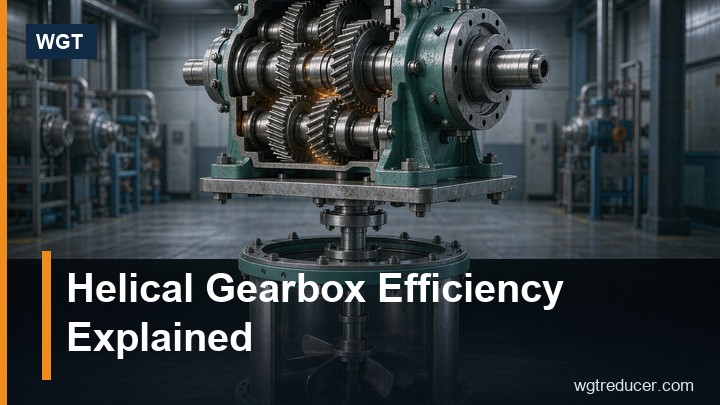
Helical Gearbox Efficiency Explained | WGT
A well-built helical gearbox turns 94 to 97 percent of the motor's power into useful output, and almost nothing can be done to improve on that figure at the catalogue level. What is worth understanding is where the missing three to six percent actually goes - because the breakdown tells you which losses grow with speed, which grow with load, and which ones are your own fault through oil level, alignment or maintenance. This article walks through the loss budget of a helical gearbox stage by stage, compares it honestly with worm gearing, and shows where efficiency should and should not influence a selection.
What "Efficiency" Means for a Gearbox
Gearbox efficiency is the ratio of output power to input power, measured at rated speed and load after the unit has warmed up. It sounds like a single number, but it is really the sum of several independent losses, each with its own behaviour:
- Mesh losses - friction between gear teeth as power passes through each engagement
- Bearing losses - rolling friction at every shaft support
- Churning losses - power spent stirring oil, growing steeply with speed
- Seal losses - the sliding friction of every lip riding on a rotating shaft
- Windage - air drag on rotating parts at high speed
A helical gearbox efficiency figure quoted in a catalogue is measured with correct oil level, at rated load, at a defined oil temperature. Run the same unit half-empty or half-loaded and the number moves. That is not a fault of the gearbox; it is the definition doing its job.
Where Each Lost Percent Goes
For a typical industrial helical unit with two or three stages, the loss budget at rated duty looks roughly like this:
| Loss source | Typical share of input power | Grows with |
|---|---|---|
| Gear mesh friction | 1.5 - 4% (about 1 - 1.5% per stage) | Torque, roughly linearly |
| Bearings | 0.2 - 0.5% | Speed and load |
| Oil churning | 0.5 - 2% | Speed squared, oil level, oil viscosity |
| Shaft seals | 0.1 - 0.3% | Speed (lip sliding) |
| Windage and misc. | under 0.2% | Speed |
Two things stand out from the table. First, mesh friction dominates, and it is set by the tooth geometry the designer chose years before you ordered the unit. Second, churning is the only loss you can meaningfully change after delivery - by getting the oil level right and the viscosity right, and by not running the unit faster than the application needs.
Why Helical Gears Waste So Little
The reason helical gearbox efficiency sits above 95 percent is geometry. A spur or helical tooth pair rolls through its engagement with mostly rolling contact and only a small amount of sliding; the friction work per revolution is small compared with the power being transmitted. The helix angle adds axial thrust that the bearings must absorb, but the rolling contact itself stays clean.
By contrast, a worm mesh works by sliding. The worm thread slides across the wheel tooth through the whole engagement, which is why a worm set turns heat generation into its defining feature and why worm efficiency falls from around 90 percent at moderate ratios to 60 percent or less at very high ratios. Neither design is wrong - they serve different duties - but they are not interchangeable on efficiency, and the comparison below makes the cost of that difference concrete.
There is a second, quieter advantage: the helical train carries load across several teeth at once, so the contact stress per tooth pair stays moderate. That does not appear directly in the efficiency number, but it appears in the oil temperature, in the noise, and in how the unit behaves after ten years of service.
The Ratio Effect: More Stages, More Losses
Every mesh costs about one to one and a half percent. That number compounds, not adds: a single-stage unit loses roughly 1.5 percent, a two-stage unit roughly 3 percent, and a three-stage unit roughly 4.5 percent at the mesh alone, before bearings and churning.
This is why the three-stage industrial gear unit in the middle of the efficiency tables is not a contradiction of the physics - it is the physics, priced fairly. A three-stage helical train reaching a ratio of 1:160 loses a few percent in total; a worm set reaching the same ratio in one stage can lose forty. When the duty runs continuously, that gap is not an abstract figure. It is kilowatts, paid every running hour, and removed as heat that the oil and the seals must survive.
The practical rule for selection: take the ratio the duty needs, then take the gear architecture that reaches it with the fewest sliding contacts. For most industrial ratios between 1:4 and 1:400, that is a parallel-shaft helical train - which is exactly what our MC3 vertical solid shaft gear units provide, three helical stages in an upright case for agitator and mixer duties.
Load Level and Part-Load Operation
Efficiency figures are quoted at rated load, and most gearboxes spend their working life below it. How the loss budget behaves at part load matters more than most buyers expect.
Mesh friction falls roughly with torque, so at half load the mesh wastes about half as much. Bearing and seal losses, however, are closer to fixed costs that scale mainly with speed. Churning does not care about load at all - it scales with speed squared and oil level. The consequence: at part load, the fixed losses take a larger share of a smaller pie, and efficiency drops - gently for a helical unit, dramatically for a worm set, whose efficiency is notoriously poor at low torque because the fixed sliding friction dominates.
Two operating decisions follow. First, do not oversize a gearbox by two frames "to be safe": an oversized unit running at 30 percent load wastes proportionally more, and a worm-driven version can halve its catalogue efficiency at that point. Second, on duties that cycle between heavy and light load, evaluate efficiency at both points rather than at the nameplate. The online selection tool lets you enter the real duty cycle and see the operating point across the whole cycle, not just at the extreme.
Lubrication, Bearings and Seals: the Losses You Control
After the mesh, the controllable losses are the ones maintenance touches:
- Oil level. Overfilled sumps are the most common self-inflicted loss. Oil above the dipstick mark adds drag on every gear that dips into it, and the extra churning shows up directly as oil temperature. On a unit where the lowest gear runs through the sump, one centimetre of extra oil can add measurable loss and several degrees of temperature.
- Oil viscosity. Thicker oil protects at low speed and high load; it churns harder at high speed. Running a synthetic oil one grade thinner than the default, where the manufacturer's tables permit it, recovers a fraction of a percent on fast-running units - and usually extends drain intervals at the same time.
- Alignment. A misaligned coupling loads the bearings sideways and adds loss where none was budgeted. The loss is small; the damage it causes to bearing life is not.
- Seal condition. A drying, hardened lip drags. Seal friction is a small number in the budget, but a failing seal is how oil leaves and dirt enters, and both of those cost far more than friction.
None of these items will raise a 95 percent unit to 97 percent. All of them will drag a healthy unit down toward 90 percent while quietly shortening its life - which is the more expensive direction.
Heat Is Efficiency You Pay For Twice
Every lost percent leaves the case as heat. At a 5.5 kW input and 95 percent efficiency, about 275 watts run the oil and the case continuously - enough to hold a healthy oil temperature in most ambient conditions, and the reason a gearbox needs thermal rating tables at all. Drop the same unit to 85 percent (a heavily loaded worm set, say) and the heat doubles to over 800 watts, which is when cooling fins stop being optional and fan kits start appearing on quotations.
So efficiency is not only an energy argument. It is a thermal argument, an oil-life argument and a seal-life argument. Oil oxidises roughly twice as fast for every ten degrees Celsius of extra bulk temperature; a hotter case dries seals faster; a hotter unit needs a bigger breather and closer oil monitoring. Buyers who select on efficiency for continuous duties are usually buying cooler running as much as they are buying saved kilowatt-hours.
Helical Compared with Worm and Bevel-Helical
| Architecture | Typical full-load efficiency | Where it wins | Where it loses |
|---|---|---|---|
| Single-stage helical | 97 - 99% | Highest efficiency, compact for moderate ratios | Limited ratio range per stage |
| Two/three-stage helical | 94 - 97% | Wide ratios, still efficient, quiet | Longer case, more surface to cool |
| Bevel-helical | 93 - 96% | Right-angle turns with good efficiency | Bevel stage costs a little more than a helical mesh |
| Worm | 60 - 90%, falling with ratio | Right angle, compact, low cost, can self-lock | Sliding contact; poor at high ratio and part load |
Read the worm row carefully before dismissing it. At low ratios a worm set is a reasonable, compact right-angle drive, and its ability to hold load stationary is genuinely useful on hoists. The trap is specifying a worm set for a high-ratio, continuously running duty, where its 65 percent efficiency turns into permanent heat load - a duty where a three-stage helical train does the same job for a third of the loss. For continuous agitator, conveyor and process duties, that comparison almost always ends in the helical column.
What Efficiency Should (and Should Not) Decide
Use helical gearbox efficiency as a selection argument where it bites: continuous duties, high installed power, high ratios, warm ambient rooms, and anywhere the electricity meter is measured against production. In those places, a few percent compound into real money and real heat.
Do not let it decide everything. A duty that runs one hour a day does not repay a premium for the last percentage point; a duty needing a self-locking output should not be forced into a back-drivable helical train for the sake of a table; and a unit whose real problem is an overfilled sump will not be rescued by a different gear architecture. Efficiency is one input to a selection, weighted heavily for continuous duty and lightly for intermittent duty - and it is the loss breakdown, not the headline number, that tells you which lever actually moves your installation.
Get advice from WGT
WGT WeiGao Transmission manufactures helical, bevel-helical and worm gear units and matches architecture to duty before quoting. Send your ratio, motor power, duty cycle and ambient conditions through the online selection system or to our engineering team, and we will confirm the architecture, the thermal margin and the oil specification together with the price.
Frequently asked questions
What is the typical efficiency of a helical gearbox?
Between 94 and 97 percent for multi-stage industrial units, and up to 98 - 99 percent for single-stage helical gears. The exact figure depends on the number of stages, the ratio, the oil and the operating point, since mesh losses compound per stage while churning and bearing losses depend on speed.
Why is a worm gearbox less efficient than a helical one?
A worm mesh transmits power by sliding contact between the worm thread and the wheel tooth, which converts far more of the input power into heat. Helical teeth roll through engagement with only minor sliding, so mesh friction stays near one percent per stage.
Does efficiency drop when a gearbox runs below rated load?
Yes, mildly. Mesh friction falls with torque, but bearing, seal and churning losses stay close to fixed, so they take a bigger share at part load. The effect is moderate for helical units and severe for worm gearing at low torque.
How much does wrong oil level affect gearbox efficiency?
An overfilled sump adds churning drag on every gear dipping into the oil, which shows up as lost efficiency and higher oil temperature. Filling to the dipstick mark with the correct viscosity keeps churning losses within the design budget.
Is a more efficient gearbox always the better choice?
For continuous, high-power or high-ratio duties, yes - the savings and the cooler running compound over years. For short-duty or self-locking applications, other properties can outweigh the last percentage point of efficiency.