


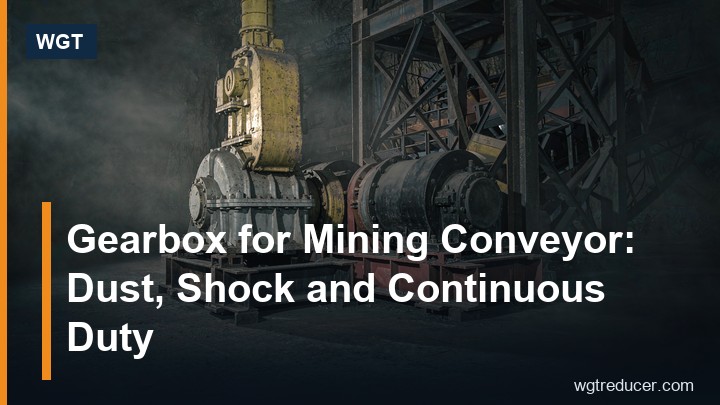
Gearbox for Mining Conveyor: Dust, Shock and Continuous Duty
A gearbox for mining conveyor duty is selected against three conditions that rarely appear together in other industries: abrasive dust that attacks every seal and breather, shock loads that arrive as stalled belts and buried material, and running hours that make the conveyor the most-used machine on the site. A mining conveyor gearbox chosen on the catalogue's average column will pass the calculation and fail the shift. This guide sets out how the real duty differs from the paper duty, which checks decide the frame, and what a supplier needs to quote the drive properly the first time.
Why Mining Duty Is a Category of Its Own
Conveyors exist in every bulk industry, but mining adds conditions that multiply each other. The dust is not nuisance dust - it is hard, sharp mineral particles that pack seal lips, block breathers and turn into grinding paste wherever oil and air meet. The loads are not smooth - a belt that takes a surge of run-of-mine material, or that stops under full load and must be restarted against it, imposes torque peaks many times the running figure. And the hours are not office hours - a trunk conveyor feeding a processing plant runs whenever the plant runs, which across a year is several times the hours of a factory machine.
Each condition alone is manageable. Together they explain why a mining conveyor gearbox fails in ways that a neat torque calculation never predicted: oil oxidised by heat that dust on the case made worse, bearings starved at low output speed, a bevel mesh that lost its pattern after one bad restart too many. All of these are selection problems, and all of them are cheaper to solve before the unit is ordered than after.
The Two Figures That Matter: Running and Breakaway
The most common selection error on conveyor drives is merging two numbers that must stay apart. The first is running torque - the steady figure the belt demands at full design capacity, which sizes the continuous rating of the unit. The second is breakaway torque - what it takes to start a belt that has stopped loaded, with the material settled and the take-up tension already in the belt. On an inclined conveyor the breakaway figure can exceed the running figure by a wide margin, and on a restart after an emergency stop it arrives with no warm-up and no warning.
A mining conveyor gearbox must be sized so that the worst of these episodes sits inside the rating once the service factor for the duty class is applied. In practice this is done the same way every ratio is done - by division. A typical check reads: motor at 1,480 rpm, head pulley at 16 rpm, so 1,480 / 16 = 92.5 and a ratio near i=93 is drawn from a three-stage band; then the frame is checked against the loaded-restart case, not just the running case. The division is the easy part. The service factor, honestly chosen for starts per hour and shock level, is what separates a drive that survives from one that merely ships.
Dust, Seals and the Breather Problem
Dust does its damage through three doors. The first is the shaft seal: a lip seal running in airborne mineral dust wears faster than any table predicts, and once it wears, the sump loses oil and the bearing behind it follows. The second is the breather: a plain breather on a case that heats and cools daily breathes dusty air in every cycle, and the particles settle into the oil. The third is simple insulation - a dust blanket caked on a hot case holds heat in the sump and shortens oil life.
The countermeasures are ordinary and effective. Labyrinth or properly specified lip seals at both shaft ends. A breather suited to dusty air, positioned away from the dust stream. A case wiped down during the monthly round, which at a mine is genuine maintenance and not housekeeping. And an oil sampling rhythm taken at fixed intervals, because in mining service the oil sample is the cheapest diagnostic on the site - it catches water from condensation, wear metal from a mesh going off, and dust ingress long before the noise does.
Sizing the Drive: A Worked Frame
| Check | What to state | Why it decides the unit |
|---|---|---|
| Ratio | Motor speed ÷ head pulley speed | Fixes the number of stages; i≈93 typically means a three-stage bevel-helical train |
| Running torque | Belt design load at full capacity | Sizes the continuous rating |
| Breakaway and restart | Worst stalled-belt case, starts per hour | Sizes the service factor, often the frame |
| Duty hours | True annual hours at the position | Sets thermal and maintenance planning |
| Environment | Dust load, ambient, underground or surface | Decides sealing, breather and cooling detail |
| Interfaces | Shaft bore, keyway, coupling or hollow bore | Decides the mounting arrangement |
Worked as a list, those six lines close a selection in one pass. A head-end drive on a long incline - say a 132 kW motor at 1,485 rpm turning the head pulley at 16 rpm - draws a ratio near i=93 and is then checked against a fully loaded restart after an emergency stop on the grade. That restart case, not the running figure, is what pushes the selection to a heavy-duty bevel-helical gear unit sized for mine duty, where the mass of the case does the damping a lighter unit would need electronics to achieve.
Where Right-Angle and Parallel Layouts Each Fit
The layout question on a conveyor is mostly a question of space and access. A right-angle bevel-helical unit puts the motor across the drive, which suits head stations on gantries and in transfer towers where floor area is scarce and the fitter needs to reach the motor without stripping guarding. A parallel-shaft unit keeps everything in one line, which suits long machine houses and installations where the belt line already dictates the shaft heights.
Underground, the decision tilts further toward compactness: every metre of drive station is excavated at cost, and a right-angle layout that shortens the station is often worth more than a marginal efficiency difference. Surface installations with more room sometimes take the parallel route for its straight-through shaft and simple coupling alignment. Neither is universally right; both are right somewhere, and the honest answer comes from the layout drawing rather than from habit.
Thermal Reality Underground and On the Surface
Heat is the quiet limiter on conveyor drives. Underground, the ambient is already warm and the air barely moves, so a drive station sheds less heat than the same unit would on the surface. On the surface, sun on the case and a hot transfer tower can do the same work. In both settings the check is the same: the thermal rating must be verified at the true corner temperature, not at a laboratory 20 degrees.
Where the check fails, the remedies are ordinary and worth costing early - move or upgrade the breather, direct a fan of air across the case, improve the ventilation of the drive station, or step up one frame to gain oil volume rather than torque. Recording the case temperature after four loaded hours at commissioning gives every later reading a baseline, and a drive whose history is compared against a baseline can be diagnosed over the phone instead of by a site visit.
Maintenance Habits That Decide the Second Decade
A mining conveyor gearbox is rarely killed by its first year. It is killed by a decade of small omissions that a short routine prevents. The routine, in order of value: sample the oil at a fixed interval and read the trend, not the single result; check the breather and the seal weep holes every round; listen to the bevel mesh from a metre away, because a mesh that develops a note has usually developed a problem; and log the case temperature at the same point each check.
The first oil change deserves its own mention. Run-in debris is real, and changing the oil early - hundreds of hours, not thousands - clears it while the delivery paperwork is still on file. Plants that skip the early change meet the debris again in year two as bearing wear that no one can explain. None of this routine is expensive; all of it is scheduled, which is precisely why it gets skipped, and why the drives that follow it quietly outlast everything around them.
What to Send for a Quotation That Comes Back Complete
| Item | Detail to include |
|---|---|
| Motor | Power, speed, starting method (DOL, soft-start, VSD) |
| Driven machine | Conveyor length, incline, take-up type, material and its surges |
| Duty | Hours per day, starts per hour, worst restart case described |
| Speeds | Output speed required and the tolerance the process accepts |
| Environment | Dust load, ambient range, underground or surface, washdown |
| Interfaces | Shaft bore and keyway, hollow bore if wanted, second shaft end for a brake |
| Mounting | Position, motor orientation, rotation direction, base detail |
Sent complete, that page returns a firm quotation and an outline drawing without a round of questions. Sent as a power figure and a shaft diameter, it returns questions, and at a mine each round of questions costs a week the production plan rarely has to spare.
FAQ
What ratio does a mining conveyor drive usually need?
Trunk and incline conveyors sit in the mid-to-high ratio band because head pulley speeds are low relative to motor speed. The figure is a division - motor speed over head pulley speed - and a result near i=90 typically points to a three-stage bevel-helical train. The ratio sizes the train; the restart case sizes the frame.
Why does a loaded restart matter more than the running load?
A stopped belt with material settled on it behaves almost like a brake until the first revolutions break the load loose. The torque needed at that instant can be several times the running figure, and it arrives cold, with the oil at its most viscous. A unit selected on running torque alone survives the average hour and dies on the exceptional one.
How often should the oil be sampled on a dusty site?
Quarterly is the practical rhythm for continuous conveyor drives, taken at the same point in each interval. The value is in the trend: rising wear metals point at the mesh, water points at the breather or a seal, and dust - identified by its mineral signature - points at the ingress path. Any of these, caught at sample stage, is a scheduled repair rather than a breakdown.
Is a right-angle or parallel-shaft layout better underground?
Right-angle layouts usually win underground because drive stations are excavated by the metre and a motor set across the output shortens the station. Parallel layouts keep the shaft line straight and are simpler to align, which suits surface installations with room to spare. The layout drawing and the access plan decide it, not preference.
Can one gearbox frame be standardised across several conveyors?
Often, yes, and it is worth checking before each drive is sized in isolation. Where several conveyors fall in overlapping torque bands, standardising on one frame means one spares pool, one oil grade and one fitting procedure the crews know by heart - and a breakdown on any conveyor can borrow the shutdown planned for another. Standardisation never appears in a torque table, but it regularly decides the total cost of the drive system.
Size the Duty, Then the Unit
Every point above reduces to one habit: describe the worst hour honestly and select against it. Send your conveyor duty to our engineers, or work the ratio and service factor yourself in the online selection system. For feeder, elevator and auxiliary positions around the same mine, the S67 helical worm gearbox covers many of the slower points, and the same duty-description discipline applies there too.
