


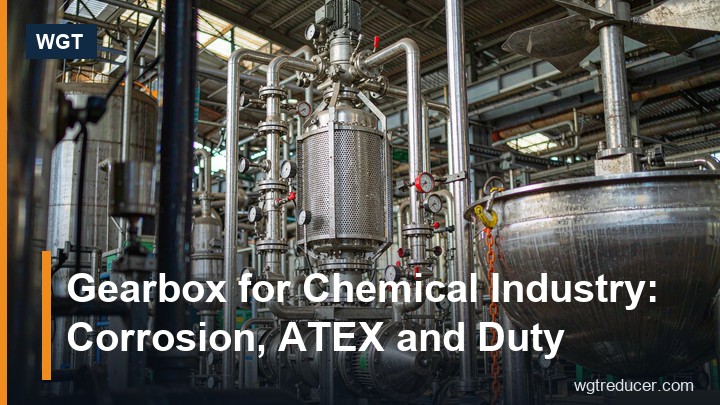
Gearbox for Chemical Industry: Corrosion, ATEX and Duty
A gearbox for chemical industry duty is chosen against three conditions that a clean factory never presents: aggressive media that attack paint, seals and breathers; atmospheres where an ignition source has to be engineered out of the drive package; and process lines that run continuously because a stop costs a batch. A chemical plant reducer specified only from a torque table will survive the calculation and disappoint in the second year. This guide sets out how corrosion, explosion protection and continuous duty change the selection, and what a supplier needs in order to quote the drive correctly the first time.
Why Chemical Plant Duty Is a Category of Its Own
Process plants concentrate, in one perimeter, conditions that most industries meet one at a time. Acids and alkalis sit in the air as vapour, not only in the pipes. Washdown regimes run on a schedule set by the process, not by housekeeping. Ambient temperatures near dryers, reactors and steam lines run well above the conditions a catalogue assumes. And the machinery itself - agitators, dosing pumps, scrapers, conveyors, fans - turns slowly and heavily, at speeds where every selection habit learned from fast machines has to be rechecked.
The consequences show up in specific, predictable places. A case whose paint is breached by a splash corrodes from the flange inward, and the first symptom is a gasket weep that reads as a seal fault. A breather on a vessel-adjacent position breathes acid-laden air into the sump every thermal cycle. A seal lip chosen for oil compatibility alone swells in the process media it was never told about. None of these are exotic failures; all of them are specification gaps, and all of them cost a fraction to close on the order than after delivery.
Corrosion: The Attack You Cannot See
Corrosion in a chemical plant rarely announces itself as rust streaks. It starts where coatings are thinnest - fastener edges, foot corners, the seam under a nameplate - and progresses wherever moisture and media are trapped against bare metal. A corrosion resistant gearbox therefore begins as a coating decision, not a catalogue line: epoxy-based paint systems applied to a prepared cast surface, stainless fasteners at the interfaces most exposed to splash, and attention to the crevices where a foot meets a plinth and a breather meets its boss.
Sealing compounds complete the defence. Standard nitrile seal lips handle mineral oil and dust for years; they are not the right answer where the surrounding atmosphere carries solvents or the position is hosed with a caustic solution. Fluoroelastomer lips hold their dimensions where nitrile swells, and they cost little more at the order stage. The same logic applies to cable glands, breather threads and the inspection cover gasket - every path into the sump is a path for the process air, and each one is specified, not inherited.
One habit closes most of the remaining gap: a paint-inspection line in the monthly round. A chip found and touched up in month three is a touch-up. The same chip found in year two is a corroded flange, a stripped foot thread and a drive that has to come off-line for a week. In chemical service, the paint film is a pressure boundary of sorts - not for media, but for the plant's own air - and it is inspected like one.
Explosive Atmospheres and the Drive Package
Where the process handles flammable vapours or combustible dusts, the drive package is specified against the zoning of the position, and the gearbox's role is narrower than buyers often assume. The division of responsibility is simple: the electric motor, its terminal box and any switchgear carry the explosion-protection certification; the mechanical gearbox does not ignite anything and carries no certification of its own. What the gearbox contributes to an ATEX drive package is discipline at the interfaces - earthing continuity across the motor-to-case joint, a torque arm and feet that cannot build a static charge against painted isolation, and a temperature profile that respects the temperature class the position demands.
That last point is where the gearbox earns its line in the specification. A case running hot on a continuous duty can approach temperatures that matter in a gas-containing zone, so the thermal check is run at the position's true ambient with the margin the zone classification requires. Antistatic paint, bonding straps across gasketed joints and a documented temperature reading at commissioning close the package. None of this changes the gear geometry; all of it changes the paperwork, and the paperwork is what the plant's compliance file will ask for years later.
Continuous Duty and the Thermal Check
Chemical process lines are the most continuous machinery in industry. An agitator that stops mid-batch can lose the batch; a scraper conveyor that stops lets material set; a cooling tower fan that stops stops the plant. The gearbox for chemical industry service is therefore sized the way the process runs - at twenty-four hours, at the position's real ambient, against a duty cycle with no polite pauses.
The thermal rating is the figure that decides, more often than torque. Two frames may both carry the load; the one whose sump settles at a comfortable temperature through a summer afternoon is the one whose oil and seals reach their intended life. Plants that check the thermal figure at the corner ambient - beside the dryer, above the steam line, in the sun on the pipe rack - size the frame honestly once and never revisit it. Plants that trust the standard laboratory conditions meet the difference in August, as oxidised oil and a seal that hardened early.
Efficiency deserves a mention in the same breath. Helical gearing runs a few points more efficient than a worm stage at the same ratio, and on a drive that turns continuously, those points become kilowatt-hours and heat - both of which the plant pays for twice, once at the meter and once at the sump.
Specifying a Chemical Plant Reducer: A Checklist
The specification that gets quoted in one pass collects the following on a single page:
| Item | What to state | Why it decides the unit |
|---|---|---|
| Duty torque and speed | Absorbed power at the worst hour, output rpm | Sizes rating and ratio; slow outputs push toward multi-stage trains |
| Duty cycle | Hours per day, starts per hour, reversals | Sets service factor and thermal reserve |
| Media exposure | Splash, vapour, washdown regime and frequency | Decides paint system, seal compound, fasteners |
| Atmosphere classification | Zone, gas or dust group, temperature class | Defines the motor package and earthing detail |
| Mounting and layout | Foot or flange, hollow bore or solid shaft, motor position | Fixes the arrangement the plant can actually fit |
| Environment | Ambient range, sun, proximity to heat sources | Decides breather, oil grade and cooling margin |
| Interfaces | Shaft diameter, keyway, usable length | Prevents the most common post-order query |
| Documentation | Nameplate data, compliance file, outline drawing | What the project file will ask for at handover |
Worked as eight lines, that page is worth a week of schedule on most projects. Suppliers quote what they can see; the enquiry above lets them see everything, which is how a chemical plant reducer arrives as a firm offer with an outline drawing instead of a list of questions.
Matching the Layout to the Process Line
The layout question in a plant is a question of access and containment. Agitator drives on vessels favour a hollow-bore, foot-mounted arrangement: the case climbs over the agitator shaft from a fixed position on a plinth, no coupling has to be aligned above live media, and the drive comes off for service without draining the vessel. The continuous-service bevel-helical gear unit in the hollow-bore range is a typical answer for those mid-plant positions, where the train's right-angle build parks the motor where the aisle leaves room for it.
Where the line runs along a wall or a pipe rack, a parallel-shaft unit keeps the shaft heights the pipework already dictates. Where a screw conveyor or a scraper needs a compact right angle with a self-locking tendency on stops, a helical-worm unit covers the slower points - the S67 helical worm gearbox is the common mid-frame there, and the same sealing and coating logic applies to it as to everything else in the plant. The honest sequence is to walk the position first and choose the layout second; the gearbox family follows the space, not the other way round.
Maintenance in a Plant That Cannot Stop
Planned outages are the currency of chemical maintenance, and gearbox work has to fit inside them. The routine that makes that possible is short and evidence-based: sample the oil at a fixed interval and read the trend, because water in the sample names a breather and wear metal names a mesh; wipe and inspect the paint film at the feet and flanges; confirm the breather is dry and breathing; and log the case temperature at the same point each round against the commissioning baseline.
The first oil change holds its usual importance - run-in debris leaves with it - and in chemical service one extra line joins the round: a check that nothing from the process has found a home on the case, because deposits that hold moisture and media against the paint do quietly what a splash does loudly. A drive maintained on that routine announces its needs at the next planned outage; a drive maintained on calendar and hope announces them at three in the morning instead.
Frequently Asked Questions
Can a standard industrial gearbox be used inside a chemical plant?
Often, yes - the gearing does not care about the atmosphere. What changes is the specification around the gearing: paint system, seal compound, fastener material and breather type are chosen for the media exposure, and the motor package is specified to the zone classification of the position. A standard unit can be the right unit; an unspecified one rarely is.
What ingress protection should a chemical plant drive have?
The position decides. Enclosed indoor positions away from washdown often run comfortably at IP55. Hosed areas, outdoor positions and any point under process splash warrant sealed cable glands, protected breathers and a washdown-tolerant paint system regardless of the motor's own rating. The gearbox's weak points are its paths into the sump, not its enclosure letter.
How is an ATEX drive different from a standard one?
The certified part is the electrical package - motor, terminal box, and any switching gear - matched to the zone, group and temperature class of the position. The gearbox contributes earthing continuity, antistatic detail at its interfaces and a case temperature that respects the temperature class. Buyers should expect the drive supplier to state which element carries which responsibility in the compliance file.
How often should the oil be changed on a chemical plant reducer?
An early first change - within the first few hundred running hours - clears run-in debris. After that, annual sampling with changes set by the trend rather than the calendar is the honest answer, shortened where the position runs hot or the sample shows water. In chemical service the oil sample doubles as an ingress detector, which makes it the cheapest line item in the maintenance budget.
Which gearbox type suits an agitator drive on a vessel?
Slow speed, steady torque and a shaft rising out of live media make the hollow-bore, foot-mounted build the default: the unit mounts over the agitator shaft, no coupling sits above the product, and the drive can be serviced without opening the vessel. Ratios that exceed the hollow-bore band's span push toward worm stages, which bring the useful self-locking tendency many agitator positions want on a stop.
Bring the Duty, Not Just the Power
Every point above reduces to one habit: describe the position as the plant actually runs it, and specify against the worst hour rather than the average one. Send your process duty to our engineers, or work the ratio and frame yourself in the online selection system. State the media, the zone and the hours alongside the speeds and torques, and the quotation that comes back will fit the position the first time - which in a plant that cannot stop is the only kind of quotation worth receiving.
