


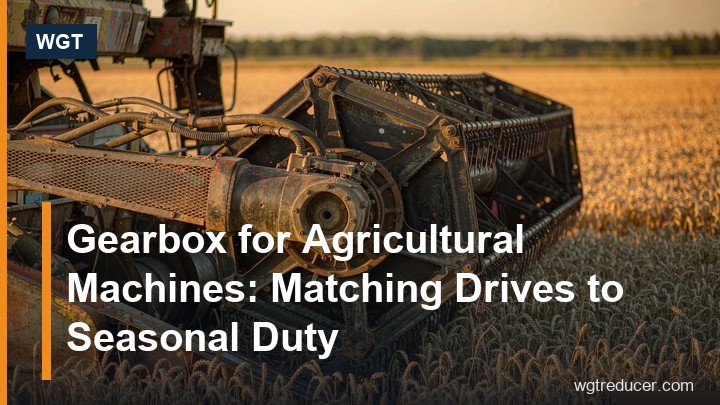
Gearbox for Agricultural Machines: Matching Drives to Seasonal Duty
Farm machinery is unforgiving equipment to specify a drive for. A machine that runs gently in June and flat out for eighteen hours a day in September puts the gearbox through two completely different lives in the same season. Dust, crop residue, temperature swings from frost to forty degrees, long storage weeks followed by sudden full load - none of this appears in the rated torque column of a catalogue, yet all of it decides whether a gearbox for agricultural machines lasts a decade or needs attention every harvest.
What Farm Duty Actually Looks Like
Agricultural loads rarely behave like industrial loads. A feed mixer wagon starts under a full tub of wet ration several times a day, each start a short shock the gear teeth feel directly. A grain auger runs light but works in dust that packs into every seal lip. An irrigation gearbox may turn the same slow circle for three months without stopping, outdoors, in sun and storm. A harvester drive sees peak torque for a few seconds every time the header plugs, then light load again.
Three features dominate almost every farm application:
| Duty feature | Typical machine | What it demands from the gearbox |
|---|---|---|
| Shock starting | Feed mixers, balers, forage equipment | Robust teeth and couplings, generous service factor |
| Dust and plant residue | Augers, conveyors, elevators | Good seals, protected breather, easy inspection |
| Seasonal idleness | Irrigation, grain handling | Storage-safe lubrication, seals that do not dry out |
The gearbox selection therefore starts from the duty pattern, not the motor rating. Two machines with identical power can need different frame sizes because one starts under load and the other does not.
Torque, Service Factor and the Real Rating
The nominal power of a tractor PTO or an electric motor is the beginning of the calculation, not the end. A gearbox that transmits a steady 30 kW at 540 rpm is a modest unit; a gearbox that transmits the same 30 kW while absorbing the torsional shock of a mixer paddle hitting a frozen lump is a heavier machine entirely.
The standard answer is a service factor: a multiplier applied to the nominal torque to cover the load character of the application. Circular and reciprocating loads, frequent starts, reversal and shock all push the factor upward. For farm machinery the sensible habit is to treat shock as normal rather than exceptional - the mixer will plug, the auger will jam, the header will stall, and the drive that survives is the one sized for the bad minute, not the average one.
A second consideration is the duty cycle within the season. A grain handling chain that runs two hundred hours a year can be selected closer to the limit than a ventilation or irrigation drive that runs continuously. Oversizing a rarely used drive wastes money and weight on the machine; undersizing a continuously running one costs a harvest.
Common Drives Across the Farm
| Machine group | Usual drive type | Selection notes |
|---|---|---|
| Grain handling (augers, bucket elevators, chain conveyors) | Shaft-mounted or foot-mounted helical worm units | Quiet, self-locking behaviour useful on inclined augers; seals matter most |
| Feed milling and mixing | Heavy-duty helical units with solid shafts | High service factor for shock starts; torque arm takes reaction cleanly |
| Irrigation and pivot machines | Slow-speed multi-stage units | Long continuous running outdoors; weather protection and storage oils |
| Fertiliser and chemical application | Compact encased units | Corrosion-resistant finish; sealed for life preferred |
Grain handling deserves a note. The M3PVSF60 vertical parallel shaft gear reducer type of arrangement - a vertical drive bolted flat over a discharge or a boot shaft - appears throughout grain stores, because it puts the motor above the dust line and the gear below the product flow with no belts to guard. Where the shaft goes down through a floor into a pit, a hollow-bore vertical unit removes the coupling and the second bearing entirely.
Seals, Breathes and Dust Defence
Dust is the silent killer of farm drives. Fine, abrasive, ever-present, it migrates along shafts the moment a seal lip loses contact. On a gearbox for agricultural machines the seal specification matters more than the gear grade: double-lip seals on both shafts, a breather positioned away from the dust stream, and mounting flanges machined so gaskets actually seal.
Where the machine sits outdoors all year - irrigation structures, grain store roofs, slurry equipment - the housing finish and fastener material matter too. Paint systems and plated fasteners cost little at purchase and decide whether the unit looks after five seasons or has wept rust into the oil.
Finally, the storage question. A drive that stands idle from November to March needs oil that protects and seals that do not take a set. Machines that overwinter should be turned over monthly, or the gearbox filled with a storage-preserving oil and drained to service oil before the season starts.
Power Take-Off and Drive Integration
Much farm machinery is driven from a tractor PTO through a shaft with universal joints, and the gearbox then becomes the angle-and-speed converter of the machine. Two integration points decide success. The first is the input: PTO drives impose their own torsional patterns, and the input shaft and bearings must accept the misalignment and moment loads the drive shaft transmits on turns and undulating ground. The second is the reaction: gear torque tries to rotate the housing, so the mounting - torque arm, foot or flange - must hold it positively without loading the driven shaft.
Electric-driven machines such as feed mills, grain stores and fixed mixing plant avoid the PTO issue but add thermal questions: a drive running eight hours continuously needs its oil temperature checked against the rating, particularly in summer ambient conditions inside a closed building.
Failure Patterns Worth Knowing Before They Happen
Farm gearboxes rarely fail without warning. The typical sequence is: seal weeps, oil level falls, hot running begins, and the first real damage follows weeks later. A walk-round inspection once a season - oil level, weep marks under the unit, breather clear, mounting bolts tight - catches almost every one of these.
The second pattern is shock damage after a jam. After any serious plug or stall, check the couplings and the input before restarting at full power; a tooth crack that goes unnoticed in October announces itself as a seized unit in March.
Choosing a Supplier for Seasonal Equipment
Agricultural customers buy differently from process plants. They need units at short notice inside a season, they need common frames across several machines in a fleet, and they need someone who can answer a shaft-dimension question during harvest, not after it. When evaluating sources, ask three things: which frames are in stock or on short lead, whether drawings and nameplate data are provided so the next unit matches, and whether spare seals and mounting hardware ship with the unit.
Our online selection system lets you size a frame against torque, ratio and mounting before you commit, and the M3RHT70 torque arm gear reducer shows the arrangement most feed and conveying machines on a farm end up using - a right-angle bevel-helical drive with the reaction carried by a torque arm, easy to align and easier to service.
A Short Checklist Before You Order
- Write down the worst load case, not the average one, and size the service factor from it.
- Confirm duty hours per season and select the frame margin accordingly.
- Fix the mounting: foot, flange, shaft-mounted with torque arm, or vertical over a discharge.
- Specify seals and breather for the dust and wash-down environment the machine actually sees.
- Agree the shaft details - diameters, keyways, clamps - against the driven machine drawing, before release.
- Plan the storage: oil type for the idle months and a turn-over routine.
Farm machinery rewards the drive that was sized for its worst day and cared for through its quiet months. Do both, and the gearbox becomes the part of the machine nobody remembers - which is exactly the outcome a good agricultural drive should deliver.
Frequently Asked Questions
How much service factor should an agricultural gearbox carry?
For machines that start under load - mixers, balers, forage equipment - a service factor of 1.5 to 2.0 on the nominal torque is sensible. For gently loaded continuous work such as ventilation or light irrigation duty, 1.25 is usually enough. The deciding question is always: what is the worst moment this drive will ever see?
Why do agricultural gearboxes fail at the seals first?
Dust and plant residue are abrasive and work into the seal lip whenever the shaft surface or the lip is imperfect. Once a weep starts, oil loss lowers the level, the upper bearings run hot, and failure follows. Double-lip seals, correct breather position and clean storage largely prevent this.
Can one gearbox serve both a grain auger and a feed mixer?
Only if it is sized for the mixer. The auger is a light, steady load; the mixer is a shock load with frequent starts. Selecting on the auger alone leaves no margin for the mixer's bad minute, and the unit will not survive the season.
How should a machine with a gearbox be stored over winter?
Turn the drive over briefly once a month so the bearings re-oil, keep the breather clear, and check for oil weep before the season starts. For long storage in humid buildings, fill with a storage-grade oil or top up fully to keep the internals coated, then confirm the service oil level before startup.
