


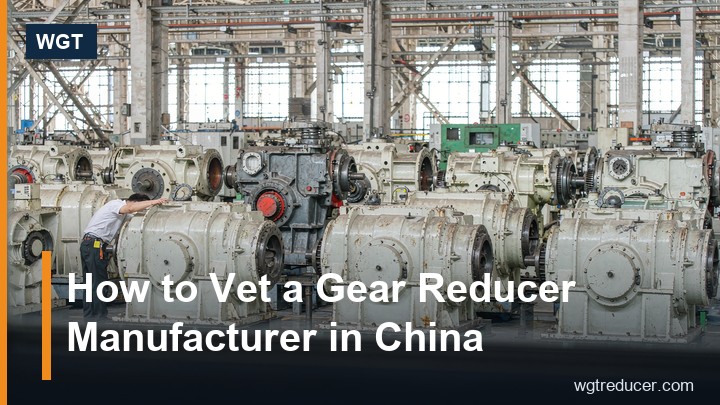
How to Vet a Gear Reducer Manufacturer in China
Most failed gearbox purchases from Asia are not failures of manufacturing - they are failures of vetting. A gear reducer manufacturer in China can be one of three things: a real factory with its own gear-cutting and heat treatment, a trading company with genuine supplier relationships, or a broker with nothing but a website. The product photos look identical from all three. The difference shows up a year later, in the behaviour of the oil seal and the answer to a spare-parts email. This checklist lays out what separates a serious gear reducer manufacturer from a good-looking one, and what a buyer can verify before the first deposit leaves the account.
Why Sourcing Region Matters Less Than Sourcing Method
China remains the default source for industrial speed reducers for good reasons: the gear-cutting capacity concentrated there is unmatched, the supply chains for castings, bearings and seals sit within a few hours of most factories, and the range of standard frames available ex-stock has grown enormously over the past decade. Buyers who source well from China routinely pay a fraction of European catalogue prices for comparable geometry, and buyers who source badly pay twice - once for the unit and once for the downtime.
The mistake to avoid is treating "manufacturer" as a single question. In reality the useful question is which of the plant's operations the supplier actually performs: design, casting, machining, gear cutting, heat treatment, assembly and test. A supplier who assembles and tests but outsources gear cutting to a certified partner is a perfectly good choice for standard frames. A supplier who claims everything and can prove nothing is not, whatever the price. The checklist below is really a structured way of asking that one question until it is answered.
The Five Signals of a Real Factory
Public information will not tell you everything, but it narrows the field quickly. The table below lists the signals worth checking in the first round of contact, before any travel or third-party inspection is budgeted.
| Signal | What to Check | Weak Version Looks Like |
|---|---|---|
| Legal and physical identity | Business licence matches the factory address; satellite view shows an industrial site, not an office block | Licence in one city, "factory" in another with no explanation |
| Equipment ownership | Photos or video of hobbing, shaping, grinding and heat-treatment equipment bearing the maker's name | Stock catalogue images, no equipment photos at all |
| Engineering staff | Named engineers who answer technical questions directly, with drawings they can modify | Every technical answer comes back as marketing copy |
| Test capability | A test rig described in concrete terms: motor size, loaded running, temperature and noise readings | "100% tested" with no method attached |
| Export track record | References, shipping documents or a trade-history check for your product class | Years of "export experience" but no destination ever named |
None of these signals alone is decisive. A factory that fails one may still be excellent for a particular product line. But a supplier who fails three or more, while quoting aggressively, is telling you how the transaction will feel when something goes wrong.
Auditing the Factory Without Leaving Your Desk
A full third-party audit is worth its cost for a strategic supply relationship, but most first orders are settled well before that stage. Two video calls and a document package settle most of it. On the first call, ask to be walked through the workshop - not the showroom - with the camera moving continuously between operations. Cutting machines, the heat-treatment line, the test stand. The rehearsal-smooth tour filmed once a year is easy to spot; the walk through an actual shift, with the sound on, is hard to fake.
On the second call, bring a drawing. Choose a frame you genuinely want to buy and walk the configuration: ratio, mounting, shaft specification, backstop or not, sealing standard. A real manufacturer's engineer will ask clarifying questions about duty and starting conditions before confirming feasibility; a trader will say yes immediately and mention no questions at all. Then request the outline drawing for your configuration. The speed and quality of that drawing - dimensioned, toleranced, with the mounting details your fitter will need - is one of the most reliable quality signals in the whole sourcing process, and it costs the buyer nothing but an email.
Quality Evidence Worth Asking For
Every supplier claims quality; the ones who can document it are worth shortlisting. The document set for a standard industrial gearbox is short and it is reasonable to ask for all of it: material certificates for gears and shafts, heat-treatment records showing the achieved case hardness and case depth, a dimensional inspection report for the sample unit, and the factory test record - loaded running, oil temperature at the stated hour, noise level, seal check.
Two habits make the documents meaningful rather than decorative. First, tie them to the serial number of the unit offered: certificates for "a unit like yours" are marketing; certificates for serial number such-and-such are evidence. Second, ask one certificate to be verified directly - a call or message to the issuing lab or a check of the report format against known standards. Most factories pass this easily. The exercise is not about catching fraud; it is about learning whether the supplier's quality system produces records you can use in a claim, should one ever be necessary.
Price, MOQ and Lead Time - Reading the Three Together
A quotation from a serious factory reads differently from one assembled by a broker. It names the frame, the ratio, the mounting configuration, the sealing and painting standard, and it separates the options - backstop, forced cooling, special shaft steel - as line items rather than burying them. It states validity, payment terms and Incoterms in plain language. When comparing quotes, hold the configuration constant and compare like with like; the cheapest quote usually differs somewhere quiet, and that quiet difference is often the oil seal, the bearing brand or the thickness of the paint that faces the weather.
Minimum order quantities deserve the same directness. For standard catalogue frames a serious manufacturer sells single units as a matter of routine - it is how plants buy replacements, and the maker's margin is built for it. Resistance to a one-piece order on a standard frame is worth probing; sometimes it reflects capacity genuinely reserved for contract customers, and sometimes it signals a supplier more comfortable with brokers than with end users. Lead time follows the same logic: standard frames typically ship in weeks, while custom bores, ratios or materials add their own realistic intervals. A quote promising a custom unit in the time a standard frame takes is quoting fiction.
After-Sales Support and the Spare-Parts Question
The relationship that matters most begins after the shipment lands, so the questions belong in the vetting round. Who answers a technical email, in what language, and within what time? Are O&M manuals, exploded parts lists and outline drawings supplied with every unit as standard? What is the commitment on spare parts availability - seals, gaskets, breathers and bearings - across the years following purchase? A supplier who answers these specifically, with named contacts and stated response times, has thought about the afterlife of the product. One who answers in generalities is telling you that the warranty clause will be the hardest conversation of the relationship.
One practical test is worth running before the order: ask for the spare-parts list for a frame you intend to buy and price the first-year spares kit through them. The speed, completeness and pricing logic of that reply predicts the support experience better than any certificate, because it exercises exactly the muscle a breakdown will later depend on.
A Working Order Checklist
The items below compress the vetting round into what a purchasing officer can actually send. A first order that carries these lines is quotable in one pass, and the quality of the reply is itself the final vetting signal.
| Checklist Item | Why It Matters |
|---|---|
| Company licence and factory address matched | Confirms you are dealing with the maker, not a rented identity |
| Workshop video walk-through, live | Shows which operations the factory really performs |
| Outline drawing for your configuration | Tests engineering depth and gives the fitter the mounting details |
| Material and heat-treatment certificates tied to serial number | Turns "quality" into claimable evidence |
| Factory test method and record format | Defines what "tested" means before you buy |
| Configuration with options as line items | Keeps quotes comparable and options honest |
| Spares list and first-year kit priced | Predicts the after-sales experience directly |
| Manual, parts list and drawing supplied with shipment | The documents your maintenance team will live with |
Frequently Asked Questions
How do I verify a gear reducer manufacturer in China without travelling?
Combine a live video walk-through of the workshop with documents tied to a serial number: business licence matched to the factory address, material and heat-treatment certificates, and a factory test record for the actual unit. Ask the supplier's engineer to walk your drawing with you; the technical quality of that conversation separates factories from traders faster than anything else.
Are Chinese gear reducers suitable for continuous heavy-duty applications?
Yes, when the frame is selected honestly for the duty. The engineering questions - service factor, thermal margin at the real ambient, starting conditions, sealing for the environment - are the same anywhere in the world. Reputable Chinese manufacturers publish ratings and can support the selection with calculations; ask for the selection note and you will learn as much about the supplier as about the gearbox.
What is a realistic lead time for industrial gearboxes from China?
Standard catalogue frames in common ratios typically ship within a few weeks. Custom bore sizes, non-standard ratios, special materials or engineered options add realistic engineering and production intervals, which a serious supplier will state explicitly. Treat a promise of a custom unit in a standard frame's time as a warning, not a bargain.
Should I buy from a manufacturer or a trading company?
Both can work, and many good trading companies add real value in communication and consolidation. What matters is knowing which one you are dealing with, because responsibilities differ when a claim arises. The vetting process above identifies which operations - gear cutting, heat treatment, assembly, test - the supplier actually performs, and honest disclosure there is worth more than the label on the door.
Choosing With Confidence
Vetting a gear reducer manufacturer is mostly disciplined curiosity: match the licence to the address, walk the workshop on video, tie certificates to serials, price the spares, and send an enquiry complete enough to be answered seriously. Buyers who run that sequence consistently find that China offers some of the strongest value in the industrial drivetrain market - and buyers who skip it supply most of the horror stories.
If you would like to test that process on a live quotation, browse the industrial gear units on our site, or run your speed, ratio and torque through the online gear reducer selection system and send the result with your enquiry. We answer selection questions with calculations, and quotations with the drawings your fitter will need.
