


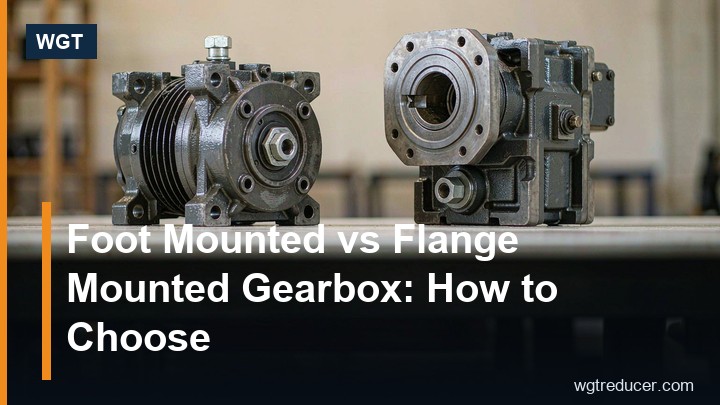
Foot Mounted vs Flange Mounted Gearbox: How to Choose
Neither mounting wins on its own merits - each one wins on a specific machine, in a specific space, with a specific maintenance plan behind it. A foot mounted gearbox stands on its own base and hands its weight and torque to a foundation; a flange mounted gearbox bolts face-to-face against the driven machine (or the motor) and lets that machine's structure carry the loads. Choose the wrong one and you pay for it twice: once in civil works you did not need, and once in every alignment session for the rest of the machine's life.
This guide sets the two arrangements side by side, shows where each is genuinely the better answer, and covers the third option - shaft mounting - that quietly solves both sets of problems on conveyors and similar machines.
What the Two Mountings Actually Mean
A foot mounted gearbox has machined feet at the base of the case. It is bolted to a plinth, a bedplate or a concrete foundation, and the connection to the driven machine is made through a coupling - typically a flexible one, with the motor on its own feet or a common baseplate. The gearbox is an independent structure. Its position in space is set by the foundation, and the coupling is the only thing connecting it to the process.
A flange mounted gearbox has a machined flange - square, round or torque-arm assisted - that bolts directly against a machined face on the driven machine or the motor. There is no coupling and no separate bedplate in the classic arrangement: the flange locates the gear case concentric with the machine's shaft, and bolts carry the joint. The gear case becomes an extension of the machine rather than a neighbour to it.
The distinction sounds architectural, but it drives everything downstream: who designs the load path, what alignment means, how the drive is removed for service, and what a spare unit has to match.
Side by Side: Where Each Mounting Wins
| Factor | Foot mounted gearbox | Flange mounted gearbox |
|---|---|---|
| Foundation and civil works | Needs a plinth or bedplate sized for weight and reaction torque | No separate foundation; the machine's structure carries the loads |
| Alignment | Shaft alignment against the driven machine, repeated after every bedplate disturbance | Set by the machined flange; no coupling to align at all |
| Overhung load on output | Carried by the gearbox bearings at a distance set by the coupling | Usually low, because the gear case locates on the machine's own bearing arrangement |
| Access for maintenance | Drive can be uncoupled and removed without touching the machine | Removal may require dismantling guarding or the machine's own parts |
| Spares strategy | One frame serves many positions with different bedplates | Flange and bolt pattern must match the specific machine face |
| Typical home ground | General plant drives, pumps, fans, mixers with room around them | Compact machines: mixers, agitators, screw drives, wheel tracks |
Read the table as a checklist for your own position rather than a score. Most plants run both mountings happily; the failures come from forcing a mounting into a position its load path was never drawn for.
When a Foot Mounted Gearbox Is the Right Choice
Choose feet when the gearbox is a genuine standalone element in the plant. If the driven machine sits far from the motor, if the drive line includes pulleys or gears between gearbox and machine, or if the maintenance strategy depends on uncoupling and swapping drives without dismantling process equipment, the foot mounted arrangement earns its foundation.
A foot mounted gearbox is also the honest answer where the machine's own structure is not up to carrying a gear case. A light-fabricated tank or a thin-walled housing has no business being asked to react hundreds of newton-metres through a flange; bolting a heavy case to flexible steel produces a vibration source that no amount of balancing removes. The plinth may cost concrete, but it also provides the stiffness the drive train needs.
The third legitimate reason is standardisation. Plants that keep a shelf of one or two frame sizes, each with its stock bedplate drawing, service any position in hours. The foundation is a one-time cost that buys interchangeability across the whole plant.
When a Flange Mounted Gearbox Is the Right Choice
Choose a flange where the driven machine already has a machined mounting face and a shaft strong enough to take the gear case. Agitator drives on tanks, screw conveyor tail drives, mixer drives built into process equipment - all of these are flanged as a matter of design, because the machine's maker intended the gearbox to be part of the machine.
The flange removes an entire class of problems. There is no coupling to misalign, guard, lubricate or wear. There is no bedplate to settle and no shims to lose. The gear case locates on a machined spigot, bolts on, and its concentricity is as good as the machining of the two faces - which on a properly made machine is very good indeed.
The price is commitment. The flange pattern, spigot diameter and bolt circle are fixed by the machine, so the spare-parts logic tightens: a replacement unit must match the face, not just the rating. And the machine's structure must genuinely carry the loads - weight, reaction torque and any overhung load at the input or output - because there is no second load path.
The Loads the Mounting Has to Carry
Whatever the arrangement, three loads have to reach the ground somehow, and it is worth knowing which part of the structure carries each.
Weight is the easy one: the gear case has mass, and either feet or a flange transfer it to structure designed for it. Reaction torque is the interesting one - every gearbox reacts its output torque against something, whether that is a foundation under the feet, bolts through a flange, or (on shaft-mounted builds) an arm pushed against the machine frame. Overhung loads arrive through shaft-mounted pulleys, chain sprockets or belt drives at the input or output, and they load the gearbox bearings in bending.
A frequent field failure is a drive where the reaction torque quietly found a path nobody designed. A foot mounted unit on a thin bedplate flexes and the flex shows up as coupling wear. A flanged unit on an under-braced bracket turns the bracket into a spring and the vibration reaches the gear mesh. The fix in both cases is the same idea: decide deliberately where the torque reacts, and make that part of the structure stiff enough to do the job.
The Third Option: Shaft-Mounted Torque-Arm Builds
On conveyors, elevators and similar machines there is a mounting that removes the coupling and the foundation at once. A shaft-mounted gearbox slides over the driven shaft itself, keys to it, and reacts its torque through a torque arm bolted to the machine frame. There is no bedplate, no coupling, no alignment session - the machine's own shaft becomes the output, and installation is a job for a chain block and an afternoon.
The trade-offs mirror the flange discussion but shifted onto the shaft: the bore fit, the key and the arm bracket now carry the loads, and the drive comes off along the shaft rather than being lifted clear. Where the layout suits it - head shafts with plain length available, and structure nearby to take the arm - it is the most economical arrangement in the building. Our MC2PLHT04 shaft-mounted gearbox shows the arrangement in practice, including how the frame is rechosen when a line's throughput goes up.
Installation and Alignment Consequences
The mounting choice decides what "installation" means in your shutdown plan. A foot mounted drive needs the bedplate set, levelled and grouted, the gearbox landed and shimmed, and the coupling aligned in two planes - a day of millwright work that must be redone whenever the bedplate is disturbed. Done well, it lasts. Done hastily, it becomes a recurring alignment job and a coupling that wears on schedule.
A flanged drive's installation is mostly about cleanliness and bolts: protect the spigot faces, check the bolt torque, and confirm the machine face was machined flat. There is no alignment step because there is nothing to align. That is a real saving on machines that get rebuilt often - but it depends entirely on the machined faces being sound, so a damaged spigot on the machine becomes the whole project.
A shaft-mounted drive installs fastest of all, with the checks concentrated on the bore fit, the key and the arm bushings rather than on any alignment instrument.
Maintenance Over the Long Run
Over a machine's life the mountings diverge in how they age. The foot mounted gearbox is inspected as its own unit: oil level, foundation bolts, coupling condition, soft-foot checks. Its failure modes are the classic ones, and its big advantage is removal - a spare goes on in hours and the suspect unit comes to the workshop where the real inspection happens.
The flanged unit hides in the machine. Its oil work is the same, but its structural joints - flange bolts, bracket welds, the machine's own bearings - are part of the inspection route, because the drive's health depends on them. Plants that add the flange bolts and the mounting bracket to the standard walk-round catch the slow loosening that plants without that habit meet as a sudden noise.
In both cases, the notebook beats the memory: temperatures, oil top-ups and noise notes, taken on the same route every week, turn the mounting's slow problems into early, cheap ones.
Frequently Asked Questions
Can I convert a foot mounted gearbox to a flange mounted one, or the other way round?
Generally no. The feet or flange are part of the case casting or an integral sub-assembly, and converting means a different case build. What plants actually do is change the arrangement at the next purchase: same or nearest frame, different mounting, with the bedplate or bracket engineered for it.
Which mounting handles shock loads better?
Neither, structurally - shock capacity lives in the gear train and the service factor. What differs is where the shock's reaction goes. A foot mounted unit passes it through the bedplate into the foundation, which is forgiving. A flanged unit passes it through the bolts into the machine, which must be stiff enough. On heavy reversing or stalling duty, check the structure as carefully as the gearbox rating.
Do I still need shaft alignment with a flange mounted gearbox?
No shaft alignment is needed, because there is no coupling - the flange and spigot set concentricity. What you check instead is the joint itself: face flatness, spigot fit, bolt torque. On a foot mounted drive, alignment is mandatory at installation and after any bedplate work.
Is a shaft mounted gearbox just a flange mounted unit with an arm?
It is a different arrangement altogether: the output is a hollow bore over the driven shaft, not a flange against the machine face. The torque arm does the job the flange bolts would do - carrying reaction torque - but the gearbox hangs on the machine's shaft instead of bolting to its face. For conveyor head shafts it is usually the cheapest of the three arrangements once civil works are counted.
The Bottom Line
Pick the mounting by looking at the machine and the structure first, the gearbox second. Feet suit standalone drives with room around them and a standardisation strategy; flanges suit machines designed to carry their gearbox on a machined face; shaft mounting suits conveyors and similar machines whose shaft is already the strongest element in the line.
Whichever way you lean, run the duty through the numbers before ordering: our online selection tool cross-checks ratio, torque and service factor against your machine, and our engineers confirm the mounting arrangement and the reaction load path in writing before you commit to a purchase order.
