


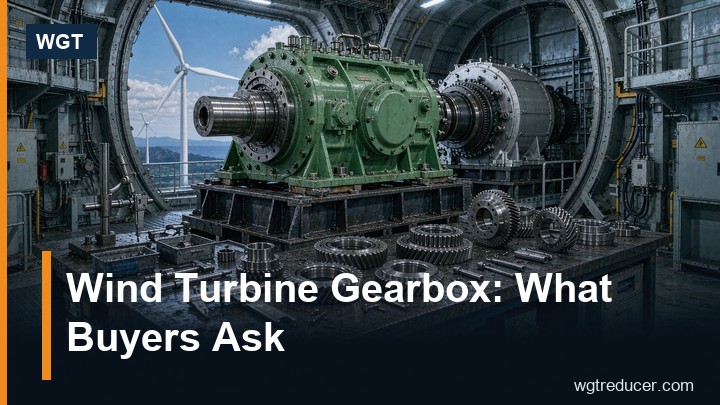
Wind Turbine Gearbox: What Buyers Ask | WGT WeiGao
Planetary Gearbox for Wind Turbines: What Buyers Ask
A wind turbine gearbox is a speed increaser: it takes the slow, high-torque rotation of the rotor and steps it up to the speed a generator can work with. Because the rotor turns slowly and the generator must turn much faster, the gearbox in a geared turbine works in the hardest regime a gearbox can face — high input torque, variable load, and a duty cycle that never stops. Buyers tend to ask the same handful of questions, whether the project is a new build, a repower or a replacement for a failed unit. This guide answers them in the order they are usually asked.
What a wind turbine gearbox actually does
In a geared wind turbine, the rotor drives the gearbox input shaft at rotor speed. The gearbox multiplies that speed up to the generator's rated input speed and, in doing so, divides the torque by roughly the same ratio. Three consequences follow, and they explain most of the specification:
- Input torque dominates the design. The planetary first stage sees the full rotor torque, so planet count, bearing arrangement and carrier design are all sized by torque, not by power.
- Load is never steady. Wind gusts, tower shadow and grid events all arrive at the input as torque fluctuations, which the gearbox must absorb without transferring every spike to the gear teeth.
The step-up duty is the defining job of a wind turbine speed increaser — worth separating clearly from the smaller gear drives on the same machine: yaw drives and pitch drives are slow, high-ratio positioning drives, not power-transmission increasers.
Why the planetary layout dominates
Almost every geared turbine on the market uses a planetary first stage, and usually several planetary stages in series. The reasons are structural:
- Coaxial arrangement. Input and output share one axis, so the drivetrain fits into a compact nacelle without a chain of offset shafts.
- Torque split. The input torque is divided across several planet gears meshing with one sun and one ring gear, so each mesh carries a fraction of the load — the only way a high-torque first stage fits in a housing a parallel-shaft train could not match.
- Short load path. A well-designed carrier and ring gear keep the torque path short and stiff, which helps both weight and reliability.
Further along the train, many designs pair planetary stages with one or two parallel-shaft helical stages, which handle the higher-speed, lower-torque part of the multiplication efficiently. The same principle, at the smaller end of the range, is what we build into the P series planetary gear reduction unit and the individual P2 planetary gear unit — a coaxial, torque-splitting layout that scales with duty.
The questions buyers actually ask — and the data to have ready
Across turbine enquiries, the same questions recur. The table below lists them with the answers a supplier should give, and what you should prepare so the answer is concrete rather than generic.
| Buyer question | What a real answer includes | What you should have ready |
|---|---|---|
| Can you match our existing unit? | Willingness to work from drawings, nameplate photos or a dimensioned sample — not just a ratio | Turbine model and year, nameplate photos, ratio, mounting interface |
| What ratio and stages do we need? | A calculated answer from rotor and generator speed, with stage layout explained | Rotor speed range, generator rated speed and type |
| How is torque fluctuation handled? | Planet arrangement, flexible pin or carrier design, how the first stage rides through gusts | Site wind class if known, failure history on comparable units |
| What about lubrication and cooling? | Oil type and fill, filtration, cooling circuit matched to the nacelle | Site ambient temperature range, available cooling interfaces |
| How do we monitor condition in service? | Sensor provisions: oil particle counters, bearing temperature points, vibration pads | Whether the SCADA can accept additional gearbox channels |
| What spares and support exist? | Seals, filters, bearings and sensors listed as service items, with a documented service route | Fleet operator's expected service intervals |
Two of these questions deserve emphasis. On matching an existing unit: a serious replacement supplier works from the physical evidence — nameplate, drawings, the failed unit itself — and will say plainly what they need before they commit. On condition monitoring: the question is not only whether sensors are fitted today, but whether the housing provides the mounting and access to fit them later.
Lubrication, cooling and condition monitoring
Most wind turbine gearbox failures reported in fleet statistics are bearing failures, and most trace back to lubrication: contamination, water, or oil that has lost its film strength under the loads a first-stage planet bearing sees. Push a supplier on three points:
- Oil specification and filtration. The oil must hold film strength at the actual contact stresses of the planetary stage, and the filtration must be fine enough to keep particles out of the planet bearings, among the most loaded rolling contacts in any industrial machine.
- Cooling matched to the site. A hot, dry site and a cold, offshore site stress the oil system in opposite ways; size the cooling circuit for the site's worst case, not the catalogue average.
- Monitoring provisions. Temperature points on the planet bearings and oil, a vibration sensor strategy agreed with the SCADA supplier, and where practical an oil condition or particle-counting line — what gets measured gets maintained before failure.
The same discipline applies to any planetary unit in a hard-duty position — the industrial equivalents are documented in our two-stage planetary gear transmission range, where the first-stage bearing loads and lubrication questions are the same in miniature.
Replacement units and long-term support
For buyers whose need is a replacement rather than a new-build supply, the conversation shifts from ratio tables to evidence. Bring the nameplate, the mounting drawings and, if the unit is out of the turbine, the failed gearbox itself. A capable manufacturer will reverse-engineer the interface, confirm the ratio and torque path, and quote a unit that bolts into the existing drivetrain.
Ask the same question of the factory that you would ask of the gearbox: what happens in year five? A spare-parts list, a named service route and a documented inspection procedure matter more at five years than a week of delivery time at order placement. Our after-sales service page sets out that commitment, from commissioning support to oil-system troubleshooting.
Get advice from WGT
WGT WeiGao Transmission has manufactured gearboxes and gear reducers since 1988, including planetary units for high-torque industrial duty. Run your duty point through the WGT Motor & Gearbox Online Selection System, then send your turbine model, speed data and interface requirements through our contact page — our engineers will return a specific recommendation with drawings and a confirmed delivery time.
Frequently asked questions
What does a gearbox do in a wind turbine?
It is a speed increaser. The rotor turns slowly with very high torque; the generator needs a much higher speed at low torque. The gearbox multiplies speed and divides torque between the two, keeping the generator and power electronics in their efficient range.
Why is the first stage of a wind turbine gearbox planetary?
Because the full rotor torque enters there. A planetary layout splits that torque across several planet gears on a coaxial axis — the only practical way to carry the load in the space a nacelle allows. Later stages are often parallel-shaft helical.
Can a failed wind turbine gearbox be replaced with a non-identical unit?
Yes, provided the replacement matches the mounting interface, the ratio band and the torque capacity, and stays compatible with the turbine's control system. Work from the nameplate, drawings and the failed unit itself, and have the supplier confirm the match in writing before manufacture.
