


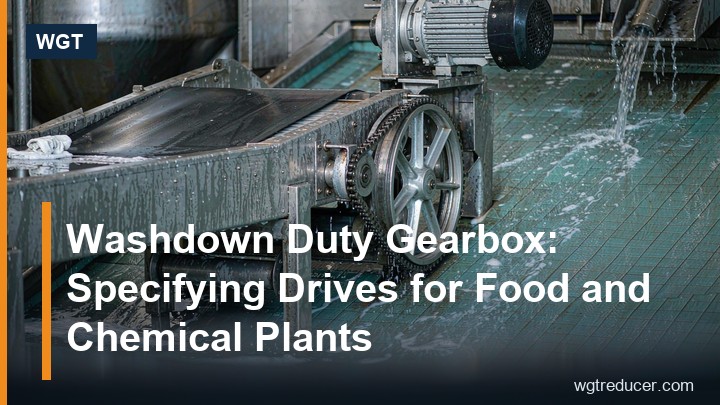
Washdown Duty Gearbox: Specifying Drives That Get Hosed | WGT
A washdown gearbox is not a standard gearbox with a higher IP number on the label. It is a unit whose finish, breather, seal arrangement, fastener grade and surface geometry were all chosen for a room where a hose is used every shift, foam is left to dwell, and the floor is wet all day. Buy the IP rating alone and the unit will still be the one that fails first - at the breather, at the shaft, or at a paint blister on the foot.
What Washdown Duty Actually Means
Three separate stresses arrive together in a washdown room, and they are usually described as one.
- Water under pressure. A washdown hose delivers far more energy than rain. It finds gaps that a splash test never touches, and it does so at close range and from below.
- Chemistry. Caustic at 1–3 per cent and 60–80 °C, chlorinated alkaline foam, acid rinse, and in some plants peracetic acid. Each attacks a different part of the specification.
- Thermal cycling. A warm case hit with cold rinse water condenses moisture inside itself. That is how water gets into oil without a single failed seal.
A unit specified for the first stress and not the other two is a unit that will be replaced on a two-year cycle and blamed on the supplier.
IP Ratings and What They Do Not Tell You
The IP number states protection against solids and liquids under defined test conditions. It says nothing about chemical resistance, nothing about how long a seal lasts when it is sprayed daily, and nothing about whether the case can be cleaned.
IP69K is the rating most often quoted for food plant equipment, and it is a good starting point - but it is a test of a new unit, in a defined pattern, once. It is not a promise about year three. The specification that survives year three is the one that also fixes the breather type, the seal arrangement and the paint system.
Paint, Fasteners and the Chemistry Room
Paint fails on washdown equipment in a predictable order: at edges and weld seams first, then around fasteners, then across large flat areas. The mechanism is usually under-film corrosion - a chip or a pinhole lets electrolyte in, and the coating lifts from underneath.
What to specify:
- Surface preparation stated as a grade, not as a word. A paint system applied over mill scale will fail regardless of its chemistry.
- A system rated for the actual chemistry. Alkali resistance and acid resistance are different properties; a plant that uses both needs a system tested against both, or a stainless case.
- Fasteners in a grade that matches the case. Stainless fasteners into a painted casting are common and acceptable; plated steel fasteners on a stainless case are not, because the fastener corrodes and the stain runs.
- Touch-up material supplied with the unit, so a chip is dealt with in the week it happens rather than at the next shutdown.
Where chlorides are present - chlorinated foam, saline product, coastal air - a painted cast-iron case needs a system chosen for chloride, and 304 stainless is not sufficient on its own. 316 is the grade that holds in a chloride environment, at a cost that is worth stating openly at quotation stage rather than discovering after the first inspection.
The Breather: Smallest Part, Most Failures
A gearbox must breathe: it warms, its air expands, and it must let that air out without letting the room in. In a washdown room the standard cap breather is an open door.
Three arrangements work.
- A membrane breather that passes air vapour but not liquid water. Cheap, effective, and the default choice for most washdown units.
- A breather piped to a protected position - inside a guard, or up under a cover where a hose cannot reach. Good where the unit is sprayed from directly above.
- A sealed-for-life unit with an expansion chamber instead of a breather. Appropriate for small units with a long oil life, and increasingly common on compact gearmotors.
What does not work is a standard breather with a rag taped over it, which is what a plant does when the specification was never settled. Condensate inside a case is the single most common cause of premature bearing failure on washdown equipment, and it usually enters through the breather.
Seals, Shafts and the Grinding Paste Problem
At the output shaft, three things meet: oil inside, wash water and product outside, and a rotating surface between them. Once product reaches the seal lip, the mixture behaves like a lapping compound and wears both the lip and the shaft.
The arrangement that lasts has four features:
- a protected seal position, set back from the case face so a direct jet cannot reach the lip;
- a slinger or flinger on the shaft that throws water and product clear before it reaches the seal;
- a counterface that stays smooth - a shaft that has pitted in storage will destroy a new seal in weeks;
- a drain path that lets the space between seal and product be flushed.
On vertical units the same logic applies at the top, where water pools. A top-entry agitator or a vertical hollow-shaft unit on a tank needs a cover that sheds water rather than a recess that holds it - the arrangement used on our vertical hollow shaft unit for washdown duty.
Cleanability Is a Design Property
A drive that cannot be cleaned will not be cleaned, and a drive that is not cleaned becomes a biofilm site. This is not only a hygiene question - it is a corrosion question, because damp product held against a painted surface is exactly the condition under which coatings fail.
| Check | Why it matters in a washdown room |
|---|---|
| No upward-facing pockets or recesses | They hold water and product after every wash |
| Covers and inspection plates with gaskets, not sealant alone | Sealant cracks; gaskets can be renewed |
| Drain plug reachable without tools | A drain that needs a spanner is never opened |
| Lifting points that do not trap water | Eyebolts with blind holes pool water |
| Smooth transition between case and feet | Product accumulates in a square corner |
| Nameplate fixed with rivets or adhesive, not slotted screws | Slots fill and cannot be cleaned |
| Guard design that drains | A solid guard becomes a water trap |
None of these items adds meaningful cost at order stage. Most of them are decisions rather than components, which is why they belong in the specification conversation rather than in a complaint eighteen months later.
Mounting choice is often made for structural reasons and then turns out to matter for hygiene. A foot-mounted unit is easiest to shim and inspect, but its feet create corners where water sits. A flange-mounted unit clears the floor and is easier to hose underneath, at the cost of a machined face that must be protected during washdown. A hollow-shaft unit removes the coupling and its guard entirely - fewer surfaces, fewer places for product to collect, and a shorter cleaning route around the shaft.
Motor and Gearbox as One Package
In a washdown room, the motor is usually the weaker half. A gear unit rated IP66 bolted to a motor rated IP55 is an IP55 installation.
Decide early whether the package is:
- a washdown motor with its own sealed terminal box, condensation drain and correct finish;
- a stainless motor, where the chemistry demands it;
- a motor protected by its position, under a cover or outside the wash zone, connected through a shaft that passes a wall.
Also confirm the lubricant. Food plants increasingly require an H1-registered lubricant for incidental contact, and a unit filled with a standard mineral oil cannot be upgraded later without a flush. The oil grade belongs on the order, together with the quantity, because the site will otherwise fill it with whatever is on the shelf.
The Enquiry That Gets a Washdown Unit Right
Six lines, and the quotation arrives usable.
- The chemistry - caustic concentration and temperature, acid rinse, chlorinated foam or peracetic, and how long foam is left to dwell.
- The wash method - hose pressure, nozzle type, temperature, and whether the drive is sprayed directly or only splashed.
- Ambient and room condition - temperature range, humidity, and whether the room is sealed and cooled or open and steamy.
- The duty point - motor speed, required output speed and torque, so the frame can be confirmed against the plant's own figures, which is what the selection system is for.
- Mounting and orientation - foot, flange or hollow shaft, and the shaft angle if the unit is not horizontal.
- Documentation - material certificates, lubricant registration, and any required paint colour or hygiene standard.
A photograph of the mounting position, taken from where the hose operator stands, tells us more about the real exposure than any datasheet line.
FAQ
Is an IP69K gearbox automatically suitable for food plants?
No. IP69K describes resistance to a high-pressure, high-temperature jet on a new unit. It says nothing about chemical resistance, cleanability, or how the seal behaves after two years of daily washing. The finish, the fasteners, the breather and the seal arrangement have to be specified as well.
Can I use a standard gearbox with a stainless cover instead?
Sometimes, in a light-splash area with neutral chemistry, that is a sensible compromise. In a room with caustic foam or chloride, the cover is not the weak point - the feet, the fasteners and the shaft are, so a partial upgrade only moves the failure.
Why does water appear in the oil when no seal has failed?
Condensation. A warm case cools overnight or under a cold rinse, and moist air is drawn in through the breather as the case contracts. A membrane breather, or a breather piped to a protected position, is the fix; changing seals will not stop it.
Which lubricant should a washdown unit use?
If the plant requires incidental food contact registration, an H1 lubricant, and the unit has to be filled with it at the factory because a later change needs a flush. Otherwise the standard grade for the ambient, recorded on the nameplate together with the quantity.
How often should a washdown drive be inspected?
More often than a dry-room drive, and the inspection is mostly visual: paint condition, fastener condition, water in the oil, and product build-up around the seal. A ten-minute check each month is cheaper than any of the failures it prevents.
Washdown duty is a specification, not a rating: fix the finish for the chemistry, the breather for the condensation, and the seal arrangement for the product, then confirm the motor meets the same standard.
