





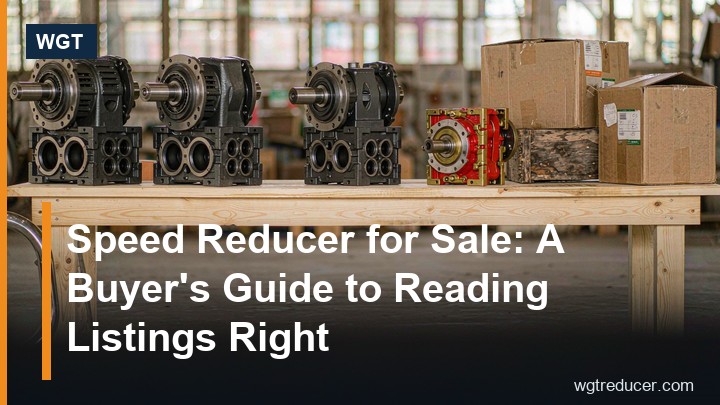
Speed Reducer for Sale: A Buyer's Guide to Reading Listings Right
Most buyers who type "speed reducer for sale" into a search engine already know the machine they need - what they are really shopping for is the confidence that the frame behind the photograph will survive their duty. That confidence is not sold in a listing; it is built from four or five numbers that any honest supplier can produce in minutes. This guide walks through what a speed reducer listing actually tells you, what it deliberately leaves out, and how to convert a good-looking listing into a purchase that runs for twenty years instead of twenty weeks.
The short version: a speed reducer is chosen by ratio, torque, service factor and mounting - in that order - and priced afterwards. A listing that leads with price and cannot answer the four numbers is selling a photograph. A listing that leads with the numbers is selling engineering, and it is worth the extra email.
What a Speed Reducer Listing Actually Describes
A typical listing carries a type string, a photograph, a ratio range and a frame size. The type string is the most information-dense item on the page, because a well-structured designation encodes the family, the number of reduction stages, the gear arrangement, the output shaft form, the mounting style and the frame size - everything a buyer needs to shortlist before the first conversation. Learning to read it turns browsing into screening.
Take a parallel-shaft industrial unit such as the MC2PLST08 solid shaft gear reducer on our product pages. The string alone tells a buyer it is a two-stage helical case, horizontal build, solid output leaving through a coupling, reaction taken by a torque arm, frame eight. No photograph conveys any of that. When comparing listings across suppliers, start from the string and let it organise the comparison - two listings of the same string should differ only in price, documentation and delivery, and if they differ in substance, one of the strings is being used loosely.
The Four Numbers That Decide the Purchase
Whatever the listing says, four numbers settle whether a unit fits. They are worth writing down before contacting any seller, because each one eliminates or confirms a whole family of listings.
| Number | What it answers | Where buyers go wrong |
|---|---|---|
| Ratio (i) | Turns motor speed into the speed the driven machine needs | Comparing output speed only, ignoring the motor speed it assumes |
| Output torque | Whether the frame carries the load continuously | Taking peak torque from a datasheet without the duty cycle behind it |
| Service factor | The margin for starts, shocks and hours | Accepting a generic 1.0 where the duty class demands more |
| Mounting | Whether the frame lands on the structure you actually have | Ordering a foot-mounted case where a torque arm was the right answer |
Ratio is simple arithmetic - motor speed divided by output speed - and any listing that quotes a ratio range can be checked against it in seconds. Torque and service factor belong together, because a frame that is generous at continuous torque can be marginal on a duty with hard starts. Mounting is the number buyers forget until installation day, when the difference between feet and a torque arm decides whether the drive bolts to existing steel or demands a new foundation. A seller who volunteers all four numbers, unprompted, has already passed most of the qualification.
Matching the Frame to the Duty
Frame selection is where buying becomes engineering, and it is the step that marketplace listings cannot do for you. The same ratio is available across an entire band of frame sizes; what pushes the choice up the band is the duty profile - hours per day, starts per shift, shock character, ambient temperature and the service life the plant expects. A light packaging conveyor and a mine trunk belt can share a ratio and sit four frames apart.
The honest way through is a short duty statement: the driven machine, the kilowatts, the speeds, the daily hours, the nature of the load and the environment. Our online selection system accepts exactly those inputs and returns a ratio and frame to start from, which converts a vague "send me a price" message into a conversation a supplier can answer precisely. Buyers who arrive with a duty statement consistently get better machines for the same money, because the supplier's engineer is selecting rather than guessing.
Price Signals: What Cheap Listings Hide
Price is the least informative number on a listing, but it is not meaningless - it signals what has been left out. A quotation that undercuts the field usually differs in oil specification, sealing package, breather type, paint system, documentation depth or the quality of the bearings behind the case. None of those differences appear in a side-by-side table of ratios and prices, and every one of them reappears in year two as heat, leaks, noise or a stalled delivery of spares.
The discipline that keeps price honest is line-by-line comparison against your own requirements, not against the other quotation. Ask what oil grade ships in the case, whether the breather is filtered, what the seal set is, whether an acceptance test record is provided, and what the spares list looks like. Suppliers who answer those five questions in writing are competing on the machine. Suppliers who answer with a further discount are competing on your optimism.
From Listing to Enquiry: The Conversation That Matters
A good listing is an opening move, and the reply it earns should be a proper enquiry. The conversion is short: state the duty statement from the section above, add the ambient in the worst month, name the mounting survey - what steel exists, where the arm can reach, how the drive will be maintained - and ask for the selection reply to show its load cases and service factor basis. That single message separates the suppliers worth meeting from the sellers worth scrolling past.
It also protects the buyer's side of the deal. The enquiry should state what will be judged: that the reply must show both load cases where the duty demands it, that an acceptance test record ships with the unit, and that the documentation set - drawings, part numbers, oil specification - arrives with the machine rather than after an argument. These lines cost nothing to write and are the difference between a purchase and a promise.
Lead Time, Spares and the Afterlife
Two more comparisons belong in every buying decision before the order is signed. The first is lead time - not just to first delivery but to a repeat order, because a frame that runs well tends to multiply across a site. The second is the afterlife: the consumables the drive will need (seals, breathers, bushings, coupling elements, oil) and whether the supplier can supply them years later. A unit whose small parts are unobtainable is a twenty-year machine with a two-year calendar.
Buyers who ask these questions early usually find that the answers differentiate suppliers more sharply than price does. A supplier who can quote a spares shelf with the first order and hold delivery terms for a repeat batch has told you how they treat customers after the invoice - which is, ultimately, what a speed reducer purchase is really testing.
FAQ
What size speed reducer do I need for my motor?
Start from the arithmetic: divide your motor speed by the output speed the driven machine needs to get the ratio, then check the output torque against the frame's rating with a service factor suited to the duty. Those three numbers - ratio, torque, service factor - decide the frame; our selection guide walks through each step with worked examples.
Why do similar-looking speed reducers have such different prices?
The differences hide in the specification behind the case: oil grade, seal set, breather type, bearing brand, paint system, testing and documentation. Two listings can quote the same ratio and frame while specifying very different machines, which is why line-by-line comparison beats price comparison every time.
Can I buy a speed reducer directly from a listing without an engineering check?
You can, and for light duty it often works. For continuous duty, shock loads, elevated ambient or safety-relevant applications, the listing should only start the conversation - the ratio, torque, service factor and mounting must be confirmed against your actual duty before the order, ideally with a written selection reply.
How long does an industrial speed reducer take to deliver?
Standard frames in common ratios are typically available in weeks; large or heavily customised units take longer, and the honest range is stated per order rather than per catalogue. Ask for first-delivery and repeat-order terms together, since a frame that performs well rarely stays a one-off purchase.
What information should I send when requesting a quote?
Send the duty statement: driven machine, motor power and speed, required output speed, daily hours, load character, ambient conditions and the mounting arrangement you have available. Suppliers can return an exact frame and ratio from those lines; without them, any quotation is a guess wearing a price tag.
Conclusion: Buy the Numbers, Not the Photograph
The phrase "speed reducer for sale" describes half a transaction; the other half is the duty the machine must survive. Buyers who lead with the four numbers - ratio, torque, service factor, mounting - and hold suppliers to a written selection reply buy drives that disappear into the plant's routine for decades. Buyers who lead with price buy the same conversation twice, once at purchase and once at the breakdown.
When you are ready to turn a shortlist into a selection, send your duty through the online selection system or compare frames directly on our product pages - the MC2PLST08 solid shaft gear reducer page shows how a listing should read when the numbers come first. The right frame for your duty is almost certainly in production somewhere; the buying process above is how you make certain it is the one that arrives.
