


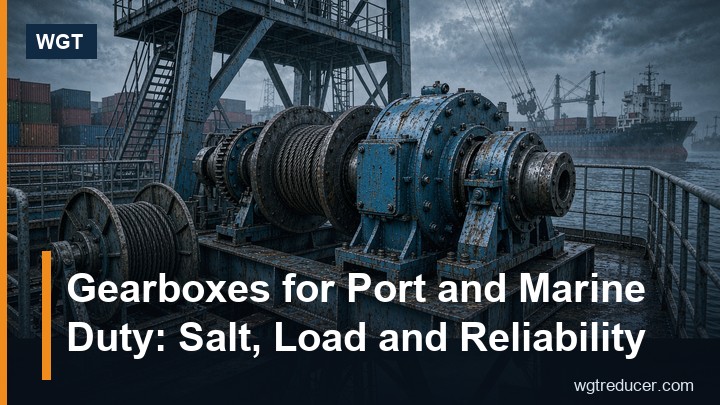
Gearboxes for Port and Marine Duty: Salt, Load and Reliability
The short answer first: an industrial gearbox specified for port and marine duty is chosen by two things the catalogue never shows - the salt it will breathe for twenty years and the shock it will absorb every working cycle. Torque tables look identical on a supplier's desk and a quayside; the difference between a drive that lasts and one that does not is written in the environment sheet, the duty profile and the sealing package.
Ports concentrate every hard duty in one place: container cranes that stop full loads thousands of times a season, winches that hold against gravity, conveyors that run through spray and dust, and a corrosive maritime atmosphere that attacks paint, fasteners and seals around the clock. This page separates those demands and shows how to specify a drive that answers all of them.
What Port and Marine Duty Means for a Drive
A port is a repeating machine, like a factory - except the factory moves, the weather is uncontrolled, and the product is steel hanging on a rope. Every drive on the quay shares three conditions: cyclic loading with frequent starts, shock events from load snatch and emergency stops, and an atmosphere that carries salt, humidity and abrasive dust in the same wind.
Marine-adjacent duty adds a fourth: the drive may sit idle for hours and then be asked to work at full rating immediately, with condensation in the case and the oil film partly drained down. The specification that succeeds treats all four as design inputs, not as afterthoughts. A gearbox rated correctly but sealed for a dry workshop will disappoint faster than one rated a size up and sealed for the actual quay.
Salt: The Environment That Rewrites the Specification
Salt is the quiet buyer at the table. Marine air carries chloride that condenses on every surface, wicks into every capillary gap and converts ordinary corrosion into a structural topic within a few winters. On a drive, the attack begins at the edges: paint cut lines, fastener heads, the pad-to-structure joint, and the lowest seal area where moisture collects.
The answers are ordinary and they must be written into the order. Coating systems specified for a C5-class marine atmosphere rather than a generic industrial one; stainless or coated fasteners at every interface; stands and brackets detailed so water drains instead of pooling; and breathers chosen for humid, salt-laden air, inspected as routinely as the oil. Plants that issue a one-page environment sheet with the enquiry get packages traceable to it; plants that send a model number get the standard paint, and the standard paint was never asked about salt.
Duty Profiles: Cranes, Winches and Conveyors
Each drive position on the quay lives a different mechanical life, and sizing them identically is the most common and most expensive mistake in the class.
| Drive position | Load character | What the specification must cover |
|---|---|---|
| Hoist and boom luffing | Gravity in one direction, braking shock every cycle | Duty class, braking torque through the train, holding capability |
| Slewing | Starts and stops of a large rotating mass, wind loading | Inertia, frequent starts per hour, skew and slew-ring friction |
| Travel and trolley | Wheel-rail shock, skew, rail joints | Shock allowance, torque sharing between drives, high cycle counts |
| Quayside conveyors | Continuous running, dust and spray, jam events | Thermal rating, containment of blockage torque, sealing |
A hoist drive that ignores braking shock will wear its gear train from the back; a travel drive sized without skew allowance will express the omission as premature wear; a conveyor drive chosen on running torque alone will meet its first jam with a trip instead of a margin. The duty profile is therefore the first page of every port enquiry.
Sizing for Shock, Stalls and Starts
Port machinery rarely fails its drives at rated load. It fails them at the events: the snatch when slack rope comes tight, the emergency stop that dumps kinetic energy into the train, the stall when a container lands before it is expected. A practical specification states those events in numbers - estimated starting torque, worst-case shock, starts per hour - and asks the supplier to confirm margins against them.
For the heavy right-angle positions - slewing, travel and the larger conveyors - the hardware class is typically a hardened bevel-helical industrial gearbox of the kind shown on the K97 heavy-duty gear reducer page, where the service factors and mounting variants for shock duty are laid out. Whatever family is chosen, the check is the same: mechanical rating for the running case, a service factor justified by the declared duty class, and thermal capacity confirmed for the actual starts per hour, because frequent starting turns a thermally marginal unit into a hot one.
Structure, Torque Reaction and Mounting
A port drive reacts its torque into steel that is also moving, flexing and corroding. The mounting arrangement - feet, torque arms or flange - must be positioned over primary structure, shimmed without forcing, and checked after the first weeks of service as the foundations settle. On slewing and hoist drives, the reaction path under braking deserves its own line in the structure drawing, because every stop sends the torque backwards through the mount.
The paperwork habit that pays here is the interface exchange: shaft dimensions, keyway tolerances, runout limits and reaction loads exchanged as drawings before the order. Ports that do this commission in days; ports that improvise on site spend their commissioning week machining and explaining.
Sealing, Breathing and the Quayside Wash
Water finds a horizontal gearbox from above and below: rain and wash water from the deck, condensation from within. The seal package for quayside duty is specified like a washdown package - lip material for the exposure, a labyrinth or slinger ahead of the lip where hosing or spray is routine, and a breather that will not turn every thermal cycle into a pressure test of the lowest seal. Drain plugs are positioned so a flush does not pool, and the inspection loop - seals, breather, pads, paint - is attached to a schedule the terminal already runs. For buyers mapping their own duty before issuing an enquiry, the online selection system is a practical starting point for frame and ratio candidates that can then be checked against the events above.
Building the Port Enquiry
The enquiry that gets a quayside drive right reads like a shift report: the drive position and driven machine, the duty class and starts per hour, the shock and stall events with numbers, the environment - salt, spray, washdown, temperature band - the mounting steel available, and the acceptance tests expected. Each line is one row in an email; each omission is a site visit inside a berth window nobody wanted to spend. Before issuing it, a shortlist can be sanity-checked through the selection system, and the reply worth holding a supplier to answers the events, the environment and the thermal case in the same document.
Frequently Asked Questions
How much corrosion protection does a port gearbox need?
Enough for the atmosphere it actually breathes, which at a working quay is typically a high marine category rather than a standard industrial one. The practical specification names the coating system and film thickness, the fastener materials, and the drainage details - and asks the supplier to confirm each against the declared environment.
Which gearbox families suit port machinery?
Heavy cyclic positions generally use hardened helical and bevel-helical industrial ranges with generous service factors; compact wheel-mounted positions often use shaft-mounted or torque-arm units; smaller winches may use worm or helical-worm sets where holding and quiet running matter. The family follows the duty profile, not the other way round.
How often should quayside drives be inspected?
A short monthly loop - paint, pads, breather, seal area, fasteners - catches marine corrosion while it is still a touch-up, with oil sampling on a fixed calendar and seal work inside planned windows. The rhythm matters more than the length: a loop attached to the terminal's own schedule survives; a separate ritual does not.
Can standard industrial gearboxes work near the coast?
Yes - with the environment package specified. The gear train does not know it is near the sea; the paint, seals, fasteners and breathers do. A standard family ordered with a marine-grade protection package, correct drainage and a realistic inspection loop runs its full life on the quay. Ordered without it, the same family becomes a corrosion case study within a few winters.
