


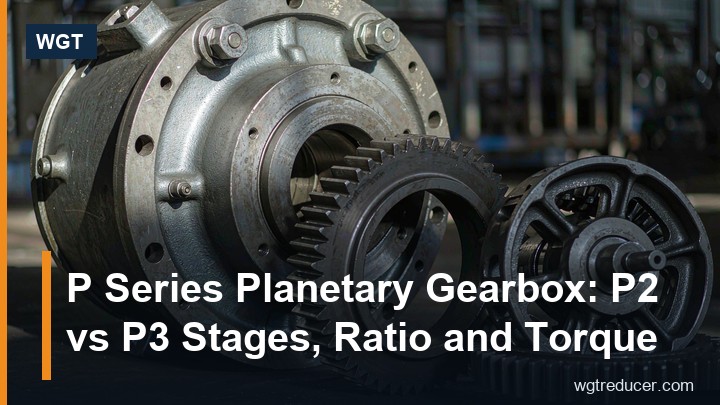
P Series Planetary Gearbox: P2 vs P3 Stages, Ratio and Torque
A P series planetary gearbox earns its place in a plant wherever a motor needs to lose a lot of speed and gain a lot of torque without the drive growing sideways: the input and output sit on one axis, the case stays compact for the torque it carries, and the stage count - P2 for two planetary stages, P3 for three - is the lever that sets how far the speed falls. This guide explains what the designation describes, how the ratios multiply through the stages, and how to decide between a two-stage and a three-stage frame for a given duty.
What the P Designation Actually Describes
In a coaxial planetary layout the sun gear at the centre receives the input, three or more planet gears mesh around it inside an internal ring gear, and the carrier - the plate holding the planet pins - turns as the output. Because the planets share the load between them, the gear faces can be smaller than in a parallel-shaft train of the same torque, which is where the planetary reducer gets its famous torque density: more torque per kilogram of gearbox than almost any competing layout.
The number after the P counts the planetary stages in series. A P2 P3 planetary range therefore offers two builds: two stages for moderate reductions, and three stages stacked coaxially for the deep ratios. Each additional stage multiplies the ratio and adds one set of meshes - a little efficiency lost, a little more length added - which is why stage count, not case size, is usually the first selection decision.
Because the input shaft and the output flange share one axis, the drive installs in line with the motor and the driven shaft. That geometry is the quiet advantage of the coaxial planetary arrangement: it drops into machines where a right-angle or offset gearbox would force a redesign of guards, couplings and foundations.
How Planetary Ratios Multiply Through the Stages
A single planetary stage's ratio follows from the tooth counts of the sun, planets and ring, and practical designs land in a band of roughly 3:1 to 10:1 per stage. The stages multiply: a two-stage build of 5:1 followed by 4:1 delivers i = 20, and a third stage of 5:1 lifts the total to i = 100. The table shows how the two builds of a P series planetary gearbox typically divide the work.
| Configuration | Typical total ratio band | Efficiency character | Suited to |
|---|---|---|---|
| P2 - two planetary stages | roughly i = 10 to 60 | Two meshes in the path; high efficiency retained | Conveyors, mixers, agitators, winches |
| P3 - three planetary stages | roughly i = 60 to 400+ | Three meshes; slightly lower overall efficiency | Slow heavy shafts, hoists, trackers, extruder heads |
Two practical consequences follow from the multiplication. First, the output speed falls fast as stages stack, so a duty that only needs i = 20 does not want a three-stage unit - the third stage would cost efficiency and length for a ratio the machine never asked for. Second, deep ratios mean low output speeds, and low output speeds make the output bearing and its lubrication carry more of the radial load story; the mounting arrangement deserves as much attention as the ratio.
Torque Density and Why Coaxial Matters
The load sharing between planets is the whole engineering trick. Three planets carrying one load divide the tooth forces, so each mesh works at a fraction of the torque, and the case that results is short and round rather than long and boxy. For machine builders this translates into specific, practical freedoms: the drive can hang on a motor flange, tuck into a mixer bridge, or bolt onto a drum end where a parallel-shaft case simply would not fit.
The coaxial planetary geometry also simplifies alignment. With input and output on one axis, the motor-drum-shaft line is straight, couplings see less misalignment, and sealing points stay predictable. In plants where many drives repeat along a line of machines, one mounting arrangement covers the whole family, which is why planetary reducers are so often standardised across a factory floor.
Torque rating grows with case size across the series, and the same stage logic applies at every size: pick the frame by the torque the duty needs with its service factor applied, then pick the stage count by the ratio. The two decisions are independent, and mixing them up - buying stages for torque - is the most common selection error in this family.
P2 or P3: Choosing the Stage Count
The honest way to choose is to compute the ratio first. Motor speed divided by the required output speed gives the target; if it lands inside the two-stage band, the P2 build wins on efficiency, length, price and one fewer set of spares. If the duty needs the deep end - a hoist drum turning at a few revolutions per minute, a tracking drive crawling around a solar field, an extruder head on a slow metering duty - the P3 P2 P3 planetary comparison ends in favour of three stages.
Starting torque and shock behaviour also weigh in. Planetary stages share shock loads well, but each added stage adds inertia and mesh compliance, and applications with hard stops and frequent reversals are usually better served by the shortest train that carries the duty. Where the machine holds a lifted load, a holdback or brake option is an order-time decision for either build, and it should be written into the enquiry rather than retrofitted.
One more consideration is noise and vibration. A two-stage coaxial planetary runs with two mesh frequencies; the three-stage adds a third and a little more length for resonance to live in. For most industrial duties the difference is academic, but on machine tools and positioning duties the shorter train is measurably the calmer one.
Mounting and Motor Integration
Most P series planetary gearbox frames arrive configured for one of three connections. A flanged input with a motor adapter carries the standard IEC motor directly and suits new machines and retrofits alike. A shrink disc on the input suits line-shaft installations where the drive hangs on an existing shaft. A solid input shaft with a coupling suits the classical foundation-mounted arrangement. On the output side, the choices mirror the inputs: a splined or keyed hollow bore, a flange, or a shrink-disc output for torques that have outgrown keys.
Whichever combination a duty needs, the connection details belong on the enquiry drawing, not in a phone call after the order. The shrink-disc seat, the flange pilot and the bolt circle are machined features with tolerances, and a frame supplied with the wrong pilot is a delay measured in weeks. Plants that standardise one motor family across many drives usually standardise the adapters at the same time, and the stores shelf thanks them for it.
Typical Duties Across Industries
The layout's strengths - coaxial geometry, torque density, deep ratios in a short case - explain where planetary reducers appear most: screw and belt conveyors needing compact head drives, mixers and agitators where the drive hangs from the bridge, hoists and winches where drum space is scarce, rotary table and tracking drives that crawl all day, and extruder and kneader heads where torque meets a small footprint. In each of these, the competing parallel-shaft or bevel-helical build is usually bigger, not stronger; the planetary frame wins the space, not the spreadsheet.
That said, the coaxial planetary layout is not automatically the answer. Where the machine already offers room for a footed case, where a low-speed parallel shaft is preferred for its robustness, or where the duty's ratio sits comfortably in a helical band, the larger family often wins on spares commonality with the rest of the plant. The selection question is always the same three numbers - speed, torque, duty class - and the layout follows from them.
Maintenance That a Planetary Frame Actually Needs
Planetary stages run in a shared oil sump, and the maintenance routine is refreshingly short: correct oil grade and level, a breathing breather matched to the dust load, temperature read at the same point each round, and an annual oil sample trended over the years. Because the stages are stacked coaxially, the oil serves several meshes at once, and contamination that enters the output seal travels further than it would in a longer train - which is why seal condition and breather cleanliness carry more weight here than in most families.
The output bearing arrangement deserves a specific mention. Deep-ratio units turn slowly and often carry heavy overhung or axial loads, and their bearings are selected against the mounting arrangement the order described. If the machine's structure changes after the order - a longer drum, a heavier load - the drive's duty has changed with it, and the selection should be revisited rather than assumed.
Frequently Asked Questions
What does P2 and P3 mean on a planetary gearbox?
The number counts the planetary stages in series. P2 means two stages and suits total ratios from roughly 10 to 60; P3 means three stages stacked coaxially and reaches the deep ratios - several hundred and beyond - that slow heavy shafts need. Each stage multiplies the ratio and adds one mesh, so the shortest train that carries the duty is usually the most efficient choice.
Why is a planetary reducer so compact for its torque?
Three or more planet gears share the load between the sun and the ring gear, so each tooth mesh works at only a fraction of the output torque. The load sharing lets the gears and case be smaller than a parallel-shaft build of the same rating, which is where the torque density comes from - and because input and output share one axis, the whole drive installs in line with the motor.
How do I decide between a P2 and a P3 frame?
Divide the motor speed by the required output speed. If the result sits in the two-stage band, choose P2 - you gain efficiency, lose length and save a set of spares. If the duty needs the deep ratios only a third stage provides, P3 is the honest answer. Torque and service factor then fix the frame size independently of the stage count.
Can a planetary gearbox hold a suspended load?
Not by itself. A planetary train is not self-locking, so a hoist or elevator duty needs a holdback or a brake - built into the unit or carried on the motor extension - and that choice must be made at order time. Declare the back-running risk in the enquiry and the correct option arrives fitted, rather than being discovered during commissioning.
Specifying One With Confidence
A P series planetary gearbox enquiry closes quickly when it carries the three selection numbers - motor speed, required output speed, and the torque with its service factor - plus the connection facts: input arrangement, output shaft or flange, mounting position, and any holdback or brake option the duty implies. With those lines filled, the reply is a firm quotation and an outline drawing, and the machine proceeds on schedule.
If you are comparing a coaxial planetary build against a parallel-shaft alternative for a live duty, browse the industrial gear units on our site, or run your speed, ratio and torque through the online gear reducer selection system and send the result with your enquiry. We answer stage-count questions with arithmetic, and quotations with the outline drawing your fitter will need.
