


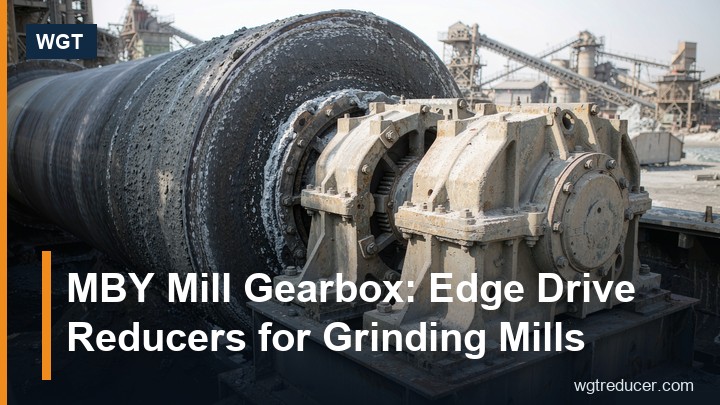
MBY Mill Gearbox: Edge Drive Reducers for Grinding Mills
A grinding mill turns slowly, weighs hundreds of tonnes with its charge, and never asks for anything gently. The reducer that drives it is therefore chosen on a different logic from a conveyor gearbox: torque arrives in waves as the charge cascades, starting is a controlled event rather than a switch, and the unit is expected to run for twenty years on a foundation that settles at its own pace. The MBY mill gearbox is one of the standard answers to that problem - a parallel-shaft, case-hardened reducer arranged to drive the mill shell from the side through a girth gear.
This guide explains what an edge drive unit does, how the MBY family is arranged, where the load really comes from, and which details decide whether the installation is quiet or troublesome. It is written for buyers and plant engineers comparing arrangements, not as a substitute for a mill builder's drive calculation.
What an Edge Drive Mill Gearbox Does
In an edge drive, the reducer sits beside the mill and its output shaft carries a pinion that meshes with a large girth gear bolted around the mill shell. The gear ratio is split between the reducer and that final open mesh: the reducer does the bulk of the reduction in enclosed, lubricated, case-hardened gearing, and the girth mesh does the last stage in the open, where it is large, slow and inspectable.
That arrangement has consequences worth understanding before the commercial conversation. The reducer is a conventional horizontal unit with feet, so it can be aligned, shimmed and replaced without dismantling the mill. The girth gear and pinion take the final torque at very low speed, which is why their lubrication and enclosure get as much attention as the reducer itself. And because the drive stands beside the mill rather than under it, maintenance access is a crane lift rather than a mill shutdown.
The MBY family is built for exactly this duty: heavy parallel-shaft reductions sized for high torque at low output speed, with a housing stiff enough to hold the mesh under a load that pulses with every revolution of the mill.
Three Ways to Drive a Grinding Mill
Most grinding installations choose between three arrangements. Each has a different cost structure and a different maintenance personality.
| Arrangement | How it works | Strengths | Watch points |
|---|---|---|---|
| Edge drive (MBY and similar) | Reducer beside the mill; output pinion drives a girth gear on the shell | Standard horizontal reducer, accessible, replaceable independently of the mill | Girth mesh alignment and lubrication; foundation stiffness under the reducer feet |
| Central drive | Reducer on the mill axis, output coupled to the shell | Compact footprint; no open girth mesh to maintain | Large slow-speed gearbox; replacement is a mill-scale job |
| Gearless / ring motor | Mill shell becomes the motor rotor | No reducer, no girth mesh; speed fully variable | Highest capital cost; electrical complexity; specialist maintenance |
For a plant buying a mid-size mill or rebuilding an existing one, the edge drive usually wins on maintenance arithmetic: the most expensive wear item is inspectable from the walkway, and the reducer is a piece of equipment the plant's own fitters can align.
Reading the MBY Designation
The letters identify the family - a mill duty, edge drive reducer with parallel shafts - and the number that follows normally refers to a nominal dimension of the unit, in most catalogues the centre distance in millimetres. What the number does not tell you is the whole story of the order: ratio, service factor for the mill's charge and starting regime, thermal rating at site ambient, lubrication arrangement, and whether a holdback or an auxiliary drive is needed for inching and mill positioning.
Treat the designation as the starting point of a specification, not its conclusion. Two units with the same family number can differ in ratio, cooling and instrumentation, and those differences are what determine whether the drive behaves in year eight of a twenty-year life.
Why the Load Profile, Not the Average Torque, Sizes the Unit
A mill's average power is a familiar number, and it is the least useful one for sizing. The torque delivered to the reducer varies through each revolution as the charge lifts and cascades, and it varies over the hour as the charge level, the material hardness and the liner condition change. Add a start against a settled charge and the peak the gear teeth see can be several times the running figure.
Three consequences follow. First, the service factor on a mill drive is not a formality; it is the whole selection, and it should be agreed against the mill builder's starting regime rather than a generic table. Second, the liner condition belongs in the conversation: worn liners change the charge's lifting behaviour and can raise the torque the drive sees at the same power draw. Third, the electrical scheme matters mechanically - a controlled start that ramps the mill up through its critical speed is a different duty from a direct start, and the reducer's bearing arrangement and lubrication must suit the one that will actually be used.
Where a plant has a year of logged motor power on the existing mill, that record is worth more than any catalogue assumption. Converted through speed and efficiency, it shows the shape of the duty, including the peaks the average hides.
Lubrication and Cooling on a Slow Heavy Drive
At low output speed, the limiting problem shifts from tooth stress to heat and film thickness. The gear teeth in a mill reducer move slowly enough that the oil film is generated under high load and low sliding velocity, and the sump has a large thermal mass that takes hours to reach its working temperature - and hours to shed it if the ambient is hot.
Practically, this means the lubrication system is part of the machine rather than an accessory. A forced-feed system with a pressure interlock, a filter that can be changed without draining the sump, and an oil cooler sized for the site's hottest month are ordinary requirements on this class of drive, not upgrades. Oil temperature and pressure are the two readings that tell the operator most about the unit, and both belong on the plant's monitoring system rather than on a gauge behind a guard.
For plants in hot climates, the cooling capacity deserves an explicit check against the ambient the drive cubicle actually reaches. A cooler sized for a European average afternoon will spend a Middle Eastern or South Asian summer at its limit, and the first symptom is usually an oil sample that smells hot before any alarm sounds.
Foundation, Alignment and the Realities of Retrofitting
An edge drive passes its reaction torque into a foundation, and the foundation is the part that is most often taken for granted. The reducer's feet must sit on a bedplate that is level, grouted and stiff enough that the unit does not walk under load; the pinion must align with the girth gear across the full face width; and the whole assembly must tolerate the mill's own thermal growth without loading the gear mesh unevenly.
Retrofits concentrate the risk. A mill built thirty years ago has a foundation drawn for a different reducer, a girth gear with a known wear pattern, and a plant layout that has accumulated pipework and ducting around the drive position. The sequence that works is dull and effective: measure the existing installation before ordering, including shaft heights, centre distances and available space; check the girth gear's tooth condition and note the contact pattern; and agree who is responsible for the alignment and the grouting, because that line is where retrofit projects usually lose their schedule.
The same discipline applies to the open mesh. A new pinion against a worn girth gear will not carry load evenly, whatever the reducer does. If the girth gear is near the end of its life, replacing the pinion alone buys a short improvement and a long argument.
What to Put in the Enquiry
A mill gearbox enquiry is a short document with a lot of content. The table below is the structure that returns a usable quotation rather than a round of questions.
| Item | What to state |
|---|---|
| Mill | Diameter and length, type of grinding, charge and material, installed power target |
| Drive arrangement | Edge drive with girth gear; pinion and girth tooth counts if fixed; existing gear condition on a retrofit |
| Speed | Mill working speed and any variable-speed range; critical speed if the mill will pass through it |
| Starting | Direct, soft start or VSD; how often the mill starts loaded; any inching requirement |
| Duty | Hours per day, days per year, expected liner life and the power trend across it |
| Site | Ambient range, altitude, indoor or outdoor, dust and water exposure, available cooling water |
| Interface | Foundation drawing or measured dimensions, shaft height, available space, lifting access |
| Documentation | Datasheets, GA drawing, oil specification, commissioning and alignment instructions |
Send that and the reply can be checked line by line. Send a power figure alone and the reply will be a frame size, which is the least interesting part of the answer.
Frequently Asked Questions
Is an MBY gearbox the same as a central drive reducer?
No. An MBY unit is an edge drive reducer: it stands beside the mill and drives the shell through a pinion and girth gear. A central drive unit sits on the mill axis and couples directly to the shell, which makes it a much larger, slower gearbox with a different maintenance profile.
Can a mill gearbox be repaired in place, or must it be removed?
Most repairs to the reducer itself require removing it, which is one of the practical advantages of an edge drive - the mill stays in place and the reducer goes to a workshop. Work on the girth mesh is done in situ, during a mill stop.
How often should the oil be sampled?
On a large slow-speed drive, monthly sampling with a full laboratory analysis and a trend record is normal practice, with the first samples taken early in the unit's life to establish a baseline. Water, viscosity, wear metals and oxidation are the four readings that earn their cost.
Why does the drive run hotter in summer even at the same load?
Because the cooler's capacity is set by the temperature difference between oil and cooling air or water. A unit with a thin margin in mild weather will sit at its alarm limit in a hot month, which is why the cooling system is sized against the worst ambient rather than the average.
Does a variable-speed drive remove the need for a service factor?
No. A VSD changes the shape of the duty, often favourably, but the gear teeth still see the torque the mill demands. The service factor conversation becomes more precise with a VSD, not unnecessary.
If you are comparing arrangements for a new mill or planning a retrofit, send the mill data and the drive interface details through our online selection tool or straight to our engineers. For the conveyors that feed and reclaim around the mill - where a shaft-mounted unit usually does the work - the MC2PLHT torque arm range shows how the same load logic is handled at the head shaft.
