


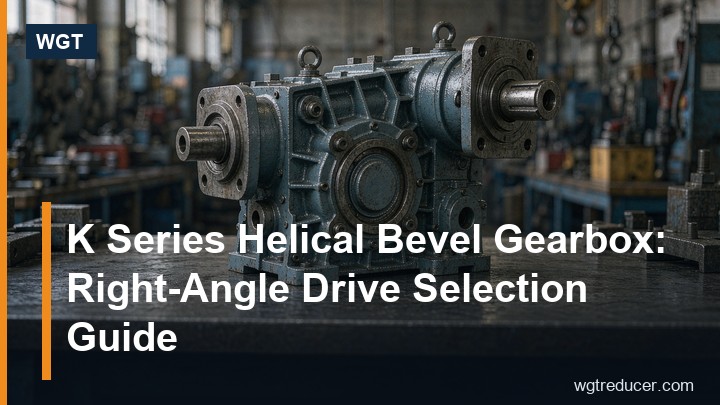
K Series Helical Bevel Gearbox: Right-Angle Drive Selection Guide
A right-angle drive is usually not chosen because it is more efficient. It is chosen because the machine has to bend. A mixer on top of a tank needs the motor standing upright beside it rather than above it; a conveyor at the end of a long line needs the drive tucked against the frame instead of projecting into the walkway; a bucket elevator needs its head shaft driven from the side. In each case a helical bevel gearbox turns the drive through ninety degrees and drops the speed in the same housing, and the K series is the general-purpose family that does it across a wide range of frame sizes.

Why a Right-Angle Stage Costs Efficiency
Every gear mesh loses a little power to friction, and a bevel pair loses more than a helical pair of the same quality because the teeth slide as well as roll. That is the honest starting point: a two-stage bevel-helical unit will not match a three-stage parallel-shaft unit of equal ratio. The gap is real but modest for a well-made spiral bevel set, and it is usually paid back by what the right-angle layout saves elsewhere - a shorter base, no jackshaft, no extra coupling, one fewer bearing pair, and a machine footprint that fits the building.
Where the comparison turns against a right-angle unit is at very high power with long continuous running, where the lost percentage shows up on the electricity bill every month. That is why large mills and long overland conveyors tend to use parallel-shaft drives. For the great majority of plant machinery, the layout benefit outweighs the efficiency cost.
Frame Sizes and What Each Step Buys
K series frames climb in a regular ladder, and the step from one frame to the next brings a larger gear centre distance, heavier shafts and a bigger bearing envelope. The table below describes what the ladder looks like in service rather than quoting ratings, because the rating of a given frame depends on the ratio built into it and on the duty class applied.
| Frame band | Typical service role | What changes as you step up |
|---|---|---|
| K37 to K47 | Small conveyors, agitators on pilot plant, packaging line drives | Compact housing, light overhung load capacity, motor direct-mounted |
| K57 to K77 | Process mixers, screw conveyors, small bucket elevators | Wider bearing centres, larger hollow bore options, torque arm available |
| K87 to K107 | Main plant conveyors, thickener drives, crusher feeders | Heavier shafts, larger output flange, fan or cooling coil usually offered |
| K127 to K157 | Heavy conveyors, mill auxiliaries, large agitators | Cast housing with reinforced feet, big bore, extended bearing life at rated load |
| K167 and above | Primary drives where the unit carries the whole machine load | Largest gear centres, special foundation drawings, optional backstop |
Frame choice should follow the duty, not the space available. A frame chosen large because the mounting area happened to be generous will run at a low load factor, which is harmless but expensive; a frame chosen small because it fits will run hot and fail at the bearing, often within the warranty period.
Reading the Variant Letters
The letters after the frame number describe the mechanical arrangement, and they matter as much as the frame size. A quotation that gives only "K87" is incomplete, because two K87 units with different suffix letters will not fit the same machine.
| Suffix element | Meaning | Practical consequence |
|---|---|---|
| Base K | Solid output shaft, foot mounting | Coupled drive, needs a foundation or a machined pad |
| A | Hollow output shaft with a shrink disc | The driven shaft passes through and is clamped, no coupling |
| F | Flange mounting instead of feet | Bolts to a machine face, common on agitators and mixers |
| AF | Flange mounting with hollow shaft | Top-entry mixers and vertical pump drives |
| S | Shaft-mounted with a torque arm | Hanging conveyor drives, reaction taken by the arm |
| T | Torque arm on a foot-mounted housing | Conveyor head shafts where a base is impractical |
Two further options change the thermal and mechanical envelope rather than the mounting: a cooling fan for units that run continuously near their thermal limit, and a backstop for inclined conveyors that must not run backwards when the drive stops loaded.
Building the Ratio
A K series unit normally combines one bevel stage with one, two or three helical stages, which produces three distinct ratio bands. The bevel stage always sits at the input, because it is the stage that turns the corner; the helical stages that follow determine how deep the reduction goes.
The arithmetic is simple division. Motor speed divided by required output speed gives the overall ratio, and the result is then matched to the nearest catalogue ratio within the band that the required number of stages can deliver. What follows the division is the part that decides whether the unit survives: the output torque at that ratio, multiplied by the service factor for the duty, has to sit inside the frame rating.
Overhung Load: The Check Most Enquiries Skip
When a pulley, sprocket or gear pinion is mounted directly on the output shaft, the shaft carries a bending moment as well as torque. That moment is the overhung load, and it is calculated from the tangential force at the pulley plus the weight of the pulley and its tension, multiplied by the distance from the bearing to the load point. A hollow-shaft unit with a shrink disc has a different load path again, because the driven shaft is supported inside the bore and the load is applied further out along it.
Overhung load is the single most common reason a correctly rated unit fails early. The gear teeth are fine, the bearings are fine on paper, and then a pulley is mounted twice as far out as the drawing assumed and the output bearing gives up. Any enquiry that carries a pulley, sprocket or pinion drawing should say so.
Thermal Capacity and the Duty Cycle
Gearboxes are limited by heat as well as by torque. The losses inside the unit become heat, the housing sheds heat to the surrounding air, and the equilibrium point is the oil temperature in service. A unit that is correctly rated for torque can still run too hot if it is enclosed in a cabinet, installed in a hot gallery, or started and stopped so often that the oil never settles.
Three factors move the thermal limit: ambient temperature, air movement around the housing, and whether the unit runs continuously or intermittently. A cooling fan raises the limit materially and costs little; a cooling coil does more but needs a water supply that the plant may not want to provide. Deciding this at selection is far cheaper than discovering it in the third week of operation.
What to Send With an Enquiry
The fastest way to get a firm, correctly sized offer is to send the machine detail rather than a model number. For a K series drive that means motor power and speed, required output speed, the driven machine type, and the mounting arrangement the machine can accept. Add the shaft or pulley drawing if the output carries one, the duty cycle, the ambient conditions, and any direction-of-rotation or backstop requirement.
With that set, the ratio, frame, suffix letters, thermal provision and accessories can all be fixed in one pass, and the drawing issued with the quotation will match the machine.
Selection Support
K series drives cover the right-angle duties in the plant: conveyors, mixers, elevators, thickener bridges and feeders. Ratio, frame and variant are calculated together with the service factor, and a dimension drawing is issued with the offer so the machine builder can check the fit before ordering. Common frame references include the K87 helical bevel gearbox and the K107 right-angle gearbox for heavier duty, while the largest sizes in the family reach the K167 heavy duty bevel gearbox.
For a first pass at the numbers, the online selection system at weigao.comp.yunqi3d.com accepts motor power, output speed and mounting position and returns candidate frames.
FAQ
What does the K in K series stand for?
It is the family designation for the helical bevel gear unit range, distinguishing it from the parallel-shaft (F), inline helical (R) and helical worm (S) families. The letter itself carries no rating information; the frame number and suffix letters after it do.
Can a K series unit be mounted in any position?
The unit can be built for several mounting positions, but the oil level, breather position and bearing lubrication arrangement are set for the position specified at order. Changing the mounting position after delivery usually requires a different oil fill and sometimes a different breather location, so the position should be stated on the enquiry.
How do I choose between a hollow shaft and a solid shaft output?
Choose a hollow shaft when the driven shaft can pass through the unit and be clamped or keyed in place, which removes a coupling and a bearing housing. Choose a solid shaft when the machine already has its own bearing support and a coupling is the natural connection, or when the unit has to be removed without dismantling the driven shaft.
Is a backstop always needed on an inclined conveyor?
It is needed whenever a loaded incline can run backwards under gravity when the drive stops. On shallow inclines with a light load the friction may be enough, but the safe assumption for a design enquiry is that a backstop is required unless the calculation says otherwise.
Why does the same frame have different ratings in different catalogues?
Because the rating depends on the ratio built into the frame, the number of stages, the duty class applied and the thermal provision. A frame number alone does not define a rating; the complete designation plus the service factor does.
