


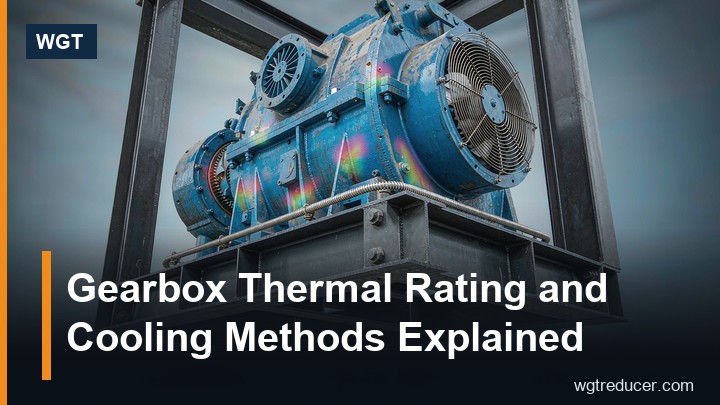
Gearbox Thermal Rating and Cooling Methods Explained
Most gearbox selections are argued out on torque and service factor, and then the unit fails for a reason that torque never addresses: it runs too hot. A gearbox is thermally limited when the heat generated by its own losses cannot leave the housing as fast as it appears. The mechanical rating says the teeth and bearings survive the load; the thermal rating says the oil survives the duty. Those are two different ceilings, and on high-ratio worm units, enclosed installations or anything standing in a hot plant, the thermal one is hit first.
Why the Mechanical Rating Does Not Cover Heat
Every gearbox turns a small percentage of the power passing through it into heat, and that heat has only three ways out: through the housing walls into the air, out with the oil through a cooler, or down through the feet into the foundation. If none of those paths can carry the loss away, the oil temperature climbs until the heat leaving equals the heat arriving. That equilibrium point is the whole story of gearbox cooling, and it has nothing to do with how much torque the gears can transmit.
The practical consequence: a unit selected at 1.4 service factor can still be unfit for a 45 °C room, because the service factor was computed from load, not from heat balance. Conversely, a unit slightly marginal on service factor often runs cool and trouble-free if it is generously cooled.
Where the Heat Comes From
The continuous heat load is set by efficiency:
P_loss = P_in x (1 - eta)
for the input power actually being transmitted. Efficiency stacks across stages, so a single-stage helical pair at roughly 98 percent loses far less than a three-stage train at 95 to 96 percent, and bevel-plus-helical right-angle units typically sit in a similar band. Worm units are in a different category: a single-stage worm at 20:1 may run near 80 percent and at 60:1 nearer 65 to 70 percent, because sliding contact in the mesh is friction rather than rolling.
The arithmetic stops being abstract quickly. A 22 kW drive at 95 percent puts about 1.1 kW of heat continuously into the housing - the equivalent of a small immersion heater bolted inside the casting. A 7.5 kW worm unit at 70 percent puts in 2.25 kW, which is why worm gearboxes on long duty cycles are so often thermally rather than mechanically limited.
One secondary source is worth knowing because it is free to fix: churning when the sump is overfilled. Fill to the sight glass with the unit level, not above, and a surprising number of "hot" gearboxes settle down.
What the Thermal Power Rating Actually Means
A published gearbox thermal rating states heat-dissipation capability at defined conditions, usually: unventilated housing, reference ambient of 20 to 40 °C, mineral oil of the specified grade, correct oil level and the mounting position the unit was designed for. It is expressed as the mechanical power the unit can transmit continuously without exceeding the permissible oil temperature - not as a torque limit.
The physics behind it is simple enough to check any catalogue figure:
Q_diss = k x A x dT
where A is the effective housing surface in square metres, dT the housing-to-air temperature difference in kelvin, and k a combined convection-plus-radiation coefficient. For a painted cast housing in still air, k sits in the region of 10 W per square metre per kelvin. A 1.5 square metre housing with oil 40 K above ambient therefore sheds roughly 600 W - the honest ceiling of an unfinned, unfanned casting, and a useful reality check when a proposal claims a small bare unit will carry a 2 kW loss.
So the selection test is not "is the torque rating sufficient" but "does the calculated P_loss at the real duty sit under the published thermal rating at the real ambient".
Ambient Temperature and Altitude Derating
Thermal ratings are quoted at a stated ambient, and the farther your plant is from that figure, the less of the rating you own. A common approximation is a loss of 1 to 2 percent of thermal capacity per kelvin above the reference - firm figures should come from the manufacturer's curves, but the magnitude is reliable enough to plan with. A unit rated 40 kW thermally at 30 °C is not a 40 kW unit in a 50 °C compressor room.
Three effects are routinely underestimated:
- Radiant heat. A gearbox beside a kiln, furnace door or steam line sees wall temperature, not air temperature, and can run 30 K above the room reading. Shield it or move it.
- Enclosure build-up. A guard or acoustic cover that looks open can halve convective exchange. If a cover is required, treat the installation as still air and size for it.
- Altitude. Air density and fan performance fall with height, roughly 1 percent per 100 m above about 1000 m, so fan-cooled units lose capacity where bare housings largely do not.
Cooling Methods and What They Buy You
Cooling options are not interchangeable upgrades; each buys a characteristic multiple of bare-housing capability and brings its own maintenance burden. The table gives typical ranges - confirm against the specific unit's thermal curves, because finning, fan design and oil volume differ.
| Method | Typical thermal uplift vs bare housing | Fits when | Watch out for |
|---|---|---|---|
| Bare housing, natural convection | 1.0 (baseline) | Light duty, intermittent running, cool open plant | Any enclosure or hot ambient removes the margin |
| Shaft-mounted fan on input | Roughly 1.6 to 2.0 | Continuous duty, clean air, adequate input speed | Fan pulls dust and lint; needs a guard |
| Independent forced-air blower | Similar to shaft fan, sometimes higher | Low input speed where a shaft fan is ineffective | Extra motor to wire and maintain |
| Finned oil-to-air cooler | Roughly 2 to 3 | Moderate overload, no water available | Clean air path, periodic fin cleaning |
| Water cooling coil in the sump | Roughly 2.5 to 3.5 | Hot, enclosed or dirty plants with water available | Water quality, scaling, condensation |
| Circulating oil unit with filter and cooler | Highest, plus filtration | Large units, high continuous losses, critical duty | Pump, controls, leak points, footprint |
A shaft fan is only effective where input speed drives it: on a conveyor unit running at 150 rpm input it moves almost no air, and an independently driven blower is the honest answer. Water cooling moves the heat problem into a circuit that must be maintained - hard plant water will scale a coil and take most of its capacity within a season.
Bigger Gearbox or Added Cooling
Both raise the thermal ceiling, so the choice is cost and reliability, not physics.
Oversizing buys housing area, oil volume and usually slightly better efficiency, with no extra equipment to maintain - the simplest answer when a frame step is available and space allows. Its cost is mass, price, and often a larger shaft that forces coupling and baseplate changes.
Cooling keeps the frame small, which matters for shaft-mounted units, retrofits and fixed centre distances, and is usually cheaper at first cost; its cost arrives later as maintenance. A workable rule: if one frame step covers the deficit, take the frame step; if two or more would be needed, or the frame cannot change, specify cooling and put the maintenance task on the schedule at the same time.
Oil Temperature Limits and What They Cost
The thermal rating is ultimately a proxy for oil condition, because lubricant life falls steeply with temperature. Mineral gear oils are generally worked to a sump temperature around 80 °C continuous with short excursions to about 95 °C; synthetic PAO and polyglycol grades tolerate more, and the manufacturer's data sheet governs. A long-standing rule of thumb is that oxidation life roughly halves for every 10 K above about 70 °C, which is why the difference between an 80 °C and a 95 °C sump is measured in years of oil life.
| Sump condition | Mineral oil | Synthetic oil | Practical meaning |
|---|---|---|---|
| Below 60 °C | Comfortable | Comfortable | Long oil life, full film margin |
| 60 to 80 °C | Normal continuous band | Normal continuous band | Standard change intervals apply |
| 80 to 95 °C | Brief excursion only | Acceptable continuous | Halve inspection intervals, sample oil |
| Above 95 °C | Not acceptable | Short-term only | Stop and fix the heat balance |
The cold end matters too: thick oil channels rather than circulates at start-up, so a sump heater is worth having on any unit that starts below about 0 °C - not because the gears cannot turn, but because bearings may run briefly dry.
Symptoms and Field Checks
Overheating announces itself before it fails: paint discolouration near the oil level, a breather weeping oil mist, seals that harden and sweat, oil that darkens or smells burnt within weeks of a change, and gear whine that appears only after an hour of running.
Measurement should be deliberate. An infrared thermometer aimed at the housing reads a few kelvin low unless emissivity is accounted for, so put matte tape on the casting and measure that, or fit a sump thermocouple on a representative unit and compare it with the design ambient. Motor winding thermistors protect the motor, never the gearbox - a gearbox can be cooking while the motor runs cool, which is exactly the case on worm and high-ratio drives.
Finally, check the load. A gearbox that ran cool for years and now runs hot is usually carrying more than it did: a changed product, a jamming conveyor, a worn downstream component. Heat is a good detector of load creep.
Frequently Asked Questions
Can a gearbox run above its thermal rating for short periods?
Yes, within limits. Thermal ratings describe continuous equilibrium, and a short peak is tolerable because oil and housing have thermal mass. The constraint is peak oil temperature and how often the excursion repeats: ten minutes an hour, every hour, accumulates the same damage as running hot continuously.
Does a thicker oil help an overheating gearbox?
No. Higher viscosity raises churning losses and slows heat transfer through the sump, so oil temperature usually rises. Viscosity is chosen for the operating temperature the unit will actually reach; if it is overheating, the fix is cooling or a smaller loss, not a heavier grade.
Why does my gearbox only run hot in summer?
Because the thermal rating was consumed by the ambient margin. Most units are selected against a 30 or 40 °C reference, and a workshop that reaches 45 °C removes 5 to 15 K of temperature difference from the heat balance - potentially a third of the available margin. If duty is year-round, size for the summer ambient.
Is a shaft fan enough on a shaft-mounted gearbox in a hot plant?
Often not. These units typically run at low input speeds on conveyors, where a fan moves little air, and the fan cannot be fitted at all on some mounting arrangements. Treat the fan as a bonus rather than the thermal basis of the selection.
What sump temperature is too hot?
For mineral oil, sustained operation above about 80 °C shortens oil life sharply and above 95 °C risks varnish and seal damage; synthetics raise the thresholds but do not remove them. If the unit cannot be held under the manufacturer's limit at the real ambient and duty, cooling or frame size has to change.
Next Step
Thermal selection starts with two numbers you already have: input power and the efficiency of the ratio you want. From those the loss is fixed, and the rest is a question of how much housing area, fan or cooler is needed to carry it away at your plant's ambient. For heavy-duty right-angle duties where thermal margin is part of the specification, see the K series heavy-duty bevel gearbox, and use the online selection system to compare ratios and frame sizes against your calculated loss before the order is placed.
