


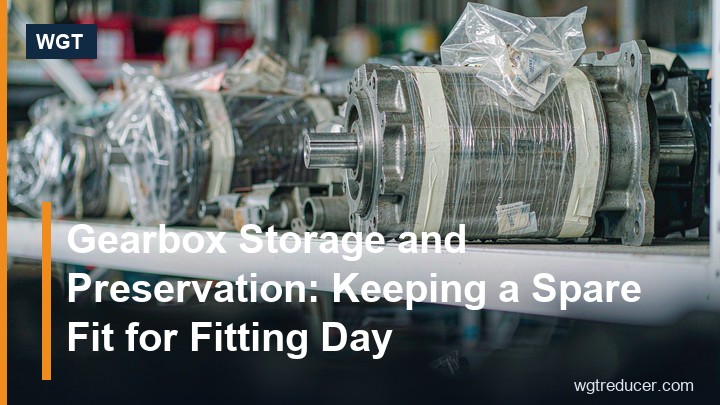
Gearbox Storage and Preservation: Keeping a Spare Fit for Fitting Day
Gearbox storage is the part of drive engineering nobody photographs. The unit is finished, inspected, crated and correct on the day it leaves the works - and then it sits, sometimes for a season, sometimes for years, in whatever corner of the plant the project schedule assigned it. Most stored gear units come out of that waiting period perfectly serviceable. The ones that do not fail in ways that look, at fitting time, like factory faults: a bore with rust in it, a bearing that knocks from the first revolution, a sump of milky oil in a unit that was never run. Every one of those is a storage failure, and every one of them was preventable for less than the cost of an hour of the delay they cause. This guide sets out what waiting actually does to a gear unit, how to prepare for it, and the short routine that keeps a spare worth fitting.
Why Waiting Damages a Gear Unit at All
A gear unit is a sealed box of oil, bearings and machined iron, and none of those three enjoys inactivity. Oil that never circulates lets its additives settle and its moisture gather; bearings that never turn rest their rolling elements on one spot, and the race under that spot slowly takes a permanent imprint; the air inside the case breathes with every day-night temperature swing, and each breath draws in whatever the surrounding atmosphere carries - water vapour in a coastal store, dust in a minerals plant, process fumes beside a pickle line.
None of this is dramatic. That is precisely the problem. A stored unit gives no symptoms, trips no alarms and appears on no inspection round, because it is "just a spare". The damage accumulates silently and presents itself on fitting day, when the crane is booked, the outage window is open and the crew is standing there with a unit that will not accept its shaft or turns with a roughness nobody can explain to the project manager. Storage care is cheap precisely because the alternative is expensive at the worst possible moment.
The Three Enemies: Condensation, Static Loading and Time
Condensation is the first and most common enemy. As the case cools each night, the air inside contracts and pulls outside air in through every available path - the breather, the shaft seals, even a loose inspection cover. In humid climates that nightly breath delivers water to the coldest internal surface, and the first evidence is usually an oil sample that reads milky, or rust bloom on a shaft end that was left bright. A breather that was perfect at the works is a maintenance item from the moment the crate is opened; on a wet or washdown position it should be a desiccant type from the beginning.
Static loading is the second. A bearing designed to rotate its load through millions of positions holds, in storage, a single contact point against its race. Months of that contact - amplified by vibration from a nearby crusher or a passing forklift - flattens the microscopic asperities of the contact and leaves a depression in the race known as false brinelling. The bearing does not know it has been damaged; neither does anyone else until the unit runs, when the damaged zone passes through the load zone at shaft frequency and announces itself as a knock that no amount of re-alignment will remove.
Time is the third enemy, and it works on the consumables. Seal lip compounds relax and take a set against the shafts they press on. Paint films age and their coverage of the awkward corners - foot corners, flange seams - gets tested by whatever moisture the first two enemies delivered. Gaskets stiffen. None of these arrives suddenly, which is why the storage routine that follows is a calendar, not a crisis response.
Preparing a Unit for the Shelf
Good storage begins before the crate closes, and it takes fifteen minutes on a delivery day that will never feel quieter. The steps are short and worth writing into the goods-inward procedure:
- Record the unit's identity: model, serial number, ratio and the project or line it belongs to. A spare without a name becomes, in three years, a puzzle.
- Confirm the oil situation. Units shipped filled stay filled with their transport plug in place; units shipped dry get their internals protected and a dated tag saying so.
- Fit the correct storage breather - desiccant where the store is humid, standard elsewhere - and log its fitting date, because a desiccant cartridge has a life.
- Protect every machined surface: shaft ends, flange faces and the output bore wrapped and greased, not left bright under a crate lid.
- Choose the location deliberately: indoors, off a wet floor, away from a wall that sweats, out of the spray of any washdown route, and not in the vibration shadow of running machinery.
The crate itself deserves a decision rather than a habit. It protects against knocks and weather in transit, but left closed in a humid store it can trap moisture against the case and turn into a condensation chamber. In a dry indoor store, opening the crate top or removing it entirely lets the unit breathe with the room instead of against it.
Storage Classes and What Each One Demands
Not every spare needs the same attention, and the honest way to organise the routine is by how long the unit will actually wait. Three classes cover nearly every situation:
| Storage class | Typical duration | Core requirements | What must happen on schedule |
|---|---|---|---|
| Short term | Under 3 months | Original transport plugs in, machined surfaces wrapped, crate intact, stored indoors | Nothing beyond a dry, indoor location |
| Medium term | 3 to 12 months | Storage breather fitted, oil level confirmed, shafts greased and capped, location free of vibration | Shaft turned by hand monthly; breather desiccant renewed if fitted |
| Long term | Over 12 months | Medium-term measures plus a dated storage log; oil topped to the correct level; shafts bar-over monthly; oil condition sampled annually | Full monthly rotation; annual oil sample and surface inspection; breather service every service interval |
The boundaries are soft - a unit in a coastal monsoon climate needs medium-term care from its first month, while one in a dry mountain store can coast through six months without complaint. What is not soft is the log. A storage card with dates on it converts the routine from a good intention into an auditable practice, and it is the first thing a commissioning engineer will ask to see before energising a unit that waited two years.
The Monthly Routine That Keeps a Stored Unit Healthy
The whole routine costs ten minutes per unit per month, and it consists of three actions. First, rotate the shaft by hand - one or two full revolutions - so the bearings re-distribute their rolling contact, the gears re-coat their meshes with oil, and any internal stiction is broken before it becomes a set. Second, look: a thirty-second inspection of the breather, the paint film at the feet and flanges, the grease caps on the shaft ends and the state of the wrap on the bore. Third, write: date, initials, and a note if anything looked different from last month.
Two situations deserve more than the standard rotation. In freezing stores, an oil-filled unit that is bar-overred aggressively before the oil has warmed can move cold, thick oil in ways the design did not intend - slow, gentle turns are the rule. And on any unit stored with its oil drained, the monthly turn still matters, because the bearings need their contact redistributed and the internal protective film rechecked even though there is no sump to sample.
Bores, Shafts and Seals: The Details That Decide the Refit
On a hollow-bore unit, storage has one extra critical surface. The output bore is the fit that will carry the entire torque when the unit is mounted over its driven shaft, and a bore that grows rust film or picks up a dent in storage converts fitting day into a machining job. A hollow-bore parallel-shaft gear unit such as the MC2PLHF02 leaves the works with its bore protected; keeping that protection intact through the storage period - and renewing the grease when it dries - is the single most valuable line in the monthly routine for that layout. The same care applies to the driven shaft the unit will eventually climb onto: greased, capped and stored with its key, because a shaft left bright in an outside store for a season will cost the bore it touches.
Solid-shaft units have their own vulnerable pair: the shaft ends that will meet the coupling, and the seal lips resting against them. A shaft end left unprotected rusts exactly where the coupling hub must slide; a seal that takes a set for two years may weep from its first running hour. The greased cap and the periodic rotation address both, and neither costs anything beyond the calendar.
Bringing a Stored Unit Back to Service
Before a stored unit is energised, three checks take minutes and prevent the classic first-start failures. Check the oil: level confirmed at the correct mark, condition clear - a milky or sedimented sample means an oil change before start, not after. Check the rotation: by hand, a full revolution or two, feeling for scraping, dead spots or roughness; anything felt here is investigated on the bench, not discovered under power. Check the fittings: transport plug exchanged for the breather, mounting surfaces clean and unmarked, torque arm and end plate hardware present, shaft protection removed only at the moment of fitting.
Then run the commissioning record exactly as for a new unit: temperatures, sound and an oil sample logged as a baseline in the first loaded hours. A unit that passes these checks begins its service life indistinguishable from one delivered yesterday - which is the entire objective of the routine above. Plants that keep the storage log fit their spares without ceremony; plants that do not, discover on fitting day which of the three enemies had been at work.
Frequently Asked Questions
How long can a gear unit be stored before it needs attention?
A dry indoor store will carry a crated, plugged unit for about three months without any action. Beyond that, the storage routine begins: breather management, monthly shaft rotation and surface inspection. Past a year, the unit is on a documented long-term regime with annual oil sampling. Climate shortens these figures - humidity and temperature swing are what drive the schedule, not the calendar alone.
Should a gearbox be stored with oil in it or empty?
Both are correct, for different situations. Short and medium waits are simplest with the factory-filled oil left in and the transport plug in place, because the oil protects the internals. Very long waits in poor conditions, or units held as bare shells, are stored drained with internal protection applied and a dated tag saying so. The one wrong answer is an empty case with no protection and no record.
What is the knocking in a gearbox that was never run before?
The classic signature of false brinelling - bearing race damage from months of static contact, often aggravated by vibration from nearby machinery. It cannot be fixed by alignment or running in; the bearing needs renewal. This is exactly why the monthly hand-rotation exists: it costs ten minutes and prevents a failure that costs a fitting day.
How do you protect a hollow output bore in storage?
Grease it, wrap it and cap it, then inspect the wrap on the monthly round and renew the grease when it has dried out. The bore is the unit's torque path once mounted, and rust or a dent there turns an afternoon's fitting into a machining job - or worse, into a fit that never runs true. The driven shaft deserves the same protection, stored with its key.
Keep the Spare Worth Keeping
A stored gear unit is not paused machinery; it is machinery aging under different rules. Describe your storage conditions - how long, what climate, what surrounds the shelf - when you request a quotation, and the unit can be prepared and documented for that wait from the works. For help matching a unit to a duty that has grown while the spare waited, work the ratio and frame in the online selection system, or send the duty to our engineers and let the storage plan arrive with the quotation.
