


Gearbox Export Specification: What to Fix Before the Container Closes | WGT
A gearbox that is correct on the drawing can still arrive wrong. Between the works and the plant gate sit six weeks of sea air, two or three handlings, a customs inspection and a commissioning crew that does not have the drawings the manufacturer assumed. Almost every export dispute traces back to something that was never written down before the crate was closed - not to a design fault. This guide lists what to settle, in the order it usually goes wrong.
Electrical Data: The First Thing to Confirm
The gearbox is mechanical, but the motor bolted to it is not, and in a gearmotor package the electrical data decides whether the unit runs at all. Confirm voltage, frequency and phase at the destination, and do it in writing rather than from memory of the last project in that country.
Two traps are common. Dual-voltage motors wired for the wrong connection arrive running at half speed with double current - a fault that reads as a gearbox problem to a plant that has never seen the unit. And a 50 Hz motor on a 60 Hz supply runs about 20 percent fast, shifting every output speed on the data sheet. If the drive is inverter-fed, state the supply and the intended speed range instead.
Nameplate, Documents and Language
The nameplate is a legal document in most plants: it is what the inspector reads and what the maintenance system indexes. Decide before production:
- Language - English is usual; bilingual plates (English plus the site's language) are common in some regions and cost very little if raised at order stage.
- Data shown - ratio, input and output speed, rated power, serial number, weight, oil grade and quantity, and the direction of rotation.
- Tagging - many projects require the plant's own equipment tag on the plate, and some require it on the crate as well.
- Certificates - material certificates, test reports and a certificate of origin are routinely requested. Confirm which, and in what form.
Documents travel separately from the goods and are usually the reason a container sits at a port. A shipment that arrives with a packing list that does not match the crate markings will be opened and repacked by strangers, in the rain, at the buyer's cost.
Protection Through Sea Transit
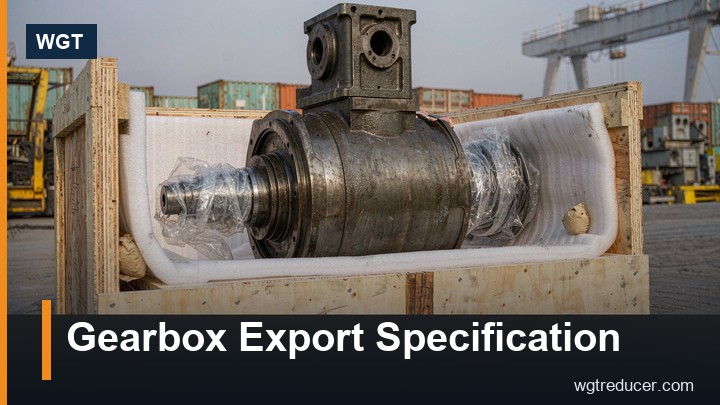
Six weeks in a container is a corrosion test. Steel cases are shipped with a preservative film on machined surfaces, desiccant in the crate, and often a vapour-phase inhibitor. What has to be specified is the standard - not the intention.
Practical points that decide whether a unit arrives bright or rusted:
- Shaft and flange faces coated with a removable preservative, protected by a cap or a wooden disc, not by tape that goes hard.
- Breathers sealed or replaced with a shipping plug, with a bright tag telling the fitter to restore the breather before running. A unit that starts with its shipping plug in place will pressurise its seals and weep oil within a shift.
- Oil - often drained for transport, or filled to a transport level. Whichever is chosen, the crate must carry a label stating what is inside and what to fill on arrival.
- Crate strength for stacking: containers are loaded two or three high, and a crate that sags transfers its load into the unit inside it.
The single most reliable protection is a crate that keeps the weather off and a film that comes off with a cloth. Elaborate systems that a site cannot remove become a commissioning problem of their own.
| Check before the crate closes | Why it matters |
|---|---|
| Shipping plugs fitted, tagged, breather bagged inside | Prevents oil loss and seal damage in transit |
| Desiccant quantity matched to crate volume | Prevents condensation corrosion over weeks at sea |
| Crate marked with weight, centre of gravity, lifting points | Crane and customs handling |
| Packing list matches crate numbers and markings | Avoids customs delays and repacking |
| Oil grade and fill quantity stated on the crate | Site crew has no other source |
| Test report and drawings packed in a document pocket | Commissioning without them costs days |
Ambient and Site Conditions at the Far End
The unit is selected against conditions that exist at the destination, not at the works. Coastal sites, tropical sites, desert sites and high-altitude sites each change the specification in a predictable way:
- Coastal and offshore - salt air attacks paint, fasteners and shaft surfaces. Specify the paint system and the fastener finish, not just the colour.
- Tropical - high humidity and high ambient reduce thermal headroom, so the thermal rating must be checked at the site ambient rather than at a catalogue figure.
- Desert - dust ingress through breathers and seals, and day-night temperature swings that draw moist air into the case as it cools.
- High altitude - reduced air density affects motor cooling more than the gearbox, but the combination is worth stating so nobody assumes sea-level ratings apply.
The same logic applies to washdown and chemical exposure: a bevel-helical unit for process duty specified for a dry plant room needs a different paint and seal arrangement on a coastal site, at the same ratio and frame.
Spares: Deciding What Sits on the Shelf
Export projects live or die on the first failure, because the distance to the factory is measured in weeks. Two levels of spares are worth discussing openly with the buyer:
- Commissioning spares - oil, filters where fitted, seals, a breather, and the tools the site needs to check alignment. Cheap, and they prevent the small problems that stop a start-up.
- Critical spares - a complete second unit, or the bearing and seal set for the output shaft. Expensive, and usually justified only where the process cannot tolerate a stop.
The honest conversation is about lead time rather than price. If a replacement unit takes ten weeks and the plant loses a production line every day it is down, the second unit pays for itself the first time it is needed. Air freight for a single unit is possible but rarely economical above a certain frame size, so the spares decision is really a shipping decision.
Installation Support Across a Language Gap
Every gearbox arrives with a manual nobody reads until something goes wrong - and on an export project the commissioning crew may not share a language with the factory.
What helps, in order of cost-effectiveness:
- Dimensional drawing with mounting hole positions, shaft dimensions and lifting points, in the buyer's preferred units.
- A one-page commissioning sheet in the site language: oil grade and quantity, breather restoration, alignment limits, first-run checks.
- Photographs of the actual unit before crating, showing the nameplate and the shaft ends - they settle arguments about what was supplied faster than any document.
- A named contact for commissioning questions, with the time difference stated so the site knows when to call.
For a critical drive, a remote commissioning call at first start is worth more than a page of instructions.
Commercial Terms That Affect the Hardware
Incoterms, warranty and payment terms are commercial, but three of them change the physical product:
- Warranty period and start date. A warranty that starts at shipment can expire before the plant runs the unit. Warranty from commissioning, with a long-stop date, is fairer and must be agreed at order stage.
- Inspection regime. If a third-party inspector will witness the test, the test procedure has to be agreed in advance, including which measurements are recorded and in what format.
- Packing standard. "Export packing" means different things to different suppliers. Specify crate type, desiccant, marking and whether the crate must be stackable. It is the cheapest clause in the contract and the one most often disputed on arrival.
None of it is exotic - it is simply the list that gets forgotten when a project is priced in a hurry.
A Pre-Shipment Sequence That Works
The order that avoids surprises, in practice:
- Confirm the duty point and the frame, using the site's own speed and torque figures rather than assumed ones, and run it through the online selection system so the buyer sees the same arithmetic.
- Confirm electrical data, nameplate content and document list in writing.
- Agree paint system, preservation and packing standard against the destination climate.
- Agree the test regime and who witnesses it.
- Agree spares, warranty start and the commissioning contact.
- Photograph the unit and the crate markings before the doors close.
Each step is a paragraph in a document. Together they are the difference between a project that commissions on schedule and one that spends its first month in correspondence.
FAQ
Should gearboxes ship with oil?
Either is workable if it is labelled. Many units ship drained or at transport level because oil in a crate can leak, attract moisture and complicate customs. What matters is that the crate states the oil grade and the fill quantity, and that the site has the correct oil before the unit is started.
What packing standard should I ask for on an export gearbox?
A closed wooden crate suited to the weight and stackable in a container, with desiccant matched to the crate volume, machined surfaces under preservative, and clear marking of weight, lifting points and crate number. Anything less is a bet on the weather.
How do I handle voltage differences on a gearmotor?
Confirm the destination supply first, then specify the motor for it - including the frequency, because a 50 Hz motor on a 60 Hz supply runs faster and changes every output speed. For inverter duty, state the speed range rather than a single nominal point.
When should the warranty start?
From commissioning, with a long-stop date measured from delivery. Warranty from shipment is common in export contracts and unfair on projects where civil works delay installation by months; raising it at order stage costs nothing.
Do I need a spare unit for an export project?
Only where a stop is expensive and the replacement lead time is longer than the plant can tolerate. For most projects, commissioning spares - oil, seals, a breather - cover the realistic failure modes; a second unit is justified by production loss, not habit.
Summary
An export gearbox is a specification exercise as much as an engineering one. Settle the electrical data, the nameplate and documents, the transit protection and packing, the site conditions, the spares policy and the warranty start before production begins - and photograph the unit before the crate closes. None of those items is difficult. All of them are expensive to fix once the container is at sea.
