


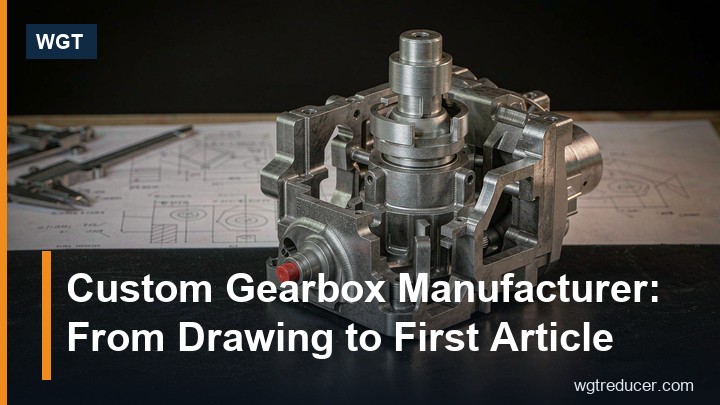
Custom Gearbox Manufacturer: From Drawing to First Article
A custom gearbox manufacturer is worth engaging when the drive in front of you refuses to fit a catalogue frame - a shaft spacing fixed by an old machine, a mounting flange no standard unit matches, or a duty combining ratios and torques that no single series covers. This guide explains how that purchase actually works: what to send, how the quote is built, what "first article" means, and the checks that keep an OEM gearbox project on schedule.
What Custom Actually Means in Gear Manufacturing
The word covers a wider range than buyers sometimes expect. At one end sits true bespoke work: a case cast around a space envelope, gearing calculated from scratch, and a unit that will never be repeated. In the middle lies the far more common territory - a standard industrial series modified at defined points: a different output shaft, a hollow bore instead of a solid shaft, a flange machined to an existing bolt circle, a motor bracket turned to suit, or a ratio assembled from the factory's gear sets that sits between catalogue steps.
Most industrial gear units can be adapted in exactly this way, because the expensive parts - housings, gear sets, bearing arrangements - are shared across a frame family. A capable manufacturer will tell you honestly which camp your requirement falls into, because the two carry very different tooling costs and lead times. If a supplier quotes a full bespoke price for what is really a modified standard unit, or promises a true bespoke at a modified-standard price, both are warnings worth reading twice.
When a Standard Unit Stops Being the Cheap Option
Custom work is usually triggered by one of three situations. The first is dimensional: a retrofit into a machine whose drivetrain geometry is fixed, where the cost of re-machining the installation exceeds the premium on an adapted unit. The second is duty: continuous high-torque service, frequent reversals, or an environment - heat, dust, washdown - that pushes past the assumptions behind a standard rating. The third is spares logic: a plant with twenty identical machines prefers one custom reducer matched to the fleet over a standard unit that fits none of them perfectly.
Buying custom purely to save money is rarely successful. But buying custom to avoid paying twice - once for a unit that almost fits and again for the steelwork to make it fit - is frequently the correct call. The arithmetic is simple to run: add the adaptation cost of a standard unit (adapters, new foundations, coupling changes, engineering hours) and compare it against the quoted premium for the modified unit delivered bolt-up ready.
The Information a Manufacturer Needs Before Quoting
A custom quote is only as good as its input. Incomplete enquiries produce not higher prices but conservative ones, because every unknown is covered with margin. The table below is the minimum a serious manufacturer will ask for, and sending it with the first email shortens the project by weeks.
| Enquiry item | Why it matters |
|---|---|
| Power, speed and starting method of the motor | Fixes the input torque the gearing must pass, including start conditions |
| Driven machine type and load pattern | Shock, reversal and starts per hour set the service factor |
| Output speed and tolerance | Determines the ratio; tolerance shows how tightly it must be held |
| Duty cycle - hours per day, starts per hour | Thermal rating and bearing life both key off this, not off nameplate power |
| Envelope drawing or space limits | The single most common reason a custom unit is needed at all |
| Shaft data - diameter, keyway, overhung load | Output shaft and bearings are designed around these figures |
| Mounting arrangement and reaction loads | Decides case design, feet, flanges or torque arm |
| Environment - ambient, dust, washdown, altitude | Drives sealing, paint, cooling and lubricant choices |
| Standards and documentation needed | Certification, drawings, inspection reports - all priced honestly only if declared early |
Send a photograph of the failed or existing unit alongside the table. It does not replace a single dimension, but it orients the selection engineer faster than any paragraph of prose.
From Enquiry to General Arrangement Drawing
The normal sequence runs: enquiry review, preliminary ratio and frame selection, then a general arrangement drawing - the GA - showing all interfaces: shaft ends, mounting faces, overall dimensions, mass and the position of every plug and breather. On a healthy project the GA arrives inside days of a complete enquiry, and the buyer's job at this stage is to review it against the real machine, not against the memory of the machine.
The most valuable review points are unglamorous: does the drain plug clear the baseframe, can the level plug be seen from the walkway, is there wrench room on every fastener, does the breather end up above an oil mist source. Changes at GA stage cost a redline mark; the same changes after casting cost a new casting. A custom gearbox manufacturer who encourages this review is protecting their own schedule as much as yours.
Prototyping and the First Article Inspection
For repeat-production or high-value one-off work, the first article is the unit that proves the process. It is inspected against the drawing item by item - case dimensions, shaft sizes, gear quality as shown by contact pattern, noise and temperature at test torque - and the results are recorded before the unit ships. Buying through a first article gate costs little and converts a promise into evidence.
Ask for three things at this stage: the inspection dimensions with actual measured values rather than pass/fail ticks, a run test at load with temperature and vibration readings, and the contact pattern photograph from the bevel or worm mesh. These three artefacts take the factory minutes to produce and give the buyer a baseline for every unit that follows. Their absence on a first article is not a formality gap; it is the project's early warning.
What a Good Custom Reducer Quote Looks Like
A professional quote for a custom or OEM gearbox names its assumptions. It states the duty the rating is valid for, the standard applied to gear and bearing calculations, the material and heat treatment of the gearing, the seal and bearing brands or equivalents, the paint system, the scope of documentation, and the lead time measured from drawing approval - not from purchase order. It also states what is excluded, because exclusions are where retrofit projects bleed money quietly.
Compare quotes on those assumptions before comparing prices. Two numbers thirty percent apart usually describe two different machines: one calculated to the real duty and one calculated to survive an unknown one. When you send a duty description for cross-checking, the same figures should return the same frame from any competent engineer - if they do not, one set of assumptions is hiding a shortcut.
Quality Evidence to Ask For Before Committing
Beyond the quote, three kinds of evidence separate manufacturers who build to drawing from those who build to hope. Process evidence: material certificates for gearing and shafts, heat treatment records, and gear inspection charts. Test evidence: a run test sheet for the actual unit, not a type-test certificate for a sibling. And continuity evidence: a named engineer who answers technical questions between order and delivery, because most custom reducer problems are solved in a five-minute exchange and inflated into weeks by ticket queues.
None of this requires an audit trip for a modest order. Request the documents with the order, read them on arrival, and file them with the machine record. The pattern across many retrofit projects is consistent: the failures trace back to skipped evidence, not to exotic engineering.
Working With a Custom Gearbox Manufacturer: FAQ
How long does a custom gearbox take from drawing to delivery?
A modified standard unit - new shaft or flange on an existing frame - typically ships in weeks, because the case and gearing already exist. A true bespoke with a new casting takes longer: pattern or mould, casting, machining, assembly and test. The honest lead time starts at drawing approval, so the faster the GA is reviewed, the earlier the unit arrives.
Is a custom reducer more expensive than modifying a standard one myself?
For a single unit, adaptation by the factory usually wins once the buyer's own engineering, adapters and downtime are counted. The factory makes the change in machining that the buyer would make in steelwork. For repeat quantities the gap widens, because the modified unit is designed once and repeated exactly.
What drawings do I need to supply?
Enough to define every interface: the space envelope, the driven and driver shafts, mounting faces and any fixed features like bolt circles or guard limits. A dimensioned sketch from the machine is a fine start; the manufacturer will formalise it into the GA for approval.
Can an existing failed unit simply be copied?
It can be measured and rebuilt, and this is common for obsolete fleets. But a copy inherits any weakness in the original. Re-rating the duty against the measured loads usually costs nothing extra and occasionally reveals that a small change - a seal type, a bearing upgrade - removes the reason the original failed.
What should the warranty cover on custom work?
At minimum: materials and workmanship for a defined running period, with the duty cycle stated in the warranty terms rather than implied. A warranty that assumes catalogue duty while the unit runs a custom duty is worth less than it sounds.
Conclusion: Buy the Process, Not Just the Unit
A custom gearbox purchase succeeds or fails at the enquiry stage. Give the manufacturer a complete duty description and honest load data, review the general arrangement against the real machine, gate delivery on a documented first article, and compare quotes on assumptions before price. Do that, and the premium over a standard unit buys exactly what it should - a drive that bolts up, runs quietly and needs no second attempt.
Ready to test the process with a real duty? Send the figures from the enquiry table above through our online selection system or straight to our engineers, and we will come back with a frame, a ratio and a firm lead time.
