


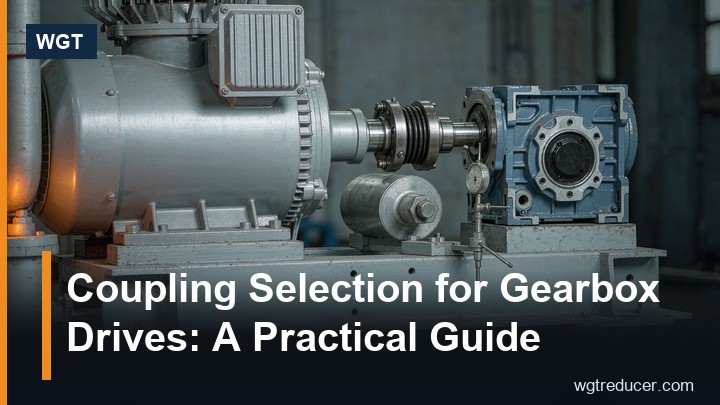
Coupling Selection for Gearbox Drives: A Practical Guide
The short answer is that a coupling between a motor and a gearbox is chosen from four numbers - the torque it must carry including peaks, the misalignment the installation will actually have, the shaft diameters and keyways at both ends, and the torsional behaviour the driven machine can tolerate - and then confirmed against speed, environment and the space available for a spacer. Coupling selection fails when it is treated as a catalogue lookup by bore size, because a coupling that fits both shafts can still be the wrong stiffness, the wrong balance class, or too small for the starting torque of the machine behind it.
This guide follows the order a drive engineer works in when sizing a coupling for a geared drive: what load the coupling sees, which coupling families are worth comparing, how the arithmetic is done, how misalignment and shaft fit decide the rest, and what has to be checked on site before the guard goes back on.
What the Coupling Actually Carries
A coupling in a geared drive carries the motor's output torque, and the gearbox multiplies that torque downstream - but the coupling never sees the multiplied value. What it does see is everything the motor does on the way to steady state: direct-on-line starting torque, which for a standard induction motor runs about 1.8 to 2.5 times rated torque; the torque peak when a jammed conveyor is restarted; reversing duty on a hoist or a traversing drive; and the torsional ripple from a reciprocating load such as a piston pump or a single-cylinder compressor.
That is why couplings are sized on a service factor rather than on nameplate torque. The rated torque of the coupling is divided by the peak torque the drive can deliver, and the result must stay above a factor chosen for the duty: around 1.5 for smooth centrifugal fans and uniform conveyors, 2.0 to 2.5 for crushers, mixers with lumpy product, and positive-displacement pumps, and higher again for drives that reverse under load or start against a full load every cycle. The coupling is also the cheapest fuse in the drive train, so there is an argument for keeping the factor on the generous side where a jam is likely and a gearbox rebuild is not.
One more load path matters and is often missed: the coupling also carries thermal growth between the shafts. A rigidly mounted gearbox on a hot baseplate pushes axial growth into whichever end is less restrained, and flexible elements absorb it - but only within the axial limits the maker publishes.
The Four Coupling Families Worth Comparing
Most industrial geared drives land in one of four families. Each has a clear comfort zone, and the choice is usually obvious once the duty and the maintenance culture are known.
| Family | How it flexes | Typical torque density | Misalignment comfort | Best fit |
|---|---|---|---|---|
| Elastomer jaw (spider) | Rubber or polyurethane insert in interlocking jaws | Low to medium | Moderate radial, small angular | Small and mid drives, pumps, fans, gearmotors, general machinery |
| Grid or spring | Serpentine steel grid in grooved hubs | Medium to high | Good radial and angular, damping | Conveyors, mixers, crushers, drives with torque ripple |
| Disc pack | Thin stainless discs bolted in packs | Medium to high | Good angular, limited radial, stiff torsionally | High-speed, high-temperature, low-backlash positioning drives |
| Gear coupling | Crowned external teeth in a flanged sleeve | High | Large angular per half, needs lubrication | Large slow drives, mill and kiln duty, long spacer shafts |
The elastomer jaw coupling is the default for a reason: it is cheap, it needs no lubrication, it tolerates a workshop-grade alignment, and its insert can be replaced in minutes. Its limits are heat, oil, and the fact that the insert is a wear part - in a hot or chemically aggressive plant it hardens and then crumbles, and the drive starts to sound different before it fails.
The grid coupling trades simplicity for torque density and damping. It handles shock better than a jaw coupling of the same size and it survives temperature that would destroy rubber, but it needs grease and a proper cover, and a worn grid gives very little warning before it lets go.
Disc and gear couplings are the choices when the drive is large, hot, or long. A disc pack is torsionally stiff and backlash-free, which suits positioning and high-speed machinery; a gear coupling tolerates the largest misalignment per half-coupling and is the traditional answer for a long spacer between a motor on a foundation and a gearbox on a separate plinth.
Sizing Arithmetic Before Anything Else
Nominal torque comes from power and speed: torque in Nm equals 9550 multiplied by power in kW and divided by speed in rpm. A 30 kW motor at 1470 rpm delivers about 195 Nm, and a coupling for a uniformly loaded fan at a service factor of 1.5 must therefore be rated at roughly 290 Nm or more. Run the same arithmetic with the starting torque instead of the rated torque when the motor starts direct-on-line against a heavy load, and with the stall torque of the driven machine when a jam is credible.
Speed sets the second limit. Every coupling has a maximum speed, and above about 1500 rpm the balance question starts to bite: a coupling that is fine at 1000 rpm can vibrate at 3000 rpm because of residual imbalance in the hubs or an eccentric spacer. High-speed drives want a coupling balanced as an assembly, and a spacer whose length-to-diameter ratio is sensible rather than merely convenient.
Bore capacity is the third limit and the one that most often decides the size, because the coupling must accept both shaft diameters with a hub wall thick enough to carry the key. A coupling chosen purely on torque may have to go one size up to take a 75 mm motor shaft against a 60 mm gearbox input, and that is normal - the larger size simply carries more margin.
Misalignment: What the Numbers Mean on Site
Flexible does not mean self-aligning. A coupling absorbs a defined amount of parallel offset, angular error and axial float, and beyond those limits the flexible element is being fatigued from the first revolution. Typical published limits for the families above sit in the ranges below, but the maker's data sheet always governs - these are order-of-magnitude figures for early sizing, not acceptance criteria.
| Family | Parallel offset, mm | Angular per half, degrees | Axial float, mm |
|---|---|---|---|
| Elastomer jaw | 0.2 to 0.5 | 0.5 to 1.0 | 1 to 3 |
| Grid | 0.3 to 0.8 | 0.25 to 0.5 | 2 to 6 |
| Disc pack | 0.1 to 0.4 | 0.5 to 1.0 | 1 to 3 |
| Gear | 0.5 to 1.5 | 1.0 to 1.5 | 3 to 10 |
The practical lesson is that a coupling tolerating 0.5 mm of offset should be installed to a fraction of that - half the allowable limit at most - because thermal growth, soft foot and foundation settlement will consume the rest over the first months of running. Aligning to the tolerance rather than to the limit is what separates a coupling that lasts ten years from one that is replaced every second shutdown.
Bore, Hub Fit and the Shaft Connection
A coupling hub is a shrink-fit or push-fit component on a shaft, and the fit decides how much of the torque the friction carries and how much the key carries. A clearance fit with a key is the common industrial arrangement and is entirely adequate when the key is sized properly and the hub is clamped axially; an interference fit carries more torque without a key and removes the backlash that a loose key introduces in reversing duty.
Three details are worth specifying rather than leaving to the supplier. First, the hub must not overhang the shaft end - a hub hanging past the shaft shoulder loads the key in bending. Second, the axial position of both hubs must be fixed so the flexible element sits at its designed gap; a jaw coupling with the spiders compressed axially by a millimetre runs hot. Third, the key must be fitted, not hammered, and the hub retained against axial walk with a set screw, an end plate or a taper bush as the design intends.
Torsional Stiffness, Backlash and Spacer Length
For most constant-speed drives torsional stiffness barely matters. For drives with a feedback loop - positioning axes, servo-driven indexing tables, machinery with a resonance in the operating band - it decides whether the machine is controllable at all. A soft elastomer coupling shifts the first torsional natural frequency down and adds damping; a stiff disc pack keeps it high and adds no damping. Neither is universally better, and the calculation belongs with the machine builder rather than the coupling catalogue.
Backlash matters for the same reason. A jaw coupling has a little, a gear coupling has some by design, a disc pack has effectively none. On a reversing drive feeding a positioning system, coupling backlash shows up as lost motion that no amount of encoder resolution can fix.
Spacer length is a compromise between service access and dynamics. A longer spacer lets you change a seal or a bearing without moving either machine, and makes alignment easier with a straight edge and feeler gauges; but it adds weight, needs balancing, and pulls the coupling's critical speed down. Where a spacer is used it should be a tube rather than two flanges on a bar, balanced after assembly rather than per component.
Installation, Commissioning and What Wears Out
Alignment on site is done in two stages: rough alignment with a straight edge and taper gauge, then final alignment with dial indicators or a laser system, with the machine feet shimmed rather than forced. Check for soft foot before anything else - one foot that does not sit flat will bend the frame and move the shaft as the bolts are tightened, and the alignment reading will drift every time the machine is bolted down. Record the final numbers; a drive with no alignment record cannot be diagnosed later.
Commissioning checks that pay for themselves: confirm the flexible element is the grade specified rather than a generic insert, confirm the guard is fitted and does not touch the rotating parts, run the drive unloaded and listen, then loaded and check vibration at the bearing housings. A coupling that is misaligned or has the wrong element shows up as twice-line-frequency vibration and as heat at the hubs within the first hour.
Wear patterns read like a diagnosis. An elastomer insert worn on one side only means parallel offset. An insert cracked evenly around its circumference means angular error or a soft foot. A grid coupling with a polished, flattened grid means it has been running at its misalignment limit. Fretting dust around a hub usually means the fit is loose and the key is carrying load it was not sized for. None of these are coupling faults in the end - they are installation and alignment faults that the coupling is reporting.
Frequently Asked Questions
Can I choose a coupling by shaft diameter alone?
No, although the bore range is what usually forces the final size. Shaft diameter tells you the hub can be bored to fit; it says nothing about the torque, the misalignment, the speed or the torsional behaviour. Size on torque with the correct service factor first, then confirm the bore range accepts both shafts without an oversized hub or a bushing that eats the keyway.
How much misalignment is acceptable in a gearbox drive?
Align to a fraction of the coupling's published limit - around half or less - and always to the maker's figure rather than a rule of thumb. Aim for parallel offset under 0.1 mm and angular error under 0.1 degrees on small and mid-size drives where the equipment allows it, and recheck after the first week of running and after any foundation work.
Does the coupling protect the gearbox from shock loads?
It softens them, and it is the intended sacrificial part in most trains, but it does not replace a correct service factor on the gearbox. A grid or elastomer coupling spreads a torque spike over milliseconds and reduces the peak that reaches the gear teeth; a stiff disc coupling transmits nearly all of it. For crushers and shredders, size both the coupling and the gearbox for the shock, not just the coupling.
Should I use a spacer coupling or mount the gearbox on the motor?
Use a spacer when the machines must stay independently serviceable or when the motor must sit away from heat or contamination; mount the gearbox directly on the motor flange when space is tight and the drive is small enough to hang. A spacer adds alignment work, weight and a guard, and it removes the option of a shrink-disc or flange connection that has no wear parts at all.
How often should a coupling be inspected?
Inspect at every planned shutdown for the first year, then at a frequency set by what the first inspections found. Check the flexible element for cracks, hardening or one-sided wear, check hub and key for fretting, check spacer bolts for torque, and check that the guard is intact. In hot, wet or dusty plants the interval shortens, and a spare insert on the shelf converts a coupling failure from a day of downtime into an hour.
Choosing in Sequence
Work in this order: peak torque with service factor, then speed and balance, then bore range, then misalignment the installation can realistically hold, then torsional stiffness and backlash if the machine is sensitive to them. That sequence matches how a geared drive is actually built, and it prevents the common outcome where a coupling is bought by bore size and then blamed for vibration it did not cause. If you are still deciding on the gearbox side of the train, the selection system at https://weigao.comp.yunqi3d.com/#/selection/params works through ratio, torque and service factor before you commit to a shaft height. For separate drives where the motor and the reducer each have their own feet, our M3RSF80 foot-mounted bevel-helical gearbox at https://www.wgtreducer.com/products/m3rsf80-bevel-helical-foot-mounted-gearbox is a useful reference point for the input shaft dimensions and allowable overhung load that the coupling hub has to work within.
